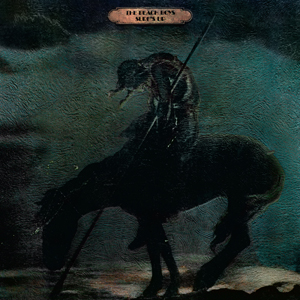
 This is one odd little album, nearly sunk by some embarrassingly earnest tracks, and saved by some truly great ones. Surf’s Up gets its title from yet another Smile refugee, this one the haunting centerpiece that was supposed to be the capper of that abandoned album. Its inclusion is welcome, but an odd choice for an album largely “concerned” with ecology. The cover, featuring a rendition of the 19th-century sculpture “The End Of The Trail”, gives the album a link to the American past, and suggests a gravitas we’re still not convinced the band could carry.
The Beach Boys had a new manager who’d managed to finagle his way into their orbit at a time when they weren’t looking too closely at résumés for accuracy. He thought they should be more socially conscious, so that’s why “Don’t Go Near The Water”—an odd sentiment from a bunch of guys who’d spent ten years telling us of the wonders of the beach and surf—starts the program with a lament about pollution. It’s an impressive recording; it’s just too bad the lyrics try too hard. All is nearly redeemed right away with Carl’s wonderful “Long Promised Road”, his first great song, and a terrific match of lyrics and music. But then “Take A Load Off Your Feet” has that same rinkydink approach that sank Smiley Smile, and it’s hard to believe they could really take themselves this seriously. The seesaw goes back for “Disney Girls (1957)”, a suitably nostalgic reverie from Bruce that’s not at all embarrassing. Which can’t be said for “Student Demonstration Time”, a stupid rewrite of “Riot In Cell Block Nine” referencing recent antiwar activity, complete with idiotic sound effects and Mike Love’s voice processed as if it were coming from a megaphone. (You know, for that “realistic” feel.)
“Feel Flows” got some exposure in this century on the Almost Famous movie soundtrack; a mildly psychedelic track, it’s layered in phasing effects and stops for a lengthy free-form jazz flute solo. “Looking At Tomorrow” is helpfully titled “A Welfare Song” as if the bleak lyrics weren’t clear enough. Its bathroom echo effects recall John Lennon, of all people, and its brevity sets up the final three songs of the album, all pointedly credited in whole or in part to Brian. “A Day In The Life Of A Tree” is one of the more bizarre songs, if only because that quivery vocal is provided not by Brian, whom it resembles, but that earth-friendly manager, singing from the point of view of a dying tree. “’Til I Die” continues the virtual wake, gorgeous despite its bleak outlook. This leads up to the unveiling of the title track, embellished from its original, abandoned 1966 incarnation to include some newer touches, and fading grandly, just like “Cabinessence” did two albums prior.
There really is more good than bad on Surf’s Up, although the bad is bad enough to mar the album as a whole. Still, Carl and Brian contributed some of their best work, though Dennis, the recent rising star, is virtually absent. Even Bruce had something worthwhile to say. At the turn of this century, Capitol reissued the album as a two-fer with Sunflower, which again had some people hailing the pair as buried treasure, as they would the big expansion of both fifty years later. Truthfully, the Boys could do a lot worse, and they would.
The Beach Boys Surf’s Up (1971)—3
I have a site adriandenning.co.uk lots of bboys stuff. happy to exchange links and blah.
ReplyDeleteIndeed! I've seen and enjoyed your site; glad you're still updating it.
ReplyDeleteSadly, he's not....
DeleteIndeed.
DeleteThey created an unintentional bit of irony when the made the “two-fer”, with “Don’t Go Near the Water” sequenced right after “Cool, Cool Water”. A lot happened in the year between the two albums.
ReplyDeleteCarl and Al did a great job with the weird backing track. Mike’s lyrics do try too hard, but he would do a lot worse with such topics (“Summer in Paradise”, anyone?). The weakest link would be his other contribution. The track of “Student Demonstration Time” is another rare, but cool, example of the band getting heavy in the studio. Of course, the lyrics sink it, especially the tasteless line about the “Bachelor of Bullets”. Better if he had stuck with the original words.
Sequenced right before it, “Disney Girls” provides quite a contrast. Like Brian, Bruce wants a return to innocence and simplicity; unlike Brian, Bruce knows that it’s just a fantasy. His best song ever. It went down like a storm live (I heard this for myself in 1986) and generated a lot of covers.
Gary Winfrey was a high school football pal of Brian and Al, which is how he ended up writing the lyrics for Al’s two main songs. “..Feet” was inspired by the aching feet of Gary’s wife during her pregnancy. Many fans put this one down, but it’s the only lighthearted track on the album. A bit of harmless fun, although I doubt anyone’s “twinkle when they fall in love”. “Lookin’ At Tomorrow” would be just another folk song, except for the creative use of phasing and the wordless verse featuring brief vocals from Mike (maybe) and Brian.
The late John Wetton thought that “Surf’s Up” was a prog album, which was a big stretch. However, Carl’s two tracks fit absolutely into the prog-pop category. Rieley’s spaced out lyrics and Carl’s equally spaced-out production are a perfect fit.
Finally, there’s Brian. I can’t believe that he thought that Dennis couldn’t provide a good vocal for “..Tree”. He would have been perfect. No one could blame Jack for being told he was only providing a guide vocal. These lyrics are also forced and a bit too obvious, but the music is gorgeous. “’Til I Die” also showed that the optimism – or naivete - of “This Whole World” was dissipating into something else. Beauty and sadness, as the Smithereens put it.
Finally, my opinion of “Surf’s Up” has changed. It IS the Beach Boys’ “A Day in the Life.” Brian once explained Parks’ lyrics. A man has a vision at a concert involving the rise and fall of empires, the bleakness of solitude and night, with the only hope – once again – trying to regain the openness of a child (“Child I Father to the Man”). (Rieley claimed that he wrote the final verse that provides the resolution. I agree). It isn’t as epic as the Beatles’ classic because it never got quite the production it deserved, either here or on Brian’s “Smile”. Close enough for me, anyway.
I always thought that the album was too short for one released in 1971. Dennis’s two outtakes would have been perfect to fill it out. Too bad that internal politics (over sequencing, apparently) got him so annoyed that he pulled them. Some fans wouldn’t have minded if Mike’s tracks (or Mike himself, for that matter) would have been tossed, instead.
For the first time since “Pet Sounds”, the group released something significantly out of their usual box, thanks in big part to Rieley. The only song that might have worked as a single. I did hear “Long Promised Road” the radio – without knowing who it was! People responded anyway. Unfortunately, as was too often true in the world of the Beach Boys, they lost momentum..
Oh, and the cover is definitely their best, from a band not known for great album covers. Very moving. The waeriness does connect to many of the album's songs.
ReplyDelete