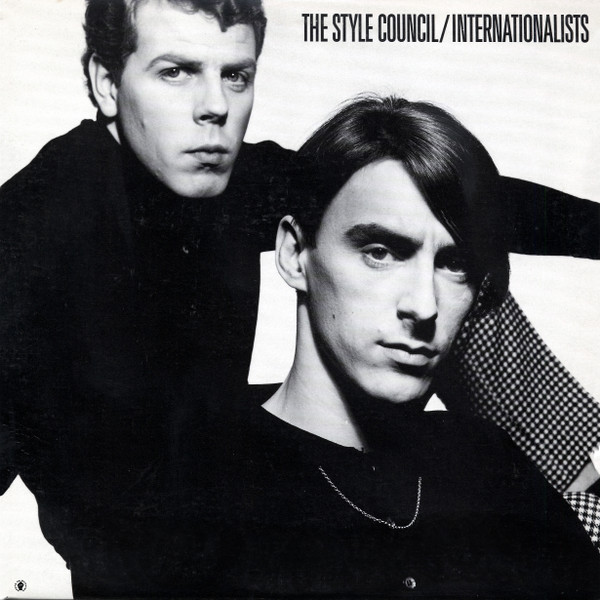
 Straight out of the gate, the Style Council kept fans busy with singles, 12-inches, and a second album. As with its predecessor, Internationalists differed from the British version in title and cover—Paul Weller’s haircut clearly the influence decades later for Bill Hader’s Stefon—but only the mildest of track substitutions, which actually helped. Pointed political stances colored the lyrics, making it almost necessary to read along on the inner sleeve, where they appeared out of order and incomplete. (Like most Brits his age, Paul Weller really, really hated Margaret Thatcher.)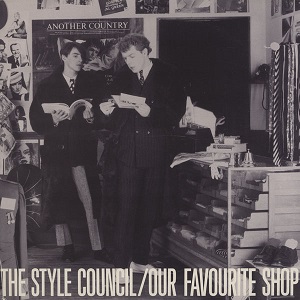

Just to be different, Mick Talbot takes the lead vocal on “Homebreakers”, probably because Weller’s phrasing wasn’t generally that measured. The jazz pop is about what we’d come to expect, but even from these guys, the bossa nova beat and harmonized flute solos in “All Gone Away” seem like parody. “Come To Milton Keynes” gets a more straightforward arrangement, but it’s a terribly sarcastic slam of a British town that didn’t deserve it any more than any others going through the same growing pains. (The trumpets always remind us of “Just Who Is The Five O’Clock Hero?”, which might have been intentional.) Weller pulls out the guitar and wah-wah pedal for the title track, but is accompanied by only a string quartet on the mournful “A Stone’s Throw Away”. The gravitas is killed by “The Stand Up Comic’s Instructions”, which are recited by comedian Lenny Henry, though the chorus is catchy. “Boy Who Cried Wolf” is a little more standard, but the overly synthy backing is a matter of taste, but would appeal to fans of Sade and future pop stars Simply Red.
Side two is a little more consistent. Church bells right out of the Kinks herald “A Man Of Great Promise”, a surprisingly buoyant song for what’s essentially an obituary. “Down In The Seine” continues their Francophile tendencies, right down to the accordion solos. Besides being bestowed with another typically unwieldy title, “The Lodgers (Or She Was Only A Shopkeeper’s Daughter)” also features a front-and-center vocal by D.C. Lee, who got star billing when it was re-recorded in an inferior version for the single; here it’s solid R&B underneath more social commentary. With “Luck” we finally get a straightforward upbeat love song, and then “With Everything To Lose” brings back the bossa nova undercut by more complaints about the government. Here in the US, likely thanks to its appearance on the Vision Quest soundtrack, the Philly-infused “Shout To The Top!”—a single from the previous fall—replaced “Our Favourite Shop”, the instrumental title track of the UK version of the album. It makes a good lead-in for the equally snappy and punctuated “Walls Come Tumbling Down!” (By the time the album was issued on CD, it was the UK sequence, with “Shout To The Top!” added at the end.)
The best parts of Internationalists are the toe-tapping ones, but it’s still a very breezy and slick album, and Americans didn’t know what to do with it. They loved it in the UK, of course, where the eventual Our Favourite Shop Deluxe Edition was loaded with contemporary B-sides (of which there were always plenty) and some demo versions, a few of which were previously released elsewhere.
The Style Council Internationalists (1985)—2½
No comments:
Post a Comment