Showing posts with label roger mcguinn. Show all posts

Tuesday, August 18, 2026

Roger McGuinn 5: Thunderbyrd

Given his higher profile from the Rolling Thunder Revue and the success of his Cardiff Rose album, one might think Roger McGuinn would build on that momentum. Well, he didn’t. He put together a touring band dubbed Thunderbyrd, named after the two most direct connotations of his brand. It was also the title of his next album, another mix of covers and cowrites with Jacques Levy.

While “All Night Long” has a gentle, dreamy opening, the chorus crashes in for a reach at arena rock—and sure enough, it’s a Peter Frampton cover, only a year after he Came Alive. “It’s Gone” has a little of that trademark Rickenbacker, but is drowned out by the mix, just as “Dixie Highway” is a fairly pedestrian driving song with the barest hook. As much as Tom Petty’s “American Girl” sounded like the Byrds to many people, Roger unfortunately takes the energy out of it, even at the same tempo, changing some of the words and blowing the phrasing. Tom Scott’s sax solo doesn’t do any favors either. “We Can Do It All Over Again” is a collaboration between white blues legend Barry Goldberg and the guy who wrote “Drift Away”, and a somewhat cloying plea to stand by this constantly working musician.

Continuing the journey through the history of American music, “Why Baby Why” is a cover of George Jones’ first hit single, with prominent steel guitar over a honky-tonk backing. “I’m Not Lonely Anymore” isn’t completely convincing, especially when he says he can “sing like a bird”, and the electric piano reminds you it was the late ‘70s. “Golden Loom” is the album’s token Dylan cover, this one a Desire outtake, dominated by Rick Vito’s bluesy harmonica and not very Dylanesque at all. But the song that nearly all that has gone before is the closing “Russian Hill”, a reverie on lost love, lost youth, lost everything, with its poetic lyrics given a sympathetic backing—or to put it another way, restraint. And unlike the bulk of the album, you can actually understand the words.

Thunderbyrd would benefit from more musical variety like that. Instead, it’s a grab bag of styles assaulted by a band trying to get attention in a loud bar. If you listen closely enough, you can almost hear the potential.

Roger McGuinn Thunderbyrd (1977)—

Friday, March 10, 2017

Roger McGuinn 4: Cardiff Rose

It’s safe to say that Roger McGuinn was lost at sea for much of the ‘70s. The Byrds had dribbled to a stop, and his solo career wasn’t exactly a brilliant new chapter. But he definitely lucked out when he got to join Bob Dylan’s Rolling Thunder Revue, given solo spots at every show and hobnobbing with like-minded musicians. Not only did they join him in recording Cardiff Rose, but Mick Ronson produced it, and most of the non-covers were co-writes with Jacques Levy, still riding high on his own Dylan connection but whom McGuinn had found first.

The spirit of the Revue pervades on “Take Me Away”, teeming with the wonder and joy of being part of the traveling troupe. As might be expected, “Jolly Roger” is a sea chantey about pirates, with sound effects to match, well matched to his strummed 12-string. Dripping with contempt for the career he’s chosen, the snotty “Rock And Roll Time” is a surprising collaboration with Bob Neuwirth and Kris Kristofferson, though the repetition of “take me away” makes an odd juxtaposition with the opening track, and we’re not so sure that was intentional. The simple acoustic strum of “Friend”, its sadness underscored by a lonesome violin, provides a striking contrast, and evokes sympathy where the next song fails. “Partners In Crime” is a shout-out to Abbie Hoffman—then on the run from the law—and the rest of the Chicago Seven, starting with something of a calypso doo-wop rhythm that changes for the chorus, then goes back to a ‘50s parody, then back to doo-wop. Apparently Levy didn’t learn his lesson with “Joey”.

Roger never found an obscure Dylan song he didn’t like, and here he gave the world its first exposure to “Up To Me”, the masterpiece left off of Blood On The Tracks due to its similarity to “Shelter From The Storm”. While it always seemed like one of his most personal songs, McGuinn makes it his own. “Round Table” retells the myth of King Arthur without leaning on medieval instrumentation, but the venerable murder ballad “Pretty Polly”, which he’d been trying to record since Sweetheart Of The Rodeo, is played straight folk with prominent banjo. He ends with another preview of a song by another Rolling Thunder alumnus, in this case Joni Mitchell’s “Dreamland”, giving it more fuzz than she ever would.

Not everything on Cardiff Rose has aged well, but at least he seemed more comfortable with his surroundings, though his growing caricature of a voice makes him sound older than he actually was. Perhaps because it was so much better than what had come before, it stayed a favorite among fans for years. (The eventual Sundazed expanded CD offered two bonuses: a defiant-sounding live take of “Dreamland”, and a baffling cover of Bowie’s “Soul Love”.)

Roger McGuinn Cardiff Rose (1976)—3
2004 Sundazed reissue: same as 1976, plus 2 extra tracks

Tuesday, December 6, 2016

Roger McGuinn 3: Roger McGuinn & Band

In the ‘70s, you made an album a year, as long as the label was willing to keep you signed. So Roger McGuinn put a band together from some country rock players and recorded Roger McGuinn & Band. It’s a strange package to begin with, as he’s the only person shown on the front cover; they are shown looking down at him from the monitors on the back. But he meant it with the title, because most of the songs were indeed written by his otherwise not-very-notable supporters.

The familiar jangle we expect from him is buried on the opening “Somebody Loves You”, a generic rocker, but is lightly picked on his cover of Dylan’s “Knockin’ On Heaven’s Door”; Roger himself had played on the original two years before. “Bull Dog” isn’t the first sung he’s sung with a canine lead character, but this one is certainly used in a more menacing way than Old Blue was. “Painted Lady” is a pleasant example of ‘70s soft rock, but it’s not clear why he needed to record another version of “Lover Of The Bayou”, though it certainly kicks.

Calypso isn’t the strong suit of most rock ‘n rollers, so “Lisa” comes off like one of Stephen Stills’ worst ideas, or Jimmy Buffett’s entire catalog, but Roger wrote this all by himself. The keyboard player’s “Circle Song” is basically “Peaceful Easy Feeling” with more dobro and banjo, while “So Long” is another by-numbers highway anthem. Speaking of which, “Easy Does It” may well have been inspired by a bumper sticker he saw, but he manages to make the sentiment work. Another retread closes this side, in this case “Born To Rock And Roll”, last heard on the Byrds reunion album and not much better here.

Any other band might have been proud of Roger McGuinn & Band, but we expect more of Roger McGuinn, with or without a band. He was clearly still finding his way, though it did give work to an up-and-coming producer who would helm future hits by Boston, Charlie Daniels, and Quarterflash, among others. (In a late effort to showcase the band, the expanded CD includes live versions of “Wasn’t Born To Follow” and “Chestnut Mare”.)

Roger McGuinn Roger McGuinn & Band (1975)—
2004 Sundazed reissue: same as 1975, plus 2 extra tracks

Sunday, August 23, 2015

Roger McGuinn 2: Peace On You

Whatever charms his first solo album had didn’t translate to sales, so his label dictated that Roger McGuinn submit to someone else producing his follow-up, and probably bring in some ringers too. In addition to Al Kooper, Dan Fogelberg—who contributed a song apiece—and Flo & Eddie (the latter’s last name spelt wrong), the musicians on Peace On You included Paul Harris and Al Perkins (most recently found in Manassas), Donnie Dacus (who’d soon be found around Stephen Stills himself), and the rhythm section of Russ Kunkel and Lee Sklar (next stop: Crosby & Nash), with the whole proceedings helmed by Bill Halverson (who’d already been associated with CSN). Even the back cover included hype-style liner notes reminding the consumer who he was and what he did, basically saying his name wasn’t enough anymore.

The joke in Charlie Rich’s “Peace On You” gets lost in its arrangement, and more so because it’s the title track. The lonesome “Without You” puts a drag on the proceedings, even with Donnie Dacus soloing constantly. Dacus himself contributed “Going To The Country”, which has promise in its picking, but he didn’t bother to write a chorus. Al Kooper’s “(Please Not) One More Time” is slathered in adult contemporary pop touches, but “Same Old Sound” is mostly notable because we finally hear the trademark 12-string play a solo.

“Do What You Want To Do” is a slightly better Allman Brothers homage from Dacus, but “Together” is more lovelorn moping that seesaws between downbeat picking and ill-advised double-time choruses. “Better Change” is the Fogelberg contribution, and a lot tougher than we expected it would be. “Gate Of Horn” is a tribute to the storied Chicago folk club where he fell in love with the genre, sadly shackled to a vaudeville-style arrangement that speeds up and slows down at various points. “The Lady” finally sounds like classic McGuinn, and about time as it’s the last track.

The problem with loading the deck with all-star talent is that they swamp the tracks, so that if not for his trademark nasal twang—which does become tiresome after a while—one might not know Peace On You was a Roger McGuinn album, even on the songs he did write, usually with Jacques Levy. Instead, it resembles Stephen Stills once he started to run out of gas, and maybe the same players had something to do with it. (The eventual Sundazed reissue added a bonus track in an earlier version of “Rock & Roll Time”, which would be redone two albums later.)

Roger McGuinn Peace On You (1974)—2
2004 Sundazed reissue: same as 1974, plus 1 extra track

Friday, July 24, 2015

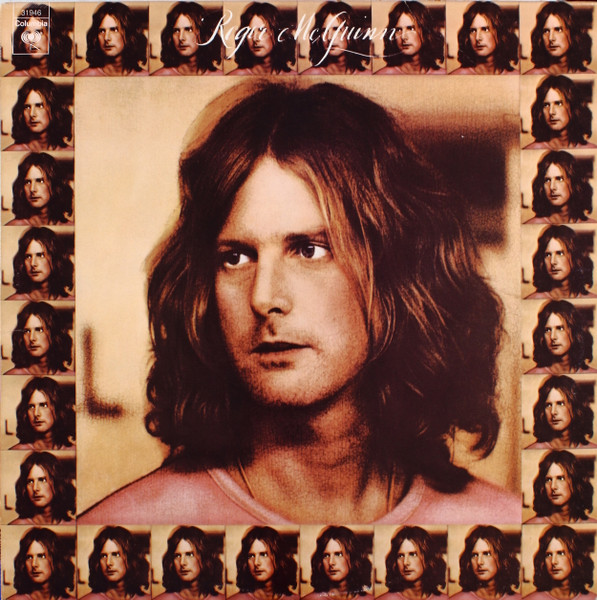
Roger McGuinn 1: Roger McGuinn

Maybe Roger McGuinn knew the Big Byrds Reunion wasn’t going to amount to much, as he didn’t seem to contribute much in the way of songwriting to that collective. After all, he had a solo career to kick off, and he did so mere months later with his self-titled debut. More to the point, he made sure to include all the music styles he insisted were of interest to him.

The folkie plaint of “I’m So Restless” is sheer parody, wherein he asks Bob Dylan, John Lennon, and Mick Jagger (in that order) how he should comport himself. He even got Dylan to blow harmonica on the track. For severe musical whiplash, it’s tough to beat “My New Woman”, which is basically a full Byrds reunion in a strange meter with jazz sax man Charles Lloyd honking freestyle throughout. Roger likely found “Lost My Drivin’ Wheel” on a Tom Rush album, but he did try it first with the Clarence-era Byrds. Charles Lloyd returns for “Draggin’”, which is about a drag race—complete with Bruce Johnston adding Beach Boys-style “oohs”—but upgrades it to airplanes, to the passengers’ collective horror. “Time Cube” continues the Moog experiment left dormant at the end of The Notorious Byrd Brothers, but these days it just jars against the banjo, and we always think a kettle is boiling in the background.

A timely tribute to hijacker D.B. Cooper, “Bag Full Of Money” sounds the most like countrified Byrds, and also dates from as far back as Farther Along. “Hanoi Hannah” tries to be a cutting blues about a soldier in Vietnam, but has a lot of timing issues. A children’s choir is almost never a good idea on any album, and it mars the cover of Spooner Oldham’s “Stone”, featuring the man himself on piano. Spanky MacFarlane (the singer, not the Little Rascal) joins in on the sea chanty “Heave Away”, and we stay in the islands for “M’Linda”, which sounds like something Stephen Stills would try to ape on his albums. His arrangement of “The Water Is Wide” turns the melody inside out, but David Crosby’s harmony keeps it just this side of adult contemporary.

Ultimately, Roger McGuinn is too all over the map to really impress, though there are some good parts. Occasional collaborator Jacques Levy is credited throughout, so some of the credit and blame can be shared. Like most of Roger’s ‘70s output, the album was largely ignored in the digital era, though several tracks were included on a 1991 compilation. Predictably, it was the Sundazed retro label that finally gave it a CD upgrade, complete with liner notes and two extra tracks: a solo strum through the traditional “John, John” and a full band version of Jackson Browne’s “Jamaica Say You Will”, this time where he sings it himself.

Roger McGuinn Roger McGuinn (1973)—3
2004 Sundazed reissue: same as 1973, plus 2 extra tracks

Tuesday, March 9, 2010

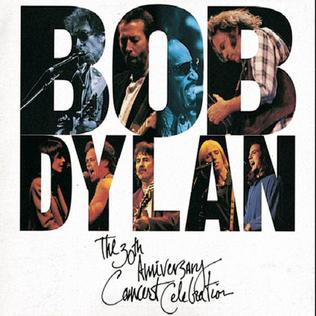
Bob Dylan 38: 30th Anniversary Concert Celebration

Good As I Been To You got a major promotional push by arriving three weeks after Columbia’s mightily hyped star-studded concert event of the season. Officially titled The 30th Anniversary Concert Celebration, today it’s best known as Bobfest, as dubbed by Neil Young halfway through his solo spot.

It was a nice idea: bring a bunch of old and new artists together to pay tribute to the old bastard, and if they were already Sony artists, all the better. The eventual VHS included most of the pay-per-view feed, but for the LP and CD versions, some moments weren’t included, like George Thorogood doing “Wanted Man”, Sophie B Hawkins’ pointless cover of “I Want You”, and a tune each from Eric Clapton and George Harrison, likely to squeeze it all onto two discs. (We also don’t get to hear Sinead O’Connor being booed offstage into the arms of Kris Kristofferson, adding further insult to her injury.)

The show had its ups and downs, beginning well with John Mellencamp with Al Kooper for “Like A Rolling Stone”, then putting his own Appalachian spin on “Leopard-Skin Pillbox Hat”. Stevie Wonder prefaces “Blowin’ In The Wind” with a spoken intro about the current election, Eddie and Mike from Sony golden boys Pearl Jam do “Masters Of War”, and Tracy Chapman (remember her?) is allowed “The Times They Are A-Changin’”.

The backup band for most of the night was Booker T and the MG’s, augmented by Jim Keltner and G.E. Smith, providing both consistency and familiarity, even when people chose less-than-familiar tunes. Lou Reed’s spit-fueled take on “Foot Of Pride” makes one think the song was written just for him, and Willie Nelson does a nice job on “What Was It You Wanted”. That sets up a string of guys with questionable voices—Kristofferson, Johnny Winter, Ron Wood—before Richie Havens and the Clancy Brothers raise the bar. The heavenly Sony trio of Shawn Colvin, Mary Chapin Carpenter, and Rosanne Cash are placed out of original sequence.

They saved most of the big guns for the second half, and that’s where most of the chills come from. Neil gets more attention for “All Along The Watchtower”, but it’s his version of “Just Like Tom Thumb’s Blues” that really shines. Clapton’s version of “Don’t Think Twice” has a phenomenal solo and George does a terrific “Absolutely Sweet Marie”. The O’Jays manage to trump what’s left of The Band, and then Tom Petty and the Heartbreakers come out to dominate. The gentleness of “License To Kill” gives way to the crowd-baiting of “Rainy Day Women”, and who else could back Roger McGuinn for “Mr. Tambourine Man”?

The man of the hour came out alone for “Song To Woody”, which apparently had sound problems, causing its exclusion. But we do get “It’s Alright, Ma”, and then an astounding “My Back Pages”, where the verses are handled in order by McGuinn, Petty, Neil, Bob, Clapton, and George. An obligatory mass chorus of “Knockin’ On Heaven’s Door” was to end the night, but Bob got the last word by himself with “Girl From The North Country”.

As with most of these affairs, Bobfest has endured as more novelty than notable, particularly considering how he filled the decades since. An upgraded edition for Blu-ray coincided with a reissue of the CD, adding two songs from rehearsals: another blazing Clapton take on “Don’t Think Twice”, and Sinead O’Connor doing the song she was scheduled to do. “I Believe In You” sounds even more fitting today, the lyrics mirroring her own public image.

Bob Dylan The 30th Anniversary Concert Celebration (1993)—3
2014 Remastered Deluxe Edition: same as 1993, plus 2 extra tracks