Showing posts with label neil finn. Show all posts

Tuesday, October 8, 2024

Neil Finn 8: Lightsleeper

Liam Finn had been appearing on father Neil’s albums since the start of the 21st century, but Lightsleeper was their first officially billed collaboration. All but two tracks are co-written by the pair, who also layer vocals and instruments all over the place for a lush, sonic smorgasbord.

A techno dreamscape explodes into a lush chorale on “Prelude–Island Of Peace”, which then flows into the dreamy “Meet Me In The Air”. “Where’s My Room” goes a lot of places, from Revolution-era Prince funk to Philly soul strings over seven minutes, with several drums competing throughout with a programmed beat. Liam’s “Anger Plays A Part” is more straightforward but sounding very much like his dad, and Neil’s “Listen” is very much in the introspective mood of his solo albums. Despite its spacey atmosphere, “Any Other Way” exudes hope from a low point.

“Back To Life” is another expression of devotion, even after taking a detour through a Greek cafĂ©. “Hiding Place” is very lush and dreamy, but little quirks in the background threaten to make any dreams less sweet, particularly after the halfway mark when competing voices add to the confusion. In a smart case of sequencing, “Ghosts” seems to be a reaction to those unsettling dreams. “We Know What It Means” is a celebration of family, remembering the early days of kids on the tour bus, and now extended to another generation, though we could do without the CB radio effects. “Hold Her Close” is very much like a lullaby, to ease nodding heads and send us gently away.

While the sounds may not keep Lightsleeper in the background, it’s very much worth revisiting. It’s very much a Finn family production, as Sharon and Elroy show up, as well as brother Tim’s daughters. But one of the more surprising contributors is Mick Fleetwood, which is timely, as shortly after the album’s release, Neil (along with Mike Campbell, suddenly with free time following the death of Tom Petty) replaced Lindsay Buckingham on a major Fleetwood Mac tour.

Neil & Liam Finn Lightsleeper (2018)—3

Tuesday, March 26, 2024

Neil Finn 7: Out Of Silence

Always into doing something different, Neil Finn’s next move was to rehearse and record an album quickly, and in front of an audience. But Out Of Silence wasn’t just another live album—its production was livestreamed, which wasn’t a common thing in those days. Another unique aspect is that he wrote (and played) the songs on piano, adding another facet to his style. Sons Elroy and Liam add bass and drums where requested; throughout, strings and a small choir of singers add color.

The electronic effect at the start notwithstanding, “Love Is Emotional” sets the bittersweet template, continued on “More Than One Of You”. Beginning with some spooky vibes, “Chameleon Days” is a little more experimental sounding, or maybe it’s just his falsetto vocal. Arpeggiated guitars drive “Independence Day”, which gets a terrific lift for the choruses. Brother Tim shows up for “Alone”, derived from the works of British author Mervyn Peake.

Keeping it in the family, wife Sharon co-wrote “Widow’s Peak”, another poetic reverie. “Second Nature” picks up the pace with the most accessible track here. He gets mildly political on the pleading “The Law Is Always On Your Side” and “Terrorise Me”, the latter of which echoes “Edible Flowers”. These make “I Know Different”, while weary, something of an expression of hope.

Out Of Silence can be a little precious at times, but it’s certainly a welcome departure. A lot is packed into its 35 minutes, and it may be his finest solo work yet.

Neil Finn Out Of Silence (2017)—3

Tuesday, October 10, 2023

Neil Finn 6: Dizzy Heights

By now it should be clear that just because Neil Finn’s name is on something doesn’t necessarily indicate that it will sound like anything else he’s done. While Crowded House, Split Enz, and even the Finn Brothers have their niches, a solo album will be surprising and unexpected.

That’s certainly the case with Dizzy Heights, which was co-produced with Dave Fridmann, and individual best known for his work with Mercury Rev, the Flaming Lips, Mogwai, and other sonically experimental entities. As set forth immediately in “Impressions”, much of this album is funky psychedelic, with lots of wah-wahs and sweeping strings, to the point where if Neil’s not singing, you’d forget it’s his album. The title track is a little more straightforward, as is “Flying In The Face Of Love”, but both are danceable. Following a nutty windup intro, “Divebomber” builds to sport a dramatic, almost harrowing orchestral arrangement that seems influenced by “Song Of The Lonely Mountain”, which he wrote and sang for Peter Jackson’s first Hobbit movie a couple years before. “Better Than TV” doesn’t have as much tension, but still swirls into a frenzy, and “Pony Ride” provides another more accessible experience.

He gets political on “White Lies And Alibis”, a diatribe about injustice straight outta Peter Gabriel and U2 that is suitably somber sounding. The bloopy intro of “Recluse” is off-putting, but it turns into the album’s best song, with a killer chorus. “Strangest Friends” is comparatively brief compared to the rest of the album, and seems to ponder the performer-audience relationship. “In My Blood” prominently uses that phrase in the chorus, but it sounds like it’s been flown in from a completely different song. The highly impressionistic “Lights Of New York” is treated in such a way that puts the listener in the scene, bringing the album to a close.

It's clear Neil made Dizzy Heights for himself, and with no expectations of world domination. Once again, it’s a family affair, with wife Sharon on bass and backing vocals, and sons Liam and Elroy providing guitar and drums respectively. There’s a lot here, and it’s worth it.

Neil Finn Dizzy Heights (2014)—3

Tuesday, April 11, 2023

Neil Finn 5: Pajama Club and Goin’ Your Way

Empty nest syndrome is apparently a universal thing, as Neil Finn discovered when his kids were grown. With more time and space than they knew what to do with, he and his wife Sharon decided to make some music. He played drums for the first time ever, and she played bass. Fellow Kiwi Sean Donnelly was brought in to add keyboards and beats, and Pajama Club was born.

The music on their eponymous (and to date, only) album is predominantly electronic, more along the lines of the experiments of Neil’s first solo album as well as the lo-fi atmosphere of the first Finn Brothers album. His voice is welcome when it’s heard, and Sharon can carry a tune as well, but it’s not always easy to find the songs amid the mix. That said, “TNT For 2” sounds most like standard Finn, “Go Kart” is goofy fun, and the chorus of “Can’t Put It Down Until It Ends” reveals a song crying out for a straight arrangement.

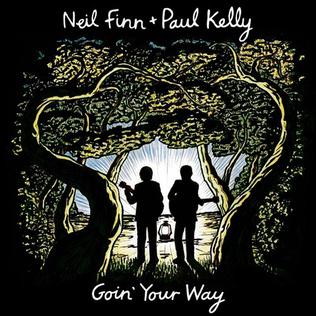
The following year, Neil embarked on a collaboration of sorts with Australian singer-songwriter Paul Kelly, who’d never really caught on in America with his band the Messengers, but was beloved at home. This mutual admiration society resulted in a tour wherein they performed each other’s songs, sometimes swapping vocals, backed by a band including Paul’s nephew Dan on guitar, Neil’s son Elroy on drums, and a bass player not related to any of them. Goin’ Your Way presents a Sydney performance, and it’s both a wonderful retrospective of Crowded House and Neil solo, plus a few Split Enz songs, as well as a nice intro to Paul Kelly’s work. The two-hour set is capped by a fun stomp through Buddy Holly’s “Words Of Love” and a subdued “Moon River”, which gives the album its title.

Pajama Club Pajama Club (2011)—
Neil Finn + Paul Kelly
Goin’ Your Way (2012)—

Monday, June 23, 2014

Neil Finn 4: The Sun Came Out

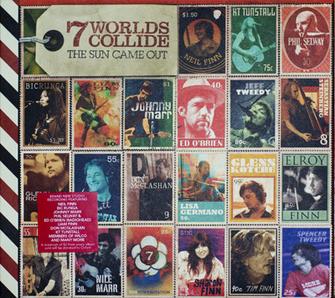
This pleasant little album came out of a three-week experiment wherein Neil Finn invited musical friends and family to workshop at his studio in New Zealand. Credited to 7 Worlds Collide—from the title given to the collective who contributed to his 2001 live album of the same nameThe Sun Came Out was made available as a single or double CD, with the proceeds intended for Oxfam. This time the all-star proceedings were augmented by members of Wilco, who were recording their latest album there anyway, one-hit wonder KT Tunstall (famous for “Black Horse And The Cherry Tree”, or that “woo-hoo” song some women like to obliterate at karaoke), and a few other folks we hadn’t heard of yet but are encouraged to explore further. Everybody plays on each other’s songs, and the whole collection is very cohesive, even with the range of vocalists.

Neil himself wrote and/or sang and/or played on several tracks, starting with the highly catchy “Too Blue”, a wonderful collaboration between Johnny Marr and Jeff Tweedy. Wilco’s eventual hit, the George Harrison-influenced “You Never Know”, makes its debut here. “Little By Little” is a collaboration between Mr. and Mrs. Finn with son Liam on drums, in something of a foreshadowing of a future project. For a more experimental change of pace, “Learn To Crawl” comes from Neil and Liam with Johnny and Radiohead’s Ed O’Brien, while “Red Wine Bottle” comes from Liam and Johnny. Ed and Liam’s “Bodhisattva Blues” is particularly noisy, offset by Tweedy’s “What Could Have Been”. “All Comedians Suffer” finds Neil fronting most of Wilco but still sounding like himself. He harmonizes splendidly, of course: on “Hazel Black”, his soulful co-write with KT; “Over & Done”, John Stirratt’s bid to be more than just Wilco’s bass player; brother Tim’s “Riding The Wave”.

The non-Neil tracks are also enjoyable, with strong contributions from Kiwi musician Don McGlashan and Aussies Glenn Richards and Bic Runga. Radiohead drummer Phil Selway reveals himself as a sensitive acoustic folkie, while young Elroy Finn sounds a lot like his dad. (Lisa Germano’s “Reptile” appears to provide the album title.) It really is a strong set, and it was a for good cause anyway.

7 Worlds Collide The Sun Came Out (2009)—

Friday, December 28, 2012

Finn Brothers 2: Everyone Is Here

After Crowded House disbanded, Neil Finn hadn’t disappeared, but neither had he made much of a dent in a music industry not very interested in his brand of pop perfection. It also didn’t help that the albums he recorded under his own name weren’t immediately as catchy as what had made him rich (assuming he was).

Since he still had something of a cult following, they were likely very excited indeed when his next project turned out to be a Finn Brothers album. And rightfully so. Following the okay results of Woodface and Finn a decade earlier, Everyone Is Here wisely avoided the “two guys in a room” approach and instead incorporated studio musicians and actual producers (one of whom was Mitchell Froom, which wasn’t obvious from the sound, thankfully). It’s a straightforward pop album, without any real experimentations, if a little somber at times, but that’s okay too.

It comes off nice and strong from the start, with the close harmonies of “Won’t Give In” and the “don’t give up” message of “Nothing Wrong With You”. The album flows right along, with melodies that seem like they’ve been in the air forever; they’re that comfortable. “Luckiest Man Alive” is a little mawkish lyrically, but boy, is it catchy.The messages in the lyrics aren’t always clear, as in “Edible Flowers” and “All God’s Children”, but the more upbeat tracks, like “Part Of Me, Part Of You”, “Anything Can Happen”, and even “Homesick”, will stick in your head.

Everyone Is Here may have been a safe move, but it was also the most satisfying new album from Neil Finn in about ten years. Naturally, it didn’t dent too many American charts, despite a few songs being played on a few episodes of Scrubs. Because it was the style at the time, it was reissued only a few months later in a so-called “special edition” with a bonus DVD and extra tracks—some of which were relics from the original version of the album, produced by Tony Visconti and subsequently rejigged—and the boys faithfully toured to support it. However, any momentum built up was threatened that March, when Crowded House drummer Paul Hester took his own life.

The Finn Brothers Everyone Is Here (2004)—3

Sunday, November 11, 2012

Neil Finn 3: 7 Worlds Collide

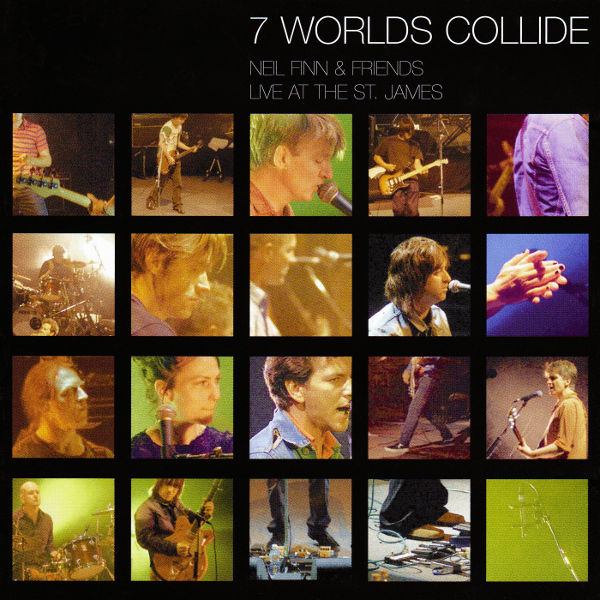
To promote the all-but-U.S. release of his second solo album, Neil Finn played a weeklong residency at a theater in Auckland, New Zealand with a band that included two members of Radiohead and other special guests, sometimes trading each other’s songs. The highlights were compiled on 7 Worlds Collide. (The DVD version added even more selections, and provides key visual clues to what’s going on.)

A few of the One Nil tracks make the program, while “Loose Tongue” from his first solo album is nicely translated to the stage. Johnny Marr emerges from years of session work to sing his own “Down On The Corner”, and Neil returns the favor by ably tackling The Smiths’ “There Is A Light That Never Goes Out”. Multi-instrumentalist Lisa Germano takes a rare spotlight on the transfixing “Paper Doll” before harmonizing nicely on “Turn And Run”. It wouldn’t be a show without Tim Finn, and the two perform not only a few from their one collaboration album to date, but preview “Edible Flowers” from the next one. Eddie Vedder reveals himself to be a huge Split Enz fan, taking lead vocals on “Take A Walk”, “Stuff And Nonsense”, and “I See Red”, the latter yelled over a band fronted by Neil’s son Liam (more on him later). The band also backs him on “Parting Ways” from the most recent Pearl Jam album. For Crowded House fans, “Weather With You” and “Don’t Dream It’s Over” close the set.

7 Worlds Collide isn’t the last time Neil would collaborate with surprisingly likeminded musicians, but it is an unexpected surprise. One suspects it may have helped pave the way for the emergence of One All in the U.S. the following year.

Neil Finn & Friends 7 Worlds Collide (2001)—

Saturday, November 10, 2012

Neil Finn 2: One Nil

It’s always sad when an established artist can’t get his or her records distributed in America, but that’s what happened to Neil Finn’s One Nil, despite the presence in the studio of Sheryl Crow, as well as Wendy Melvoin and Lisa Coleman, who also co-wrote some of the songs. The album isn’t as experimental as Try Whistling This, but it’s still not enough for him to merely write the songs; he’s just as concerned with making records, so production peppers the aural landscape.

“The Climber” is a cheerful little number seemingly sung from the point of view of a man stranded in an avalanche, going seamlessly via drum machine into the much more homey “Rest Of The Day Off”. “Hole In The Ice” starts out abrasively, but has another wonderful Neil Finn chorus to redeem it. “Wherever You Are” also appears to be built up from a home demo, and it rolls along inoffensively. “Last To Know” is a nice little strum, but “Don’t Ask Why” is noisy and fairly obnoxious, sticking out of the middle.

The mild prayer “Secret God” is a step in the right direction, sounding more like a band, with those underwater guitars leading to a mysterious ending, but “Turn And Run” is a standout, with Sheryl Crow actually on pitch and suitably mixed. “Elastic Heart” is too muddy and irritating for these ears, redeemed by the superior mix of “Anytime”. With its accordion, “Driving Me Mad” could almost be a Crowded House tune, as could, for that matter, “Into The Sunset”, another chance for the song to exist without too much fuss.

As mentioned, One Nil wasn’t released in the U.S. for over a full year, and when it was, it sported a rejigged lineup and had been retitled One All. Songs were remixed, some gaining a few seconds and others shaved, while “Don’t Ask Why” and “Elastic Heart” were dropped to no great loss, and two new songs were inserted. “Lullaby Requiem” is lovely, though it’s at an odd place in the middle of the album, while “Human Kindness” is more clattery, which we’d blame on the influence of Mitchell Froom. The album still starts and ends with the same tracks, so the new sequence doesn’t enhance or detract from the listening experience; it takes time to grow, and least more people have a chance to hear it.

Neil Finn One Nil (2001)—3
Neil Finn
One All (2002)—3

Saturday, October 13, 2012

Neil Finn 1: Try Whistling This

After Crowded House disbanded, Neil Finn found himself without a band for the first time in decades. So rather than start over with a new combo, he worked from the ground up, mostly on his own, embracing new technology to explore his more experimental side.

The first thing we hear on Try Whistling This is a primitive drum machine, which continues under the pleasantly picked acoustic guitar and sunny melody of “Last One Standing”. Altogether, a good start. “Souvenir” is reminiscent of the lo-fi experiments on the Finn Brothers album, right down to the octave harmonies. With a keyboard and verse right off a ‘70s Eno track, “King Tide” is off-putting at first, but once the other instruments come in, the song rises. Following the moody title track, which comes into its own during the last minute or so, the album’s clear highlight is “She Will Have Her Way”, which could have been a smash hit nationwide had it only gotten airplay. If it wasn’t so slow, maybe “Sinner” would have impressed some programmer, based as it is around a cocktail piano and strings loop.

Knowing how these musical geniuses come up with ideas, we’re going to assume “Twisty Bass” was a working title that stuck. Whatever the story, it’s too long and draggy to keep interest. Luckily, “Loose Tongue” sports one of those infectious riffs; if not for the modern effects, it could be a Crowded House track, and it’s got a cool coda too. “Truth” and “Astro” are further buried gems, and much more straightforward than the middle of the album, but he dumps out the effects bag for “Dream Date”, which is otherwise catchy. “Faster Than Light” suggests that he and R.E.M. were listening to some of the same producers for ideas around the same time. Finally, “Addicted” wanders around a simple tack piano, before winding slowly down to a stop.

Try Whistling This was underwhelming upon release, for those of us still stuck in the sunny power pop of the House. It’s improved in retrospect, with many melodies emerging from the murk. Kudos to him for taking the chance.

Neil Finn Try Whistling This (1998)—3

Monday, May 28, 2012

Finn Brothers 1: Finn

An album that nobody noticed when it came out was the first real debut of the Finn Brothers. Despite having worked together in Split Enz, it was a long time before they were allowed to be left on their own to create. (Their previous attempt to do so ended up mutating into the third Crowded House album, with mixed results.)

For Finn, the two of them worked together and only together. With the exception of the bass on one track, every noise we hear comes from them, be it guitar, keyboard or drum. It’s the drums that stand out, since neither of the Brothers is about to get tapped to fill in on the kit for any band needing same any time soon.

Finn is the sound of them in a room, bouncing ideas off one another. For the most part it sounds exactly like that, one guy playing and the other reacting. Neil, with the sweeter voice, takes most of the leads, while Tim is right behind in well-mixed harmony. The sound is a little too consistent, so many of the songs sound very similar production-wise, though “Only Talking Sense”, “Eyes Of The World”, and “Mood Swinging Man” are undeniably ca. The first real departure is “Last Day In June”, credited to Neil alone, based around a piano and not sounding too far away from early mournful Elton John. “Suffer Never”, which follows, sports a mean lead guitar line borrowed from Daniel Lanois. “Angels Heap” is exactly the kind of tunesmithing we’ve come to expect from these boys, and that lasts even through less comforting tracks like “Where Is My Soul”. Every now and then what sounds like island percussion sneaks in, making the album even more of an ode to New Zealand than Together Alone. The lilting “Paradise (Wherever You Are)” bleeds into “Kiss The Road Of Rarotonga”, which sounds like it was partially recorded at a small club, with bad drums to match.

Until its US release (under the title Finn Brothers) the album was only here available as a pricey import. Still, it’s nice and quirky enough to please fans of Crowded House, and put a few pennies in the pockets of brother Tim, who hadn’t seen anything approaching his little brother’s success.

Finn Finn (1995)—3