Showing posts with label joe jackson. Show all posts

Friday, April 17, 2026

Joe Jackson 22: Hope And Fury

It’s always encouraging when Joe Jackson emerges with a set of songs that aren’t specially part of a grand concept. Hope And Fury finds him keeping it basic yet again—another good sign—with his current trio backing him, anchored yet again by the staunch bass of Graham Maby. The music is described as “bicoastal Latin jazz funk rock”, which pretty much sums up his more commercial albums.

That description isn’t immediately apparent on the opening to “Welcome To Burning-By-Sea”, where the tribal rhythm doesn’t support any kind of melody until the chorus. If there is a theme to the album, it would be the state of the world, particularly in comparison to life in the same place in another time. (And frankly, the cover photo looks just a little too much like bad AI.) His defiance comes through on the more melodic “I’m Not Sorry”, a slap at cancel culture from a guy still miffed he can’t smoke in bars. “Made God Laugh” is the first really constructed and arranged song here, incorporating echoes of previous decades and a killer chorus. Speaking of previous decades, “Do Do Do” (which rhymes with “no no no”) begins with a cop on “Twist And Shout” sports cheesy Farfisa organ and guitar stabs while having a lot of fun with wordplay. The saga of Billy exploring alternate lifestyles in “Fabulous People” may or may not be autobiographical, but boy, is it catchy. (The percolating bass and doubled piano and xylophone evoke that of “Stepping Out”.)

Unfortunately the main guitar riff of “After All This Time” immediately resonates of “Smooth” by Santana, and it’s a shame he couldn’t have found a better hook, since the pre-choruses and choruses are worth getting to, to the point where one doesn’t notice the deliberately pointed clichés stacked in the verses. “The Face” is another anthem for the timid, with a terrific call-and-response bridge and extended solos highlighting almost Klezmer violins, progressive guitar, and his own piano. On an album with already sophisticated ideas, “The End Of The Pier” stands out with its precise juxtaposition of families a century apart, even if the earlier one doesn’t seem that far back. (In fact, “Sunday Papers” would fit lyrically at the halfway point.) “See You In September” is thankfully not the near-bubblegum hit from the ‘60s, but something more resonant of the Great American Songbook, with its Ellington chords and shades of “As Time Goes By”. It would have been better served with just the piano and strings, and without percussion, but he really likes that percussion.

While Hope And Fury is short and sweet at under 35 minutes, there’s enough here for sinking one’s teeth. Although it doesn’t grab with the immediacy of Rain or Fool, it’s another fine installment in what seems to be a career without end.

Joe Jackson Hope And Fury (2026)—3

Tuesday, December 19, 2023

Joe Jackson 21: What A Racket!

Genre exercises have been part of Joe Jackson’s career since his fourth album. Having successfully shown his ability to recreate jump blues of the swing era, he’s challenged himself as a composer on several occasions to go outside the rock album box, with varying results.

This time he’s going back a century to dwell in English music hall, having concocted a barely believable back story about a set of “recently discovered” songs by the long-lost, long-forgotten Max Champion. One listen to Mr. Joe Jackson Presents: Max Champion In “What A Racket!” should prove to any of his fans that he’s solely responsible for the words, music, and even the crafted arrangements. Each song is sung with an overly pronounced Cockney accent throughout, which both obscures the lyrics and prevents individual songs from standing out from the uniform pack. One can draw a line to Gilbert & Sullivan by way of Eric Idle much of time. That said, he’s in good voice, so his continued insistence on social cigarette smoking hasn’t taken its toll yet.

Said back story suggest that these old chestnuts are still as timely as today’s headlines, and indeed, he’s careful to blend old tropes with mildly timeless commentary. The so-called overture “Why, Why, Why?” decries complainers and dissent, but then “The Sporting Life” tackles (sorry) the plight of an non-athletically inclined citizen. The decorations on the overly maudlin “Dear Old Mum” distract from some of the nuances in the lyrics, such as the dwindling size of the family and the ways she supported them. There seems to be some kind of pertinent message in “Monty Mundy (Is Maltese!)” but it only makes us want to listen to Tom Lehrer. A peeping Tom gets ironic comeuppance in “The Shades Of Night”, which closes with something of a “get home safe, folks” salutation—odd in the middle of the album, but it caps what’s called Part the First, so consider this your notice for intermission.

Sure enough, the rousing title track—an anti-noise rant—crashes in as the virtual curtains open, but “The Bishop And The Actress” tries too hard to be covertly bawdy. “Think Of The Show!” is a variation on the timeworn life-on-the-road lament, a subject he covered way back on “The Band Wore Blue Shirts”. “Never So Nice In The Morning” is very clever, but the constant switching between the slow verse and moderate chorus makes the song drag. On one level, “Health & Safety” chides exercise buffs, but in the end it skewers the concept of armed forces in peacetime. And while Part the First had something of an obvious finale, “Worse Things Happen At Sea” is merely a keep-your-chin-up message with a singalong chorus with an anachronistic digital-sounding piano.

He’s likely not expecting sales in the millions with What A Racket!; after all this time Joe Jackson writes to please only himself. Given how many other so-called jukebox musicals have been concocted over the years over flimsier premises, it’s entirely possible that these songs could find their way to a theatrical venue at some point. Whether it does or not, we’ll wait to see what other songs he might write.

Joe Jackson Mr. Joe Jackson Presents: Max Champion In “What A Racket!” (2023)—3

Friday, January 25, 2019

Joe Jackson 20: Fool

He’s always been somewhat defiant, but few artists with the experience of Joe Jackson would release a new album three weeks into the calendar year, historically one of the slowest stretches of the retail season. But he does what he wants, whether anybody likes it or not.

While his previous release was something of “I’ve got enough songs for an album,” Fool keeps it truly simple: eight songs, four per side, recorded quickly after woodshedding them on a summer tour, recorded after the last stop (in Boise) of all places. It’s short enough to get one’s head around, but substantial. There is a recurring theme if you want one, but Fool is really just a collection of strong songs. There’s plenty of piano, plus the indispensable Graham Maby on bass. The guitarist and drummer, who have been touring with him for a few years, carry enough of the vibe of the original Joe Jackson Band while also handling the quieter stuff deftly. Even after making records for 40 years, he can be forgiven for repeating himself, but at least he has the good taste to revisit his better tunes and influences; listen for echoes of XTC, Steely Dan, and even the Beatles.

With an ominous rumble, “Big Black Cloud” balances doom-and-gloom lyrics with a plea for salvation in the choruses, over heavy piano and drums, with some power chords. “Fabulously Absolute” manages to combine punk, new wave, and catchy pop in the arrangement, with sarcastic verses and great transitions. Take a moment to listen to the high-speed syncopated guitar-and-bass combo in the break. “Dave” is a portrait of an average Joe (pun intended, we’ll explain shortly) with a “mind like a sieve” and a “head like a brick” who goes about his simple day, not caring much past his breakfast and pointless job. The chorus basically ponders whether, compared to those of us who wring our hands over the big issues and striving beyond our grasp, Dave may be better off. We also wonder whether the protagonist’s name is intentional, being that the auteur’s given name is actually David. Things travel to near-smooth jazz territory on “Strange Land”, but the piece, lyrics and music and all, rises above that simple label for a gorgeous meditation.

Things pick up for “Friend Better”, which revisits yet again his old favorite “The In Crowd” by Ramsey Lewis, backed by a drumbeat straight off of Blaze Of Glory. The title track is a hodgepodge of styles, with a faux-Mideastern motif, Shakespearean quotes, detours into samba, and shouted lyrics like its counterpart on side one. We’d like to read some further autobiography into “32 Kisses”, a pensive yet wistful look back at a relationship from a mature perspective, choosing to concentrating on the smaller, happier details. It’s a lowkey setup for “Alchemy”, the long closer that approaches lounge territory but still sounds just like him. And if you think about it, it describes what he does for a living.

There’s a lot that sounds familiar here, in the comfortable sense of the word. Fool is his best album since the excellent Rain, and a much more logical follow-up than that Duke Ellington experiment was. The sequence is wonderfully paced, and the sides really do mirror each other somewhat, reinforcing the comedy and tragedy theme in the artwork. Sometimes it’s best to keep it simple.

Joe Jackson Fool (2019)—4

Friday, October 23, 2015

Joe Jackson 19: Fast Forward

Never too far from a concept, Fast Forward presents Joe Jackson in four different cities, represented by four songs each, recorded by a unique band in each, originally envisioned as four EPs but approximating four sides. For the most part, the location is moot, since there’s only the occasional arrangement unique to Amsterdam or Berlin that wouldn’t work in New Orleans or New York.

New York was the birthplace of Night And Day and Body And Soul, and echoes of those albums can be detected in this section. Bill Frisell and the great Graham Maby feature in here, the title track and “If It Wasn’t For You” both nice examples of pop-rock. Something of a departure comes in his reworking of Television’s “See No Evil”, which turns the riff on itself and gives Frisell a chance to stretch. “Kings Of The City” brings it back to a cool Steely Dan vibe.

It’s a seamless jump to Amsterdam, where he’s joined by a drummer, a keyboard player and some strings. “A Little Smile” is excellent pop, but a 14-year-old kid sings the first verse on “Far Away”, presumably due to Joe’s addiction to guest vocalists, making an already unsettling song more uncomfortable. “So You Say” doesn’t provide much uplift, but moments of “Poor Thing” in between the horns do.

Berlin brought us Rain, so luckily the only track suggesting oom-pah music and Joel Grey is his translation of “Good Bye Jonny”. Or maybe the ECM-flavored intro of “If I Could See Your Face” counts too, but that goes on to a more sinister rock sound complete with F-bomb. “Junkie Diva” suggests the death of Amy Winehouse, without mentioning her directly, while “The Blue Time” is a pretty, seductive ballad.

Rock drums resurface in New Orleans, right away on the alternately galloping and driving “Neon Rain”. “Satellite” seems to stop and start, while “Keep On Dreaming” sports horns, mostly sounding like side three of Big World. And it takes a lot of grapes to end an album with a song called “Ode To Joy”, much less quote the melody, but as far as his finales go, it’s a good one.

Fast Forward is a long album, and there are certainly tracks over which one might feel compelled to fast-forward. But better he writes straightforward songs (for him) than laboring over a Broadway show, pseudo or otherwise.

Joe Jackson Fast Forward (2015)—3

Tuesday, September 9, 2014

Joe Jackson 18: The Duke

Well, that didn’t last long. Maybe he‘d gotten songwriting out of his system, as Joe’s next major work was a tribute to the music of Duke Ellington, with new arrangements, complete with an all-star cast of special guests. Cue crickets.

While there’s no questioning the importance of the music examined on The Duke, it’s almost as if Joe is determined to prove to the world that they, not he, were wrong to dismiss such earlier celebrity-studded train wrecks as Night Music and Heaven & Hell. Having already proven his talent with jazz throughout his career, and specifically on Jumpin’ Jive, did he really think the world wanted to hear what could do with Steve Vai and Iggy Pop at his disposal?

Stylistically, it’s all over the map. The opener is smooth jazz punctuated by Vai’s noodlings. Several tracks are driven by the rhythm section of Christian McBride on bass and ?uestlove on drums (in addition to other Roots here and there) with JJ favorite Sue Hadjopolous on percussion. Vocals appear, sometimes from Joe, once from Sharon Jones, but also from Sufi and Brazilian singers for authenticity if not comprehension. Some tracks combine different pieces into one, and much of it sounds like Steely Dan, and not in a good way either.

And two decades into the new century, he’s still using canned synthesizer sounds over more progressive sounds. The big closer of “It Don’t Mean A Thing” samples Ellington’s own voice and flatulent effects, with Iggy Pop bringing nothing to the table, but not taking over the stage, thankfully. One wishes Joe had kept it simple, but he didn’t. “Mood Indigo”, for example, is way more labored than his earlier rendition. Yet there’s a wonderful moment of a “Satin Doll” medley where it’s just his piano striding through the melody.

The lesson to be learned? Go dig up the originals and marvel at the genius of the real thing. That’s a much better tribute.

Joe Jackson The Duke (2012)—2

Monday, June 9, 2014

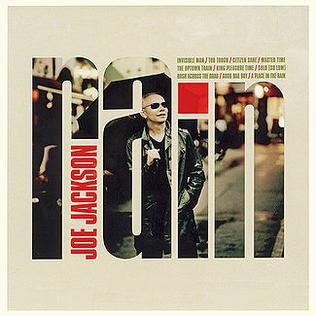
Joe Jackson 17: Rain

Now that it’s uncommon for artists to release an album a year, we simply don’t get to hear dispatches from the front as often. At least the upside is that veteran performers (the smarter ones, anyway) now put out new albums only when they’ve absolutely got something worth saying. And in the 21st century, Joe Jackson is one of those people.

He’s had his own gripes with the machinery over the years, as documented in his memoir A Cure For Gravity. Since his first album he’s gone through four labels and dabbled in a variety of genres throughout his career, some more successful than others. On Rain, easily his best album since the ‘80s, the only gimmick is keeping it simple: piano (lots of it), bass, drums and his own voice on ten strong songs.

Backed by the rhythm section of the original Joe Jackson Band, each track is straightforward with a multitude of hooks, starting with “Invisible Man”, something of a statement of purpose. Many of the other tracks have a timelessness to them, as if they could have been written at any other part of his career, following in order with “Too Tough”, “Citizen Sane” and the aching “Wasted Time”, another heartbroken classic with zero schmaltz. A nice tonic is “The Uptown Train”, which channels Ramsey Lewis’s “The In Crowd” (again) without directly plagiarizing.

“King Pleasure Time” is another jazz reference, but in name only; a terrific tempo drives this acerbic portrait. Any pomposity in the deceptively self-obsessed “Solo (So Low)”, a pseudo-classical piece with vocal, gets punctured by a few well-placed four-letter words. “Rush Across The Road” is near-perfect pop, complete with a bass solo replicating the chorus and even a fake ending. Snide commentary on the music business has to wait all the way until “Good Bad Boy”, an attitude going on for nearly six decades now. Finally, “Place In The Rain” recalls “Love At First Light” from Volume 4, and provides an odd appreciation for the album title, complete with ambient sound over the last minute.

Critics at the time compared the album to the original Night And Day, but a better precedent would be Summer In The City, recorded with a similar format. The occasional layered vocals on Rain show that it’s wasn’t captured completely live in the studio, but it may as well have been. If “intimate” isn’t the best word to describe this performance, let’s just say it’s direct, and was well worth the nearly five-year wait.

Joe Jackson Rain (2008)—4

Tuesday, March 25, 2014

Joe Jackson 16: Volume 4

Having gone back in time once already, sort of, Joe’s next move went even further. He reunited the original Joe Jackson Band and picked right up where they left off. Okay, not really, but Volume 4 does well to wash away the bad taste left by much of Beat Crazy all those years ago.

Right away, Dangerous Dave Houghton rolls in the drums and Graham Maby percolates a bass line, Joe lets out a howl and Gary Sanford proves that he hasn’t changed his amp settings in 23 years. But then Joe throws on a piano part right out of Night And Day, and “Take It Like A Man” manages to meld a lot of styles together. The equally clever “Still Alive” nicely apes the XTC version of the Beatles, with a bridge reminiscent of Steely Dan’s “Barrytown”. “Awkward Age” absolutely crackles, just like they used to. And just like they used to, they get mellow, or at least mellower, on “Chrome”, with its intricately plucked guitar and a bass solo where the guitar or piano solo would be. The mood stays that way for “Love At First Light”, a slightly melancholy portrait and a rather adult perspective on a casual encounter. As a possible reaction, “Fairy Dust” crashes in with a 5/4 tempo, heavy wah-wah guitar and jazz attack, and presents another argument about sexual roles.

“Little Bit Stupid” has a great trashy sound to go with the title, before moving back to a sensitive approach on “Blue Flame”, about as close as the album gets to a seduction. Then, as if to wipe that away, there’s “Dirty Martini”, complete with the band chanting backups and a cheesy Farfisa-guitar duet, stopping for a New Orleans-flavored piano break. “Thugz ‘R’ Us” works where it shouldn’t, a ska-fueled spoof of angry youth, sounding mostly like a Madness track of, say, 23 years earlier. And finally, “Bright Grey” comes to an edgy, angry finish, just this side of chaotic.

Volume 4 is no more a “comeback” than any other artist’s so-called “return to form”, but what makes it successful is its simplicity. Listeners knew by now that Joe Jackson was an exceedingly talented musician, and even a skilled composer, though sometimes songs require a more straightforward approach, and that’s what we have here.

Those whose appetites were whet by the six-EP included in early pressings of the album (the Japanese, incidentally, got an excellent cover of Todd Rundgren’s “Couldn’t I Just Tell You”) would have been very pleased to scoop up Afterlife, captured on the reunited band’s tour, mixing old and new, including songs that only Graham Maby may have played before.

Joe Jackson Band Volume 4 (2003)—3

Friday, January 24, 2014

Joe Jackson 15: Night And Day II

After a decade of relative commercial failure, it was just as uncomfortable to watch Joe Jackson begin the millennium with an album that pointedly referenced his last real hit. It’s always a ballsy move to revisit old glories, even more so when you give it a title like Night And Day II. On his own website he questions whether the title was a good idea, so maybe it’s best to think of it on its own, rather than a sequel—much like Harvest Moon only suggested a connection to Harvest.

In fact, anyone who has affection for the first Night And Day would do well not to look for a connection, because while the first album had its moments of brightness, most of the observations in Night And Day II are pretty dismal. One wonders why he insists on living in a city as ugly as the one he describes for 47 minutes—and this was a full year before 9/11.

With the exception of a string quartet, occasional bass, some percussion and some guest vocalists—which by now is a major red flag on any Joe Jackson album—this is a one-man operation. That means he also programmed all the drums himself. Where the earlier album utilized segues, here all the tracks are connected by the same high-hat pattern, no matter the tempo of the song. It starts in the “Prelude” and continues through “Hell Of A Town”, which references a catchphrase from Midnight Cowboy, begins to quote “Chinatown” and even talks about “steppin’ out” (not for the only time). “Stranger Than You” is the closest thing to a single, being the most upbeat track with the catchiest chorus. Any optimism suggested is smothered by the foreboding “Why”, with its fractured English sung by Iranian singer Sussan Deyhim. “Glamour And Pain” features vocals by the mysterious Dale De Vere, who looks strikingly familiar. (Based on the provided photo in the booklet, she would appear to be the artiste’s alter ego.) This lament of a “Superwhore” goes on a little long, broken up by occasional references to “Steppin’ Out”.

With a recurrent electric piano that resembles a busy signal, “Dear Mom” chases somebody’s sister around the city to eventual success but not much hope. Only three years after her appearance on a Metallica album, everybody’s favorite cracked chanteuse Marianne Faithfull takes her turn on “Love Got Lost”, which is one of the better tracks on the album, particularly in the chorus. “Just Because” begins with an extremely tense appearance by the string quartet, demonstrating the paranoid message of the already clichéd lyrical hook. The high-hat lets some Latin percussion come in for “Happyland”. A very pretty, very sad song about a notorious nightclub fire that killed 87 people in the Bronx ten years earlier, the line about “the hottest club in town” is just plain bad taste. The “Steppin’ Out” motif returns again throughout “Stay”, while slow chords and words bring him to settle on doing just that.

In the end, Night And Day II is another album made for a subdued setting, right along with most of his recent work. However, much like someone who’s been prescribed medication to temper a bipolar disorder, the mood never swings wide enough to make you want to spend any more time around the guy.

Joe Jackson Night And Day II (2000)—

Monday, August 19, 2013

Joe Jackson 14: Summer In The City

With his classical experiments seemingly pleasing nobody but himself and a handful of diehards, it was amazing to see that Joe Jackson still had the support of a major label like Sony. (Not only that, but they gave him his own imprint, though why he chose Manticore, previously the domain of Emerson, Lake & Palmer, remains a mystery.) The bean counters would have been very pleased indeed to see the contents of this live album, recorded at a few club shows with Joe on piano, backed by only Gary Burke on drums and the ever-faithful Graham Maby on bass. Summer In The City delivers an hour’s worth of music, pulled from his “pop” years, alongside some covers given his own reverent stamp, just to prove that he’s not a complete snob.

The title comes from the Lovin’ Spoonful classic, so it’s only right that the album begins with a run through that song. Some meandering sets up “Obvious Song”, his last near-hit from nearly a decade before. “Another World” is taken pretty straight, except for a bass solo; Joe even remarks that he usually doesn’t go for those, but Graham’s never one to abuse that power. A lengthy, non-reggae “Fools In Love” shows off its debt to the Yardbirds’ “For Your Love” via an interlude, just as “The In Crowd” sets up “Down To London”. (This after a reverent “Mood Indigo”, in tribute to Duke Ellington.)

The next handful of tracks are listed as a “medley”; basically that means he played them all in a row without much gap. Otherwise, there’s not much in common between “Eleanor Rigby”, “Be My Number Two”, “Home Town” and “It’s Different For Girls” except for the fact that he does them seamlessly. (Oh, and that they’re all excellent performances of good songs.) However, Steely Dan’s “King Of The World” proves to be an excellent model for his own “You Can’t Get What You Want”. If this worldwide stardom thing didn’t work out, he could easily make a living doing such covers in any number of piano bars around the world. The closing take on “One More Time”, the guitar-heavy opener to his debut, even works in this format.

Summer In The City provides a nice reminder to fans and detractors just what a fine performer he is, proving that when he deigns to, he can really give the people what they want. This was a nice carrot to dangle the business, especially since he was about to go back to the well again.

Joe Jackson Summer In The City: Live In New York (2000)—4

Friday, August 2, 2013

Joe Jackson 13: Symphony No. 1

In absolute defiance of commercial salvation, Joe decided to write and record a symphony. This wasn’t an orchestral album, like the otherwise ignored Will Power, nor was it particularly “classical”. If anything, Symphony No. 1 resembles the electronic keyboard-based pieces one might find on an ECM album, and certainly on his most recent non-rock releases. Along with his own keyboards, the usual JJ combo is heard, with special guests Terence Blanchard on saxophone and stunt guitarist Steve Vai.

While he’s someone who’s said he hated the idea of concept albums, the four movements are supposed to represent the stages of life. Maybe so, but the album is best enjoyed without context. It’s also an improvement over his last two albums, which tried to bridge big musical ideas and modern lyrics. Because no words are sung or spoken here, the music is left to speak for itself. It almost qualifies as “night music”.

Normally an album like this would be relegated to the opening paragraph of a larger review devoted to a subsequent album, but because Symphony No. 1 was such a pleasant surprise—especially given the arduous task of trying to sum up Night Music and Heaven & Hell—it garners more than a footnote. Whether or not it’s a bona fide symphony is moot, though it did win the first-ever Grammy for Best Pop Instrumental Album. Rather, it’s quite enjoyable, and deserving of wider exposure. We almost feel like we owe the guy an apology.

Joe Jackson Symphony No. 1 (1999)—3

Monday, June 17, 2013

Joe Jackson 12: Heaven & Hell

Another three years passed before Joe resurfaced, and he wasn’t any closer to compromising his musical path for anybody. Now he was on Sony Classical, and after the trend of “symphonic” reinterpretations of classic rock staples had somewhat plateaued, he was still determined to meld classical music with rock elements. This would be no mere orchestration, however; being Joe Jackson, his big project would be an exploration of the seven deadly sins.

Thus, Heaven & Hell was cast with a variety of singers to support his work. Onetime labelmate Suzanne Vega appears as the voice of the “fallen angel” seducing Joe’s “soul in torment” on “Angel”, while acclaimed soprano Dawn Upshaw provides the Latin counterpoint. Upshaw appears again on the next track, “Tuzla”, to trade lines with Joe and his occasional singing partner Joe Askew. Later on, Jane Siberry decorates “The Bridge”, with a nice jazzy string arrangement.

There are some fine instrumental moments, such as in the “Prelude” and the “Passacaglia” portion of “A Bud And A Slice” (until the bassoon is taken over by the guy from Crash Test Dummies, well past his expiration date). But because the subject matter is “dark” by nature, that almost dictates that the music be ugly. This culminates in “Right”, illustrating the “anger” portion of the program, wherein our hero shouts a litany of four-letter words and phrase over fists pounding on the piano, while three drummers (one in each speaker, plus another playing plastic buckets) pound away.

Most of the tracks on Heaven & Hell are on the lengthy side, and demand a lot of attention. One wishes he had either done a completely instrumental album, letting the music speak for itself, or maybe toned down the gravitas of the vocal portions and sung them himself. Catchy melodies used to come so easy for him, so it’s a shame that he overworks his ideas to the point of dullness. It didn’t work on Night Music, and it doesn’t work here.

Joe Jackson & Friends Heaven & Hell (1997)—2

Monday, March 4, 2013

Joe Jackson 11: Night Music

Having watched his most recent blatant attempt at accessible pop go ignored by most consumers, Joe Jackson went back to his little room and wrote for himself, seemingly. The results, after a three-year silence, emerged as Night Music, a challenging album that’s nearly impossible to ingest when the sun is visible.

It is not, as All Music Guide writes it off, “a song cycle about writer’s block”; the lyrics do address the self-doubt and questioning that can occur when one is trying to fall asleep. Besides not being very uplifting, such thoughts can too easily be equated with a wish for death and soon.

Four instrumental “Nocturnes” are spread throughout, further blurring the categorization of the album as pop, classical or neither. The second begins promisingly, but the most striking is the third, with its lovely oboe melody until it’s interrupted by some radio static, likely to suggest a bad dream. (His best work with the title was a gorgeous piano solo on the otherwise classical Will Power, another album nobody bought or seemed to enjoy.)

Four minutes in, the first “song” appears, proclaiming: “The older I get, the more stupid I feel,” and that’s the high point of cleverness. Despite a grand trumpet intro, “Ever After” tiptoes under a high soprano descant until drums kick in. “The Man Who Wrote Danny Boy” has a lovely Celtic lilt, telling a fable about a Faustian deal for immortality. While the narrator doesn’t sell his soul, he does succumb to the temptation of employing a guest vocalist—in this case, Clannad singer and Enya sibling Máire Brennan, used more briefly than Renée Fleming two tracks later. “Only The Future” brings a welcome change of tempo, a distinct melody over a barely changing root note. But the final “Nocturne” puts the brakes on, before “Sea Of Secrets” finally sends him off to slumberland, apparently.

Slow and pretty is one thing; it also helps to be memorable. Night Music is a nearly as “solo” as he ever got, as he’s credited with playing all but a handful of non-percussion or keyboard instruments. While his prowess is impressive, unfortunately some of the synthesized sounds were dated even for 1994; still, it must have been cheaper than hiring an orchestra. Not a lot happens, despite the album’s length.

Joe Jackson Night Music (1994)—2

Wednesday, April 25, 2012

Joe Jackson 10: Laughter & Lust

For the first time in his ten-year career, Joe was on a new label. One would have thought they’d’ve put their all into touting their new signee, especially when he presented them with an album full of the type of catchy pop A&M hoped he’d return to. Laughter & Lust gathered several of his reliable supporting players for a collection of just plain songs with no blatant concept, for once—even despite the title.

“Obvious Song” rises from cacophony for a catchy rant about the state of the world. “Goin’ Downtown”, despite being a theme he’s come close to too many times, is unfortunately married to a horn part that suggest the theme to your local evening news. “Stranger Than Fiction” channels early-‘80s Graham Parker, with prominent cowbell and conga to drive its rhymes. His cover of Fleetwood Mac’s “Oh Well” relies too much on synthesizers and percussion, but at least he paid tribute with the right touch of slap echo on his vocal. “Jamie G.” would have fit just fine on his first album, and manages to charm its way through the heavy Latin arrangement. In a nod to the sequencing of Blaze Of Glory, a quick drum break slows down to welcome in the wonderfully nasal Farfisa organ that frames the equally snotty “Hit Single”. While not exactly a slice of “pure pop heaven”, “It’s All Too Much” revives his distaste of saturation in the media.

“When You’re Not Around” and “The Other Me” provide adult ruminations on romance that could be hit singles for anyone who wanted to cover them. The moody “Trying To Cry” manages to stay interesting over six minutes of the same repeated unresolved chord, only modulating for a quasi-operatic section following the familiar subject matter (men forced into stereotypical masculine roles). The narrator of “My House” seems a little on the edge, while the guy blaming “The Old Songs” for his problems gets to do that over another homage of an arrangement. The best is saved for last, however. Despite its resemblance to a certain Barry Manilow song based on a Chopin prelude, its lush yet quiet arrangement carries like a boat on the ocean, fading away to the sound of waves.

Enough people must have heard that Laughter & Lust was just okay. It’s not even pointedly bad; it simply isn’t very exciting. The dated sound of the production doesn’t help. Maybe his depiction as prisoner with ball-and-chain was supposed to be symbolic of the role he felt forced to play. But the songs are catchy without being too crafted—he still plays a few of them while out on tour—so it gets a rating just a hair on the positive side.

Joe Jackson Laughter & Lust (1991)—3

Friday, August 5, 2011

Joe Jackson 9: Blaze Of Glory

Joe’s fascination with the LP as an entity continued on his next real album, a look back at his generation’s progress. Although he insisted it wasn’t a concept album (“it’s not the f—king Wall, for f—k’s sake,” he would tell impatient audiences), Blaze Of Glory is a song cycle, programmed in such a way that each track, while different than the next, has a built-in segue that sets up the sound of its successor. The use of lead vocalists other than himself also makes it more of a Big Production than the average rock album.

As had become his approach, the album ranges from rock to lush pop, sometimes within the same track. “Tomorrow’s World” fades in with an expression of wonder at what technology can bring, with pointed references to what didn’t come to fruition. “Me And You (Against The World)” gives a glimpse at the first brush with romance, followed by the determination of success in the big city espoused in “Down To London”, which features one of the better fake harmonicas as played on a synthesizer. The dreams, however, are already tarnished with the regret in “Sentimental Thing” (not sung by Joe, and its melody already used on the Tucker soundtrack). We’re not sure where the instrumental “Acropolis Now” fits into the story, except that one of its themes sounds borrowed from the title track of another concept album. “Blaze Of Glory” has a great backing track, but the words are basically a rewrite of Bad Company’s “Shooting Star”, right down to the metaphor and protagonist’s name. A not-so-subtle nod to “On Broadway” closes out the side.

While he may not have intended to allude to so many songs known in the common vernacular, there’s no escaping the similarity of “Rant And Rave” to “Footloose”, despite its 6/4 meter and detours into sleazy jazz. The relentless drums segue nicely into the intro of “Nineteen Forever”, one of his greatest and most unjustifiably ignored singles. It’s a wonderful ‘60s pop pastiche, with just the right amount of horns, exuberant vocals and even a Coral electric sitar. The determination to stay eternally young is exemplified in the extended fake live ending, complete with shouts of “one more time”. Instead, a lone trumpet leads into “The Best I Can Do”, another trademark vague love song with a vocal that still reminds us of Steve Martin. “Evil Empire” is a not-so-subtle slap at American policy at a time when Reagan was still seemingly universally beloved, and for those not impressed with the album thus far, “Discipline” is sure to seal its fate. Based on an intentionally annoying drum and bass loop, it weaves in horns, spoken excerpts and vintage keyboards into a maddening display of automation, broken only by a smooth jazz interlude. Those listening on CD would be rewarded by skipping ahead to the closing “Human Touch”, another aching piano ballad with a heartbreaking violin and a vocal arrangement reminiscent of the Righteous Brothers.

Blaze Of Glory is not immediately accessible, taking a few listens to catch hold. Some of it could easily be shaved in favor of the songs as opposed to holding up the story. Unfortunately for him, it was not a huge success outside his fan base, and the label that had supported him for so long dropped him in the next music industry consolidation. (In a cut in the running for the unkindest, Jon Bon Jovi put out an album the following year with the same title and sold more than a few more copies.)

Joe Jackson Blaze Of Glory (1989)—3

Wednesday, July 27, 2011

Joe Jackson 8: Live 1980/86

Despite not being the most lucrative artist on their label, A&M was still willing to bankroll any ideas Joe Jackson had. First, 1987’s Will Power was an original, strictly symphonic work that combined orchestral instruments with guitar, saxophone, and electronic keyboards and challenged most listeners, with the exception of the exquisite “Nocturne” piano instrumental.

Much of the next year was dedicated to writing and recording the soundtrack to Francis Ford Coppola’s latest flop. Tucker: The Man And His Dream was also predominantly instrumental, based around forties swing, alternating between mood music and upbeat fanfares like “Toast Of The Town”. He’d certainly improved since Mike’s Murder.

But in the middle came the surprising release of a double live album. What makes Live 1980/86 so entertaining is given in the title—a side each from four different tours covering six years on the road. Each of the bands is different in some way, but all are tight as can be.

The first side is dedicated to the final show by the original Joe Jackson band, beginning with a tentative “One To One” before introducing the band and revving it up. An amazing performance of “Is She Really Going Out With Him?” (one of three here) spirals up into an extended vamp on the opening chords that manages to morph into a blistering “Don’t Wanna Be Like That”.

Sides two and three, recorded little over a year apart, are acknowledged in the excellent liner notes as being similar, but even the more contemporary pop sounds he’d developed manage to transform songs like “On Your Radio” and “Fools In Love”. The version of “A Slow Song”, which closes side three, is absolutely overflowing with emotion—again, described in the liner notes—the sax solo nicely replacing the calmer organ of the album version. (The crowd reaction provides a nice contrast to the included photo of the audience at a 1982 gig opening up for the Who, taken from the viewpoint of the singer, looking out over a stadium floor full of raised middle fingers.)

Side four—the only one not to feature the stalwart Graham Maby on bass—was the most recent tour captured at the time, and it’s the best side. Several songs are reworked here: “Be My Number Two” merges very nicely into “Breaking Us In Two” with a subdued nylon-string solo; “It’s Different For Girls” is transformed into an acoustic strum; “You Can’t Get What You Want” loses the horns without the energy; “Jumpin’ Jive” gets a rockin’ workout that must have been memorized by Brian Setzer; and “Steppin’ Out” becomes an atmospheric meditation as filtered through side two of Big World.

With almost two hours of music, Live 1980/86 is riveting and hardly tedious. Yes, there are actually three different versions of “Is She Really Going Out With Him?” on this album, and while the so-called “acoustic” and “a cappella” renditions are enjoyable in their own ways, the best is still the tense burner from 1980. As it should, Joe’s prowess on the piano is slowly revealed through the four sides.

Joe Jackson Will Power (1987)—2
Joe Jackson
Live 1980/86 (1988)—4
Joe Jackson
“Tucker: The Man And His Dream” The Original Motion Picture Soundtrack (1988)—3

Saturday, July 16, 2011

Joe Jackson 7: Big World

After a few years of genre-jumping, Joe Jackson returned to something resembling the rock of his first album, but with a twist. In a departure for the ultra-processing of the decade, he recorded the songs for Big World over a period of three days in front of an audience at a theater in New York City, using a compact band and four backup singers, Joe himself switching from piano to melodica to accordion as the songs dictate. He carefully edited out any crowd noise, but the result is an album that definitely sparkles with the energy of a live performance, rendering the experiment a success.

And if that wasn’t all, the original vinyl contained the songs on three sides of two records; the label on the fourth side reads “THERE IS NO MUSIC ON THIS SIDE.” (We played it anyway to make sure; there isn’t.) This effectively divides the album into three parts, which doesn’t always translate to the cassette or CD format.

Part One fades in with “Wild West”, complete with Clint Eastwood flute, but goes right for the throat in its questioning of The American Way. The theme continues in “Right And Wrong”, complete with timely baseball commentary for the local crowd. “(It’s A) Big World” aims for something grand, but meanders around an ersatz Arabian riff without actually going anywhere. “Precious Time” is a breathless cipher, but all is well with the driving, yearning “Tonight And Forever”, another song that should have been a smash hit single.

Part Two takes it down a notch or so, with four songs on the dreamier side. “Shanghai Sky” is a gorgeous meditation on the piano, repeating the theme to ask “how the world got so small”, and playing it again as it started. “Fifty Dollar Love Affair” puts us in the middle of a film noir scene, yet the action is contemporary. “We Can’t Live Together” starts low and sultry but winds up with the angst of the choruses and guitar solo. Then it’s back to politics with a stately study of the previous “Forty Years” and the evolving state of the world.

After that, Part Three seems slight, but its charms emerge. “Survival” pounds a riff into the floor with not a lot of substance to back it up, followed by “Soul Kiss”, which decries the dearth of substance in pop culture over nice piano work. “The Jet Set” is a humorous narrative by a typical ugly tourist, then “Tango Atlantico” uses the dance metaphor to ridicule Reagan and Thatcher. The nostalgia of “Home Town” has certainly added to its appeal over the years, plus it’s got a fantastic opening line: “Of all the stupid things I could have thought, this was the worst.” “Man In The Street” brings it all home by unleashing the Rock; strangely enough, it was recorded during rehearsals, with no audience present.

Despite peaking at #34 on the Billboard album chart, Big World was hardly the commercial or critical success it should have been. Today it endures as an authentic, BS-free artifact from the ‘80s, unknown to many. And to add insult to injury, it was out of print for years, making it a steal for anyone who found it in the used bin, but is currently available for streaming.

Joe Jackson Big World (1986)—4

Friday, July 15, 2011

Joe Jackson 6: Body And Soul

Staying in New York City for the nonce, Joe’s next move was to make an album that embraced digital technology while staying true to the more organic elements of the instruments. Simultaneously looking forward and back, Body And Soul was even packaged like an old Blue Note album, complete with vintage typography and heady liner notes (most likely penned by the Artist).

“The Verdict” crashes out of the speakers with a grand horn theme; while it’s only tangentially related to the film of the same name, there’s a grandeur of sorts that infuses the narrator. “Cha Cha Loco” rehashes the Latin experiments of the last album over a piano line that doesn’t do much, but a nice big ballad comes in “Not Here, Not Now”. Over a sad melody, the lyrics detail a crumbling relationship kept afloat by a desire to not to “make a scene” amongst friends—the narcissism of the ‘80s made clear. With the unwieldy title “You Can't Get What You Want (Till You Know What You Want)”, that song wasn’t the most likely candidate for a hit single, but once you get past the horns and enjoy the bridge, even the bass and guitar solos start to make sense. The optimism continues on “Go For It”, an oddly encouraging sentiment coming from his mouth. Or maybe he was being ironic?

His fascination with the metropolitan melting pot culminates on “Loisaida”, its title a phonetic translation of Manhattan’s Lower East Side. It’s designed to be an impressionistic journey through the neighborhood, something of a cousin to “Harlem Nocturne”, and at that level it works, even if the sax part reminds us of “No Anchovies, Please” by the J. Geils Band. The liner notes helpfully point out the harmonic juxtapositions of “Happy Ending”; while the “Be My Baby” drum part is always welcome, the Night Court fan in us wishes backup singer Ellen Foley could have sung the female half of the duet. There’s time for another big ballad, the wondrous “Be My Number Two” that manages to sound romantic despite its undercurrent of selfishness. Predominantly voice and piano, it breaks through at the end by adding drums, violin and horns. Another tone poem of sorts, “Heart Of Ice”, is used to bookend the album. For the first part of it, it almost sounds like a Pat Metheny album, and that’s not meant as a slam.

Body And Soul was not a huge hit, but when heard back to back with Night And Day, it emerges as the superior album. The steps taken to provide optimal sound comes through on the vinyl, while the breadth of musical styles makes it excellent pop.

Joe Jackson Body And Soul (1984)—

Wednesday, July 6, 2011

Joe Jackson 5: Night And Day

A move to New York City invigorated Joe, and he recorded his next album of original material with a small group of players, not one of whom added a guitar to the recordings. On vinyl, Night And Day had two sides—“night” and “day”, naturally—but the designations didn’t necessarily apply to the music within, which could have easily taken place anywhere within a 24-hour cycle in the Big Apple.

From the beginning, he embraces the diverse ethnic culture of the city, with the Latin touches and percussion on “Another World”, followed by a search for “Chinatown”. There are no silences between the songs on this side; each fades into one another, just like the radio. But at least it’s not as abrupt as changing television channels, which would make “T.V. Age” even more irritating. “Target” wanders over the same Latin piano line for too long, but the side is redeemed by the hit single “Steppin’ Out”. Still catchy as ever, it was several years before we realized it, remarkably, has the same bass line throughout, except for the verses.

Ever a student of pop music history, “Breaking Us In Two” begins identically to Badfinger’s “Day After Day”, but he uses it to base a wonderful lovers’ lament. “Cancer” might be the best of the songs on the album with a Latin theme lambasting modern society; while that’s not saying much, at least the piano solo is more exploratory. The success of the album was such that the label even bankrolled a video for “Real Men”, which got lots of MTV airplay despite its easily misunderstood lyrics about machismo, racism, homosexuality and other stereotypes. It’s still a gorgeously sad song, an idea he expands on for the epic “A Slow Song”. This masterwork may as well be his theme song—indeed, he still closes his shows with it—a bold plea to cut through the disposable trends so that “real” music can transform our lives.

With its pop sound and attitude, exemplified by the cartoon on the front cover, Night And Day wasn’t about to please anyone who missed the edgy punk of his debut. But he was determined to be a working musician and composer, and enough people bought the album to keep his publisher happy. (It still cracks us up that drummer Larry Tolfree has the same look on his face as he did on Jumpin’ Jive. At least Graham Maby lost the beard.)

The album got a boost from its videos and a lengthy tour, yet Joe still found time to compose the music for the film Mike’s Murder. Despite starring Debra Winger at the peak of her popularity, the film had a lot of problems getting released, which meant the soundtrack album didn’t find much traction, and most of the music didn’t end up getting used in the film anyway. Probably just as well, as one side of tepid vocal tracks was remarkable only for “Memphis”, which ripped off the hook from the Spencer Davis Group’s “Gimme Some Lovin’” (over the bass line from “Steppin’ Out”), and side two’s instrumentals were just dull. These very New York sounds were an odd match for a film about LA, and he would find more focus on his next album.

Commercially, Joe had also peaked, yet Night And Day has remained popular since its release. The 2003 Deluxe Edition seemed promising—at the very least, to show that his old label still thought highly enough of him to bother. Six solo demos demonstrate how mapped out the songs were before the band was brought in, and the five vocals from side one of Mike’s Murder kept that music in circulation, for better or worse. While the inclusion of the entirety of side two of Live 1980/86 was all good and well in context, it took the idea of recycling a tad far.

Joe Jackson Night And Day (1982)—3
2003 Deluxe Edition: same as 1982, plus 16 extra tracks
Joe Jackson Mike’s Murder Soundtrack (1983)—2

Wednesday, June 8, 2011

Joe Jackson 4: Jumpin’ Jive

As long as he was being ignored on the pop charts, Joe’s next move was to break away from his touring band (saving only Graham Maby) and put together a swing revue. Both band and album were christened Joe Jackson’s Jumpin’ Jive, and both album and setlist contained nothing but songs associated with the likes of Cab Calloway and Louis Jordan.

Despite his own prowess at the piano, he lets somebody else handle the keys, limiting himself to vibes, scatting and singing, although he does use a couple of cartoony voices on the parenthetical masterpieces “You Run Your Mouth (And I’ll Run My Business)” and “What’s The Use Of Getting Sober (When You’re Gonna Get Drunk Again)”. The three-man horn section doesn’t get too much in the way, and everyone gets to shout along.

Chances are that anyone but jazz aficionados would be familiar with any of these tunes, with the possible exception of “Tuxedo Junction”, the Glenn Miller standard, and “Is You Is Or Is You Ain’t My Baby”, which a certain generation would have beloved from a Tom & Jerry cartoon. “San Francisco Fan” is a nice slice of hi-de-ho, and if you don’t get a twitch of a smile at “Jack, You’re Dead” and “Five Guys Named Moe”, then there’s something wrong with you.

Okay, so maybe a swing album from an Angry Young Man wasn’t the best idea for the time, but once you get into the mood for it, Jumpin’ Jive is just plain fun. Amazingly, it even charted. (And, not that anyone was keeping score, but it also beat Elvis Costello’s country jaunt into stores by about six months.) Fast forward to the end of the century, when films like Swingers and The Brian Setzer Orchestra got the kids interested in the swing genre, the album was reissued with a new cover that aimed to be stylish but missed by using an anachronistic photo of the artiste. Nonetheless, it has remined essential.

Joe Jackson Joe Jackson’s Jumpin’ Jive (1981)—4

Wednesday, June 1, 2011

Joe Jackson 3: Beat Crazy

Barely a year after people first heard him on the radio, Joe was disillusioned with the music business. Three albums in two years was a tall order for anyone, but he could barely contain his disgust with a note on the inner sleeve of Beat Crazy that literally questioned why he bothered.

The album was a quest to “make some sense of rock and roll”, and for the most part, it’s a departure from the pogo-happy sound of his previous albums, embracing the more moody, piano-based pieces. The title track doesn’t fit into that category, beginning with a scream and placing the complaints of the previous generation squarely in the present. Bassist Graham Maby sings the verses, and Joe responds with the edgy choruses. There’s a split second before “One To One” takes over, a pretty lament about a modern relationship. Here the piano and organ answer each other nicely. This in turn switches to the moody dub of “In Every Dream Home (A Nightmare)”, a peek behind the curtains of a city neighborhood. “The Evil Eye” is closer what people wanted, continuing almost seamlessly in “Mad At You”, which at over six minutes almost seems like an extended remix. (The video features, along with a wonderful use of baked beans, the first-ever glimpse of Joe in drag.)

As evidenced on side one, part of Joe’s lyrical arsenal included studies of juxtapositions and paradoxes, where things aren’t what they seem and double standards are exposed. “Crime Don’t Pay”, which only includes about a minute of singing between its lengthy intro and outro, demonstrates one example of the unfairness of modern society, while “Biology” questions the loose fidelity of bands on the road versus the women they left at home. “Someone Up There” updates the old idea of boy-meets-girl-loses-girl. “Pretty Boys” is not an answer to “Pretty Girls” from his first album, but a rant against pop idols and talking heads on TV. Most people probably skipped over “Battleground”, a blatant imitation of Jamaican “dub poet” Linton Kwesi Johnson, but hopefully they stuck around for “Fit”, the best song on the album. For not the last time, Joe questions what makes a man a man, throwing in some racial issues, over a fantastic band performance that makes for a fine finale. (And not for the last time, his own sexuality would be subject to conjecture.) This would be the perfect soundtrack for a scene in an ‘80s coming-of-age film where the protagonist storms out of a house, slamming the screen door in time to the opening drum beat, and driving his car all night pondering his predicament.

Inevitably, Beat Crazy doesn’t quite satisfy, and much of this can probably be put down to having such a full recording and touring schedule. A change was in order, and he would soon make a striking one. (This album has been ignored in this century, after others were expanded. Should anyone decide to, it would behoove them to add the B-side “Enough Is Not Enough”, as well as the standalone “The Harder They Come” single—yes, the Jimmy Cliff song—and its B-sides, “Out Of Style” and “Tilt”. Each has made it to CD over the years, but they belong here, and would be welcome.)

Joe Jackson Band Beat Crazy (1980)—2