Showing posts with label robert fripp. Show all posts

Tuesday, October 18, 2016

King Crimson 21: A Scarcity Of Miracles

Despite being subtitled “A King Crimson ProjeKct”, A Scarcity Of Miracles should not be mistaken for a 21st century Crimson album. Rather, it was built up from a collaboration between Robert Fripp and one Jakko Jakszyk, who’d fronted a group of reunited Crimson alumni, including Mel Collins, who added some saxophone parts to the works in progress. Tony Levin and Porcupine Tree drummer Gavin Harrison (who’d played with Crimson in 2008) added a rhythm section and that was the album.

Most of the pieces are on the long side, with melancholy melodies and soundscape-style atmospheres. Each track has a vocal and lyrics, and Jakko harmonizes with himself. In this and other ways it’s similar to Fripp’s collaboration with David Sylvian, not as dance-heavy, but still rhythmic in places. Collins is prominent, but guitars provide the main structures, in different styles and electricity; a Chinese zither features occasionally. Some familiar-sounding riffs appear before the higher-energy segment of “The Other Man”, which is the most frenetic and welcome portion of the album. (Those who bought the DVD package got alternate mixes of the album’s tracks, as well as two improvs, which would eventually be offered for download.)

While more historic for what was to follow for the principals—and the appearance of two of the songs in future setlistsA Scarcity Of Miracles remains mostly a curio, not astounding, but not awful. It chronicles a new beginning for these principals. And because of said principals, it’s catalogued here thusly.

Jakszyk, Fripp and Collins A Scarcity Of Miracles (2011)—3

Sunday, October 21, 2012

Robert Fripp 6: The Next Day

David Sylvian was best known as the dreamy frontman for the New Wave band Japan; he became better acquainted with Robert Fripp after doing a session together in 1985. At the turn of the ‘90s, Fripp had toyed with the idea of another incarnation of King Crimson, with Sylvian as lead singer. While that didn’t happen, the two did manage to complete a collaborative tour, which resulted in an album.

The Next Day is very much a collaboration, dominated by Sylvian’s croon, over loops as well as real drums and percussion, with Fripp mostly adding color on the side when he’s not driving the riff. Another key contributor is Trey Gunn, who’d graduated from Crafty Guitarist to proficient Chapman Stick player and had joined the duo on the initial tour. Veteran drummer Jerry Marotta is also on a few tracks, along with computer treatments from co-producer David Botrill.

The album begins with the funky (always a strange word to associate with Fripp) “God’s Monkey”. But for the experiments in meter, this is fairly mainstream, as is “Jean The Birdman” with its dense lyrics. “Firepower” brings in a lot more crunch, and sports more familiar Fripp soloing that livens up the second half of this ten-minute track. (Plus, what sounds like a violin evokes echoes of the Larks’ Tongues era.) Another snaky riff drives “Brightness Falls”, which is just too slow to be danceable.

The second half of the album is a little more indulgent, if frankly tedious. “20th Century Dreaming (A Shaman’s Song)” has promise at first, but soon devolves into ambient effects while the bassline burbles beneath. Not so for “Darshan (Road To Graceland)”, which explores the era’s ubiquitous “Manchester beat” loop for about 17 minutes. It picks up anytime Sylvian sings an actual verse or Fripp’s guitar comes up in the mix, but takes up a lot of space without really going anywhere, despite the title. If anything, it makes the Frippertronic soundscape of “Bringing Down The Light” more welcome.

To support the album, the duo plus Gunn recruited “infinite guitarist” Michael Brook and Pat Mastelotto, most famous for pounding the skins for Mr. Mister, for another brief tour. The shows at the Royal Albert Hall were released as a limited edition CD called Damage, which Sylvian remixed and resequenced in 2001 for a more widespread release. The first version gets points for beginning with the moody title track, while the second adds “Jean The Birdman” at the expense of “Darshan”, which also cuts six minutes from the total disc time. Both versions provide better performances of the album’s tunes, plus a few selections from Sylvian’s solo albums as well as a song from Rain Tree Crow, the eponymous Japan reunion from 1991. In both cases, the albums end with two more rare songs: the rocking outtake “Blinding Light Of Heaven” and the much more subdued “The Next Day”. (Completists will also want to seek out the two CD singles for “Jean The Birdman”, which include more subdued Sylvian tracks with Frippertronics, and the “Darshan” maxi-single with two commissioned remixes of the song that are actually shorter than the album track.)

Though the pair wouldn’t take their collaboration further, the rhythm section would continue to be useful for Fripp. And while The Next Day and particularly Damage very much foreshadowed his next adventure, that future would be very different indeed had Sylvian accepted the challenge of singing in King Crimson.

David Sylvian & Robert Fripp The Next Day (1993)—
Sylvian/Fripp
Damage (1994)—3

Thursday, October 11, 2012

Robert Fripp 5: Kneeling At The Shrine

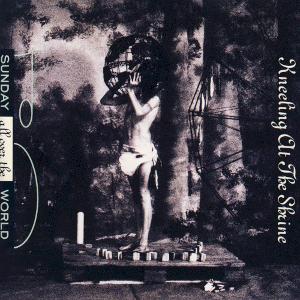
In 1986, Robert Fripp married Toyah Willcox, an actress and singer best known for her outlandish voice and style in both milieus. She already had nine albums under her own name by the time they decided to put a band together. After tapping Crafty Guitarist Trey Gunn on Chapman Stick and drummer Paul Beavis—who must be tired of the jokes by now—for a few short tours, the quartet eventually recorded Kneeling At The Shrine, taking the band name from the first track on the album.

Toyah is the predominant musical force here, as her distinct voice (and we assume lyrics) are firmly in the tradition of edgy New Wave art-pop, somewhere between Siouxsie Sioux and Kate Bush. Still, she should have known that the hook for “If I Were A Man” was already established by Erasure. While there are few echoes of ‘80s Crimson, Fripp fans won’t have to listen too closely for his input, as many of the backings are driven by his picking, with solos here and there as well. (“Strange Girls” has what we could swear are Space Invaders effects under his usual ascending riffs.) “Don’t Take It Away” is a catchy pop song, while the closing “Freedom”—uniquely credited as written by the couple and not the whole band—is still a straightforward, almost conventional-sounding track, even at almost eight minutes.

Nothing more would be heard from Sunday All Over The World, though Toyah and Fripp would go on to be an iconoclastic couple through the decades to follow while pursuing their own individual artistic paths. They are still together today.

Sunday All Over The World Kneeling At The Shrine (1991)—2

Tuesday, October 9, 2012

Robert Fripp 4: The League Of Crafty Guitarists

The years following the end of the ‘80s incarnation of King Crimson found Robert Fripp immersed in a music instruction-cum-philosophy retreat called Guitar Craft, the most notable public result of which being the implementation of an alternate tuning he’d devised. As more students joined the course over time, it was almost inevitable that new music would arise out of the quorum, and soon The League of Crafty Guitarists was formed.

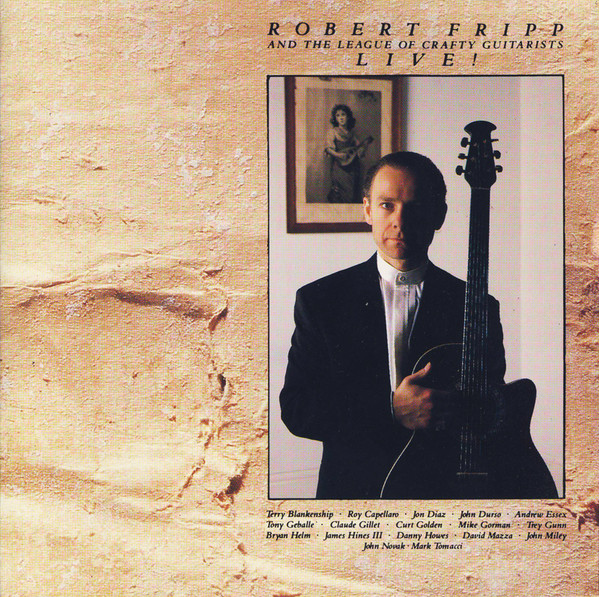
The first release from the conglomerate was mostly recorded at a series of college gigs, and shows how seventeen similarly tuned acoustic guitars can combine while Fripp directs and/or solos on top. The three main “Guitar Craft Theme[s]” appear out of order but recall some of the experiments of Michael Hedges and his ilk, while most of the given piece titles aren’t as leading as “Tight Muscle Party At Love Beach”—one of three tracks not credited solely to Fripp—overall the music is mesmerizing and occasionally soothing. The closing “Crafty March” is particularly interesting, as we hear the musicians enter and exit the hall while playing. (Not that the album needed filling out, but “The New World” is a separately recorded Frippertronics piece with a nice solo atop it, and one of the better examples of that genre.)

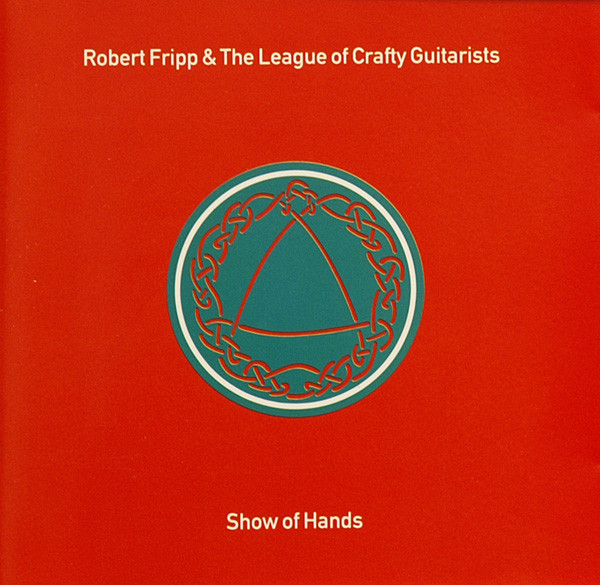
Five years went by before another incarnation of Crafties came together for an album. Show Of Hands boasted more individual Crafty compositions of varying success but further intricacy. However, just over a half-hour of music is split up by, frankly, disruptive solo vocal selections from one Patricia Leavitt. Still, “Eye Of The Needle”, “Scaling The Whales”, “Asturias”, and “A Connecticut Yankee In The Court Of King Arthur” recall the better parts of Live!, and “The Moving Force” is a lovely trilling piece with added viola that sounds like it uses fewer players than the seventeen listed.

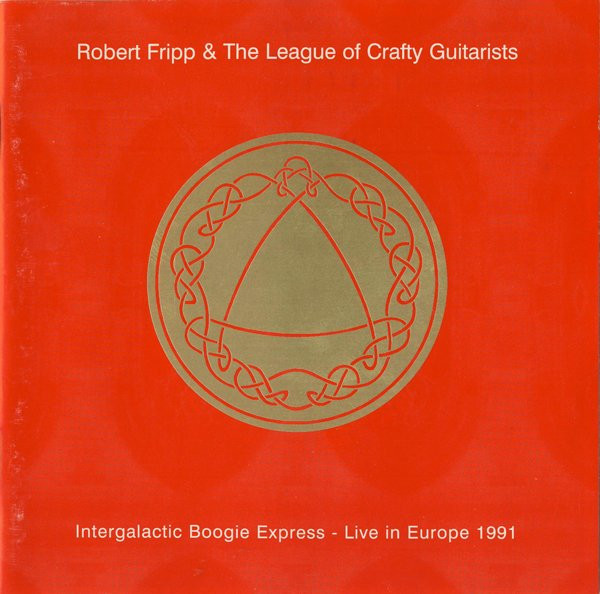
A better representation of this League’s potential came four years later when Intergalactic Boogie Express, an official bootleg of the subsequent tour, appeared as one of the first releases on Fripp’s new Discipline Global Mobile label. Highlights include some Bach pieces, a new Fripp composition called “Larks’ Thrak”, and a wonderful arrangement of the traditional chestnut “Wabash Cannonball”, while seven pages of liner notes in small print document the financial hassles with his old label that loomed large over the tour and nearly bankrupted him. (Even before that, The Bridge Between was the only release by the pompously dubbed Robert Fripp String Quintet, which consisted of the auteur with key collaborator Trey Gunn and three Crafties who’d formed the California Guitar Trio. Once again original compositions are peppered with Bach pieces, but with more electronic touches via the Chapman stick and E-bows and whatnot that vary between complementary and distracting. While something of a tangent, the album still nicely fills in the years between Crimson incarnations.)

Robert Fripp and the League Of Crafty Guitarists Live! (1986)—3
Robert Fripp & The League Of Crafty Guitarists
Show Of Hands (1991)—
The Robert Fripp String Quintet
The Bridge Between (1993)—3
Robert Fripp & The League Of Crafty Guitarists
Intergalactic Boogie Express — Live In Europe 1991 (1995)—3

Tuesday, October 2, 2012

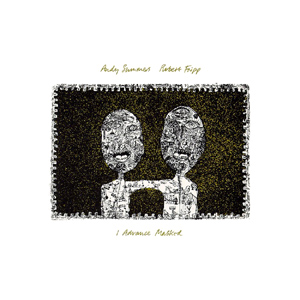
Andy Summers and Robert Fripp: I Advance Masked and Bewitched

At first it sounded like an odd match—the guitarist for a popular mainstream band facing off against the same for one of rock’s most challenging—but taken down to the basic details, it makes sense that Andy Summers and Robert Fripp would be so compatible. There were enough precedents in both the Police and King Crimson to show their similarities, and tendencies to create textures and spit out staccato solos. (They’re about the same age, too, Andy the older by three years. He’d also played in a whole slew of esoteric outfits before the Police got him.)

I Advance Masked is a true duet, each track compositionally credited to both, playing alternately dizzying runs up and down necks and exploring the capabilities of the guitar synthesizer. Being entirely instrumental, the titles suggest various moods, sometimes beautifully, as with “Girl On A Swing”, where a gentle piano dances around an acoustic guitar while a birdlike melody soars back and forth. “Painting And Dance” presents a nice little chamber piece, and tracks like “Under Bridges Of Silence”, “The Truth Of Skies”, and “In The Cloud Forest” contain enough Frippertronics to create moods. There are enough uptempo pieces to keep it from being entirely impressionistic; the title track (which builds on “The Zero Of The Signified” from Under Heavy Manners and shares some constructive elements with “Neurotica” from Beat) is particularly edgy, a tension that continues on the percussive “New Marimba”. “Hardy Country” also provides a change in dynamic, just as “Stultified” ends the album with a set of precisely played dissonant figures.

While not a smash hit, and little promotion considering their commitments to their main bands, a follow-up still materialized. Bewitched isn’t simply more of the same, mostly because it’s more of a Summers album than a full collaboration with Fripp, as the writing credits make plain. The album was split between a “dance” side, which adds a real rhythm section, albeit with electronic-sounding drums but also Sara Lee from the League Of Gentlemen on bass, and a “dream” side, which is much more contemplative as well as satisfying. Once again the titles try to be descriptive (“Begin The Day”, “Parade”, “Forgotten Steps”, “Train”, the title track), and while “What Kind Of Man Reads Playboy” is upbeat, reminiscent of Fripp’s “discotronics” period, at ten minutes it tends to drag. When the album works best, the notion of Brian Eno mixing an ECM album isn’t so alien.

Having limited themselves to two albums, a 90-minute Maxell conveniently contains both nicely, and even worth having on continual auto-reverse. If Police fans found their way here, they could well have graduated to King Crimson via a back door. More directly, the albums give the listener a chance to hear Fripp’s current style unadorned by the Levin/Bruford rhythm section, nor particularly Adrian Belew. They also raise Andy’s profile a bit, giving him a chance to step out of Sting’s shadow.

Forty years later, while Fripp was methodically and painstakingly upgrading and reissuing his life’s work, the Summers and Fripp albums hovered on the perimeter. Then Andy found a bunch of tapes that had been forgotten, enabling the compilers of The Complete Recordings 1981-1984 to present both albums in new mixes by David Singleton. The differences are subtle; the piano on “Girl On A Swing” is more pronounced, while “Parade” has some chatter under the intro and comes to a complete ending instead of being faded. Each of the albums got bonus tracks—alternate mixes mostly, plus the furious tracks “Brainstorm II” and the dreamier “Balinese”—as well as another disc’s worth of outtakes. Mother Hold The Candle Steady was compiled from sketches of ideas for both albums into finished compositions, plus alternate takes of “Parade” and “Maquillage”. Some of these new tricks are very nice, but then there’s the wacky carnival atmosphere of “Foi Um Optimo Dia”, complete with a chorus of happy revelers. The title track shares its name with that of an improvisation on Crimson live album), and “Step N’ Fetchit” is a remake of an Exposure outtake. Rounding out the disc is a half-hour of excerpts from Fripp’s cassettes of their writing sessions and conversations under the title “Can We Record Tony?” (The full “audio documentary” is included on a Blu-ray disc, along with original, new, and surround mixes of the three albums.)

Andy Summers/Robert Fripp I Advance Masked (1982)—4
Andy Summers/Robert Fripp
Bewitched (1984)—3
Andy Summers and Robert Fripp
The Complete Recordings 1981-1984 (2025)—

Sunday, August 26, 2012

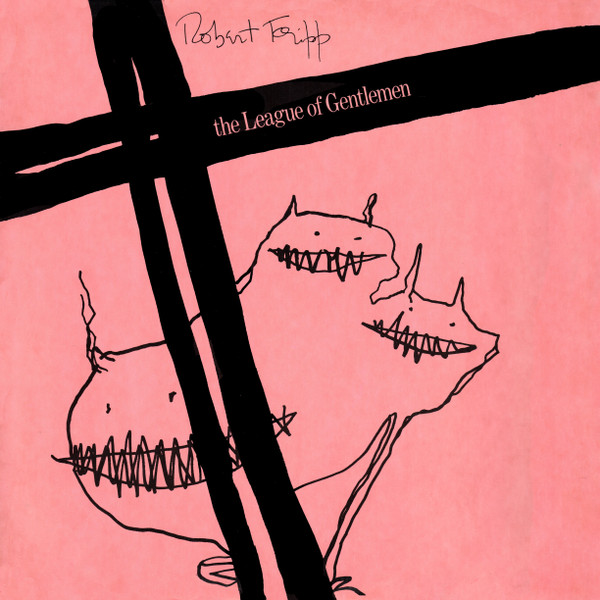
Robert Fripp 3: The League Of Gentlemen

At a brisk pace to realize his musical vision in his self-imposed “Drive To 1981”, Robert Fripp’s next trick was to get funky. Well, not really; to his mind the natural extension of discotronics would be music that would move your body as well as your mind, and you needed a rhythm section for that. He’d already shared some of this vision on the Under Heavy Manners half of his last album, so he found Barry Andrews, fresh from XTC, to play organ, plus Sara Lee on bass and Jonny Toobad on drums, and thus the League of Gentlemen was formed.

Four months of work on and off the road resulted in something of a repertoire that would make up their one and only album, except that the drummer turned out to have substance abuse issues, so he only played on two tracks of what would be released as The League Of Gentlemen. The other tracks were handled by Kevin Wilkinson, who’d played in the band that had opened up for the League, which is how he learned the songs. To flesh out what he already deemed less than an accurate representation of what the band could do, Fripp took a nod from Exposure and inserted various spoken word sections, some taken from lectures by his spiritual guide J.G. Bennett, some from various Roches, some of a woman in ecstasy, and some lifted from the radio a la My Life In The Bush Of Ghosts. The effect is very much like Zappa’s Lumpy Gravy, and just as strange.

One of these collages opens the album, with “Inductive Resonance” providing relief in an actual musical composition. “Minor Man” is another groove of sorts, but with Danielle Dax mewling over the top. While likely impossible to request by name, “Heptaparaparshinokh” is a bopping little number named after a “cosmic law of seven”, as is the easier-to-pronounce “Dislocated”. “Pareto Optimum I” appears to be synth-based, building slowly on repeated notes, almost Frippertronic-style, while “Eye Needles” is back to the whole combo again. Another collage appears to discuss Fripp’s prowess in non-musical areas, ending side one.

“Pareto Optimum II” continues the experiment of the first, and then “Cognitive Dissonance” is another band track overlaid with Bennett lecturing. The grooves in “H.G. Wells” and “Trap” are also marred, frankly, by voices and moaning where they didn’t need any, but if you listen closely you can hear predictions of the next King Crimson album. That’s it for the band; “Ochre” is a more melodic exploration on the “Pareto Optimum” ideas, and another collage closes us out.

Fripp has maintained that the album was a compromise to meet a contractual obligation, so The League Of Gentlemen has never been reissued in any form; the seven tracks that featured the whole band were included, with extraneous commentary mixed out, on 1985’s God Save The King compilation, which also sampled rejigged tracks from Under Heavy Manners. This limited availability only underscored the original album’s shortcomings.

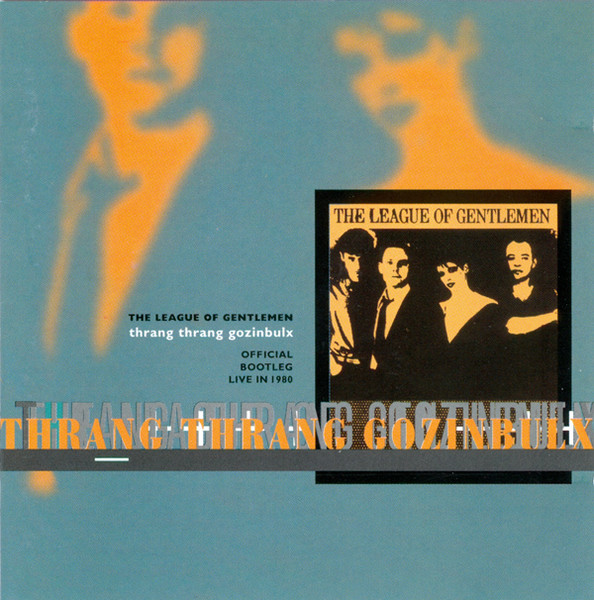
Besides, the band was at its best live. Years later, once his own DGM label began plundering his archives, Thrang Thrang Gozinbulx presented a compilation of performances by the original combo from club shows in the months before they attempted to put together the album proper. It’s accurately dubbed an “official bootleg”, as the source cassettes were from the back of the venues, with lots of crowd noise competing with the band. Unfortunately, the crowd sounds so rapturous and the size of a stadium crowd, almost comically, to the point of sounding canned.

That said, the music cooks. Besides demonstrating a lot of energy—somewhere between the B-52’s and Metal Box PiL—they seem more like they’re playing together, displaying dynamics missing in the studio. We also get to hear pieces that didn’t make the original album, including three variations of the title track, the more measured “Boy At Piano”; the deceptively titled “Christian Children Marching, Singing”; “Ooh! Mr. Fripp”, which predicts the type of thing he’d play in his next band; and the much slower but still groovy “Farewell Johnny Brill”. Hidden all the way at the end of the disc, following a lengthy silence, are various onstage announcements by Fripp beseeching the band to party and the audience to dance. (Other gigs from the original Gents are available in decent-for-bootleg quality for download at Fripp’s website, as well as in the Exposures box. There we can hear the crowd was certainly receptive, but more engaged beyond mere cheering. Steven Wilson’s modern mixes of the studio tracks, including the God Save The King selections and some unreleased, are also in the set.)

Robert Fripp The League Of Gentlemen (1981)—
Robert Fripp/The League Of Gentlemen
God Save The King (1985)—
The League Of Gentlemen
Thrang Thrang Gozinbulx (1996)—3

Saturday, August 25, 2012

Robert Fripp 2: Frippertronics

Once finally released, Exposure returned Robert Fripp to the music industry, kind of, and he sought to find his way through it on his own terms. His Frippertronics experiments of improvising over prerecorded loops saw him performing in small, non-standard venues, from record stores to pizza parlors, with the audience up close. This was how he chose to compose, and while making an album out of them wouldn’t be easy, he managed to get two.

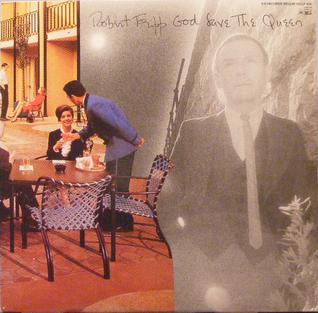
The first was given the unwieldy title God Save The Queen/Under Heavy Manners, which suggested they were condensed from what could have been two separate albums. Each half of the title referred to a different side of the record or tape, each built on Frippertronics loops. The first (called “Side A”) offers three performances of increasing lengths, bleeping, and intensity, all sounding very much like No Pussyfooting but without any Eno input. The other (called “Side One”) adds a rhythm section, including Eno and Talking Heads favorite Busta Jones, to the loops, which was Fripp’s idea of “discotronics”. “Under Heavy Manners” begins much like the rest of the track until overdubbed band kicks in, and a pseudonymed David Byrne bleats a raspy vocal. After coming to a halt, Fripp instructs the proceedings to “continue,” and “The Zero Of The Signified” presents a more relentless beat, which eventually fades for the Frippertronics to dominate as they too fade.

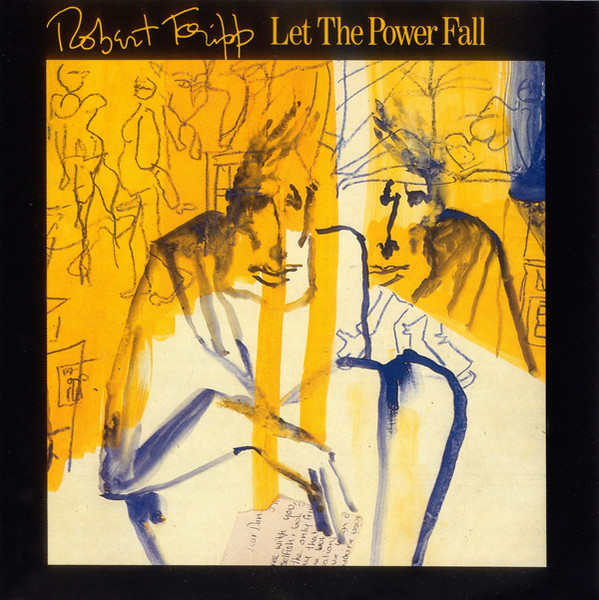
A year later, Let The Power Fall presented another full album of Frippertronics from the same 1979 performances that begat the previous set; this time there was no added rhythm section. Three longer pieces alternate with three shorter ones, all similar in structure but differing in intensity. From time to time a melody emerges, and they can be quite lovely, but they come and go, as is the fleeting nature of the music.

These albums are interesting for filling in the blanks between ‘70s Crimson and ‘80s Crimson, but they are not easy listening. Fripp has always preferred live performance to a static media format to express himself musically, so these pieces may well have been more exciting for those who witnessed them take shape out of seemingly nowhere. In fact, 2022’s Exposures box set collected further hours’ worth of Fripp performances from this period on five CDs, and even more on Blu-ray, so the selections that made up these two albums had to have stood out somehow.

When some of his back catalog was first prepared for CD in the mid-‘80s, Fripp couldn’t help “revising” (his term) some of the music. 1985’s God Save The King compilation augmented the Under Heavy Manners half with music from 1981’s dance-oriented The League of Gentlemen. The “title track” was a rejigged “The Zero Of The Signified” with a new, more furious solo overdubbed throughout. This track, along with the previously unreleased jam “Music On Hold”, was included as a bonus on the first-ever CD reissue of Queen/Manners, following their inclusion in Exposures. Meanwhile, Let The Power Fall got a “Definitive Edition” CD release in 1989 alongside other King Crimson albums; its reissue in the wake of Exposures sported extras consisting of a single edit and two alternate mixes, all of the “1984” track.

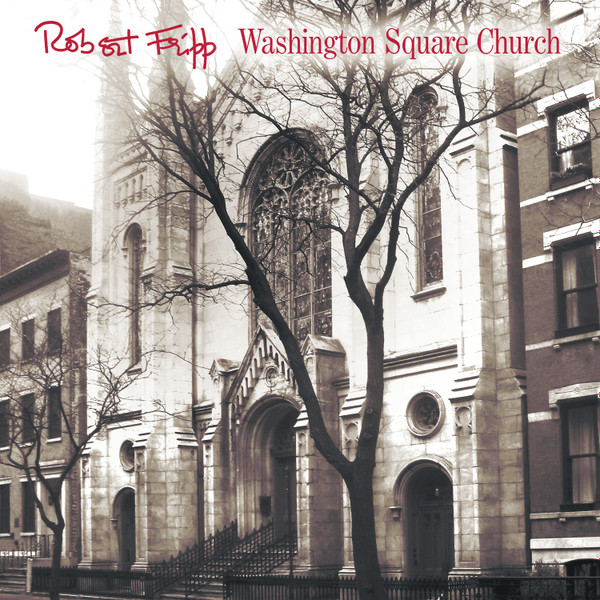
Also hidden within the multitude of discs in the Exposures doorstop was one little surprise, and deemed of such importance that it was also released on its own. Washington Square Church was recorded during a residency at the New York City venue of the same name in the summer of 1981. What makes this collection of Frippertronics stand out is that not only do we hear the loops used for the performances, but for the first time, they are synchronized with his live improvised solos—a facet that made each Frippertronics concert a unique and intimate experience. At times pastoral and at others frenzied, this is probably the best way to hear Frippertronics without being there.

As technology evolved, so did Fripp’s approach to Frippertronics. By the ‘90s they had evolved into “soundscapes”, and resulted in a series of self-published CDs and downloads. Possibly their widest exposure came during 2020’s Covid lockdown, when a weekly “Music For Quiet Moments” was plucked from the archives and distributed via YouTube and streaming sites, eventually collected as a box set. Now numbering in the dozens, these will not be explored in this forum.

Robert Fripp God Save The Queen/Under Heavy Manners (1980)—2
2022 reissue: same as 1980, plus 2 extra tracks
Robert Fripp Let The Power Fall (1981)—2
2022 reissue: same as 1981, plus 3 extra tracks
Robert Fripp Washington Square Church (2022)—3

Monday, August 13, 2012

Robert Fripp 1: Exposure

Something of a sabbatical followed Robert Fripp’s most recent disbanding of King Crimson. He immersed himself in a spiritual philosophy, to which he adheres and practices to this day. Musically, he explored the possibilities of Frippertronics, the guitar/tape loop method he’d first developed with Brian Eno. He also spent time in the Greenwich Village punk scene, producing the Roches and working with Daryl Hall, adding his touches to David Bowie’s “Heroes” album, and even accompanying Peter Gabriel on his first solo tour. That experience led him to produce Gabriel’s second album, which features the piece that also is the title of the album at hand.

Exposure is presented as a suite, incorporating eavesdropped conversations, interviews old and new, and Fripp’s own compositions. Easily the most striking thing about the album is the appearance of Daryl Hall, singing in the voice that sold bazillions of Top 40 records, yet fitting very well into the album.

Other, more learned “Fripp scholars” have delved deeply into the evolution of this album, and on paper (or screen) it reads a lot more out there than it actually is. What stands out is just how accessible it is. “Preface” is akin to an orchestra tuning up, jostled by the straight rock of “You Burn Me Up I’m A Cigarette”, which features the most basic chord changes in Fripp’s catalog under Daryl Hall’s pounding piano and vocal. That said, “Breathless” sounds the most like Crimson (the Red era, at least). “Disengage” starts quietly before what sounds like Daryl Hall again but is really Peter Hammill shrieking his way through the jam. Hall’s more at home on “North Star”, while Hammill sounds downright vampiric on “Chicago”. “NY3” pits a furious fusion jam against a shouting match from Fripp’s neighbors, so that the much softer “Mary”, with its pretty vocal, plucked guitar and Frippertronics, provides welcome relief.

The title track is basically an alternate mix of the Gabriel version, but augmented by Terre Roche singing and screaming the title to the point of distress while Fripp and Eno spell it. Another series of aphorisms punctuates “Häaden Two”, the mild cacophony giving way to the bleak “Urban Landscape”. Suddenly “I May Not Have Had Enough Of Me But I’ve Had Enough Of You” crashes through with a more “melodic” lovers’ spat. An allegedly condensed lecture provides a burst (worthy of John & Yoko) before the sequence that ends the album. “Water Music I” presents Frippertronics accompanied by another lecture, segueing into a lovely Peter Gabriel piano-and-vocal rendition of his own “Here Comes The Flood”, followed by a moment of silence and the evocative sound painting of “Water Music II”. The “Postscript” echoes “Preface”.

The album has been rejigged more times than necessary, mostly because Fripp’s original plan to have more Daryl Hall was not approved by the singer’s label before it was even released in the first place. (Nor did they like the solo album Fripp produced for him.) He remixed Exposure for digital in the mid-‘80s, and a so-called “Definitive Edition” was the only way to get it on CD, although here “Water Music II” ran a few minutes longer. In this century, the album was reissued in a set with its original mix on one disc, with a “Third Edition” on a second, which presented the remix with Daryl Hall’s vocal tracks (and occasionally, alternate lyrics) reinstated where applicable. In this context, not only is it easier to see a bridge to the Adrian Belew era of King Crimson, but makes one ponder a bizarro world those early ‘80s Hall & Oates hits didn’t exist, given Hall’s continued collaboration with Fripp.

A later “Fourth Edition” paired a new remix by Stephen Wilson on a CD with a DVD containing a surround mix of same, a remaster of the Third Edition, and an early sequence when the album was to be called Last Of The Great New York Heartthrobs and featuring all of Hall’s original vocals. All editions were part of the 2022’s massive Exposures box set, which—to oversimplify it—culled the majority of the music Fripp created in the years between the 1974 and 1980s Crimson lineups, on CD and again in higher definition on DVD and/or Blu-ray. A fifth version of Exposure, titled Breathless, Or How I Gradually Internalised The Social Reality Of Manhattan Until It Seemed To Be A Very Reasonable Way Of Life, was exclusive to the box, and included Wilson remixes of the Heartthrobs sequence.

Because of its disparate musical styles, even Crimson fans might find Exposure less than satisfying. It was obviously a big deal to Fripp, and thirty years of hindsight better show where it fits into the story at large. (As for the Daryl Hall album, Sacred Songs was finally released a year later, and mixed standard Hall & Oates blue-eyed soul with Frippertronics, most notably halfway through side two in the middle of “Babs And Babs”, leading to “Urban Landscape” and “NYCNY”, which was “I May Have Had Enough Of Me” with different lyrics and melody from Hall. The rest of the players include three guys from the Hall & Oates band who’d most recently been in Elton John’s band. How this album and the Peter Gabriel album fit into Fripp’s grand trilogy concept remains elusive.)

Robert Fripp Exposure (1979)—3
2006 CD reissue: same as 1979, plus 22 extra tracks

Saturday, May 28, 2011

Fripp & Eno 5: Beyond Even

Robert Fripp had already pioneered a system of releasing seemingly random selections from the deep King Crimson archives by the 21st century, and his Discipline Global Mobile operation would soon make further economic inroads by offering direct downloads. These extended to various of his non-Crimson ensembles and activities, so a 2006 compilation titled The Cotswold Gnomes, credited to Fripp & Eno, was an intriguing tease.

Described as “a sequence of sketches, out-takes, work in progress and alternative mixes,” its genesis was made clearer when the music was released on CD a year later as Beyond Even (1992-2006). Those who’d found The Equatorial Stars to be less than thrilling might have been more pleased with the breadth of styles undertaken here. Most of the pieces have percussion, so it doesn’t belong to the strictly ambient pile. The first few tracks burble along, then for the aptly titled “Sneering Loop” Fripp lets loose with a nasty riff. “Timean Sparkles” benefits from no percussion, and is closest to the quieter parts of Evening Star; “Hopeful Timean” sports contributions from bassist Tim Harries and is even quieter yet spookier. From time to time we hear some atmospherics reminiscent of Fripp’s albums with Andy Summers, blurring the lines further as to who did what on those particular albums. “The Idea Of Decline” recalls the “juju space jazz” of Nerve Net, but the latter half of the album leans to the spacey. Even the occasional energy of the first half is no match for the closer, the utterly explosive “Cross Crisis In Lust Storm”, which features ‘90s Crimso Trey Gunn on what we’ll assume is his trusty Chapman Stick. (Fripp rated his own contribution to this track very highly.)

Modern technology had of course made it much easier for people who were neither Fripp nor Eno to create automated loops and textures; still, these veterans get the benefit of being old hands at experimenting. Beyond Even is a nice peek for fans into their workshop. (A limited edition package offered the music two ways: one disc separated into individual tracks, with a few seconds of silence between each, and the other as a segued yet still indexed suite of continuous music. Even the artists’ own sites disagree as to what “disc one” is, but the streaming version is continuous, so there you go.)

Fripp & Eno Beyond Even (1992-2006) (2007)—

Sunday, March 6, 2011

Fripp & Eno 4: The Equatorial Stars

While Robert Fripp appeared on the occasional Brian Eno album in the ‘90s, it seemed that their years of intense collaboration were in the past. We were wrong.

The Equatorial Stars presents a modern but not radical departure from their initial work together. For the most part, these are ambient pieces along the lines of Thursday Afternoon and Apollo, with the latter connection underscored by the track titles, each named after an actual star or constellation. Those seeking Fripp’s more serrated style of playing will be disappointed, but it should be noted that he’d spent many of recent off years between King Crimson projects taking his Frippertronics approach to exotic locales around the world, creating “soundscapes” of improvisatory playing over prepared loops.

As with most (successful) ambient recordings, concentrated listening is rewarded by not required, but a few segments stand out. Fripp’s soloing is subtle on “Meissa” and “Tarazed”, and particularly noticeable on “Ankaa”. “Altair” is pinned to a funk rhythm that actually raises the volume and sets toes tapping. Overall, the mood borders on spooky, but The Equatorial Stars is recommended to anyone who enjoys Apollo.

Fripp & Eno The Equatorial Stars (2004)—3

Sunday, May 16, 2010

Fripp & Eno 3: The Essential Fripp And Eno

Through a variety of backroom shenanigans that rankle Robert Fripp to this day, the back catalogs of certain artists on the EG label ended up being distributed by Virgin. So while Fripp curated a couple of box sets dedicated to King Crimson, and Brian Eno oversaw two box sets of his own, an interesting little compilation snuck out of interest to followers of both.

The Essential Fripp And Eno is a highly subjective title for an album that consists of (No Pussyfooting) in its entirety, followed by the first two tracks from Evening Star. While we consider the rest of that album to be just as essential as its older brother, the compilers wanted to be sure there was room to include four previously unreleased collaborations by the dynamic duo. Naturally this would be cause for celebration and interest, until the music kicks in.

“Healthy Colours” was recorded around 1979, when both Fripp and Eno were based in New York City and exploring the potential of funk beats and found atmospheres—very much like the experiments that would appear on My Life In The Bush Of Ghosts. The same basic track, just over five and half minutes, appears four times, each with different embellishments, helpfully subtitled with respective Roman numerals. “Healthy Colours I” is the most straightforward, with a watery bass groove and just the slightest Fripp strumming. “Healthy Colours II” brings in grating samples from a 911 call, “III” adds highly abrasive guitar, and “IV” layers soundbites from talk radio. It doesn’t encourage repeated listening, but seeing as it takes up only a third of the total playing time, the rest of the set doesn’t suffer too much. Newcomers would be better off springing for those first two albums on their own.

Robert Fripp/Brian Eno The Essential Fripp And Eno (1994)—3

Saturday, November 14, 2009

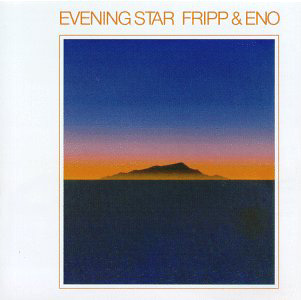
Fripp & Eno 2: Evening Star

Robert Fripp’s first order of business after disbanding King Crimson in 1975 was to reunite with Brian Eno for further experimenting. This time Eno had prepared a library of loops for Fripp to use as extemporaneous inspiration, and the duo used the setup for a series of concerts in Europe, one of which was bootlegged and eventually given an official release through Fripp’s online store (complete with anagrammed song titles and reproductions of the loops inspiring the onstage improvisations).

One of those performances, “Wind On Water”, opens Evening Star, an album of their latest studio experiments. The balance of side one is just as lovely, even pastoral; the title track is a gentle blend of harmonics, arpeggios and fluid solos, “Evensong” fades in and out just as it seems to develop a song-like structure, and “Wind On Wind” is a preview of what would be the title track of Eno’s Discreet Music. “An Index Of Metals”, which takes up all of side two, is a decidedly more sinister production, unsettling at full-length, yet still fascinating. (The current CD separates the track into six indexed points.)

Fripp and Eno would collaborate many times again, but it would be decades before another team-up on the level of (No Pussyfooting) and Evening Star. These two albums are essential for fans of either man, neatly fitting onto a Maxell for long drives, provided you don’t go into a trance while listening.

Fripp & Eno Evening Star (1975)—
Fripp & Eno
Live In Paris 28.05.75 (2011)—3
2014 CD reissue: same as 2011, plus 2 extra tracks

Saturday, October 31, 2009

Fripp & Eno 1: No Pussyfooting

In 1972, on breaks from their respective bands, Robert Fripp brought his guitar and pedals over to Brian Eno’s house to see what kind of music they could make. Eno showed Fripp his technique of looping live music in real-time via two tape recorders. Fripp played with himself, so to speak, on a piece eventually dubbed “The Heavenly Music Corporation”, and thus, Frippertronics was born.

A year later, they met up again at an actual studio with the same brief. This time Eno manipulated his VCS3 synthesizer for Fripp’s fretting benefit, and called the result “Swastika Girls”. The completed works, equal to two sides of an LP, were released as (No Pussyfooting).

While the genesis of this project may sound a lot like how John & Yoko’s Two Virgins came about, the difference is that both Fripp and Eno were much more adept at making something musical come out of tape experiments, and their project certainly would not have gone further than their own ears had it not possessed any musical value. Indeed, one of the most striking things about (No Pussyfooting) is how it manages to sound different with every listen.

As a tribute to its notorious BBC radio debut, where the album was played off reel-to-reel tape threaded backwards, the double-CD reissue includes bonuses of a sort. In addition to being separated into indexed sections for “easier access”, both pieces are presented in reverse, and “Heavenly Music” also appears a third time at half-speed. Only those familiar with the music would otherwise know which was which given a sampling.

Fripp & Eno (No Pussyfooting) (1973)—3
2008 CD reissue: same as 1973, plus 3 extra tracks