Showing posts with label simon and garfunkel. Show all posts

Friday, February 19, 2021

Simon & Garfunkel 9: Old Friends Live

Vintage concerts were one thing, but as long as Paul Simon and Art Garfunkel were still alive and performing separately, audiences wanted to see and hear them harmonize together. Just a few years into the century, they finally got their chance.

Old Friends: Live On Stage presents the bulk of the set from their reunion tour (extra songs were added to the DVD, which also offers the spectacle of Paul doing ill-advised rock star poses). Their voices are older, certainly, but they still have that blend. However, while the songs are recognizable, these are not carbon copies; many are transformed into the more modern sounds coming from the band, handpicked by Paul. And when they do replicate the record, as on “Hazy Shade Of Winter”, the singers have modified their parts. Though there is some overlap, it’s not a straight copy of the Central Park concert; this time out we get to hear such nuggets as “The Only Living Boy In New York”, a medley of “At The Zoo” and “Baby Driver”, “Leaves That Are Green”, and even “My Little Town”.

About halfway through the first act they chat a little bit about their youth and history together; Artie is as gracious as usual, and Paul takes the opportunity to take a few shots. They do a brief busk of “Hey Schoolgirl”, then bring out the actual Everly Brothers for a combined assault on “Bye Bye Love”. Artie sings “Kathy’s Song”, surprisingly, and trades verses with Paul on “American Tune”; “Slip Slidin’ Away” is the only other nod to either solo career. And while he cedes the second verse of “Bridge Over Troubled Water” to its author, Paul’s attempts at being soulful fall flat. Finally, on a new studio song called “Citizen Of The Planet”, included as a closing “bonus”, their voices sound younger, leading us to wonder if this is an outtake from Hearts And Bones.

Maybe you had to be there, but at least this particular reunion wasn’t embarrassing, considering that at this late date they’re unlikely to try it again. It’s nice to know that while they were getting along, we get to feel it.

Simon & Garfunkel Old Friends: Live On Stage (2004)—3

Tuesday, February 16, 2021

Simon & Garfunkel 8: Live 1967 & 1969

With a concise catalog and outtakes already mined, how else could Columbia capitalize on Simon & Garfunkel in the 21st century? The answer was so head-slappingly obvious it’s a wonder it took so long: live albums from the archives. Two sets were eventually released, both stepping far up sonically from the bootlegs that had circulated through the decades.

Live From New York City, 1967 expanded on the Lincoln Center peek-in from the Old Friends box, leaving “Red Rubber Ball” as an exclusive to that set. It’s just Artie and Paul onstage, with none of the anonymous session polish, and nearly every song gets something of an explanatory introduction, adding to the intimacy. Most of the set would be familiar to anyone who had the albums, plus “A Hazy Shade Of Winter” was the current hit single. The future B-side “You Don’t Know Where Your Interest Lies” is something of a surprise, as it hadn’t been finished yet, and “A Church Is Burning” would only be known to those who tracked down Paul’s elusive solo debut. (He switches between six-string and 12-string acoustic guitars depending on the tune, plus you can hear his affected British accent even on the straight intros.)

First released as a Starbucks exclusive, Live 1969 was compiled from a handful of concerts from the autumn of that year. Nicely sequenced, it begins with the boys playing by themselves, joined seven songs in by Wrecking Crew legends Fred Carter, Jr on guitar, Joe Osborn on bass, Larry Knechtel on keys, and Hal Blaine on drums. In addition to adding variety in the song selection, in this case the boys sound energized with a band behind them, and adapt well.

Several remarks are made throughout regarding the album they say they’re trying to finish, and four of those new songs are premiered here, including a stunning performance of “Bridge Over Troubled Water”. The crowd welcomes “The Boxer”, the newest song they knew, which here sports the extra verse familiar to us now from the 1982 reunion, replacing the instrumental break from the studio version. The album closes as it began, with only the duo onstage, including an efficiently arranged “Old Friends/Bookends”. (It has since been determined that the versions of “For Emily, Whenever I May Find Her” and “Kathy’s Song” are the same lovely ones that appeared on Greatest Hits, while “That Silver-Haired Daddy Of Mine” is not the same one as on Old Friends. The entire set was eventually included in the 40th anniversary edition of Bridge Over Troubled Water, which was of course the album in progress when the shows originally took place.)

Simon & Garfunkel Live From New York City, 1967 (2002)—
Simon & Garfunkel
Live 1969 (2009)—4

Tuesday, February 4, 2020

Simon & Garfunkel 7: Old Friends

As they only had five albums, it had been easy for people to amass the Simon & Garfunkel catalog for years, particularly when most of the albums were available at the budget “Nice Price” tier. That didn’t stop the label from putting them all in a box called Collected Works; this 1981 release came with no frills but the music, although the eventual CD version cut it down to three discs by doubling up the first two pairs while adding a booklet of lyrics.

By the mid-‘90s the archival box set had been well established, so they were due, and Old Friends managed to outdo Paul’s skimpy offering of a few years before. Besides having a perfect title, this three-disc set served up music from their first Columbia sessions all the way to their last shows in the ‘60s, ending fittingly with “My Little Town”. For the most part, the music is presented chronologically, generally by recording date, which sometimes better reflects when certain singles appeared months before they were included on albums.

A lovely demo of “Bleecker Street” begins the set, followed by seven songs from the first album. Eight songs from the second are well spaced, so the single version of “The Sound Of Silence” doesn’t come too soon after the LP version. “Homeward Bound” was from those sessions, and it precedes their great take on Jackson C. Frank’s “Blues Run The Game”. Eight songs from Parsley, Sage lead into “A Hazy Shade Of Winter” and “At The Zoo” in place as singles. Five selections from a 1967 Lincoln Center concert provide new perspectives on oft-heard tracks, plus a harmonized rendition of “A Church Is Burning” from Paul’s then-obscure solo album and even “Red Rubber Ball”, which had topped the charts the year before by the Cyrkle. The trawl through what would become Bookends continues with “Fakin’ It” and its rare B-side, “You Don’t Know Where Your Interest Lies”. For some reason they recorded a couple of Christmas carols around this time; both end the second disc. Three songs from a 1968 concert include an earlier live recording of “Bye Bye Love”, followed by the rest of Bridge Over Troubled Water in order of recording. The duo’s demo of “Feuilles-O” appears, but not the notorious “Cuba Si, Nixon No”. Two performances from Carnegie Hall, these from late in 1969, include a medley of “Hey Schoolgirl” and “Black Slacks”, followed by “That Silver Haired Daddy Of Mine”.

As with most boxes of this ilk, Old Friends delivers a lot, but leaves the listener wanting more, such as the handful of album tracks not included. A few years later, The Columbia Studio Recordings expanded on the original idea of Collected Works by bolstering each of the albums with bonus tracks, repeating some (but not all) from the Old Friends set. (The expanded albums were all made available individually as well.)

Simon & Garfunkel Old Friends (1997)—
Simon & Garfunkel
The Columbia Studio Recordings (1964-1970) (2001)—4

Tuesday, October 1, 2019

Paul Simon 13: 1964/1993

Lots of people’s careers were celebrated with box sets in the early ‘90s, and some of them were actually worth investing in—usually if there were rare or unreleased tracks on them. That’s what made Paul Simon’s place on the shelf so maddening. First of all, the title was off; the music runs the gamut from 1957 to 1991, so somebody wasn’t paying attention. Even limited to three discs, as befits a guy who’d recorded fewer than a dozen albums, much of 1964/1993 was stuff people had already, whether on the albums themselves or, more likely for the time, Negotiations And Love Songs.

The set begins with the version of “Leaves That Are Green” from his then-out-of-print solo album, moving through only a handful of tracks from the Simon & Garfunkel albums—possibly due to licensing—with the live take of “Kathy’s Song” for variety. A tentative demo of an unfinished “Bridge Over Troubled Water”, already sounding like he meant it for Art to sing, is included for petulant reasons. The classic rendition follows, as does a strange little spoken segment called “The Breakup”, wherein Art attempts to make a statement about their separation while Paul interrupts constantly from the control booth. This goes into the original “Hey, Schoolgirl” single from 1957, then “My Little Town” is the last we hear from Art before the chronology returns to the start of Paul’s actual solo career.

From there, it’s basically an expansion on Negotiations, with a lot of the same tunes, save a live version of “Still Crazy After All These Years” from 1991. The final disc has seven songs from Graceland, five from The Rhythm Of The Saints, and three from Concert In The Park. There is another bonus in the form of “Thelma”, an outtake from Rhythm Of The Saints that’s worth more than a cursory listen.

Certainly, the music contained on 1964/1993 is such a high quality, even if you had it already, that we can’t fault the content. It simply should have been something else entirely, and both he and his label would soon learn a harsh lesson on what consumers were willing to abide.

Paul Simon 1964/1993 (1993)—

Friday, March 22, 2013

Simon & Garfunkel 6: Greatest Hits and Concert In Central Park

1970 said farewell to not only the Beatles, but also Simon & Garfunkel. As with the Fab Four, fans of the odd couple from Queens continually hoped for a reunion. And a few times, their dreams came true.

Two years was an eternity in those days, so their one-off performance at a George McGovern benefit was a Big Deal. Columbia issued the Greatest Hits album around the same time. Along with a handful (but not all) of their hit singles, some undated live versions provide wonderful substitutions. (“Kathy’s Song” and “For Emily, Whenever I May Find Her” showcase each of the boys in a solo.) Besides photographic evidence that Paul Simon looks just as awful with a hat as without one, it’s also the only place to get “America” with a clean intro.

By this time, Simon had already started his solo career proper, and Garfunkel was soon to follow. Outside of the occasional joint gag appearance, the only other collaboration of the dynamic duo was 1975’s “My Little Town”, released as a joint single promoting each of their current, separate LPs. Meanwhile, both boys took stabs at movie stardom, sporadically releasing solo LPs throughout the decade. Art’s were as unadventurous as Paul’s were increasingly slick, and when the ‘80s arrived, not even Paul’s handful of hit singles kept him from seeming a has-been. (Even he was aware of this, as One-Trick Pony made plain.)

Still, it was with mostly joy rather than cynicism that greeted the news of another benefit concert, this one happening on the Great Lawn in Central Park, to be recorded for an album and broadcast on HBO. The Concert In Central Park presents the entire show as performed, with two exceptions: an encore repeat of “Late In The Evening”, and the ironically disrupted “The Late Great Johnny Ace”, a song about dead musicians performed nine months after John Lennon’s murder less than a mile away. In addition to their hits, backed by competent studio musicians, Art gamely harmonizes on some of Paul’s solo hits. The covers of the oldies “Wake Up Little Susie” and “Maybelline” add to the general feeling of nostalgia and fun.

The original 2-LP package, which even included a booklet with lyrics and photos, both vintage and of the event itself, wasn’t cheap, and fans were basically buying some of these songs for the third or fourth time. But it still captures a special moment in time, where the two old friends managed to harmonize, no matter what was going on between them backstage. Its specialness, if that’s a word, was underscored by the decision the following to do a reunion tour and record an album together, both of which were aborted due to infighting, and it would be some time before either man found his bearings again. In fact, once Paul had regained his commercial status, he returned to the park nearly ten years later to the day, with an even larger band, but no Art.

Simon and Garfunkel Simon And Garfunkel’s Greatest Hits (1972)—4
Simon and Garfunkel
The Concert In Central Park (1982)—4

Saturday, February 2, 2013

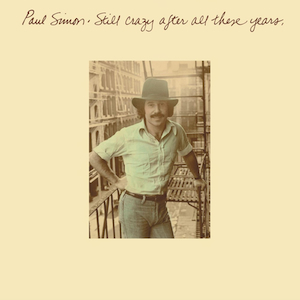
Paul Simon 5: Still Crazy After All These Years

A common theme in the mid-‘70s was the so-called divorce album, wherein confessional singer-songwriters lamented the passing of the relationship with whatever dew-eyed muse that had inspired their most beloved songs of romantic devotion. John Lennon spilled his troubles on Walls And Bridges, and Bob Dylan arguably set the standard with Blood On The Tracks, but Paul Simon’s way with cryptic words kept Still Crazy After All These Years from being merely dirty laundry. It even won Grammys. (He limited the expression of his inner turmoil to a cheesy mustache and a cheesier hat.)

The album is front-loaded with some of his best songs, beginning with the resigned title track, its cool electric piano and offbeat strings that perfectly frame the inevitable sax solo. One big draw is “My Little Town”, a reunion on tape with Art Garfunkel (also included on his own concurrently released album). Easily one of their spookier tracks, it nails the feeling of being trapped by one’s origins, heritage, family, society, etc.; in other words, everything that made Simon & Garfunkel spokesmen for their disaffected generation. “I Do It For Your Love” is an extremely melancholy reverie on the ended marriage, finding a metaphor in an odd place, but countered by the jive-rhyme in “50 Ways To Leave Your Lover”, something of a spin on “Love Potion #9”. After four solid tracks, “Night Game” is just plain odd, taking some common baseball expressions literally. It seems out of place here, being more in line with his proper solo debut.

For a big-time mood swing, “Gone At Last” is a gospel raveup sung as a duet with Phoebe Snow and the now-familiar Jessy Dixon Singers whooping it up in back. From there, “Some Folks’ Lives Roll Easy” seems to be way too slow, but manages to keep up with itself, and our warped ears hear influences on and of Van Morrison and Tom Waits of the same period. We don’t have much use for “Have A Good Time”, between the cutesy delivery, broken-legs meter shifts, and particularly the out-of-place sax solo appearing at the end like a busker around a corner in a subway tunnel. “You’re Kind” is much better, by being simple and offering up a twist ending that’s very real. A final mood swing arrives in “Silent Eyes”, a slow, poetic creation, not exactly a prayer, but still establishes a mood of night and sleep. (In an odd bit of foreshadowing, the piano here is played by Leon Pendarvis, whom most casual TV viewers would recognize as a longtime member of the Saturday Night Live band. Thanks in part to his friendship with producer Lorne Michaels, Paul Simon would go on to appear on the show in various capacities many times over the coming decades.)

Such a strong closing track makes Still Crazy After All These Years Paul Simon’s best work since splitting with Artie, and easily on par with the better Simon & Garfunkel albums. (Bonus tracks on the eventual reissue include a demo of a future hit single and a very alternate arrangement of “Gone At Last”.) It must have taken a lot out of him, since his output would be less prolific going forward.

Paul Simon Still Crazy After All These Years (1975)—
2004 CD reissue: same as 1975, plus 2 extra tracks

Sunday, September 30, 2012

Art Garfunkel: Angel Clare

One has to feel a little sorry for Art Garfunkel, having been the second banana in a successful duo, albeit one who arguably made them so palatable to a wide audience. But left on his own, without an in-house genius to craft songs for him to lay magic upon, what was he to do?

Well, first he made a couple of movies, and he even taught high school math. But the man was born to sing, sing, sing, and so he tapped Roy Halee and a sea of musicians to help craft his first solo album. Angel Clare is credited to his surname only, and gathers a truly odd assortment of traditionals and songs by contemporary writers, like Paul Williams, Jimmy Webb, Van Morrison and Randy Newman.

This is a pop album, despite the presence of Jerry Garcia, J.J. Cale, two of Derek’s Dominos, and even his erstwhile partner on one track. But his choices are downright bizarre—the murder ballad “Down In The Willow Garden”, the less obscure “Barbara Allen”, Van’s reggae outtake “I Shall Sing”, and “Feuilles-Oh”, a folk song that helped break up the duo, strapped to a Bach chorale given truly spacey lyrics. He does try to experiment with different sounds and instruments, on “Mary Was An Only Child” and “Woyaya”.

But we’re here for the voice, which always manages to find those twists that bring tears to your eyes. “Traveling Boy” is a typically creepy Paul Williams tune that tries to cover a kiss-off to last night’s groupie with fake tenderness—the flip side of Leon Russell’s “Superstar”, if you will—but good luck not swooning at the breakdown and buildup for the last minute. The smash hit “All I Know” is best known for its own hook, which disguises the malice in the relationship the rest of the song describes. Even in the slap at the “Old Man” is a pretty song with a highly mean sentiment. (He would admit that he chose songs for their melodies before reading the lyrics.) Nudged along by the arrangements, those little moments crop up to generate such an ache that it’s hard not to wallow in them.

Surprisingly, Angel Clare hasn’t gained a reputation as a fractured masterpiece, likely because Artie never battled an addiction to anything stronger than weed. There’s almost something diabolical about that angelic (sorry) voice coming out of that cherubic face delivering the words of disturbed people. The album title comes from a less-than-savory character in English literature, so maybe he’s more clever than we think. But move aside some of the weirder songs, and you can almost hear the coming of Barry Manilow. (They would have been a good match, but Barry didn’t need someone to sing his songs, and then where would Darius Rucker have learned his phrasing?) The liner notes would have us believe the whole thing was recorded in a church, but that doesn’t excuse the appearance of the boys’ choir on side two. Put the three tearjerkers on a constant loop and forget the rest, and cry until you can cry no more.

Garfunkel Angel Clare (1973)—

Friday, March 9, 2012

Simon & Garfunkel 5: Bridge Over Troubled Water

Another long delay was primed with some singles before Bridge Over Trouble Water finally emerged. Their elegant pop turned more sophisticated, with the addition of a rhythm section and what would soon be called “third world” influences. (It was also their first album to break the 30-minute barrier.)

It’s kind of a depressing album, since the boys weren’t getting along that well, which shows in the lyrics and on the dreary cover. But it’s chock full of hits, many of which would be learned at school, camp and church singalongs. The rest of the album is pretty good too.

The title track is one of the greatest vocal performances not only of the 20th century, but in the history of recorded music. One day Paul Simon will be able to accept that while he created it, it took Art Garfunkel to make it so incredible. Until then, he can sit on it, Potsie. The rest of us can enjoy the stately piano, Art’s clear delivery, and the hint of strings that creep in before the final verse, building with the cracking drums until the sweeping finish. It’s a credit to the sequencing that “El Condor Pasa” trills in on Peruvian instruments, a Latin touch that nicely sets up the hand-clappy singalong of “Cecelia”. “Keep The Customer Satisfied” hearkens back to their rockabilly roots, in a nice allegory for the touring musician. In comparison, “So Long, Frank Lloyd Wright” is about as pretentious as they can get, even if it is a veiled reference to their own dwindling partnership.

“The Boxer” had been a hit single a good nine months earlier, and a wonderful demonstration of the boys’ close harmonies. Enough scans of the lyrics puts paid to the concept that the song’s supposed to be an unflattering portrait of Bob Dylan; instead we can see the young Paul Simon lashing back against the unscrupulous record company executives who challenged his integrity, forcing him to put out five albums in six years. “Baby Driver” was its flipside, another jaunty throwback to an earlier decade, with inscrutable lyrics. Slightly more direct is “The Only Living Boy In New York”, where Paul admits to actually missing having Artie around. The song is aching and stirring, especially those soaring backing vocals over the end. It’s too bad that “Why Don’t You Write Me” deflates the emotion with a hokey doo-wop throwaway. Their true roots shine on a half-live performance of the Everlys’ “Bye Bye Love”, ending with the gentle benediction in “Song For The Asking”.

Even if they hadn’t planned it that way, nearly all of Bridge Over Trouble Water sounds like a goodbye note. The cover art plays up their differences, and not just in height and hair color. Yet the disparate parts all come together, and as if they knew it would be their final statement—which, to date, it has—they gave it their all. While some of their music may be stuck in the time in which it was created, it’s still an amazing listen. And nobody since sounds like them.

Simon and Garfunkel Bridge Over Troubled Water (1970)—4
2001 CD reissue: same as 1970, plus 2 extra tracks
2011 40th Anniversary Edition: same as 1970, plus Live 1969 album and DVD

Friday, February 24, 2012

Simon & Garfunkel 4: Bookends

After only three albums, the duo had somehow managed to circumvent the usual demands made on recording artists of the time. Rather than constantly pushing out product, they were able to take their sweet time between albums. A few well-spaced singles kept fans interested in the meantime. By the time Bookends came out, eighteen months since their last album, it was technically competing with their music on the soundtrack to The Graduate (which often gets included in official discographies, but outside of a few alternate takes, it’s not really a Simon & Garfunkel album but a Dave Grusin project).

Now that it was standard for artists of their stature, the lyrics (many of which didn’t seem to bother to rhyme) were printed in full on the back cover. Side one attempts to be something of a concept, portraying the modern journey from youth to old age, but it moves much to fast to really register. The lovely piece called “Bookends Theme” exists long enough to linger before “Save The Life Of My Child” blares in. The arrangement favors sound effects and atmosphere over musicality, but once you hear the snatch of “The Sound Of Silence” in the middle, good luck ignoring it. The piece is very evocative of a film or TV news report. Apparently the boy makes it off the ledge in time to get on a bus and travel across “America”, full of highway imagery and observation. But apparently “Kathy” wasn’t enough to keep his interest, so he lights a cigarette and considers dumping her in “Overs”. Art’s compilation of “Voices Of Old People” comes off as a long commercial break, until you realize that the words could just as well have come from people that age today as in 1967. The image of the elderly is more delicately if less harrowingly portrayed in “Old Friends”, which would become an unwitting theme song for the duo. After an overwrought string section the “Bookends Theme” returns, this time with a verse, and it’s lovely.

Maybe they knew they were taking too long, because side two ignores any concept outside of collecting the singles that had been released since the last album. “Fakin’ It” begins with a blast not unlike a bagpipe over heavy drums, traveling through some vague verses and an infectious chorus before a trip to a previous life and fading on the same drone. “Punky’s Dilemma” was previewed in their Monterey Pop set, with Paul Simon apparently so gonged on weed that he adopted an English accent. We still don’t know what the hell the song is about, nor why Barbra Streisand would eventually cover it. (Then again, it’s no worse than her version of “Life On Mars”.) “Mrs. Robinson” certainly helped sell the album, and once again we must remind people that while “I Am The Walrus” says “goo goo g’joob”, this song says “koo koo ka-choo”; there’s a difference, so please don’t confuse them. “A Hazy Shade Of Winter” sports a lively baroque arrangement and a killer riff, ending on a breathless pant. As a result, “At The Zoo” is anticlimactic.

Bookends will likely cause arguments over whether the whole is greater than the parts or vice versa. Certainly side one works as a suite, though “America” and “Overs” certainly shine on their own. The singles on side two all stood alone originally anyway. An interesting exercise might be to rearrange the album so the “ages of man” concept runs throughout, like this:
         Bookends Theme – At The Zoo – Punky’s Dilemma – Save The Life Of My Child – America –
         Mrs. Robinson – Overs – Fakin’ It – A Hazy Shade Of Winter – Voices Of Old People – Old
         Friends – Bookends Theme
It could work. Couldn’t it?

Simon & Garfunkel Bookends (1968)—
2001 CD reissue: same as 1968, plus 2 extra tracks

Monday, February 13, 2012

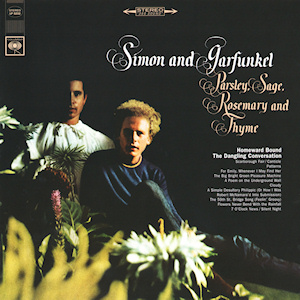
Simon & Garfunkel 3: Parsley, Sage, Rosemary & Thyme

Helped along by well-timed singles, Simon & Garfunkel reached a level of excellence on their third album. Parsley, Sage, Rosemary & Thyme exists in a private world of chamber pop, wherein traditional folk melodies mesh with suburban angst and wry commentary. If there’s anything negative to be said about it, it’s that it’s so short. But there’s a lot of quality crammed into those quickly played songs.

“Scarborough Fair/Canticle” is possibly the most famous version of this old English folk song, already borrowed heavily by Bob Dylan for “Girl From The North Country”. Here the haunting melody is juxtaposed against an original Simon anti-war lyric. “Patterns” interrupts with percussive guitar, insistent bongos and spooky organ, and the music finally lifts on “Cloudy”, despite its uncertain mood. “Homeward Bound” was already a hit single, recorded during the sessions for the second album, a vivid portrait of the lonely modern troubadour that doesn’t seem false in the least. Taking a step away from soul-searching, “The Big Bright Green Pleasure Machine” skewers commercialism (such as that which might even sell a few LPs). And “The 59th Street Bridge Song (Feelin’ Groovy)” was embraced by pot-smokers and pre-schoolers alike, possibly due to Simon’s second use, in a title even, of that archaic word.

“The Dangling Conversation” gets knocked for its pretentious tone, but that’s to be expected from the characters in the song. It’s still a lovely, sad song. The equally well-constructed “Flowers Never Bend With The Rainfall” wouldn’t sound out of place on a Monkees album, but it was actually recorded the previous year alongside “Homeward Bound”. A title like “A Simple Desultory Philippic (Or How I Was Robert McNamara’d Into Submission)” already sounds like a Dylan parody, which it is. Some of the pop-culture rhymes are very clever, and the impression is so pointed that Simon comes off of as just a little envious of his labelmate. It’s only fitting that this piece is followed by “For Emily, Whenever I May Find Her”, an excellent candidate for Art Garfunkel’s greatest performance and an ode to the ultimate imaginary woman. The guitar strums faster and faster to an unresolved end, only to give way to a portrait of a graffitist in “A Poem On The Underground Wall”. And lest anyone get too comfortable, “7 O’Clock News/Silent Night” pits a typically harrowing modern news broadcast against a pastoral reading of the Christmas carol.

Its generally down atmosphere notwithstanding, Parsley, Sage, Rosemary & Thyme is an enticing album, a work of art. Despite the rock combo heard on the songs that require one, the overall sound comes from the voices and acoustic guitar, with the barest embellishments, putting Simon & Garfunkel on a tier all by themselves. They knew they had something special, and the album’s importance in the biz was underscored by Ralph Gleason’s small-print liner notes, which may help illuminate some of the references.

Simon and Garfunkel Parsley, Sage, Rosemary & Thyme (1966)—4
2001 CD reissue: same as 1966, plus 2 extra tracks

Wednesday, February 1, 2012

Simon & Garfunkel 2: Sounds Of Silence

Since Dylan had successfully made the leap from acoustic to electric, producer Tom Wilson experimented with a song from the first Simon & Garfunkel album that was getting some airplay. By adding electric guitar, bass and drums to the song in question, all of a sudden the duo had a number-one hit with “The Sound Of Silence”. Which meant it was time to make another album.

Luckily for the new folk-rockers, Simon had been busy busking around London and writing new material (as displayed on his UK-only solo album released that fall, and subsequently mined back in America). So Sounds Of Silence came together in time for the new year, with the hit single version of “The Sound Of Silence” and its B-side, the dated “We’ve Got A Groovey Thing Goin’”, and “Somewhere They Can’t Find Me”, itself a rewrite of the title track of the first album, recorded earlier in the year and initially shelved. There is some further repetition within those; the “Anji” theme is previewed on “Somewhere They Can’t Find Me”, and adds the riff from “Groovey Thing” towards the end. Additionally, Simon seems to have a fixation on suicide: “Richard Cory” (based on a 19th-century poem) shoots himself, while “A Most Peculiar Man” succumbs to self-inflicted natural gas poisoning.

Nitpicking aside, Paul Simon was turning into an excellent songwriter. “Kathy’s Song” is a hypnotic love letter, while “Leaves That Are Green” and “April Come She Will” are stellar in their simplicity. “Blessed” is a little too dissonant for our tastes, but “I Am A Rock”, another hit single, is a catchy and telling in its defiance.

Sounds Of Silence rises past the certain curse of the quick cash-in. Not every tune is a gem, but the homework Paul had done busking in London pays off with excellent songwriting that strays from folk into the type of social commentary that would be his hallmark. (His only contemporary at the time was Ray Davies, whose tongue was much further into his own cheek. Where Simon saw despair and desolation, Davies suggested that a retreat to the old days would solve everything.) It’s also easy to see that the pair, now forced by commerce to work together, had already started to follow their own paths. Some songs are sung by one or the other, and many times Artie’s harmony seems like an afterthought. Because of the rushed nature of the album, the expanded CD from 2001 adds exactly one outtake from the main album sessions (a lovely reading of “Blues Run The Game”), padding the rest with three traditional songs recorded at their very last recording session in 1970.

Simon & Garfunkel Sounds Of Silence (1966)—3
2001 CD reissue: same as 1966, plus 4 extra tracks

Saturday, January 28, 2012

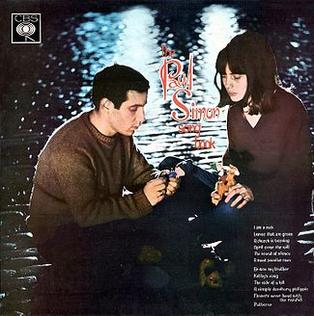
Paul Simon 1: The Paul Simon Songbook

This album was always a curio, recorded completely solo in London between the first two Simon & Garfunkel albums, released only in England, and unavailable for the better part of thirty years on the directive of the artiste. He eventually got over it, and now we can wonder what the problem was. After all, hasn’t Paul Simon spent most of his career downplaying his partner’s superior voice and its importance to his songs?

Besides providing alternate versions of what would become several established Simon & Garfunkel favorites, The Paul Simon Songbook presents what was likely his repertoire whilst pounding the cobblestoned streets of London. Two songs had already appeared on the duo’s debut, five would be re-recorded for their second album, and four others would appear in some form on their third. For the pop music student, these are fascinating unplugged demos, and even works in progress.

The actual performances aside, it’s the truly rare material that makes this album so enticing. “A Church Is Burning” is an original protest song, and a good one, not to be confused with “The Sun Is Burning” on the S&G debut. They would perform it in occasional concerts, but for many years this was the only recording ever. “The Side Of A Hill” is mostly unknown, except that several lines would be reworked and used as a counterpoint to the main melody of “Scarborough Fair”. Similarly, “A Simple Desultory Philippic” here substitutes Lyndon Johnson for Robert McNamara in the spoken intro, and sports a markedly different accompaniment, mostly based on “Wake Up Little Susie” with a little “It’s Alright Ma” thrown in. The bridge still apes Dylan, but most of the people throughout the song would be replaced by other, dare we say better, and certainly more recognizable references.

It’s tempting to give The Paul Simon Songbook a higher rating, but only for the novelty of it. Each of the songs are arguably better in their more familiar, arranged incarnations; now that it’s universally available, even in the US of A, complete with two alternate takes, listeners can judge for themselves.

Paul Simon The Paul Simon Songbook (1965)—
2004 CD reissue: same as 1965, plus 2 extra tracks

Monday, January 23, 2012

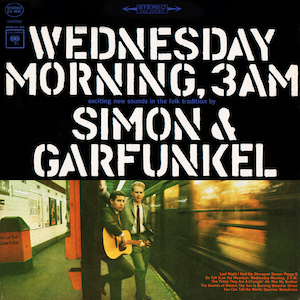
Simon & Garfunkel 1: Wednesday Morning, 3 A.M.

But for an odd whim by a hip producer, people may never have heard of Simon & Garfunkel, nor might the artists have recorded anything past this first album. They had had a few prior hits, in the late-‘50s as Tom and Jerry, even getting to appear on American Bandstand. A few years at college kept them busy when stardom failed to happen, and then when the folk music boom hit, the boys were right on top of it.

Armed with an acoustic guitar and sweet harmonies, the Mutt and Jeff of Forest Hills recorded their debut LP over a few weeks in March of 1964, in defiance of the British Invasion threatening the business. Of the twelve songs on Wednesday Morning, 3 A.M., five come from the pen of Paul Simon. “Bleecker Street” paints a portrait of that iconic avenue. “Sparrow” is an allegory of some sort, but “He Was My Brother” is more direct, a timely elegy for a Freedom Rider. The title track is the striking departure of the set, a monologue from a cheap apartment, made all the more pretentious by the reference to “pieces of silver”. But it would be “The Sound Of Silence” that would endure, an incredibly poetic piece of work striking for its imagery, Garfunkel’s sweet voice, and Simon’s monotonic bleat.

The rest of the album is a mixed bag that mostly comes across as folk-lite, and it’s no wonder that the album didn’t sell. Perhaps there weren’t a lot of songs for affluent Jewish kids to make commercial, which would explain why such spirituals as “You Can Tell The World” and “Go Tell It On The Mountain” appear, along with an arrangement from a Catholic mass. More direct, if naïve, are “The Sun Is Burning” and “Last Night I Had The Strangest Dream”, the latter sporting an ill-advised banjo. And in tribute to the kid from Minnesota, the boys harmonize on “The Times They Are A-Changin’” and even take a stab at “Peggy-O”, which Dylan had included on his first album.

So Wednesday Morning, 3 A.M. is a very earnest collection of music that wasn’t about to change the world, but taken in context with what they would eventually achieve, it’s a nice snapshot. It’s certainly pleasant, and in places pretty. Given the dozens of similar records coming out at the time, we’ll leave it to the experts to rule whether these actually were “exciting new sounds in the folk tradition”.

Simon & Garfunkel Wednesday Morning, 3 A.M. (1964)—3
2001 CD reissue: same as 1964, plus 3 extra tracks