Showing posts with label xmas. Show all posts

Friday, December 6, 2024

Ben Folds 16: Sleigher

For the longest time, Ben Folds had exactly two Christmas songs in his catalog: “Lonely Christmas Eve” from the live-action film version of How The Grinch Stole Christmas, and the profane “Bizarre Christmas Incident”, written for said film when all he knew about the project was that it was to be a comedy about Christmas directed by Ron Howard and starring Jim Carrey. (We don’t count “Brick” for the same reason that Die Hard is not a Christmas movie.) Still, we always suspected that the king of piano snark would be sentimental around the holidays, and he finally got to explore it with an album cleverly titled Sleigher, which mixes originals with three covers.

We still can’t find the melody of “Little Drummer Bolero”—it doesn’t sound like the “pa rum-pum pum pum” song—but it’s a lovely instrumental. “Sleepwalking Through Christmas” has just a twinge of melancholy, but it’s not as lonesome nor as touching as “Me And Maurice” (the pair is even depicted in the cover cartoon, complete with “full green bag of shame”). “Christmas Time Rhyme” does a nice job of stringing together images from the perspective of kids of all ages, with just one eff-bomb. Another instrumental, “Waiting For Snow” is brief but still pretty.

“We Could Have This” finally inserts some romance and the promise of a happy future, sung as a duet with the mildly chirpy Lindsey Kraft. The most obvious and least daring tune is “The Christmas Song”, as his rendition of chestnuts roasting is accompanied by guitar, piano, and harmonica. He heard Burt Bacharach’s “The Bell That Couldn’t Jingle” (with lyrics by the same guy who wrote the lyrics for “Speak Softly Love” from The Godfather and other movie themes) from a Herb Alpert album, and it’s very evocative of that style, but “Xmas Aye Eye” (as in AI) is a complete shift, grating electro-pop with lyrics provided by ChatGPT and peppered with sound effects. Finally, “You Don’t Have To Be A Santa Claus” is all Mills Brothers, and good advice any day.

At just under 35 minutes, Sleigher certainly doesn’t wear out its welcome, even if the harmonica does. But given the beauty of the instrumentals, we would certainly welcome more tracks like that. Maybe next year.

Ben Folds Sleigher (2024)—3

Friday, December 23, 2022

Nick Lowe: Quality Street

While unfairly pegged a one-hit wonder thanks to “Cruel To Be Kind”, Nick Lowe is actually a rock ‘n roll legend. Having led the pub rock circuit in the ‘70s, he became a solid bass player and producer on call, having shepherded such luminaries as Chrissie Hynde and Elvis Costello through their first recording sessions. He’s still out there, playing gigs and rocking the best head of silver hair next to that of Robyn Hitchcock.

Even though he’s managed to “do his own thing” into this century—and granted, steady royalties from a cover of “(What’s So Funny ‘Bout) Peace, Love And Understanding” on the bajillion-selling soundtrack to The Bodyguard helped—his record label still wants his records to be lucrative. They apparently were the ones who suggested he do a Christmas album, and he was polite enough to give it a shot.

Quality Street: A Seasonal Selection For All The Family is just as likeable as its performer is reputed to be. Rockabilly-style versions of the spirituals “Children Go Where I Send Thee” and “Rise Up Shepherds” have an edge on the Tex-Mex arrangement of “Silent Night”. Some relatively obscure covers get welcome airings, including Eddy Arnold’s “Christmas Can’t Be Far Away”, Roger Miller’s “Old Toy Trains”, and a lovely take on Roy Wood’s “I Wish It Could Be Christmas Everyday”. “The North Pole Express” comes from a kids’ record his drummer found, while “Just To Be With You (This Christmas)” puts a lounge twist on a song by modern blues band The Mighty Blue Kings.

His own songs are the real winners: “Christmas At The Airport” puts a positive spin on holiday traveling hell, while “I Was Born In Bethlehem” is a lovely perspective on the origin story. Lyrical help from Ron Sexsmith and Ry Cooder on “Hooves On The Roof” and “A Dollar Short Of Happy” respectively isn’t as successful, but they still fit. Altogether, with his band including longtime contributors Geraint Watkins and Bobby Irwin providing able support throughout, Quality Street fulfills the thesis in its subtitle. (For more fun, The Quality Holiday Revue Live offers highlights from the following year’s support tour with Los Straitjackets as the backing band; who also provide their surf cover of Vince Guaraldi’s “Linus And Lucy”.)

Nick Lowe Quality Street: A Seasonal Selection For All The Family (2013)—3

Tuesday, December 20, 2022

Steve Perry 5: The Season

With nearly lightning speed, Steve Perry put out more new music only a year after his comeback with Traces. Granted, it was a Christmas single—an ill-advised cover of “Silver Bells”, plus an edit of same and a version of “Have Yourself A Merry Little Christmas” with melodic liberties—but it did qualify as new.

As it turned out, these were merely appetizers for The Season, an eight-song collection of well-worn holiday standards, accompanied by the guy who produced Traces plus subdued drumming by Vinnie Colaiuta. When they’re sung straight, he just sounds old and tired, but those are more palatable than the tag he adds to “I’ll Be Home For Christmas” and the overly smooth touches on “Winter Wonderland” and “Santa Claus Is Coming To Town”. We do have to give him points for restoring the intro verse to “What Are You Doing New Year’s Eve?” but we also wonder whether the younger man would have belted these better, or just as cringingly.

A year later, following his recent trend, the album was reissued in a deluxe digital edition that began with two new original songs. “Maybe This Year” was a new original with some originality, for lack of a better word, while “This Christmas” revived an obscure Donny Hathaway track. While an improvement over the original program, the overall melancholy isn’t likely to make your spirits bright.

“Maybe This Year” proved to be a prophetic title as two years after that a third incarnation of the album happened, this time in physical format on the revived Dark Horse label, of all places. The Season 3 offered a rejigged order and six new tracks scattered among everything that had gone before. The album now opens with the Louis Armstrong perennial “What A Wonderful World” (as opposed to the Sam Cooke song we figured he’d be all over, but that’s not exactly Xmassy). “Jingle Bell Rock” is taken at about half the speed of the original, with an attempt at slow funk, an approach that’s a little more effective on “Rudolph The Red-Nosed Reindeer” but even creepier with “Let It Snow”. The big surprise is a virtual duet on “Call Me Irresponsible” with his deceased father; it’s very sweet, if not exactly Grammy material. The closing recitation of “‘Twas The Night Before Christmas” is delivered with no accompaniment, wisely, but it caps what is still an extremely gloomy album.

Steve Perry The Season (2021)—2
2024 The Season 3: same as 2021, plus 8 extra tracks

Friday, December 16, 2022

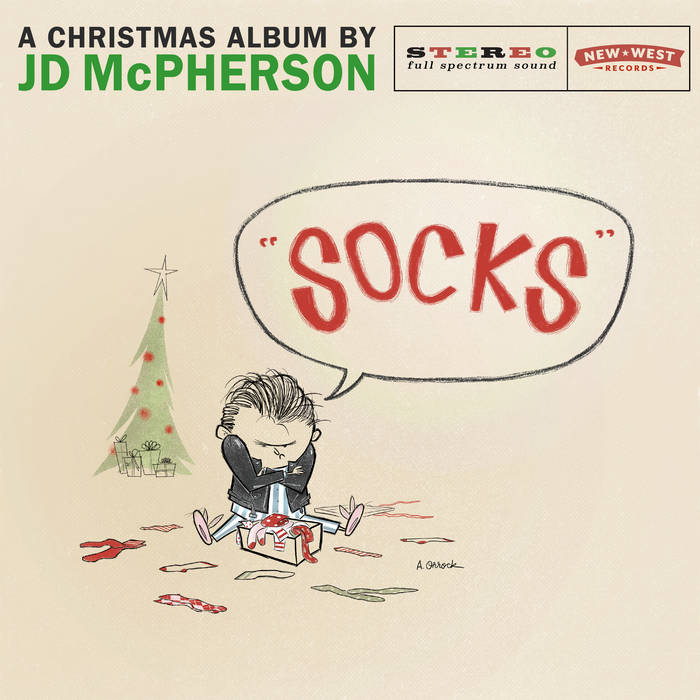
JD McPherson: Socks

Once the holiday season arrives, one’s tolerance of the frequency and preponderance of Christmas music is often related to how many times we have to hear the same songs over and over and over again. For every old favorite there seem to be fewer and fewer modern classics. Somebody had to write those songs in the first place, after all.

JD McPherson is a young-ish rockabilly player from the Tulsa area who took up this challenge and ran with it. Socks has the vibe of classic R&B, all self-penned originals, recorded with “no schmaltz”, though there is an occasional celeste to color the tracks. Beyond that, there are twangy guitars, honking saxes, piano triplets, and cheesy organs.

“All The Gifts I Need” sets the thesis, and the rest of the album follows it. “Bad Kid” and “Santa’s Got A Mean Machine” made us double-check that these weren’t actual oldies. “Hey Skinny Santa!” takes a clever culinary tour through various cities, and “Holly, Carol, Candy & Joy” is definitely one of those songs that should have been written already. The title track more than lives up to the promise of the cover art, reinforced by “Ugly Sweater Blues”, while “Claus Vs. Claus”, a duet with the sultry Lucie Silvas, provides a fresh angle on holiday stress at the North Pole, but we assure you there is a happy ending.

Socks is a short album, barely over half an hour, but there’s no filler. We wonder why more people don’t write songs like these, and when someone will get around to covering them.

JD McPherson Socks (2018)—

Friday, December 24, 2021

Ben Keith: Seven Gates

Most people know him in the context of most of Neil Young’s albums without Crazy Horse, but Ben Keith was already an established Nashville studio musician before he worked on Harvest. The year before that he played on Ringo Starr’s Beaucoups Of Blues, and ten years before that he provided the pedal steel for Patsy Cline’s “I Fall To Pieces”.

About a year before he produced Jewel’s first album, Ben Keith completed a Christmas album. Partially recorded at Neil’s Broken Arrow Ranch studio, with some sessions in Nashville and elsewhere, Seven Gates has more of an authentic country feel than most showbiz holiday albums, which is probably why it was resoundingly ignored upon release. Music fans would have snapped it up, as it features Neil on several tracks either singing or playing his pump organ, while Mickey Raphael (best known for playing harmonica alongside Willie Nelson) is all over the place. Wanna hear Johnny Cash duet with Neil on “The Little Drummer Boy”? Here it is. Pat McLaughlin and Rusty Kershaw warble through “Christmas Time’s A Comin’”. But don’t be fooled by “We Will Rock You”—it’s actually “The Rocking Carol”, 50 years before Brian May used the words for something else. Here it’s sung by Nashville’s Pamela Brown and Neil’s wife Pegi.

The album is at its best when it’s simplest on the instrumentals, such as “Ave Maria”, “Silver Bells”, “Away In A Manger”, and “Blue Christmas”. It’s occasionally overproduced with dated synth strings, but all in all, it evokes snowy hills and pine trees for a serene listen. Thankfully, the children’s choir doesn’t show up until track 8, and we don’t know why so many people arrange “Greensleeves” aka “What Child Is This” to sound apocalyptic, though Neil appears at the end singing alongside his sister Astrid and Nicolette Larson.

Some 13 years later the album was reissued, again quietly, under the title Christmas At The Ranch with a different cover. But it also sports a modified version of “Les Trois Cloches”, now with vocals by Neil and Pegi.

Ben Keith & Friends Seven Gates (1994)—3

Tuesday, December 24, 2019

Jorma Kaukonen 2: Christmas

The holidays are all about giving, and one of our faithful readers and staunch supporters hipped us to an album we’d overlooked. Simply titled Christmas, it’s a simple collection of originals and standards from the fingers of Jorma Kaukonen, with help from collaborator Michael Falzarano.

Much like Hot Tuna seesawed between acoustic folk and electric blues, the album isn’t strictly one style or the other, but through the magic of digital, whether on a disc or streaming, one can change the sequence. Some of the instrumentals only count as holiday songs due to sleigh bells as percussion, but they work because the artists say they do. “Christmas Blues” and “You’re Still Standing” rely on distorted guitar to distract from the basic lyrics, but “The Christmas Rule” is a hilarious cautionary tale about why you shouldn’t use your fireplace on Christmas Eve. A very reverent reading of “Silent Night” is followed by “Holiday Marmalade”, which turns it into an extended 11-minute blues. “Baby Boy” is a traditional tune we suspect may have originated in the Caribbean, and a nice surprise. Just like the album itself.

Jorma Kaukonen Christmas (1996)—3

Friday, December 20, 2019

Monkees 10: Christmas Party

Given the critical success of the first new Monkees album in 20 years, it should surprise no one that a follow-up would shortly be in the works, considering the advanced years of the vocalists. Extra points if you guessed it would be a Christmas album. Sure enough, Christmas Party attempts to recreate the recipe of Good Times!, using the same producer, some of the same songwriters, and plenty of modern technology to bring Davy Jones back from the grave.

If you’re good at math, you’ll also notice that eight of the thirteen songs are sung by Micky Dolenz, with no other Monkee involvement. His tunes include new holiday songs from the fingers of Andy Partridge, Rivers Cuomo, novelist Michael Chabon, and Peter Buck and Scott McCaughey from R.E.M. and the Minus Five. After he gets those out of the way, he tackles more modern rock ‘n roll standards, including “Jesus Christ” by Big Star, “I Wish It Could Be Christmas Every Day” by Wizzard, and most daringly of all, “Wonderful Christmastime” by Paul McCartney. Finally, his cover of “Merry Christmas Baby” proves he ain’t no blues man.

Since a Micky Dolenz Christmas album wouldn’t be as lucrative for anybody, Michael Nesmith contributed two covers recorded on his own: Mel Tormé’s unstoppable chestnut “The Christmas Song” and the more obscure but quite lovely “Snowfall”. An unrecognizable Peter Tork added a vocal-and-banjo rendition of “Angels We Have Heard On High”, while Davy’s vocals on “Mele Kalikimaka” and “Silver Bells” come from 1991. As ever, he knew how to work a room, a professional to the end. (Smart consumers and Monkeemaniacs would have rushed to their nearest Target store to get two exclusive bonus tracks: “Ríu Chíu”, sourced from the TV show’s 1967 Christmas episode, and “Christmas Is My Time Of Year”, originally recorded by Micky, Davy, and Peter in 1976 for the still-active fan club.)

There aren’t a lot of rock ‘n roll Christmas albums, and we’ve already covered the better ones. One’s enjoyment of Christmas Party depends on how much one can stomach an aging yet unflappably enthusiastic Micky Dolenz. Frankly, the ones he doesn’t sing are more successful, and the album is paced mostly well. We wanted to hate it, and we don’t. And it is just once a year.

The Monkees Christmas Party (2018)—3

Tuesday, December 25, 2018

Booker T. & The MG’s: In The Christmas Spirit

Given that everybody allowed near a microphone in the 21st century has recorded a Christmas album, sometimes you just want to get away from yet another version of a song that’s been sung many times in many ways. That’s why we usually reach for the nearest holiday CD that’s instrumental. But even those can sound alike after a while, particularly if they’re in the same old easy listening, jazz, or classical mode. At the same time, rock ‘n roll takes on the catalog tend to lose their novelty after a while, even if only played a couple of weeks out of the year.

That’s what makes In The Christmas Spirit by Booker T. & The MG’s such a welcome respite season after season. A combo best known for the classic “Green Onions” and sharing the guitarist and bass player with the Blues Brothers, here the band serves up a dozen favorites in the same Memphis R&B groove that established them as the Stax Records house band. Hammond B-3 organ takes center stage for most of it, with tasteful Telecaster and percolating bass over perfectly syncopated drums.

Having originally been issued as two sides of a record, the first half is more upbeat, with the usual suspects (“Jingle Bells”, “Winter Wonderland”, “Silver Bells”, etc.) while the second takes a slower pace, starting with a bluesy “Merry Christmas Baby”, staying quiet for “Silent Night”, “We Three Kings” and the like, which sound for all the world like church if not for the ticking snare drum. Just to remind you who they are, the set picks up at the very end with “We Wish You A Merry Christmas”.

Like most albums of the time, In The Christmas Spirit is short, but likely to get repeat plays once it’s loaded up. We haven’t figured out why the album had two different covers a year apart over here; adding to the confusion, it was called Soul Christmas—not to be confused with an entirely different compilation—with another alternative for the artwork overseas. As for the extraneous apostrophe in the band’s name, we’ll leave the blame with the record company.

Booker T. & The MG’s In The Christmas Spirit (1966)—4

Friday, December 22, 2017

Smithereens 8: Christmas With The Smithereens

Only a handful of rock (as opposed to pop) bands have attempted to devote an entire album to Christmas music, so it makes sense that one of the few to try, much less succeed, would be a combo with an overt retro sound. One of the more clever novelty projects of the Smithereens’ continued career, Christmas With The Smithereens finds the band bashing their way through a variety of Yuletide-related rock ‘n roll songs.

Their choices avoid the obvious ones, and their arrangements are fresh, for the most part. “Santa Bring My Baby Back To Me” is best known as a swaggering Elvis tune, yet these guys put a distinct Merseybeat bent on it, complete with harmonica. “Rockin’ Around The Christmas Tree” and “Run Rudolph Run” aren’t carbon copies either. Rather than retread “Little Saint Nick”, resident Beach Boys nut Dennis Diken sings lead on Brian Wilson’s “Merry Christmas Baby”, and the Ramones’ “Merry Christmas (I Don’t Want To Fight Tonight)” is reinforced as a modern classic. The three originals work too, working in references to It’s A Wonderful Life being on TV, and finding albums like Shut Down Vol. 2 and Rubber Soul under the tree.

There is some filler, like the recitation of A Visit From St. Nicholas over a swing drum solo, and a four-minute expansion on the single verse of Beatles’ “Christmas Time Is Here Again!”. Even “Christmas” by the Who is an odd choice, except for foreshadowing their Tommy tribute two years down the road. But again, considering the empty field of competitors, Christmas With The Smithereens is enjoyable both as a holiday album, as well as part of their catalog.

The Smithereens Christmas With The Smithereens (2007)—

Tuesday, December 23, 2014

Elvis Presley: Christmas Album

While a glance at the budget cassette rack this time of year could make it seem like the King of Rock ‘N Roll recorded ten different Christmas albums, that was a misleading implication thanks to RCA’s incessant repackaging of their biggest star. There were ever only two albums, recorded 14 years apart, give or take a single here and there. Even after the catalog was streamlined in the ‘90s, the same music has appeared again and again, sometimes with hideous results.

Of those two albums, the first is the best, recorded the year before Elvis went into the Army, never to return. But even that was a repackage of sorts, with eight new holiday tracks supported by the four songs from that year’s Peace In The Valley EP of gospel music. While not strictly Christmas music, they present a side of Elvis Presley that was perhaps his truest. Indeed, his gospel recordings rank among his finest performances. “(There’ll Be) Peace In The Valley (For Me)” is a wonderful group vocal, and once you get past the mawkishness of “I Believe”, “Take My Hand, Precious Lord” and “It Is No Secret (What God Can Do)” provide pure serenity.

But it’s still the rocking half that people remember, and for good reason. Besides having Scotty Moore, Bill Black and D.J. Fontana holding up the beat in back, this was the debut of Leiber & Stoller’s “Santa Claus Is Back In Town” and the snappy “Santa Bring My Baby Back To Me”, both unmistakably Elvis. In between there’s “White Christmas” a la the Drifters, a swaggering “Here Comes Santa Claus”, “I’ll Be Home For Christmas” and his wacky update of “Blue Christmas”, with that yodeling backing making it more “blue” than sad. The much calmer “O Little Town Of Bethlehem” and “Silent Night” begin side two, for a better transition to the gospel tracks.

Elvis was more of a singles artist than an album artist, but the care put into this original sequence underscore what was lost anytime the contents were shuffled, reshuffled, augmented, and diminished time and time again. The least intrusive ones usually pair it with 1971’s Elvis Sings The Wonderful World Of Christmas. Coming from the Vegas jumpsuit years, it’s not completely awful, but over the top and insincere, about as preferable to the ‘50s Elvis as latter-day Bing Crosby is to “White Christmas”. Left in its intended state, Elvis’ Christmas Album demonstrates what made him so special, especially to those of us who weren’t around before he became a caricature.

Elvis Presley Elvis’ Christmas Album (1957)—4

Tuesday, December 16, 2014

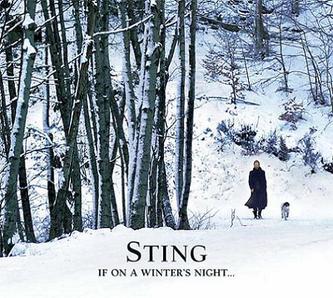
Sting 11: If On A Winter’s Night

Way back in 1985, as the singles from The Dream Of The Blue Turtles piled up, Sting recorded an arrangement of the relatively obscure carol “Gabriel’s Message” as a B-side. It gained more exposure a couple of years later as part of the first Very Special Christmas charity album, and with its sparse presentation, even with layered vocals, it has remained a welcome holiday favorite.

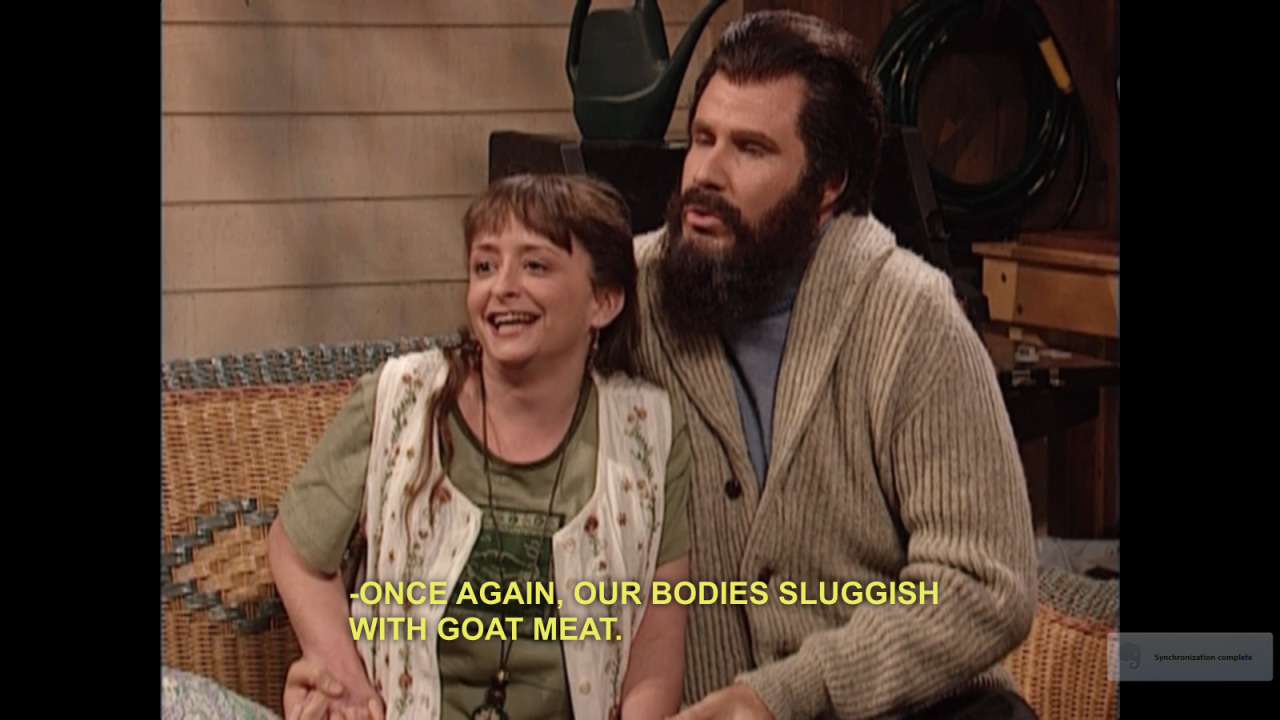
The same song opens If On A Winter’s Night…, but it’s a brand new performance that sets the tone for the rest of this not-exactly-Yuletide-themed album. He uses the same breathy, sonorous tone that made his lute album such a tough listen; in the days of vinyl, you’d check the player to make sure it was at the correct speed. The photos of him with his masculine, full beard as he stands in a bulky sweater—reminding one of that professor character Will Ferrell used to play on SNL, talking about his “lover” and gorging himself on goat meat—contemplating either the snow outside or the guitar in his hand, give the game away.

These songs just seem so overdone, even with such humble instrumentation. Even when he does something relatively straight, like the old chestnut “Lo, How A Rose E’er Blooming”, he sinks it with a four-line monologue in the middle that would embarrass Barry White. His wordless vocal interlude on “The Snow It Melts The Soonest” is therefore welcome, as it doesn’t sound like he’s doing a character, or auditioning for a movie role, as demonstrated by his lugubrious reading of “Now Winter Comes Slowly”. “The Burning Babe” comes closest to the Sting of old, with jazzy drums, soprano sax and a decent vocal.

The gushing liner notes, describing how and why the album was recorded, don’t really give much insight as to why he chose what he chose other than they sounded like winter songs. He re-does “The Hounds Of Winter” from his last good album, for no other reason as that one word in the title, or maybe to ensure some publishing royalties. As most of these are traditional songs, he could use the coin. Speaking of which, “Soul Cake” is the wassail song as established by Peter, Paul & Mary; “The Hurdy-Gurdy Man” is not the Donovan song, as that would have been a stretch.

All the way through If On A Winter’s Night… is the nagging thought, “This would be so much nicer if he wasn’t on it.” If you’re looking for yuletide music with an English folk lilt, this isn’t it. As a Christmas album it falls short, and as a Sting album it’s just too precious. Better it be considered a winter album; musically, of course, it’s lovely, and that’s what makes it so frustrating. Subtle hurdy-gurdy, Northumbrian pipes, delicately plucked guitars and other gentle touches often show the potential so often stomped over like so much snow from boots out in the hall. It’s therefore best enjoyed in the background when you’ve finished shoveling out your driveway, since it won’t inspire you beforehand.

Sting If On A Winter’s Night… (2009)—

Tuesday, December 25, 2012

Holiday Special #4: Festival Of Carols In Brass

A holiday tradition in the New York Metropolitan area for many years was The Yule Log. Every night on Christmas Eve (and again on Christmas morning) channel 11 would show a looped film of a fireplace with brass fixtures, while a seamless program of what used to be called “beautiful music” played in accompaniment. (The music was simulcast in FM stereo on the station’s radio affiliate—pretty high-tech sh-t in those days.) Even though our house had a working fireplace throughout my youth, stoked to perfection by my dad, we still had the TV tuned in to The Yule Log, with the music blaring from every radio available. A Google search reports that the artists supplied were usually along the lines of the Boston Pops and Percy Faith; we recall a few select vocal pieces, like “The Little Drummer Boy”.

As with many mainstays of one’s childhood, we don’t truly appreciate certain things until they’ve gone missing, and there was an outcry when certain local TV affiliates removed it from their programming. By the ‘90s, enough homes had VCRs anyway, and could easily buy a cheap tape of a fireplace for kitsch purposes, the show having been originally designed for Manhattan apartment dwellers without hearths of their own. But the original was still the best, and after a decade of mismanagement at the station—during which even Beavis and Butt-Head referred to it on one of their holiday episodes—The Yule Log officially returned to the airwaves where it’s remained, albeit only on Christmas morning.

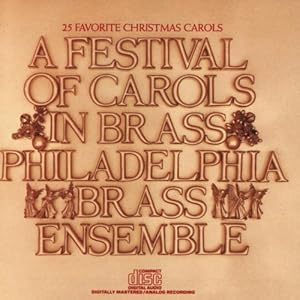
That dark period when it was nowhere to be found didn’t have the convenience of the Internet and digital technology, much less YouTube, so us sentimental types had to rely on our own mind movies to experience The Yule Log and become a kid again. The Mantovani qualities of those old records didn’t always hold up, but one vintage album always managed to set the mood. A Festival Of Carols In Brass by the Philadelphia Brass Ensemble is a perfect soundtrack for a roaring fire above which stockings are hung with care. The epitome of simplicity, it stayed in print through the digital era on a “Nice Price” CD with basic artwork and no credits outside the 25 tracks. The selections are crisp and not at all overbearing, and like any good instrumental collection, just as satisfying to have in the background as for close listening. It always seems to end too quickly, but that’s why CD players have a repeat function.

The Philadelphia Brass Ensemble A Festival Of Carols In Brass (1967)—5

Monday, December 24, 2012

George Winston: December

New Age music gets a bad rap, and often for good reason. One of our correspondents used to refer to it as “wine coolers for your ears”, back in the early ‘90s when it was at its arguable commercial peak. Some of it, as displayed by the Narada and Hearts Of Space labels, can indeed seem a little fruity. But there have been some enduring examples over the years.

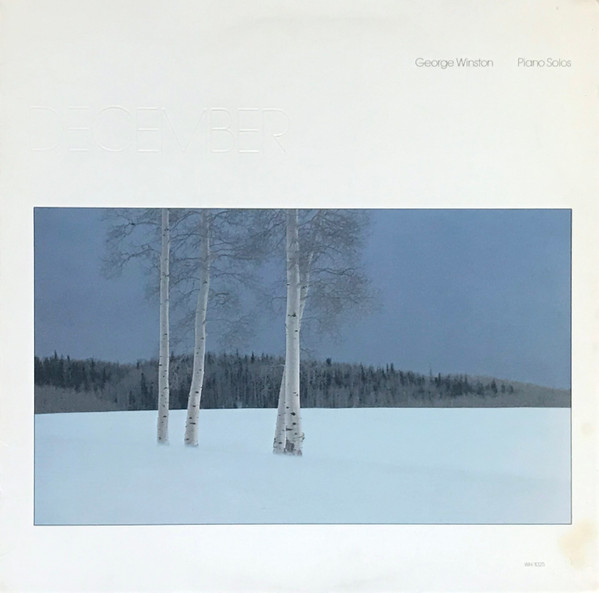
The album that established the genre came from an unlikely place. The 25th release on the Windham Hill label—designed in 1976 in the mold of ECM Records, with its stark instrumental content matched by equally stark artwork—was the third album by so-called “folk pianist” George Winston. A balding, bearded man who dressed for his concerts in turtlenecks and corduroys, playing the piano in his stocking feet, his music was inspired equally by his environment as the instrumental music that used to be a part of Top 40 radio. The story goes that he was originally signed to Windham Hill to record an acoustic guitar album, but once label owner William Ackerman heard him playing the piano “for fun”, that plan went out the window. Autumn was Winston’s debut, featuring lengthy improvisations on fall themes, followed by Winter Into Spring, a more challenging distillation of those seasons.

December takes the best elements of both albums and presents them as a wonderful evocation of snowy landscapes and nights dotted by tiny lights of many colors. Because of its reliance on melodies familiar to the season, it is somewhat restricted to play at the end of the calendar year, but in this age of digital shuffling, that doesn’t have to be the case. It’s unlikely that his exploration on “Carol Of The Bells” would go over well in the summer without raising a few eyebrows, but “The Holly And The Ivy” is an excellent example of where he can take a basic theme. Its simple melody is played through a few times before he finds a rolling set of changes to improvise upon, creating a wonderful wall of sound from just two hands. Likewise, arrangements of “Jesu, Joy Of Man’s Desiring” (here titled just “Joy”) and the well-worn “Variations On The Kanon By Johann Pachelbel” do suggest the holidays, but don’t have to.

Lesser-known melodies are given welcome exposure, such as the Appalachian carol “Jesus, Jesus Rest Your Head” and “Some Children See Him”, the first of many carols by the jazz musician Alfred Burt that Winston would revive over the years. Of his own compositions, “Peace” is as stark as the photo on the cover and the three-part “Night” makes for vivid mind movies, but it’s the opening “Thanksgiving” that is a triumph in simplicity.

Such was the impact or success of December that George Winston didn’t put out a new album for nine years. Some have been worth the wait, particularly Forest, and his album-long tributes to the likes of Vince Guaraldi and The Doors (no, really) are very educational. It’s to his credit that he never went back to the well, choosing to follow his muse rather than inundate the market with further Christmas albums that would have little chance of replicating the beauty of this one.

George Winston December (1982)—4

Saturday, December 22, 2012

Holiday Special #3: The Little Drummer Boy

When the LP gained prominence in the ‘50s, it was largely due the idea of a larger theme. Frank Sinatra had already been programming sets of songs for specific moods, and original Broadway cast became big sellers. So it only made sense that a 12-inch record (played at 33⅓) of Christmas music would convince the American consumer to part with two dollars. Sinatra did his part, as older 78s by Bing Crosby were transferred to the new format, and crooners like Nat “King” Cole and Johnny Mathis laid down their stamp.

People were still writing new holiday numbers back then; it’s not an easy concept to get one’s head around, especially if the first songs you memorized as soon as you could talk were the tales of Rudolph, Frosty and Santa Claus. But somebody had to write those songs, and sat in smoky offices in the big city to do so. That’s how “The Little Drummer Boy”, an apocryphal retelling of a visit from three kings, came to be arranged and recorded by Harry Simeone and his hastily assembled chorale. (It would be another ten years before rock ‘n roll bands would try, and fail, to convert the idea of a drummer boy to the modern sound. And of course, ten years after that, David Bowie’s aversion to the song would force a team of TV writers to add an alternate descant to the melody.)

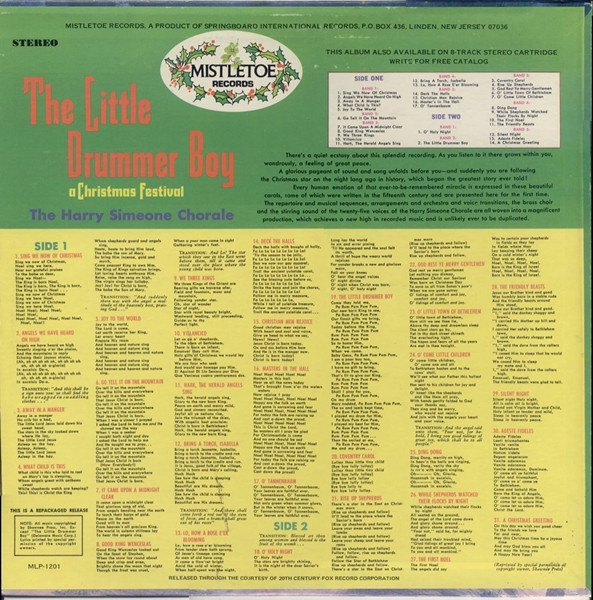
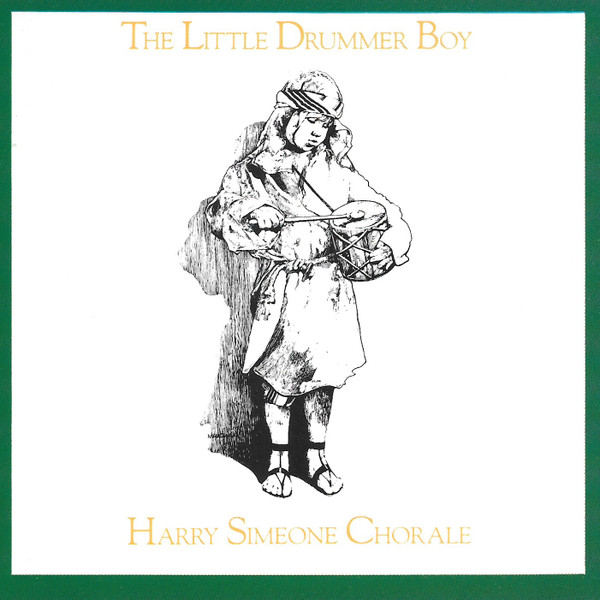
The song was a hit single, and included on an album called Sing We Now Of Christmas. After a few changes of distribution, somebody had the bright idea to change the title of the album to reflect the hit. As it turns out, outside of the title and cover art, the copy we grew up with has a back cover identical to the original release, from the blurb about the reason for the season and the complete lyrics to each of the songs on the album. It’s still in print today, with yet another cover from its tenure on the Casablanca label. Evidence of its first incarnation still exists on track six of the CD, where the “Sing We Now Of Christmas” theme appears again to set up what was side two.

What makes The Little Drummer Boy such an excellent Christmas album is its design: 31 different songs spread over the two sides, most consisting only of the first verse or so, giving the young music fan an easy way to become familiar with a wide variety of holiday music, from carols to hymns and spirituals and a few pop songs along the way. (This music fan loved the album so much that he’d attempt to listen to it all year round, a wish only granted when he got a record player of his very own, with a speaker small enough that it wouldn’t bother others in the house had he decided to play the album in July.)

Considering all the other Christmas albums that have been remastered and reissued over the years, it’s surprising (to us, anyway) that The Little Drummer Boy or whatever you want to call it hasn’t gotten the same love. The CD hasn’t been upgraded since its appearance in the late ‘80s, and even that sounds like it’s been transferred from a record. But it still set a high mark for other albums to follow, as demonstrated by Christmas Chorale. Given the choice, it’s the one we like to play on Christmas morning while opening the stockings and waiting for the coffee to brew.

Harry Simeone Chorale Sing We Now Of Christmas (1959)—
1963 LP reissue: same as 1959, with new title The Little Drummer Boy
1987 CD reissue: same as 1963

Friday, December 21, 2012

Kingston Trio: The Last Month Of The Year

Some of us who happened to be born when we did were forced to learn about much of the music on this blog well after the fact. We heard about the Beatles, Stones, Who and so forth on the radio, as our parents were too busy raising kids to experience the ‘60s. There was music in the house, to be sure, but their record collections were stuck in an earlier era—lots of Frank Sinatra and Henry Mancini, but also Christmas albums and, at their most radical, the Kingston Trio.

Compared with some of the other folksingers of the time, the Trio was fairly inoffensive—well-scrubbed young men with buzzcuts and matching shirts, looking for all the world like they’d met at a fraternity party at some small university. Their harmonies and pop sensibility made them safe for listeners of all ages, usually avoiding controversy and overt protest. (Though a single listen to “The Merry Minuet” will dispel any notions that they had their heads in the sand.)

There’s no doubt that they were talented, and each of the fellows were avid researchers of music from around the world to add to their repertoire. When they recorded what was basically a Christmas album, they naturally eschewed the type of songs that had been pop hits, presenting a selection of more obscure folk songs related not to Santa Claus but to December, The Last Month Of The Year. The theme of Christmas does run through the album, even on the lullabies “All Through The Night” and “Bye Bye Thou Little Tiny Child” (a.k.a. the Coventry Carol). “Goodnight My Baby” is a tad too upbeat to be a lullaby, but it does mention Saint Nick. The liner notes say that “Go Where I Send Thee” had its roots in Jewish and Christian traditions, but their version is definitely spiritual. “Mary Mild” is an odd little song about the boy Jesus being shunned by the neighbor kids for being born in a stable, masking the part of the story where the kids drown. “The White Snows Of Winter” is a gorgeous love song we’re surprised hasn’t been revived of late.

There are two songs we’ve only heard one other place—“Sing We Noel” and “Follow Now, Oh Shepherds” both appeared on the Harry Simone Chorale album a few years earlier. Other songs get unique treatments, such as “Sommerset Gloucestershire Wassail”. “We Wish You A Merry Christmas” is delivered round-style, matching the other side’s “A Round About Christmas”, which is the one about the goose getting fat and ha’pennies.

The album was apparently a sizable flop upon release, illustrated by its absence from the aforementioned record collection heavy on both Kingston Trio and Christmas albums. It stayed out of print for over thirty years, until Capitol rereleased the Trio catalog. After many of those were deleted, an oldie boutique label had it for a while. We must acknowledge the colleague that brought it to our attention during its limbo years, and we’re pleased to report that The Last Month Of The Year is available via the usual download outlets. Not quite the same as holding the LP/CD in your hands and reading/squinting at the liner notes while it plays, but at least the music can be heard. Which is good, because it’s wonderful.

The Kingston Trio The Last Month Of The Year (1960)—4
Current CD availability: none; download only

Thursday, December 20, 2012

Holiday Special #2: The Bells Of Dublin

The Chieftains are one of those mainstream outfits peddling their own brand of traditional Irish music, found once upon a time at most big box stores in the “Celtic” section next to the Clancy Brothers. After having something of a boost from Van Morrison, they released a series of albums that featured collaborations with a variety of established artists, all singing to their accompaniment. One of their nicer projects—surpassed only by The Long Black Veil a couple of years later, teaming them with the likes of Tom Jones and the Rolling Stones—was a Christmas album based around The Bells Of Dublin.

Besides presenting a pleasant selection of airs and graces (if you like that sort of thing), the collaborations were unexpected. Honorary Dubliner Elvis Costello contributes the gory tale of a family dinner gone wrong (not for the first or last time) in “St. Stephen’s Day Murders”. The McGarrigle sisters offer a medley of French carols, then Burgess Meredith sets up a Gaelic shepherds’ tale. Marianne Faithfull adds her sweet rasp for “I Saw Three Ships”—contrast that with Rickie Lee Jones, who sounds like she’s either on the verge of tears or a sneeze for “O Holy Night”. Jackson Browne had been quiet for a few years when he came up with “The Rebel Jesus”.

Beyond the “star” aspect, the traditional selections are the glue of the album. The Voice Squad lends support to several carols, as well as the extended dance demonstration of “The Wren” (even if singer Kevin Conneff sounds a little like Popeye on some of his scatting). The final section of blends three carols into a big finish on “O Come All Ye Faithful”, with the organist from a Belfast cathedral playing into those bells.

The Bells Of Dublin will likely irritate those who aren’t fond of Irish music, but we find it awfully soothing. As various CDs (and LPs) have gone in and out of our holiday stack over the years, this one is a constant.

The Chieftains The Bells Of Dublin (1991)—

Wednesday, December 19, 2012

Phil Spector: A Christmas Gift For You

While his name today generally is associated with a murder conviction or how he ruined “The Long And Winding Road”, Phil Spector really did make an impact on rock ‘n roll in his time. His “wall of sound” made dozens of instruments sound terrific on AM radio (in glorious mono) no matter who was singing. Brian Wilson used the same musicians and studio for his albums, and even Bruce Springsteen knew that he needed the Spector approach to make “Born To Run” the anthem that it is (which indirectly led to Meat Loaf and Bat Out Of Hell). But if Phil Spector did nothing else, he put together one hell of a Christmas album.

A Christmas Gift For You follows on the formula that drove “Be My Baby”, “Da Doo Ron Ron”, and dozens of other hits. Spector knew what worked and he did it to death (sorry), relying on repeated rhythms and musical motifs. This album is just like those singles; even though there’s a prominent sleigh bell in the percussion, it’s mixed just as high as the castanets and tambourine. On every track, all secular pop standards, you can hear Teenage Steve Douglas honking away on sax, Leon Russell’s piano octaves, and Hal Blaine’s thundering drums (and we assume it’s him doing the clippity-clop effects on “March Of The Wooden Soldiers” and “Santa Claus Is Coming To Town”). Jack Nitzsche is credited with the arrangements, so thank him for such touches as the 12-string that opens “Rudolph the Red-Nosed Reindeer”, the “Heat Wave” vibe on “Sleigh Ride”, and even “I Saw Mommy Kissing Santa Claus”, which begins with a sweet intro culminating in a loud smooch before barreling through the song, ending with a quote from “Rock-A-Bye Baby”. (“Winter Wonderland” ends with “Jingle Bells”, “Marshmallow World” with “Deck The Halls” and so on.)

Partially because of the tight rein Spector had on his roster, his main milieu was the single, not the album. So rather than have one artist carry the whole thing, A Christmas Gift For You rotates between Darlene Love, the Crystals, the Ronettes and the unfortunately named Bob B. Soxx & The Blue Jeans. Darlene leads off the program with “White Christmas”; already tackled doo-wop style by the Drifters, this adds a spoken bridge acknowledging what the holidays are like in “sunny L.A.”, far from the snow witnessed by many of the album’s listeners. She sings a total of four numbers, the winner being “Christmas (Baby Please Come Home)”, the only “original” song on the album, thankfully revived by U2’s version 25 years later.

While Darlene had arguably the best voice, Phil Spector was obsessed with Ronnie Bennett; without a doubt, her beehived, eyelinered delivery of “Fwawsty Da Snow Ming” (to the best of our phonetics) is guaranteed to stir the red blood of any teenage male. The other Ronettes provide the delicious “dinga-linga-linga-ding dong ding” on “Sleigh Ride”. The Crystals hold their own (“Santa Claus Is Coming To Town” is the arrangement Springsteen made standard, and we’re still wondering what “elephant boats” are) and Mr. Soxx doesn’t stick around long enough to bother anybody.

A lot of the intros are interchangeable, but so what? If you don’t like this album, you’re a Communist. There’s no need to describe every track since you’ve heard them already. Several songs appear in Goodfellas, which is probably playing on Spike, FX, or AMC right now. Apparently it was not a huge hit in its time, but it’s stayed in print all through the years, first on the Beatles’ Apple label, then through Rhino, ABKCO, and now on Sony. It’s still 35 minutes long, and it’s still in mono. The way it should be.

A Christmas Gift For You From Phil Spector (1963)—4

Tuesday, December 18, 2012

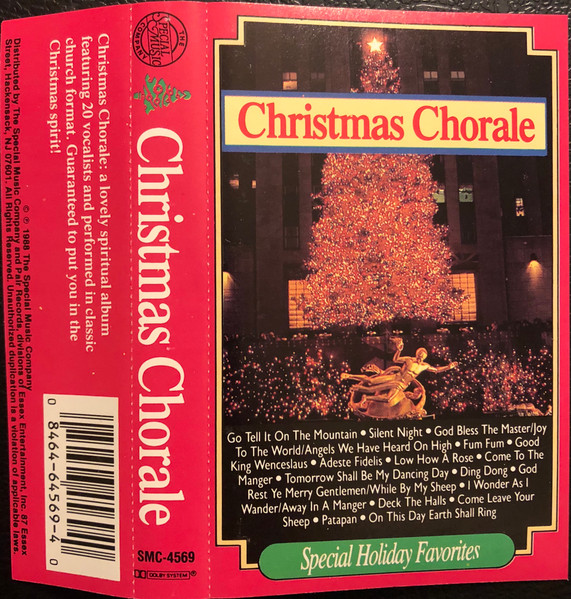
Holiday Special #1: Christmas Chorale

This is easily the most bizarre traditional Christmas recording we have ever heard. First heard on cassette circa 1989—one of those things you’d buy at a gas station for three bucks—the case had no production notes or credits, just a badly spelled track listing to go with the title and distributor (“Special Music”, and who are we to argue?). Starting with a bunch of people harrumphing amongst themselves with the occasional "Tell it on the mountain!" interjection, Christmas Chorale sounds like a small adult choir singing truly unique arrangements of hymns and carols to the occasional accompaniment of a spirited piano.

It’s not easy to express just how odd some of these renditions are. Beyond the performance art aspects of “Go Tell It On The Mountain”, there’s the logjam of “God Bless The Master/Joy To The World”, which does indeed combine those songs, with “Ding! Dong! Merrily On High” sung at the same time, but not necessarily in the same key. “Ding! Dong!” is reprised later in the program, with doorbell impressions woven into the arrangement. “Good King Wenceslas” appears to change time signature with every other measure, just as other familiar melodies are stretched and chopped to the point where it’s impossible to sing along.

A friend originally brought this album to the attention of your humble correspondent, and as far as we know, we are the only two people on the planet who have spent money on it and actually enjoy it. Over the years the mystery has only grown; who are the voices coming through the speakers? Did they snag any royalties from our purchase? Do they even know this album exists?

As often happens in the public domain, the contents have been repackaged and re-sold over the years, which might make our CD version a collectors’ item. (Stop laughing. Christmas is a time for wild wishes and outlandish dreams, after all.) The latest version of iTunes offers something of a clue, crediting a few of the tracks to Neville Garvey and the Los Angeles Chorale. A subsequent Google search only brings up various e-tail sites with what appears to be yet another permutation of the program. Some listings for Christmas Chorale credit the performance to the Royal Philharmonic Orchestra, which doesn’t make sense since the only instrument heard is that piano. Unless the choir is really the orchestra members singing. That would be something!

The closest we can figure out is that it might be the Los Angeles Master Chorale, who have had recordings released on a bunch of actual classical labels of merit, which takes away from our dream of some unknown community group that gather weekly somewhere in the Midwest to rehearse for sparsely attended concerts in front of retirees and bored children, while the best piano player in town dreams of playing on a real stage. Maybe some things are best left to the imagination. But what we wouldn’t give to be a fly on the wall at these rehearsals, the recording session, and the moment when the first box lot arrived with Christmas Chorale all shrinkwrapped and clean, poised to take its place in the pantheon of holiday music.

Christmas Chorale (1988?)—3

Monday, December 17, 2012

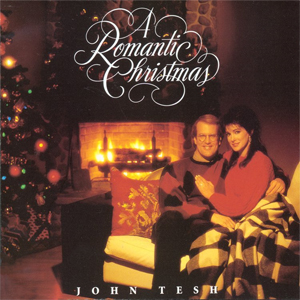
John Tesh: A Romantic Christmas

Well before VH-1 and “I Love The ‘80s” made snarkiness cool, there were a handful of cultural icons whose existence encouraged ridicule, and those of us of a certain generation remember our whipping boys fondly.

Sometime after John Tesh had established himself on the mass media map as the co-host of Entertainment Tonight, wacky ideas entered his oversized head. First, he asked New Age schlockmeister Yanni if he could join his touring band as a backup keyboardist. Then he started issuing a series of albums of his own, inspired by the Tour de France and such other exciting events. Finally, he stole TV’s Connie Sellecca away from Buck Rogers (TV’s Gil Gerard), a match made in Burbank.

The fruits of this domino effect were thrust upon the unsuspecting public with his seventh CD, a tribute to both the institution of holiday cash cow as well as the Neopolitan minx by his side. A Romantic Christmas was designed to simultaneously tug the heartstrings of America’s Hallmark shopper and yank the chains of those of us who zeroed in on the back cover photo of somebody’s lacy black undergarments (Connie’s, we hope) strewn about (but not too near) the hearth. Beyond that enticing image—since scrubbed, so don’t look for it—the album is lush, but not syrupy, consisting predominantly of hymns and carols performed without the melismatic passion of the average Kenny G album. While Tesh’s name is on the spine, and he’s credited with acoustic piano, the bulk of the program is supplied by the army of musicians in “his” orchestra, mostly supporting a prominent “classical guitar”. When that guy lays out, a boy’s choir sings just off pitch on three tracks.

The man gets kudos as early as track two, an arrangement of “Gesu Bambino” that the average consumer would know best from Luciano Pavarotti’s Christmas album, and a tune that hasn’t been overdone by everyone who thinks it’s a good idea to do a Christmas album. The rest are the usual pre-industrial yuletide chestnuts, designed to evoke memories of what we’ve been told the holiday must have been like in Victorian times, only with a little digital reverb. Tesh doesn’t really leave a hefty mark from his meaty paws until the two original tracks near the end of the hour-long program, both of which feature violinist Charlie Bisharat and both of which sound a little alike. The closing rendition of “Chestnuts Roasting On An Open Fire” is the closest we get to the expected Kenny G territory, given the soprano sax and fake electric piano accompaniment.

Given all that, A Romantic Christmas is actually pretty nice. If there’s anyone out there who can actually get it on with their lady to the strains of “Bring A Torch, Jeannette, Isabella”, we don’t want to know about it, even if they’re as photogenic as the Teshes. What makes the album worthy of a slot in your CD arsenal is its effectiveness as pleasant tree-trimming music—just as nice to have in the background while you’re trying to get in the spirit as it is should you decide to actually listen to it. Given all the potential of being an overwrought mess, it offers a soothing program, instead of something that inspires ridicule, which would be expected. Granted, we haven’t been able to build up the grapes strong enough to check out any of his other work—not least Sax On The Beach, Sax By The Fire, and Sax All Night. But even decades later, as ET still tries to pass itself off as news and his syndicated radio show attempts to inspire the typical Lite-FM listener on those evenings stuck in traffic after working late, A Romantic Christmas is a great way to win a bet. (As in, “Nice album, isn’t it? You won’t believe what it is when I show you the jewel case.”)

John Tesh A Romantic Christmas (1992)—

Sunday, December 25, 2011

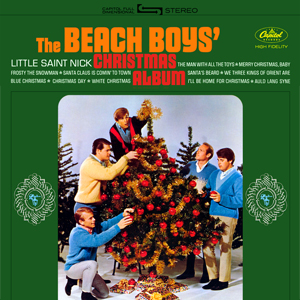
Beach Boys 8: Christmas Album

Like any red-blooded American boy, Brian Wilson loved Christmas. Likely influenced by Phil Spector’s album as well as their own “Little Saint Nick” from the year before (think a thematic cross between a little Deuce Coupe and a certain sleigh), The Beach Boys' Christmas Album was released a month after their live album, Capitol having zero qualms about loading up the shelves with their artists.

Five of the songs are Brian Wilson originals, played (most likely) by the band themselves. “Little Saint Nick” is still the best meld of the holiday spirit and the band’s brand. “The Man With All The Toys” has a jarring hiccup of a supporting part, “Santa’s Beard” and “Merry Christmas Baby” present Mike at his most nasal, while Al is credited with lead on “Christmas Day”. Outside of the occasional quote in a guitar solo, these are pop tunes with specific lyrics. Based on these it’s just as well that Brian didn’t try to write a whole album of Christmas songs, else his nervous breakdown might’ve been sooner or more severe.

To complete the album, the rest of the program consists of holiday favorites given lush, Four Freshman-style arrangements, much more typical of Johnny Mathis. Brian sings a couple of the prettier ones alone, but they all come together for the likes of “Frosty The Snowman” and “Santa Claus Is Coming To Town”, the latter with an unfortunate “circus” motif in between verses. They give their best blend to “I’ll Be Home For Christmas”, and bury some harmonic gymnastics under brother Dennis’s “special” spoken message over “Auld Lang Syne”.

Despite the promise of side one, this is not a rockin’ Christmas album, yet it does provide an interesting transition to the more advanced music Brian would create in 1965. The album never really went out of print, and even appeared on CD a few times, once with bonus tracks, including the single version of “Little Saint Nick”, an odd alternate of the same but sung over the backing track for “Drive-In”, and an a cappella mix of “Auld Lang Syne”.

At the end of the ‘90s, Ultimate Christmas more than doubled the original lineup with further extras, most notably an interview with Brian from a 1964 promo, the clumsy “Child Of Winter” standalone single from 1974, and selections from the band’s aborted 1977 Christmas album. These are just plain odd, as many of them were either holiday-tinged remakes of unfinished tracks. For one, “Santa’s Got An Airplane” updated the mode of travel with help of the unfinished late-‘60s track “Loop De Loop”, while “Melekalikimaka” and “Bells Of Christmas” would be reworked for the M.I.U. Album. Al Jardine’s kids narrate “(I Saw Santa) Rockin’ Around The Christmas Tree”, which rips off two separate songs, but “Winter Symphony” is a promising Brian tune that could stand to be slower and not as busy. There’s even a rare Dennis Wilson recording, the moving “Morning Christmas”, for that cult base. As with most Beach Boys music post-Endless Summer, these later tracks are simply not as strong as the prime material from the original era. (This too went out of print, superseded by 2004’s Christmas With The Beach Boys, which repackaged the tracks but left out “Christmas Time Is Here Again”, which was basically “Peggy Sue” with new words. Five years later, Christmas Harmonies offered a very strange 15-song distillation of the music. Meanwhile, their a cappella rendition of “The Lord’s Prayer”, the B-side to “Little Saint Nick”, hasn’t been included on any of these CDs since 1991, but has turned up elsewhere.)

The Beach Boys The Beach Boys’ Christmas Album (1964)—3
1991 CD reissue: same as 1964, plus 4 extra tracks
The Beach Boys Ultimate Christmas (1998)—2