Showing posts with label eric clapton. Show all posts

Friday, June 19, 2026

Elton John 31: Two Rooms

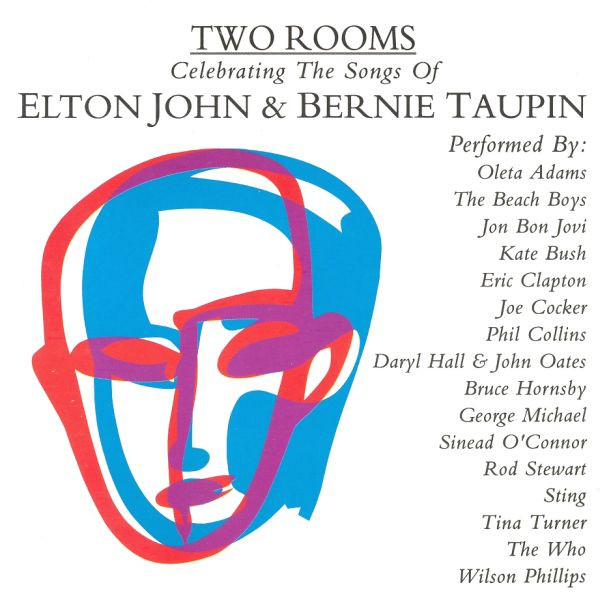
A multi-disc overview was one way for Elton John to assess his career, but he wasn’t done doing that. Along with the box set trend, thematic tribute albums began to be a thing in the ‘90s. Just as with the Grateful Dead the same year, Two Rooms was an all-star compilation “celebrating the songs of Elton John and Bernie Taupin”. Most of the songs were fairly faithful to the original, while still allowing the artists to put their own stamp.

Eric Clapton injects more gospel and a great solo into “Border Song”, then Kate Bush makes “Rocket Man” reggae, albeit with Uillian pipes. Sting’s “Come Down In Time” is a great choice, handled very gently, while the Who plow through “Saturday Night’s Alright For Fighting” with a quote from “Take Me To The Pilot”, just as Elton put “I Can’t Explain” in his version of “Pinball Wizard”. While the photo of the Beach Boys shows Brian Wilson, it’s only Carl, Al Jardine, and Bruce Johnston singing “Crocodile Rock” over a prerecorded track, while Mike Love chimes in with “re-mem-mem, remember-member”. Fittingly, Wilson Phillips (then still popular) follow with “Daniel”. Joe Cocker does a wonderful job belting out “Sorry Seems To Be The Hardest Word”, unfortunately given a boomy arrangement with in-your-face saxophone. Jon Bon Jovi does a band karaoke version of “Levon”; hearing the American pronunciation of “garage”, jars here.

Tina Turner tackles “The Bitch Is Back” for the second time in her career, and nails it, but while “Philadelphia Freedom” is fitting for Hall & Oates, their reading is pretty limp. Twenty years after recording “Country Comfort”, Rod Stewart goes the safe route with a tepid “Your Song”. Oleta Adams, then riding on a hit single, makes “Don’t Let The Sun Go Down On Me” that much more soulful, then Bruce Hornsby takes “Madman Across The Water” to a more gothic place. Sinead O’Connor’s gentle, heartfelt interpretation of “Sacrifice” is possibly the highlight of the album, while Phil Collins’ straight take on “Burn Down The Mission” is mostly notable for Steve Winwood on organ (according to the credits, anyway). George Michael offers a lengthy live “Tonight” with winds and strings, since “Don’t Let The Sun Go Down On Me” had already been claimed; his own duet with Elton on the latter from the same show would be released shortly as a single.

Two Rooms was promoted by a feature-length documentary on VHS, followed by an abridged TV special hosted by Sylvester Stallone of all people. The album wasn’t likely to make new fans for these artists, and like most tribute packages, the novelty wears off quickly. Seventeen years later, the concept would be repeated with a pair of albums with the intent of “reimagining the songs of Elton John & Bernie Taupin”: Revamp sported covers by modern artists ranging from Miley Cyrus and Lady Gaga to the Killers and Queens of the Stone Age, while Restoration was devoted to country artists.

Two Rooms: Celebrating The Songs Of Elton John & Bernie Taupin (1991)—3

Tuesday, January 17, 2023

Eric Clapton 6: 461 Ocean Boulevard

Seemingly finally off junk for good, Eric Clapton headed back to Florida. With the help of Tom Dowd in the control room, and former Domino Carl Radle bringing in some players from Oklahoma, he managed to complete his second real solo album, named after the address of the house where he was living. With the addition of labelmate Yvonne Elliman from the Jesus Christ Superstar albums, he also established a band that would serve him for the rest of the decade.

Right off the bat, “Motherless Children” recalls the Dominos with a galloping beat, constant organ, and melodic slide for a great starter. He immediately turns things down for the spiritual “Give Me Strength”, and underscores it with a truly wimpy rendition of “Willie And The Hand Jive”. “Get Ready”, co-written and sung with Yvonne Elliman, is an improvement on both, but as the third slow song in a row, it’s easy to overlook. But then its reggae beat is immediately elevated with a cover of “I Shot The Sheriff”, which certainly made more people aware of Bob Marley.

“I Can’t Hold Out” begins with a dirty guitar, but mostly sleepwalks through a standard 12-bar written by either Willie Dixon or Elmore James. “Please Be With Me” is something of a Duane Allman tribute, being written by the leader of Cowboy, who were signed to the Allmans’ label and toured with the band; their original version featured Duane on dobro, which Eric plays here. Even though Jim Carrey co-opted it 25 years later, we’re still a sucker for “Let It Grow”, an incredibly melodic little wonder that slightly modifies “Stairway To Heaven” chord changes into something of a power ballad that showcases multiple guitar tones. Robert Johnson continues to be a touchstone, as “Steady Rollin’ Man” is injected with some funk. George Terry—aka the other guitarist on the album—provides the riff-happy “Mainline Florida” for a catchy finale.

For better or for worse, 461 Ocean Boulevard establishes the Clapton brand going forward: competent, easy listening rock that’s neither challenging nor groundbreaking, steeped in the blues, but still focused in the present. He’s best when he simply plays his guitar; unfortunately he can’t always carry an album. If this is your thing, go forward happily. Personally, we prefer more grit.

Due to a publishing dispute over “Give Me Strength”, that song was pulled from later reprints of the album and replaced with “Better Make It Through Today”, a track from his next album. When 461 was first released on CD, this new sequence was the same, but with “Give Me Strength” stuck at the end. The mid-‘90s remaster finally restored the original 10-track lineup. 2004’s deluxe edition filled out the first disc with some in-studio jams, and added a second disc compiled from London shows at the end of the year, opening with a gospel-tinged version of Charlie Chaplin’s “Smile”. (Further studio outtakes were added to 2013’s Give Me Strength: The ’74/’75 Recordings box set, making both expansions required for completists.)

Eric Clapton 461 Ocean Boulevard (1974)—3
2004 Deluxe Edition: same as 1974, plus 16 extra tracks

Friday, June 24, 2022

Eric Clapton 5: Rainbow Concert

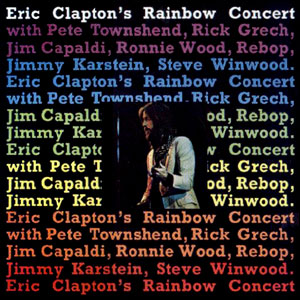
Credit Pete Townshend for trying to get Eric Clapton back to regular work instead of succumbing to his heroin addiction. This entailed assembling an all-star band to back him for a pair of shows at London’s Rainbow Theater. In addition to himself, the other musicians were erstwhile Traffic members Steve Winwood, Jim Capaldi, Rebop Kwaku Baah, and Ric Grech, plus Ron Wood and the elusive Jimmy Karstein. All were prominently listed on the cover of Eric Clapton’s Rainbow Concert, released nine months later by a label that had already been busy recycling Clapton recordings.

All-star concerts are often more notable for who’s playing rather than how well they play, and the six songs here aren’t exactly mind-blowing. After a half-decent “Badge” and a run through the Dominos rarity “Roll It Over”, Stevie sings “Presence Of The Lord.” He takes the lead on Traffic’s “Pearly Queen”, which manages to hold together despite the full stage before galloping to a finish. “After Midnight” is somewhat plodding, but “Little Wing” benefits from the extra players, and they’re mostly in tune. (Reports that several vocals were overdubbed after the fact have not been disproved.)

Coming soon after the Dominos live album, Rainbow Concert wasn’t much more than a cash grab with star power to move it, and so it remained. Following Clapton’s resurgence in the ‘90s, the eventual remastered CD was filled nearly to capacity with further performances from the two shows, reconstructed to approximate a true setlist. Unfortunately, they did so by editing down the songs that were on the original album, which was short to begin with, and leaving out two others from the original night. (Did we really need to hear Townshend ribbing an unamused Capaldi between numbers about an alleged STD?)

That said, the new version is certainly listenable, if not a true document. We hear an emcee introduce “Eric Clapton and the Palpitations,” and they rip right into “Layla”. “Blues Power” and “Key To The Highway” allow for more dueling and noodling, and Stevie nicely takes the high parts on “Bottle Of Red Wine” and “Tell The Truth”. The two drummers can’t cop Jim Gordon’s backwards beat on “Bell Bottom Blues”, but they trade off with Rebop for the middle of “Let It Rain”. All told, it’s better, but not exactly essential.

Eric Clapton Eric Clapton’s Rainbow Concert (1973)—
1995 Chronicles remaster: “same” as 1973, plus 8 extra tracks

Tuesday, February 15, 2022

Eric Clapton 4: In Concert

The Layla album was definitely a case of lightning in a bottle. Attempts at a follow-up Derek and the Dominos album didn’t get too far, partially because of various addictions, the absence of Duane Allman, and Clapton’s refusal to keep working with Jim Gordon. Carl Radle went on to work with Leon Russell, and Bobby Whitlock got tired of waiting for Eric to make music with him.

His record company, of course, was happy to keep their golden boy on the racks, starting with 1972’s The History Of Eric Clapton, which compiled a chronological journey through tracks from his days with the Yardbirds, John Mayall, Cream, Blind Faith, Delaney & Bonnie, and the two solo albums. Rarities included the single version of “Tell The Truth” and a jam of same from the Layla sessions, plus off tracks with Jimmy Page, Steve Winwood, and King Curtis.

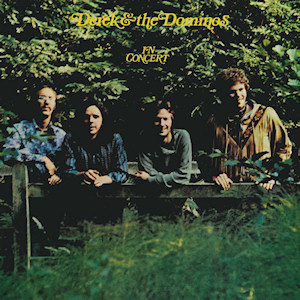
A reissue of “Layla” as a single boosted sales of its parent album, so in the absence of a studio release, a double live album engineered by Eddie Kramer at the Fillmore East in October 1970, just before Layla’s release, became the second Derek and the Dominos album. While it may seem like a quick cash-in, it’s actually a decent record. Without Duane in the room, and in contrast to the crowded stages with Delaney & Bonnie and Joe Cocker’s Mad Dogs & Englishmen, the quartet leans on economy and delivers. They were all pros, after all. Because they can, each track leads to soloing and more soloing; most exceed eight minutes.

An extended drum groove with only the slightest accents from the other band members turns into “Why Does Love Got To Be So Sad”. The extreme stereo separation has Bobby’s vocal and organ on the left and Eric on the right, with Carl and Jim bouncing in the middle, and it’s a crisp mix. “Got To Get Better In A Little While” would have been featured on their second album if they’d finished it, but here it’s a 14-minute boogie with some energetic piano and plenty of wah-wah.

Rather than recycle the Layla album wholesale, the band touches on earlier Clapton showcases. “Let It Rain” cascades for over 17 minutes, though a third of that is the drum solo. The crowd goes wild. “Presence Of The Lord” was sung by Steve Winwood on the Blind Faith album, but Eric strains to reach the notes here. Bobby harmonizes here and there, which helps. “Tell The Truth” doesn’t have the drive of the album version, and much of it is a jam on a single chord, but Bobby is a better vocal foil on “Bottle Of Red Wine”.

“Roll It Over” would have only been known to those who’d found the swiftly deleted single from a few months before; this is a decent performance and worthy of release. “Blues Power” has another moody intro the belies the boogie that follows, but the band navigates the stops and starts well and Eric’s fast chordal riffing propels the tune over the too-long ending. When it finally does, it’s right into the much slower “Have You Ever Loved A Woman” for plenty of fretwork.

In the digital era, the album was mostly ignored, possibly because of Clapton’s own disinterest. But some twenty years after its original release, after Eric had experienced more than a few comebacks along with the runaway success of his Unplugged special and album, his old label compiled an upgrade of sorts as Live At The Fillmore. Six of the songs from In Concert were repeated in a new sequence, interspersed with two tracks repeated from Clapton’s Crossroads box set and five performances appearing for the first time. Different versions of “Why Does Love Got To Be So Sad”, “Tell The Truth”, and “Let It Rain” provide different perspectives, while “Crossroads”, “Key To The Highway”, and “Nobody Knows You When You’re Down And Out” go deeper into the blues. “Little Wing” gains poignancy due to Jimi Hendrix’s death a month before. The liner notes kindly noted which of the two shows used spawned each track, though Anthony DeCurtis should have known how to spell Delaney Bramlett’s first name. Photos from the actual shows are nice too.

Derek & The Dominos In Concert (1973)—
Derek and the Dominos
Live At The Fillmore (1994)—

Friday, February 7, 2020

Robbie Robertson 5: How To Become Clairvoyant

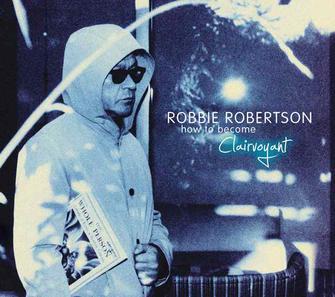
After a decade spent scoring films and hawking the legacy of the Band, Robbie Robertson actually got around to recording an album of songs. Despite the photos of the artist in a hoodie and contributions from people like Trent Reznor and Marius de Vries, throughout How To Become Clairvoyant he generally acts his age and goes with his strengths.

He’s also wise enough to ask notable guests to contribute. “Straight Down The Line” immediately conjures good memories of his first two solo albums, with help from guitarist Robert Randolph. The sultry “When The Night Was Young” and “The Right Mistake” feature the vocals of one Angela McLuskey. But the most prominent special guest is Eric Clapton, who sings and plays on half the album, even writing some, while Steve Winwood adds his trademark organ. Clapton is most prominent on “Fear Of Falling”, which sounds more like one of his own recent albums, and the instrumental “Madame X”, which is the track with the Reznor credit but hardly Nine Inch Nails. “Axman” name-checks various guitar slingers of days gone by, but the only guy Robbie trades licks with is Tom Morello of Rage Against The Machine.

Even without the neon-bright guest appearances, the songs are commendable, for the most part. “He Don’t Live Here No More” is full of mystery, but “This Is Where I Get Off” only scratches the surface about why he left The Band, mostly relying on clichés. “She’s Not Mine” might sink under a more syrupy arrangement, but here he lets his raspy voice do the talking, whereas “Won’t Be Back” is sufficiently heartbreaking. The title track had already appeared on a soundtrack for the vampire TV series True Blood, and is loaded with imagery and metaphors, with a teasing narrative a la “Somewhere Down The Crazy River”. The closing instrumental “Tango For Django” doesn’t sound much like a tango to these ears, but some of the atmospherics are nice.

Without a doubt, How To Become Clairvoyant is a very pleasant surprise, and certainly the true follow-up to the debut and Storyville. It’s a grower, and we like that.

Robbie Robertson How To Become Clairvoyant (2011)—3

Friday, November 27, 2015

Band 9: The Last Waltz

It shouldn’t be news to anyone that The Last Waltz is one of the better rockumentaries in the genre. Much of the credit belongs to Martin Scorsese’s direction, which alternates staged interviews and performances with “you are there” footage from The Band’s star-studded farewell concert. The editing is particularly masterful; rather than presenting the concert as it was, many of the performances are shuffled. The film even opens with “Don’t Do It”, which was actually the night’s final encore.

Such suspensions of time are sometimes necessary to elevate a film that’s not designed to be a fly-on-the-wall cinema verité portrait. And when you add Robbie Robertson, with his fancy new haircut, telling his new best friend about “eight years of concerts, stadiums and arenas”, a simple glance at their actual activity between 1968 and 1976 will have the scholar wondering how empty itineraries in 1972 and all but one date in 1975 made their job so grueling.

All our nitpicking aside, the film is still fun to watch, and the music is terrific. The album, originally a three-record set, is paced well, with Band classics alternating with vocal spots by their very special guests, augmented by a horn section. Their old boss Ronnie Hawkins comes out for “Who Do You Love”, and Neil Young manages to overcome the ball of coke he snorted before his still sleepy rendition of “Helpless”. Joni Mitchell’s voice appears from backstage during that number, and then she comes out for an excellent performance of “Coyote”.

Robbie had recently produced an album for Neil Diamond, and despite Levon Helm’s protestations, was given a spot singing “Dry Your Eyes”. It’s a fine song, but nothing compared to Rick Danko’s excellent job on “It Makes No Difference”, not to mention Garth Hudson’s beautiful sax solo. Dr. John closes side two with “Such A Night”, a good setup for the blues sequence on side three. Paul Butterfield blows harp on their arrangement of “Mystery Train”, Muddy Waters burns the place down with “Mannish Boy”, and Eric Clapton duels with Robbie on “Further On Up The Road”.

Poor Richard Manuel doesn’t get a chance to sing until “The Shape I’m In” on side four, followed by their friend Bobby Charles coming out for “Down South In New Orleans”. Van Morrison emerges from his mid-decade hiatus to sing “Tura-Lura-Lura” with Richard, before completely demolishing the place on “Caravan”. Bob Dylan was an expected guest, but shocks with his nearly shoulder-length hair stuffed under a hat. All but one of his songs from the show appeared on the original album; 1966 is visited via “Baby Let Me Follow You Down” and “I Don’t Believe You”, and a tender “Forever Young” manages to turn into a reprise of the first track. Then everybody crowds the stage for a mass chorus on “I Shall Be Released”, Richard somewhere back there on his piano.

Side six presents “The Last Waltz Suite”, a loose set of songs recorded on a soundstage, and some inserted in the film. In addition to “The Weight” performed with some of the Staples Singers and “Evangeline” with Emmylou Harris, Robbie gets a solo vocal on “Out Of The Blue”, while Richard barks “The Well” and duets “The Last Waltz Refrain” with Robbie. “The Last Waltz Theme”, which appears at the top of side one, closes the set with an orchestra. While not stellar, they’re easily better than most of Islands.

Several songs in the album aren’t in the film, and vice versa. Even the four-CD box set, which adds much more from the concert and rehearsals, doesn’t include the complete show as performed. But of all their live releases, The Last Waltz is the best, and not just for their own songs. In the end it’s the music that makes it a nice finale for whatever was actually over; Levon would insist that the whole deal was Robbie’s ego trip, and the other guys would play together, in dives even smaller than the ones where they started out, up until and beyond Richard’s suicide in 1986, and continuing in various combinations until Rick died in 1999.

The Band The Last Waltz (1978)—4
2002 box set: same as 1978, plus 24 extra tracks

Friday, March 6, 2015

Yardbirds 4: Greatest Hits

American labels knew how to recycle product in the ‘60s, and since a few months had gone by since the last album, Epic decided to release a greatest hits set by the Yardbirds. It’s only half an hour long, as were a lot of albums back then, but it really does cover their hits to date. It includes two songs from the first album, four songs from Having A Rave-Up, and only “Over Under Sideways Down” from that album. New to LP in the states were the previous year’s stellar single “Shapes Of Things” and its B-side “New York City Blues” (which opens with the same riff Jimmy Page would cop for “You Shook Me”, adding insult to Jeff Beck’s injury, but we’re getting ahead of ourselves), plus “Happenings Ten Years Time Ago”, which means the album includes performances by all three of the band’s soon-to-be-legendary lead guitarists.

Three years later, once each of those lead guitarists had become household names in households that listened to FM radio, Epic issued a double album with the inspired title Featuring Performances By Jeff Beck, Eric Clapton, Jimmy Page. With 20 songs coming in at just under an hour, it repeated nothing from the hits album—which had covered pretty much all of the songs that qualified as actual hits—and scrambled deep tracks from all the American albums in no understandable sequence, seesawing from blues to experimental. Several paragraphs of liner notes bemoaned the band’s commercial failures, but didn’t bother to detail which albums begat which songs, nor which of the performances featured which guitarist, even though each had an instrumental all to themselves. The bizarre cover art was typical of the era, and the same designer would get to work on another related project ere long.

Both of these compilations would go out of print by the end of the ‘70s, and because the masters were owned by different managers depending on who produced what, licensing would continue to be wonky, and shoddy rehashes abounded overseas. Then, in 1986, the Rhino made good on their original brief to restore music to the masses with a hits collection with the hopeful title of Volume One. This set concentrated on the Giorgio Gomelsky era, with began with Clapton and covered the first two American albums, including two further tracks from Five Live Yardbirds. It did a fine job of presenting them as blues interpreters, but the contents predated some of Beck’s innovations.

While a second volume never materialized, Rhino did score a coup in the new century with Ultimate! This was another apt title, as it crammed two CDs full of just about everything, starting with their first demos, through four tracks from Five Live Yardbirds, most of the three American albums, and all key singles and B-sides, plus a rare Italian single and three fey Keith Relf solo sides. Attention to detail ensured liner notes and comprehensive discographical information, including recording dates, locations, and even engineers; who knew Eddy Offord, Roy Halee, and even Bones Howe taped this band?

This, too, is out of print, but luckily in the digital era it’s possible to stream most of the music. The original albums are out there, along with various grey-area live performances. And of course, the BBC. After scoring the rights to Roger The Engineer, Warner Archives followed another ‘90s catalog trend with the 1997 release of BBC Sessions for the first time in the US after a few years floating around elsewhere. This set presented 26 tracks from the Beck and Page eras, complete with interview snippets from the usual clipped-voiced deejays and a few tunes that never made it to wax. This too became scarce, until 2024 brought The Ultimate Live At The BBC—they sure like that adjective—box of four discs.

The Yardbirds The Yardbirds’ Greatest Hits (1967)—4
The Yardbirds
Featuring Performances By Jeff Beck, Eric Clapton, Jimmy Page (1970)—
The Yardbirds
Greatest Hits, Volume One (1964-1966) (1986)—
The Yardbirds
Ultimate! (2001)—4
Current CD availability: none

Monday, November 25, 2013

Eric Clapton 3: Layla

So much has been written over the years about this album that we hesitate to weigh in. Certainly it’s essential for any fans of the electric guitar; even after everything Eric Clapton accomplished in the ‘60s, Layla was still a new height for his development, both professionally and creatively.

It’s understandably considered a Clapton album—released only three months after his solo debut—but we must remember that Derek and the Dominos were, above all, a band. Clapton and keyboard player Bobby Whitlock collaborated early and often on the album, Bobby’s vocals adding a Sam & Dave-style vibe to the album as a whole. Bassist Carl Radle and drummer Jim Gordon were tight, having played with Delaney & Bonnie (where they met Clapton) and Joe Cocker’s Mad Dogs & Englishmen. All four (along with Dave Mason, seemingly incapable of being in any band for more than a few gigs) worked on George Harrison’s All Things Must Pass, and went off to Florida to record. While there, they crossed paths with the Allman Brothers Band, which is how Duane Allman ended up guesting on the album. (That’s also important to mention: he didn’t play on the whole thing, and only played two shows with the Dominos. He was devoted to his own band and remained so.)

“I Looked Away” is a great opener, and a song that doesn’t get enough attention. All of the elements of the band are introduced here, setting a standard for the four sides. Jim Gordon inverts the snare and kick on “Bell Bottom Blues” in a way no one else do, yet makes it work. “Keep On Growing”, just like “Anyday” on side two, builds a good groove over six and a half minutes, working the guitars and organ nicely against each other. Likewise, “Nobody Knows You When You’re Down And Out” and “Key To The Highway” establish themselves as the modern standard by which these blues standards are known today. If there’s a clunker in the first half, it’s “I Am Yours”, which uses a poetic idea from an earlier century but not as well as the title track, and predicts Clapton’s laid-back style of the ‘70s.

The second half of the album is stellar. “Tell The Truth” finds the stank and stays there, giving Duane plenty of room to soar. “Why Does Love Got To Be So Sad?” builds on a hyper-tense rhythm—with excellent fretwork from Carl Radle—eventually settling into a nice groove for the fade. “Have You Ever Loved A Woman” is another cover, but more fitting with Clapton’s overall theme for the album, that being his infatuation with George Harrison’s wife.

Things absolutely take off on side four. Their epic, keening arrangement of “Little Wing” does to Hendrix’s original what he did to “All Along The Watchtower” (and amazingly, they recorded it before he died). The final cover is the much simpler “It’s Too Late”, which gets its point across much faster than the blues workouts of the other sides. It’s merely a sorbet for the unmistakable riff of “Layla”, a song that’s a classic all its own, but is truly made by Jim Gordon’s gorgeous piano theme (which he stole from Rita Coolidge) over the second half of the track. It is truly one of the finer moments in music. And where can you go from there? Bobby’s solo “Thorn Tree In The Garden” has been compared to “Good Night” following “Revolution 9”, but we think it’s more like having to settle for vanilla ice cream because they ran out of chocolate.

There’s a lot of music on Layla, and the great moments still stand out, even after decades of Classic Rock Radio threatening to kill them off. It’s very possible to make a stellar single LP out of the music here, but that would suggest that the lesser tracks are garbage, which they’re not.

Because of the length, it first appeared as a double CD until the industry caught up to capacity capabilities. It was also the recipient of the first box set devoted to a single album; 1990’s The Layla Sessions served up the album on a single disc, plus a disc of jams with and with the Allman Brothers Band, and another disc of alternate takes. That was for the 20th anniversary; the 40th anniversary brought forth a deluxe edition, with other unreleased tracks, plus songs recorded for their stillborn second album, and the so-called “super deluxe” version, which added an expansion of 1973’s In Concert album to all that. These are all for those with unlimited income; everybody else should stick with the original. On vinyl. Or the single CD, ‘cos it’s convenient.

Derek and the Dominos Layla And Other Assorted Love Songs (1970)—
1992 The Layla Sessions: 20th Anniversary Edition: same as 1970, plus 15 extra tracks
2011 40th Anniversary Deluxe Edition: same as 1970, plus 13 extra tracks (Super Deluxe Edition adds another 13 tracks plus DVD)

Sunday, November 10, 2013

Eric Clapton 2: Eric Clapton

Despite having been a big shot on the scene for several years, it wasn’t until he took a job touring with Delaney & Bonnie and Friends that Eric Clapton considered doing an album under his own name. Most of the aforementioned Friends played on the sessions, including two guys who would soon run off with Joe Cocker for the Mad Dogs & Englishmen tour before regrouping with Eric later that year. Another key contributor was Leon Russell on piano, who would weave his way throughout various projects of the time.

From the blistering one-chord “Slunky” jam, most of the songs were co-written with Delaney Bramlett, along the American boogie lines of the blues than the psychedelia of his prior releases. Neither the lyrics nor his voice bring the proper gravitas to “Poor Boy” or “Lonesome And A Long Way From Home”, but the galloping “After Midnight”—the first of several J.J. Cale songs Clapton would cover over the years—is more like it. Built on acoustic guitars and harmonies, “Easy Now” is a welcome change of pace, but the chorus lyrics are a little embarrassing. Despite the somber fake intro, “Blues Power” brings back the boogie to please the crowd.

Side two doesn’t have as much variety; “Bottle Of Red Wine” is mostly shouted with Delaney, and a decent riff falls under the weight of “Lovin’ You Lovin’ Me”. “I Told You For The Last Time” is fairly ordinary, with the writing credited to Delaney and Steve Cropper, and “I Don’t Know Why” doesn’t live up to the potential of its horn chart either. He does save the best for last however, with the sublime “Let It Rain”. (The bass runs, by the way, are not by Carl Radle but Stephen Stills.)

While it has its charms, Eric Clapton shows the auteur still finding his way, not sure if he wants to play the blues or be a crooner. The combo occasionally overpowers him, particularly thanks to the blaring horns of Jim Price and Bobby Keys, and he’d remember the value of the economy in a smaller outfit soon enough. Still, it’s a template for a solo career that is as spotty as it is enduring.

Being who he is, of course, the album gained “classic” status as years went by. The eventual Deluxe Edition expansion included Delaney’s inferior mixes of ten of the album’s songs, along with single cuts by King Curtis and Delaney & Bonnie, as well as session outtakes, including an early version of “Let It Rain” with different lyrics. All of these were included on the further-expanded 50th Anniversary Deluxe Edition, which put each mix by Tom Dowd, Delaney, and an even worse one by Eric himself on its own disc, with the outtakes on its own and bolstered by an additional alternate take. Those who love the album can now hear it three different ways.

Eric Clapton Eric Clapton (1970)—3
2006 Deluxe Edition: same as 1970, plus 17 extra tracks
2021 50th Anniversary Deluxe Edition: same as 2006, plus 12 extra tracks

Saturday, November 9, 2013

Cream 5: Live Cream

Just because the band was done didn’t mean there wasn’t money to be skimmed off Cream. With all three members still active with various new projects, their label went back to the vaults and emerged ere long with Live Cream, which mostly presented two sides’ worth of extended versions of songs from the first album, recorded during the same stretch of shows that spawned the live portion of Wheels Of Fire. “N.S.U.” is particularly good, though we always think “Sweet Wine” is played too slowly. The sound is terrific, and the interplay excellent. Oddly, the compilers also chose this outlet to unleash “Lawdy Mama”, a Disraeli Gears outtake better known as “Strange Brew” with different lyrics.

Two years later, after Eric Clapton had already struck gold on his own and with Derek and the Dominos, Live Cream Volume II leaned more on the “hits” (“White Room”, “Sunshine Of Your Love”, f’rinstance). This time the sources were split between the same Wheels Of Fire shows and those from their farewell tour, as sampled on Goodbye. “Deserted Cities Of The Heart” stands out, but then again so does the crowd noise throughout, and it’s a matter of taste whether these particular tunes sound better live. But the key draw here is a 13-minute exploration on “Steppin’ Out”, which Clapton had done with the Blues Breakers, but hadn’t been included on any Cream album. Both albums, while more tossed together than lovingly presented, still showed off the band’s power, and nicely bookend their work.

From there, Cream’s legacy was recycled through countless complications and repackages. Clapton was the only surviving band member when, over half a century after the band called it quits, the powers that be put together Goodbye Tour—Live 1968, a set of four discs each containing a complete show from that brief run. The Oakland show is arguably the most interesting, as the set list varies the widest from the other three; Ginger Baker takes his drum solo on “Passing The Time” instead of “Toad”, which wasn’t performed. “Toad” as well as “Traintime” show up on disc two and three; the crowd was rowdy at the L.A. Forum, and not because of Buddy Miles introducing the band, while the San Diego show is heard for the first time ever here. Finally, while the final show at the Royal Albert Hall had already been broadcast at the time and released on video (it’s the one where the camera on Jack Bruce’s microphone is close enough to show his fillings and tonsils) this is the first time it’s been on CD. While it sounds like mud compared to the other discs, it’s historically important. Though you’d think someone would have noticed that some of the photos in the booklet are backwards.

Cream Live Cream (1970)—
Cream
Live Cream Volume II (1972)—3
Cream
Goodbye Tour—Live 1968 (2020)—3

Wednesday, September 25, 2013

Blind Faith: Blind Faith

Weary of playing in a so-called supergroup, Clapton left Cream to form another one. But Blind Faith wasn’t a complete about-face, as Ginger Baker came along. Thus, two-thirds of Cream hooked up with Steve Winwood, late of Traffic, and Ric Grech (who played the violin on the Stones’ “Factory Girl”) to pursue Clapton’s vision of the Band, with not a little influence from Traffic. Their self-titled album was recorded fairly quickly, by today’s standards anyway.

“Had To Cry Today” beats a riff into the ground for nearly nine minutes, with lots of overlaid guitars and a nicely phased freak-out section that’s not even that freaky. However, “Can’t Find My Way Home” would become many people’s favorite campfire song, with its descending D shapes, acoustic guitars and haunting vocal. Winwood had already mastered the second-verse-same-as-the-first method on “Dear Mr. Fantasy”, making it easy for budding folksingers to memorize it. His piano finally emerges on “Well All Right”, which put some money into Buddy Holly’s estate; it would not be the last time a Clapton version would put a definite stamp on somebody else’s song. Eric himself only wrote one song on the album, but following the single-verse method of “Can’t Find My Way Home”, “Presence Of The Lord” was given to Stevie to sing, and he does, nicely. (Notably, Clapton does not take a lead vocal on the album.)

Side two starts of well with “Sea Of Joy”, a multi-part song that nicely mixes psychedelia with folk, with equal doses of guitar and organ, and even a violin solo. “Do What You Like” is much more trying; credited solely to Ginger Baker, mostly likely for the 5/4 meter, it has a couple of verses, then lets Stevie, Eric, Ric and Ginger each solo for a while. This indulgence would be said to be sadly indicative of what was wrong with the album, and would likely be skipped by most listeners not already grooving or on chemicals. The last minute of subtle cacophony, however, is about as fitting as any grand “finale”.

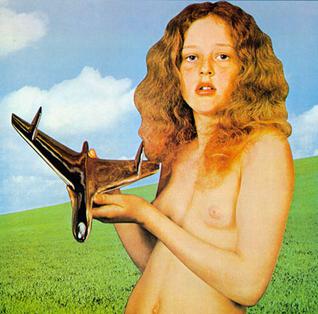
Blind Faith was a supergroup in a time when commercialism was considered bad form in the music business, and the album was only in stores for about a month before the band dissolved. These days it’s arguably notable for its garish cover; we much prefer the silly band photo that actually identifies the members, used on a later pressing, as shown here.

Because there was never a follow-up, collectors and fans have grasped at whatever bonus straws they could find. One of the first CDs (manufactured in Europe) had two unreleased tracks that have since been exposed as outtakes from a Ric Grech solo project, and not by Blind Faith at all. A later expanded edition proved that there wasn’t much for the band past the six songs recorded and released, and by the time they might have, they had already splintered back to their own ideas. Of those outtakes, the faster take of “Sleeping On The Ground” is of the caliber of the LP, or at least a B-side, while the electric “Can’t Find My Way Home” shows they were right to go with what they chose. (Fans of guitar improvisation and cowbell would likely drool over the four lengthy, Grech-less jams that make up the second disc.)

Blind Faith Blind Faith (1969)—4
2001 Deluxe Edition: same as 1969, plus 9 extra tracks

Friday, September 13, 2013

Cream 4: Goodbye

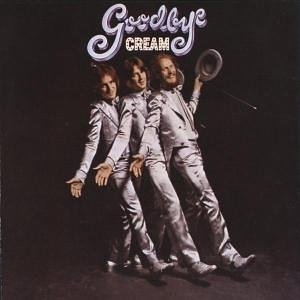
While not as obvious a moniker as the totally fake The Beatles Break Up in Mark Shipper’s revisionist history of that band (which, sadly, we can’t find a web link to demonstrate), Goodbye’s title and matching artwork (silly suits on the front, song titles on tombstones in the gatefold) didn’t leave any conjecture about the band’s future in the wind, having done a farewell tour the previous fall. Three songs from that tour make up two thirds of the album—a lengthy “I’m So Glad”, and so-so explorations on two songs from the album before.

In further democratic fashion, each of the remaining three tracks was contributed by each member, of varying quality. The first is the best—the classic “Badge”, co-written by Clapton and George Harrison, coming in under two minutes fifty like a good single should. It’s got everything: tension in the verses, an infectious bridge, distinct but pointless lyrics, and just enough piano and Mellotron to give it color. Even Jack Bruce keeps it simple on that intro. Jack then puts on a truly cartoonish voice for “Doing That Scrapyard Thing”, complete with a vaudeville piano fighting for space against the Leslie guitar. The music for “What A Bringdown” is credited to Ginger Baker—a rhythm that will reappear soon enough—while the track itself is a self-fulfilling prophecy, with vocals traded by the other two guys.

If they wanted to add more value, whoever was in charge could have included the previous fall’s flop single “Anyone For Tennis”, a strange little trifle that would have weighed the album too much on Eric (or maybe he was already embarrassed by it). It has shown up on the occasional CD reissue, but it really doesn’t add much. It pains us to rate this album so low, but as great as “Badge” is, the rest of Goodbye hints that they just couldn’t be bothered. It’s too bad, because when they were good, they were very, very good.

Cream Goodbye (1969)—2

Monday, September 2, 2013

Cream 3: Wheels Of Fire

Rock was getting excessive, and while it was only their third album, Cream decided to make it a double, with two sides of studio recordings and two others of live performances. Wheels Of Fire continues their explorations of psychedelia and blues, with striking results.

Jack Bruce takes lead vocals on nearly every song on the studio half, with Eric Clapton mostly limited to guitar. Still, the two of them leave their mark on “White Room”, a showcase for descending riffs and wah-wah, though what makes the song stand out are the violas on the intro, played by producer Felix Pappalardi. “Sitting On Top Of The World” was a blues standard played pretty much by everybody, including the Grateful Dead. Things start to get weird on “Passing The Time”; the intro doesn’t reappear in the track, the verse suggests a sinister nursery rhyme, and the chorus is about as fuzzy as can be. Jack completely takes over on “As You Said”, playing all the acoustic guitar and string bass, following his own Eastern vocal through a Leslie speaker.

Side two picks up the challenge with “Pressed Rat And Warthog”, another goofy children’s verse recited by Ginger Baker, heralded by trumpet and flute. (We’ve yet to clarify whether the closed-down shop selling atonal apples and amplified heat is a Beatles reference.) The blues come back for “Politician”, a twisted variation on “Born Under A Bad Sign”, which had only been recorded for the first time a few months earlier by Albert King. In between, “Those Were The Days” revives some of the mythological whimsy of Disraeli Gears, all the while defying a straight meter. “Deserted Cities Of The Heart” is a driving track, with more furious acoustic strumming and a nice counterpoint in the interludes.

Clapton finally takes a lead vocal on the live disc, and it’s not a stretch to say that the four minutes of “Crossroads” are the highlight of what’s already a pretty decent album, and excellent in its economy. Following that, it’s easy to lose focus for the 16 minutes of “Spoonful”, since it would appear both Clapton and Bruce are soloing simultaneously. “Traintime” is fine if you like a guy accompanying himself on harmonica, but Ginger manages to keep up. If you think that’s indulgent, you might not want to sit through “Toad”, but as drum solos go, it’s one of the more palatable ones, even at 16 minutes.

There’s a lot of music on Wheels Of Fire, and it’s not a stretch to suggest that the studio half plus “Crossroads” would have been sufficient on their own. But apparently the band was already thinking about moving on, so just as The Beatles decided to load up their albums to satisfy contractual obligations, Cream’s time wasn’t long.

While their first two albums had already received the expanded treatment, this one had to wait eight years after its 50th anniversary before it was released in a Super Deluxe Edition. The studio tracks appeared four times each across the first two discs: remastered stereo, phase-corrected stereo, and stereo and mono from “reference reels”. (The most obvious differences are an extra minute of jamming in the middle of “Passing The Time” and an extra second of speech before “Pressed Rat And Warthog”. Beyond that, your ears may vary.) A third disc presented the live portion of the original album, and a fourth offered up pretty much everything from Live Cream and Live Cream II that wasn’t in the Goodbye Tour box, plus a previously unreleased “We’re Going Wrong”. A fifth disc mopped up various single versions and even more alternate mixes, plus “Anyone For Tennis” in mono and stereo and two more live tracks. Of course, that meant a total of six variations of some songs, so you really gotta like this album to begin with.

Cream Wheels Of Fire (1968)—
2026 Super Deluxe Edition: same as 1968, plus 50 extra tracks

Wednesday, August 21, 2013

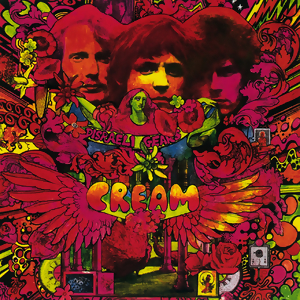
Cream 2: Disraeli Gears

Like any hungry band, Cream gigged a lot, and managed to build up enough material for another album. Disraeli Gears is arguably their most popular album, as it features many of their most famous songs—any of which are likely playing on the radio as you read this.

Eric Clapton was getting the courage to sing more, as heard on “Strange Brew”, but even more prominently in duet with Jack Bruce on “Sunshine Of Your Love”, one of the most iconic riffs ever. But a more important influence on the band would be engineer Felix Pappalardi, who managed to contribute songs (and eventually instruments) to the mix, starting with “World Of Pain”, the motif of which would be borrowed 27 years later by Elvis Costello, of all people. “Dance The Night Away” is dominated by two 12-string guitars, played in a style Jimmy Page must have heard while with the Yardbirds. The nearly plodding “Blue Condition” marks the vocal debut of Ginger Baker, whose pitchless delivery reminds one of Syd Barrett, though his pronunciation “through” as “froo” is endearing.

Jack’s voice dominates side two, which starts with the one-two punch of “Tales Of Brave Ulysses” and “SWLABR”. They’re two of the funniest songs in rock, and we’re not so sure that was intentional. Part of it comes from Bruce’s near-histrionic delivery (“comin' to me with that soulful look on your FA-A-A-A-CE”; “her NAME is AF-ro-DIE-TEE”,), the rest from the lyrics. They’re also very catchy, musically, “Ulysses” sporting a chord sequence that will re-appear, and soon. The “up” feel is soon enveloped in the mist that is “We’re Going Wrong”. It’s a very moody song, played with such tension and mystery that when the blues comes back for “Outside Woman Blues”, it’s like coming up for air. (It’s credited as an arrangement of somebody else’s song, which we’d love to hear to confirm whether Eric added “whilst” himself—making it the consummate British blues recording.) Despite some excellent guitar, “Take It Back” suffers from distracting harmonica and party sounds, but its off-kilter effect makes a logical transition to “Mother’s Lament”, a silly traditional song sung in thick Cockney three-part harmony.

Some would say Disraeli Gears is their best album; as ever, one’s enjoyment will be tempered by how sick they are of those radio staples. The interplay between the three is incredible, and entirely in synch, with nobody dominating. (The drums are still mixed to one channel, which was the style at the time.) Even if you never need to hear the hits again, there’s enough buried in between to grab your attention. (The eventual deluxe expansion offered the album in mono and stereo, but shortchanged fans with demos and BBC sessions that had already been released, the only rarity being “Blue Condition” sung by Clapton, in both mono and stereo.)

Cream Disraeli Gears (1967)—4
2004 Deluxe Edition: same as 1967, plus 29 extra tracks

Friday, August 9, 2013

Cream 1: Fresh Cream

These days Eric Clapton is the most famous member, but Cream started out as a compact democracy. The original power trio, they had Clapton on guitar (naturally) delivering the blues angle, rounded out by two jazz pedigreed guys in Ginger Baker on drums and Jack Bruce on bass, vocals, harmonica and whatever else he could touch.

Bruce was the dominant singer in the band, established on Fresh Cream, seeing as Clapton wasn’t as confident in his vocals at the start. Besides being able to carry a tune while playing the bass, Bruce’s keening baritone lent itself to layered harmonies, as displayed on “N.S.U.” and “Sweet Wine”, both of which could be called psychedelic before the fact. “Sleepy Time Time” and “Dreaming” come from more of a music hall tradition, which likely appealed to manager Robert Stigwood. All together, they deliver a diverse menu of styles. (Just to keep things confusing, the original US LP began with “I Feel Free”, their first hit single, and omitted “Spoonful”, which ended the first side. In their homeland, the opposite was the case. The CD you can buy today includes both, thankfully, being essential to the album.)

Side two provides something of a blues primer, being mostly hepped-up arrangements of songs every London R&B band should have memorized by then. “Cat’s Squirrel” is a suspended-fourth riff as old as the hills, and just plain fun. Clapton sings a rather polite lead on Robert Johnson’s ragtimey “Four Until Late”, which is wiped aside by a furious “Rollin’ And Tumblin’”. “I’m So Glad”, an extremely simple Skip James song, rises above its simplicity via a neat descending intro, compact guitar solo and dynamic drums. Those drums dominate the last song on the album, as “Toad” begins with a jam on E, followed by a definitely musical drum solo that would become a template, for better for worse, for drummers of all levels of skill.

It’s a terrific debut, economical and powerful. The one nitpicky thing that holds back enjoyment of the album—besides the bomber jackets on the cover—is its extreme stereo separation, with the basic backing track (instruments) in one channel and the vocals on the other. That makes some tracks sound like one of your speakers isn’t working, and after seemingly every other album had received some kind of expanded edition, Fresh Cream had to wait until its fiftieth anniversary had passed before this was rectified. The Super Deluxe Edition presented the original British sequence in both mono and stereo, each on its own disc bolstered by singles and alternate mixes. A third disc added a pile of outtakes and BBC sessions, while a Blu-ray disc included the US mix (plus “Spoonful”, their first single “Wrapping Paper”, and “The Coffee Song”, a rarity released against their wishes in Scandinavia) in both mono and stereo, in high resolution.

Cream Fresh Cream (1967)—4
2017 Super Deluxe Edition: same as 1967, plus 52 extra tracks (and Blu-ray)

Sunday, June 9, 2013

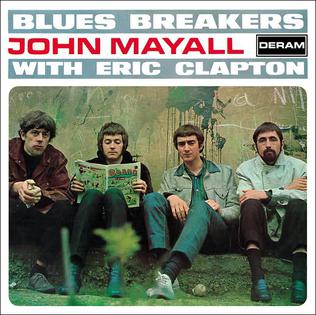
Eric Clapton 1: Blues Breakers

John Mayall was responsible for launching the careers of countless blues guitarists and bands, mostly because the people he found kept taking off on him and forming other outfits. He himself wasn’t blessed with the best voice, but made up for it with his organ and harmonica playing, and gave his sidemen room to shine. Blues Breakers was his second album, on which he gave co-billing in the same size type to the lead guitarist who’d bolted from the Yardbirds for being too poppy.

This is a solid electric blues album, wherein Eric Clapton displays his prowess and tone on a Les Paul, and a good argument that the Brits played it better than any other imitators. And they weren’t stuck in the past, either; through this album disciples were turned on to the likes of Otis Rush, Freddie King, Memphis Slim, and Little Walter. Respectively, “All Your Love”, “Hideaway”, “Steppin’ Out”, and “It Ain’t Right” were only a few years old at the time. “Parchman Farm” is based on Mose Allison’s arrangement, and features no guitar we can discern. Ray Charles’ “What’d I Say” is mostly a setup for a Hughie Flint drum solo; when the band comes back in, Clapton quotes “Day Tripper”. The kid also takes his first lead vocal on Robert Johnson’s “Ramblin’ On My Mind”.

Of the originals, “Little Girl” is tight and tense, while “Another Man” recycles older lyrics as Mayall’s own (tsk tsk) for a harmonica showcase. “Double Crossing Time” is a Mayall-Clapton cowrite, providing a slower change of pace, just as “Have You Heard” does on the other side. That one’s got a prominent saxophone; “Key To Love” uses a horn section well in the mix too. (That bass player, by the way, is the perennially unsung John McVie.)

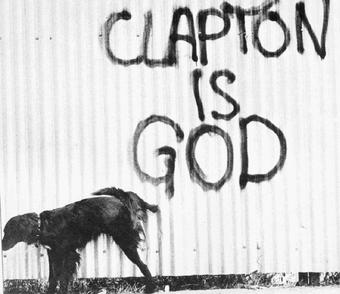
When it first came out on CD, the only extra content was the now-famous photo of graffiti with canine commentary. An eventual remaster added a one-off duet single and its B-side, while the eventual Deluxe Edition put the mono and (later) stereo mixes on one disc, with a variety of BBC sessions and previously scattered live tracks, some of which have Jack Bruce on bass. But the original 12-track lineup will be enough to show why some thought Clapton was God.

John Mayall With Eric Clapton Blues Breakers (1966)—4
2001 remastered CD: same as 1966, plus 2 extra tracks
2009 Deluxe Edition: same as 2001, plus 29 extra tracks

Sunday, April 14, 2013

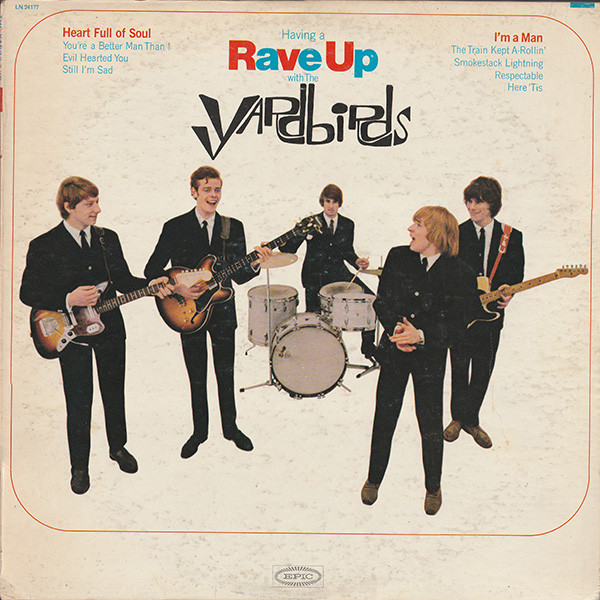
Yardbirds 2: Having A Rave-Up

After scoring a hit single on both sides of the pond, the Yardbirds’ manager made sure they kept the hits coming in between gigs. Single after single were released in the UK, while America demanded albums, and that’s how Having A Rave-Up With The Yardbirds! happened.

Side one of the album offers a smattering of those singles, although the first track made its debut here. The mildly socially conscious “You’re A Better Man Than I”, written by Manfred Mann’s drummer, sports good dynamics and a exploratory Jeff Beck solo over one chord. “Evil Hearted You” and “Heart Full Of Soul” were both written by Graham Gouldman, who was responsible for “For Your Love”; the former has a mild James Bond theme feel, while the latter sports a very Indian-flavored riff. Bo Diddley’s “I’m A Man” had already been covered by everybody in London, but it’s the Yardbirds’ version that stands above, with their patented rave-up approach (which would be copped by the Count Five for “Psychotic Reaction”). The rhythm section gets credit for writing “Still I’m Sad”, which betrays the brief flirtation many British groups of the time played with Gregorian chant. “Train Kept A-Rollin’” is a trash classic, from Beck’s locomotive imitation to Keith Relf’s inexplicably double-tracked, mismatched vocals. This recording is responsible for Led Zeppelin and Aerosmith, so take that as you will.

While the packaging said nothing about it, the entirety of side two was excerpted from the previous year’s Five Live Yardbirds, which was the band’s only British LP release so far, and which still featured Eric Clapton on lead guitar. This was the stuff Clapton thrived on: Howlin’ Wolf’s “Smokestack Lightning”, the Isley Brothers’ “Respectable”, Bo Diddley’s “Here ‘Tis”, and another blast through “I’m A Man”. And considering it was recorded at London’s legendary Marquee Club, the sound is very good.

Even though it wasn’t clear how or why the album was put together, Having A Rave-Up remains a solid listen. The singles are all solid, and somebody did us a favor by allowing the comparatively lengthy songs on side two, averaging five minutes each, to show the strength of the band, even if it did give short shrift to Clapton in the process. The album has had a confusing life in the digital era, but at the same time Five Live Yardbirds has remained available—starting with an official U.S. release on Rhino in 1988—which is a blessing.

The Yardbirds Having A Rave-Up With The Yardbirds! (1965)—

Sunday, September 2, 2012

Yardbirds 1: For Your Love

As with most of the British blues boom bands, balancing integrity with teenybopper appeal, the Yardbirds catalog is a mess. At one time or another one could find all their “classic” songs on one collection or another, but often they’re mixed with multiple takes of various blues covers. Their main consistency through all the changes was singer Keith Relf, he of the bleach-blonde bowl cut and surprisingly nasal voice. He’s the one singing on the hits, no matter which of the legendary guitarists—Eric Clapton, Jeff Beck, Jimmy Page, and of course, Top Topham—who passed through the organization is playing. Chances are, if it gets airplay today, Beck is playing lead. (The drummer is always Jim McCarty, but good luck picking him out.)

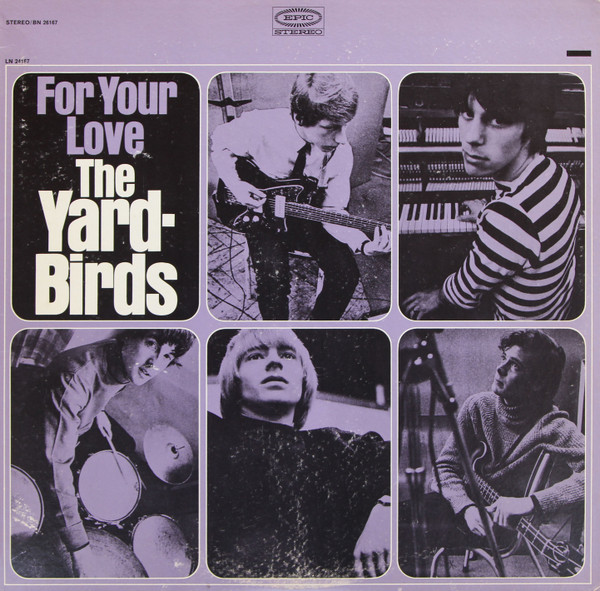
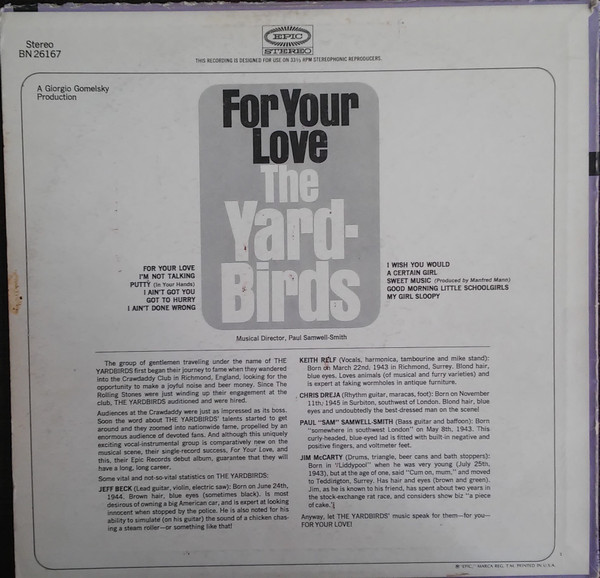
Their first American LP had no British equivalent, and by the time it came out, Clapton had already left, replaced by Jeff Beck. He appears on the cover of For Your Love, despite only playing on three of the songs, and depicted in front of a piano, which he did not play. The album was put together by their manager, Giorgio Gomelsky, to capitalize on the eponymous hit single that was Clapton’s last straw. Having already missed out on the money the Rolling Stones were making, Gomelsky was determined to make the most of the Yardbirds.

That single was dominated by a harpsichord and bongos also not played by any official band member, with guitar only appearing on the bluesy middle section. Since the band hadn’t started writing their own material yet, the rest of the album is dominated by blues and jazz covers, most already released on British singles. Some of these are definitive, like Mose Allison’s “I’m Not Talkin’” (which has a lot of Beck bending), Billy Boy Arnold’s “I Wish You Would” and “I Ain’t Got You”, and the venerable “Good Morning Little Schoolgirl”. Even “A Certain Girl” has charm in its call-and-response vocals.

They aren’t all winners. “Putty (In Your Hands)” was first recorded by the Shirelles, and probably appealed because of its “Money”-style riff. Clapton dominates the Chess-influenced “Got To Hurry” instrumental, which putters to a halt. “I Ain’t Done Wrong” is another studio jam on old tropes mostly notable for Beck’s wah pedal and heavy chording. “Sweet Music” stands out, partially because it’s a botched attempt to croon, and mostly because the overall sound is different, having been produced by contemporary scene fixture Manfred Mann. And “My Girl Sloopy” has been done better by lots of other people.

Still, as albums go, For Your Love delivers a lot of what made the Yardbirds popular over here, with enough of the blues sound to keep purists happy. It’s been out of print in the States for a long time, but overseas labels have reissued it multiple times, with and without bonus tracks. Something else to remember—most of the band’s early stuff was recorded quickly and cheaply, and therefore sounds awful today. The goofy liner notes must also be read to be appreciated.

The Yardbirds For Your Love (1965)—3

Wednesday, February 23, 2011

Rolling Stones 37: Rock And Roll Circus

Way back in 1968, around the time of the original release of Beggars Banquet, the Stones decided to promote it with a TV special built around the concept of a variety show, with guest performances and their own mini-concert set. It was then shelved immediately after filming completed, ensuring that Rock And Roll Circus became one of the most legendary unreleased projects of the rock era. (Incidentally, Michael Lindsay-Hogg can claim involvement in two such deals.)

Its legend only grew when one of the performances, the Who playing a fantastic version of “A Quick One”, was included in their 1979 movie The Kids Are Alright. With its status as a notoriously incomplete event, it was particularly surprising when the film (and matching CD) was released intact a good 28 years after the original taping.

It was worth the wait. Rock And Roll Circus is an amazing snapshot in time, showing the Stones at a key place in their development, playing “Jumpin’ Jack Flash” and four songs from Beggars Banquet, and previewing “You Can’t Always Get What You Want”. Even Brian Jones played with enthusiasm, adding some slide guitar despite one hand in a cast. (He’d be dead the following July; indeed the liner notes make mention of all the participants who’d passed on in the interim.) And of course, we always like hearing Nicky Hopkins play piano.

The guests are revealing, as well. Taj Mahal wasn’t well known anywhere yet, and Jethro Tull still sounds like a blues band. Marianne Faithfull sings one song sweetly, and the Who did indeed blow everyone else off the stage with their definitive take on “A Quick One”. The most surprising performance was that of the Dirty Mac, a supergroup involving Eric Clapton, Mitch Mitchell, and Keith Richard (on bass) backing John Lennon for a rendition of “Yer Blues” from the just-released White Album. Unfortunately, the same combo continues playing behind Yoko Ono, in a sloppy jam you’ll be happy to skip.

When it finally came out, Rock And Roll Circus did indeed live up to its hyped legend. One only wishes that the bands could have played more songs, and longer. They did, after all.) But what’s there is what there was, and the program flows nicely on CD. Finally.

Over the years various DVDs offered bonuses in the way of additional footage and multiple angles, but it took another two decades for any further audio to be released. Nothing was added to the main program, but the deluxe expanded package added a second CD with three further Taj Mahal songs and Brian’s introduction of two pieces by classical pianist Julius Katchen (who would beat Brian to the grave by a couple of months due to cancer). Most exciting are three more performances by the Dirty Mac: an alternate take of “Yer Blues”, a long-bootlegged “Warmup Jam”, and even a passable attempt at “Revolution” that breaks down when John says he doesn’t remember what to do for the solo; why he didn’t just ask Nicky Hopkins, who played it, is lost to the ages.

The Rolling Stones Rock And Roll Circus (1996)—4
2019 Deluxe Edition: same as 1968, plus 9 extra tracks

Thursday, January 27, 2011

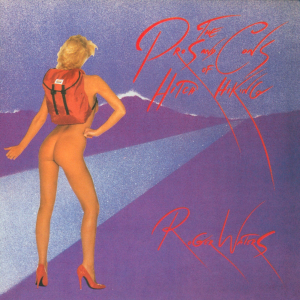
Roger Waters 1: The Pros And Cons Of Hitch Hiking

Immediately after unleashing The Final Cut, Roger Waters went back to the studio to record another, even more impenetrable song cycle, originally concocted back before The Wall. What eventually emerged as The Pros And Cons Of Hitch Hiking had been rejected by the other Floyds as “too personal”, and no matter how many times one listens to it, they were right.

At least the concept is intriguing: following the dream/nightmares of a man in the pre-dawn hours, presented in real time, and each of the songs is time-stamped. For roughly 42 minutes Roger muses over the same I-iv motif in 12/8 meter; sound effects and dialogue snippets abound, and if there’s a story in here, it’s not linear. He’s driving with his wife, they pick up a pair of hitchhikers and he attempts intercourse with one of them. His guilt is repaid by an attack by Arab terrorists who assault his wife, so he imagines himself away at Oktoberfest. He makes an attempt to save his marriage by moving out to the country, which soon goes awry. Then poof! He himself is a hitchhiker, eventually realizes that his problems aren’t that different from the rest of humanity, feels better, wakes up scared and is relieved to find his wife sleeping by his side.

With only a few exceptions, it’s one long song. Rolling Stone’s Kurt Loder said it best: “You could count the actual melodies here on Mickey Mouse’s fingers.” The ones that stand out are recycled from “Mother”, “The Final Cut”, “In The Flesh” and “The Fletcher Memorial Home”, and the effect isn’t so much clever self-reference but laziness and lack of inspiration. “Sexual Revolution” attempts to provide a beat, but it turns out this was a Wall reject. He delivers “Go Fishing” so histrionically it’s no wonder she left him in the country. The title track is catchy, but the cryptic references to Yoko Ono, Dick Tracy and Shane only make it seem like another dream. The song everyone likes is “Every Stranger’s Eyes”, which is mostly one of his litany lists, but has enough of a decent backing to make it soar.

At least the album is “Floydian” in its presentation. He uses most of the supporting players from The Final Cut, with the key additions of Eric Clapton (for a Strat tone, and a thumb of the nose to David Gilmour) and David Sanborn, whose squawking sax underscores his discomfort anytime thinks get dark. He took Clapton on the road to present the album and key songs from his past in a multimedia extravaganza. But ultimately, The Pros And Cons Of Hitch Hiking is just plain uncomfortable, leaving the listener in a bad mood and likely to lash out at unsuspecting friends and family. And if anyone can explain what exactly those pros and cons are, we’d love to know.

Roger Waters The Pros And Cons Of Hitch Hiking (1984)—2