Showing posts with label steve winwood. Show all posts

Friday, February 27, 2026

Steve Winwood 2: Arc Of A Diver

After a decade of wandering, bolstered by session work and hopefully decent royalty payments, Steve Winwood re-emerged at the start of the ‘80s as a pop star, once again on his own terms. Arc Of A Diver took everyone by surprise, starting with an incredibly catchy hit single, and a reminder that the kid could truly belt out a classic. What’s more, he recorded the album completely on his own, playing all the instruments in his own studio, yet it has the sound of a full band captured by a team of engineers. (Fun fact: the guy responsible for the cover art also did the original paintings for Bob Dylan’s Saved that same year, as well as the faux-cubic designs of two Traffic albums.)

The album was his first collaboration with lyricist Will Jennings, who’d already written hit songs for such adult contemporary icons as Barry Manilow and Dionne Warwick, and would go on to win Oscars for his movie themes. While his lyrics for “While You See A Chance” are definitely in the feel-good attaboy category, the music, driven along by Winwood’s iconic piano, organ, and that synth sound, emerging like an aural sunrise, makes the song a true winner. The title track is another co-write with Viv Stanshall, full of imagery and sporting nice guitar licks throughout. Unfortunately, “Second-Hand Woman” derails the progress, between the lyrics, dated production, and programmed drums. Fortunately, it’s the shortest song on the album, and is forgotten shortly after “Slowdown Sundown”, a ballad with trilling mandolins that recalls the better parts of the last Traffic album.

Side two concentrates on grooves; “Spanish Dancer” isn’t much more than a one colored by different synth tones, only occasionally diverting into another theme for the choruses. The disco inferno continues on “Night Train”, but at least he derived a nice popping bass line, albeit on the Minimoog. He does a pretty good job of jamming with himself, so even though it’s a home demo in need of editing, it works. “Dust” takes us out with another reverie, and superior lyrics by the guy responsible for “Second-Hand Woman”.

Arc Of A Diver made Steve Winwood a household name again, even more so than he’d ever been. With six out of only its seven tracks topping five minutes, he hadn’t quite figured how to keep his ideas compact, but listeners happily stayed for the whole ride. (The eventual Deluxe Edition wasn’t very illuminating, adding only two alternate mixes, a later rerecording of “Spanish Dancer” with a deeper vocal, and a BBC radio documentary about his career.)

Steve Winwood Arc Of A Diver (1980)—3
2012 Deluxe Edition: same as 1980, plus 4 extra tracks

Tuesday, November 4, 2025

Steve Winwood 1: Steve Winwood

Not long after appearing in Stomu Yamashta’s Go project, Steve Winwood finally put out his first album under his own name. The songs on the album are very much of the time, soundwise; Jim Capaldi is still a songwriting collaborator, and Reebop appears here and there, but the tunes aren’t really any more exciting than the ones on the last Traffic album. He plays all the keyboards and most of the guitars, and Willie Weeks and Andy Newmark are the rhythm section for most of it, which lends to some of the blandness.

The tone is set by “Hold On”, which but for his distinctive voice sounds like something off a contemporary Boz Scaggs album. The groove picks up a bit for “Time Is Running Out”, a wordy slice of social commentary that crams a lot of words, images, and rhymes into a mix that obscures them, even over the chanted coda, so any intended statement is lost in a reason to dance, which one would think defeats the purpose. “Midland Maniac” stands out because it’s performed entirely by the auteur. Unfortunately, it’s also eight-and-a-half minutes long. It does have distinct, not always cohesive sections, and the changes keep the ear’s attention, but there’s no reason to drag it out.

While it sports a different rhythm section and Junior Marvin of the Wailers on guitar, “Vacant Chair” isn’t that different from the rest of the album, but it’s simply a better, more developed song with an arrangement that belies its somber subject matter, that being the death of a friend. (We had to look up the meaning of the repeated African phrase; it translates as “the dead are weeping for the dead”.) “Luck’s In” begins promisingly, but turns its back on Latin jazz for more standard funk, albeit with an odd meter in the verses. The romantic lyrics don’t gel with the backing, and whatever hope lies therein has disappeared on “Let Me Make Something Of Your Life”. With echoes of “No Time To Live” and “(Sometimes I Feel So) Uninspired”, it certainly sounds like the obvious choice for a closer.

Steve Winwood isn’t bad, but it doesn’t really stick. We always forget what a good guitarist he could be, but we’re guessing the songs are all on the long side because that’s all he had, and they needed to fill up the sides somehow. If anything, it’s very much a harbinger for the solo career he would soon nurture and develop—in other words, safe adult-contemporary pop without much bite. Which is fine if you like that sort of thing.

Steve Winwood Steve Winwood (1977)—

Friday, December 12, 2014

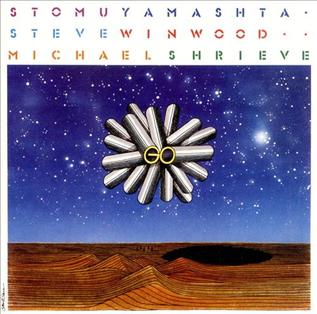
Stomu Yamashta: Go

Steve Winwood was relatively quiet in the years following the end of Traffic, before gearing up for the solo career that would ultimately bring him a higher love. His first real project was a rather adventurous one, and one that still dwells in relative obscurity today.

A truly odd gathering of musicians, Go was billed as a collaboration between Japanese percussionist Stomu Yamashta, Winwood and Santana drummer Michael Shrieve, in that order. As if that wasn’t enough, their eponymous album also included contributions from Tangerine Dream’s Klaus Schulze on synthesizers, Pat Thrall and Al DiMeola on lead guitars, Junior Marvin from Bob Marley’s Wailers on rhythm, Traffic’s Rosko Gee on bass, backing vocals by Thunderthighs, and string arrangements from none other than Paul Buckmaster. Taken all together, Go melds jazz fusion, synth prog, and even, given the year, disco for an end result that should fail horribly, but doesn’t.

Like all concept albums, good or bad, there’s a story, which isn’t easy to follow considering that it begins on side two. Lyrics for all tracks save one are credited to Michael Quartermain, if that is his real name. And even once you get the story (travel through space and time, good vs. evil, what is the nature of man, how can you mend a broken heart and so forth) you don’t really care; it’s the music that matters.

A suitably spacey intro brings in “Solitude”, which turns into “Nature” in time for Winwood’s first, tentative vocal. Similarly, “Air Over” is a setup for “Crossing The Line”, a more straightforward rock song. “Man Of Leo” is pretty dated funk, but some typical tasty Hammond organ work, melding to DiMeola’s solo workout for “Stellar”, punctuated by seemingly random clanging that will inspire fans of Blazing Saddles to exclaim “The sheriff is near!” The story presumably ends with the extended extraterrestrial effects of “Space Theme”.

Lots more space sounds dominate side two, through “Carnival” which is meant to evoke Stravinsky, but might be better appreciated with “Atom Heart Mother” or “Saucerful Of Secrets” as a point of reference. Winwood returns halfway through the side with some truly mushmouthed vocals on “Ghost Machine”, a brisk number that ends almost as quickly. “Surf Spin” floats around to set up “Time Is Here”, an aimless jam for a “seize the day” message, while “Winner/Loser”, credited solely to Winwood, has a contemporary Elton John vibe, but also sounds the most like the natural follow-up to the last Traffic album.

Most of the participants would go on to perform and release the suite (in its correct order, with extended solos) for the self-explanatory Go — Live From Paris, and most save Winwood would return on Go Too. The albums have appeared on CD, sometimes combined into a complete set, but the original LP, with its wonky sequence and booklet, is still preferred.

Stomu Yamashta/Steve Winwood/Michael Shrieve Go (1976)—3

Wednesday, September 25, 2013

Blind Faith: Blind Faith

Weary of playing in a so-called supergroup, Clapton left Cream to form another one. But Blind Faith wasn’t a complete about-face, as Ginger Baker came along. Thus, two-thirds of Cream hooked up with Steve Winwood, late of Traffic, and Ric Grech (who played the violin on the Stones’ “Factory Girl”) to pursue Clapton’s vision of the Band, with not a little influence from Traffic. Their self-titled album was recorded fairly quickly, by today’s standards anyway.

“Had To Cry Today” beats a riff into the ground for nearly nine minutes, with lots of overlaid guitars and a nicely phased freak-out section that’s not even that freaky. However, “Can’t Find My Way Home” would become many people’s favorite campfire song, with its descending D shapes, acoustic guitars and haunting vocal. Winwood had already mastered the second-verse-same-as-the-first method on “Dear Mr. Fantasy”, making it easy for budding folksingers to memorize it. His piano finally emerges on “Well All Right”, which put some money into Buddy Holly’s estate; it would not be the last time a Clapton version would put a definite stamp on somebody else’s song. Eric himself only wrote one song on the album, but following the single-verse method of “Can’t Find My Way Home”, “Presence Of The Lord” was given to Stevie to sing, and he does, nicely. (Notably, Clapton does not take a lead vocal on the album.)

Side two starts of well with “Sea Of Joy”, a multi-part song that nicely mixes psychedelia with folk, with equal doses of guitar and organ, and even a violin solo. “Do What You Like” is much more trying; credited solely to Ginger Baker, mostly likely for the 5/4 meter, it has a couple of verses, then lets Stevie, Eric, Ric and Ginger each solo for a while. This indulgence would be said to be sadly indicative of what was wrong with the album, and would likely be skipped by most listeners not already grooving or on chemicals. The last minute of subtle cacophony, however, is about as fitting as any grand “finale”.

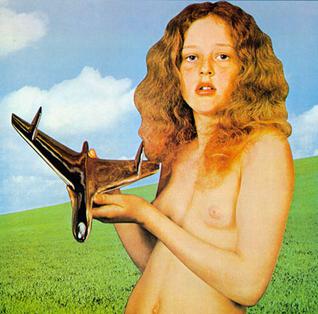
Blind Faith was a supergroup in a time when commercialism was considered bad form in the music business, and the album was only in stores for about a month before the band dissolved. These days it’s arguably notable for its garish cover; we much prefer the silly band photo that actually identifies the members, used on a later pressing, as shown here.

Because there was never a follow-up, collectors and fans have grasped at whatever bonus straws they could find. One of the first CDs (manufactured in Europe) had two unreleased tracks that have since been exposed as outtakes from a Ric Grech solo project, and not by Blind Faith at all. A later expanded edition proved that there wasn’t much for the band past the six songs recorded and released, and by the time they might have, they had already splintered back to their own ideas. Of those outtakes, the faster take of “Sleeping On The Ground” is of the caliber of the LP, or at least a B-side, while the electric “Can’t Find My Way Home” shows they were right to go with what they chose. (Fans of guitar improvisation and cowbell would likely drool over the four lengthy, Grech-less jams that make up the second disc.)

Blind Faith Blind Faith (1969)—4
2001 Deluxe Edition: same as 1969, plus 9 extra tracks