Tuesday, December 31, 2013

Gerry O’Keefe: Whatever Suits You

The word “pop” in relation to music has had several connotations over the past fifty years, most of them derogatory. Today it conjures mental images of man-boys with bad haircuts and lithe jailbait writhing or getting implants. Once upon a time, even the Beatles were considered a pop group, before they were appreciated as musicians by those deemed fit to judge such things.

Pop is short for popular, of course, and to be popular in the industry is to be lucrative. Therefore, the songwriters behind all the big faceless hits of the ‘60s in particular had to crank out songs that would appeal to current trends, but because they were craftsmen (and women), they took a certain pride in their work, and strove to create things of lasting merit. They were made to sound good through a single speaker broadcasting AM radio, certainly. Nostalgia doesn’t have to be pathetic, of course.

These days, the purveyors of pop work with ProTools and autotune, and the sounds they create can be as interchangeable as the product that ultimately made Greg Brady decide not to wear Johnny Bravo’s suit. Somewhere among them is a handful of writers who still start with an acoustic guitar, pen and paper to hone their craft.

Gerry O’Keefe understands how it’s done, and is doing his own part trying to reclaim the tradition of the pop craftsman in a sterile atmosphere. His music stems from the example set by the Brill Building types that dominated the top 40 charts of decades past. After many years working in original and cover bands in the Chicago area, his knack for recognizing a solid hook has finally resulted in his very first album under his own name.

Whatever Suits You is an easygoing collection of friendly strums, accented by heartland riffs and understated harmonies. Best of all, the words are as well constructed as the chords. Any modern acoustic troubadour would kill for a song like “Your Brand New Beginning” in their set. It’s easy to imagine songs like “Good When It’s Gone”, “We’ll Call It Hope” and “Stuck, Still, Not Even Slow” on the radio. “The Road That Doesn’t End” gets an extra boost from a simple piano added to the standard guitar-bass-drums combination to accentuate the ache. And good luck getting the Beatles ‘65 twang of “Darlin’ Divine” out of your head once it’s there.

It would seem that people don’t write songs like this anymore, but we know that’s not true; they’re just hard to find. Thankfully, Whatever Suits You is available via the usual online merchants, in download format as well as an actual, tangible CD with artwork, liner notes and everything. It’s one of the nicer surprises of the year.

Gerry O’Keefe Whatever Suits You (2013)—3½

Monday, December 30, 2013

Programming Alert

This blog has been going steady for nearly six years, and there is still plenty of music yet to be tapped, considered and collected. It began as a creative outlet during an employment drought, and has continued despite positive changes to that drought.

When we began, we thought twice a week would work, in the tradition of the two days in the week when we got our main shipments at the CD store. Time and inspiration led us to post three days a week soon after embarking, which led to some truly imaginative scheduling.

The inspiration is still there, but the time is not. Therefore beginning this week, we're going back to that twice-weekly schedule. We hope that dedicated readers will understand; after reviewing about a thousand albums, can anyone accuse us of slacking? Ultimately, quality must be considered before quantity. Besides, it's not like we're stopping completely.

Look for a new post tomorrow, and again on Friday. That's the pattern we'll keep going forward, and should we manage to speed up the output again, everybody wins.

Thanks for reading this far, and please keep spreading the word. Here's to a great new year.

Sunday, December 29, 2013

David Crosby 3: Thousand Roads

Only four years after his second solo album, David Crosby appeared with a third installment. Could he really have written an album’s worth of songs in that time?

Unfortunately, as Thousand Roads proved, the answer was a big fat no. Not that it bothered him; he was happy to restrict himself to vocals, not even touching the guitar, and contributed exactly one solo composition in addition to two high-profile co-writes. The obvious selling point was the first single, “Hero”, not only written with Phil Collins but featuring him prominently on vocals. “Yvette In English” is a collaboration with Joni Mitchell, who would release her own version a year later; Crosby’s is laid-back, and a high point. The title track also has promise, something of a dirty blues with minimal drums and electric and acoustic dueling from Andy Fairweather-Low and Bernie Leadon respectively.

Every other song was written by somebody else, all strictly in the adult contemporary mode, yet with sensitive hippie ideals and themes close to his heart. “Too Young To Die” comes from Jimmy Webb, of all people, and is about driving fast, as opposed to Stephen Bishop’s closing tearjerker “Natalie”, about an OD victim. Marc Cohn and John Hiatt, both decent writers whose commercial high points were already behind them, are featured in the first half, and the genre’s favorite unknown songwriter, Paul Brady, gets a spot in the second half, as does a writer who’d recently given a couple of hits to Bonnie Raitt.

Throughout the album, Graham Nash pops up to harmonize with his buddy, and help remind the listener who’s album it is. Anyone looking for a pleasant MOR album for upscale suburban afternoon will enjoy it, but coming from the legacy of David Crosby, even considering CSN’s lightweight tendencies, Thousand Roads is a dead end. (Yeah, we said it.)

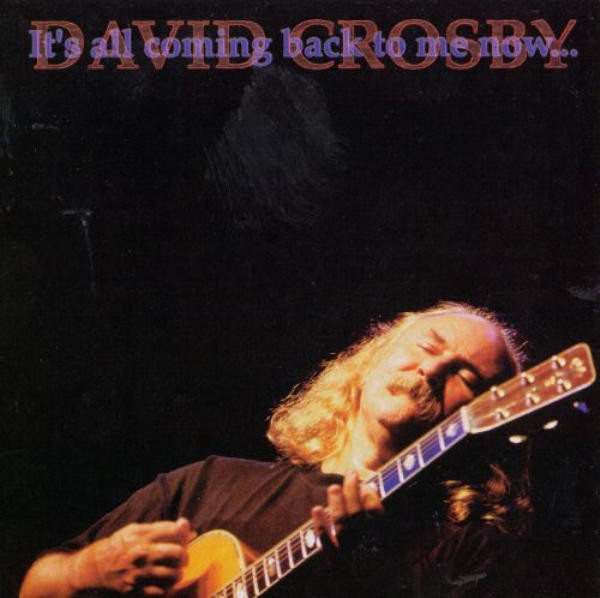
Amazingly, his brief promotional tour for the album highlighted two new original songs, both of which appeared on It’s All Coming Back To Me Now…, an entertaining document of a night at the Whisky A Go Go. “Rusty & Blue” is a decent meditation with nice atmospherics by Jeff Pevar, while “Till It Shines On You” would get a full CSN treatment soon enough. Lengthy explorations on tunes from the ‘60s and ‘70s fill out the package, and not only does Chris Robinson of the Black Crowes come out to mewl on “Almost Cut My Hair”, good ol’ Graham Nash shows up for that extra bit of excitement. (The album title mystifies, as it’s likely Crosby hadn’t heard the song that Celine Dion would scream to the top of the charts in a few years’ time.)

David Crosby Thousand Roads (1993)—2
David Crosby
It’s All Coming Back To Me Now… (1995)—3

Friday, December 27, 2013

Beatles 33: Bootleg Recordings 1963

When a rumor emerges in Beatlemaniacland, the inhabitants immediately begin picking it apart, seesawing between euphoria and anger, and falling off several times into conjecture and other tangents. So it was that news of a bumper bundle of unreleased material to emerge on iTunes (now that the two companies named Apple were the bestest of buddies) sparked off a week or so of unfounded opinions. Then it was available, then it wasn’t, and then it was again.

Given the title Bootleg Recordings 1963, it’s a little over two hours of material—predominantly BBC radio performances as yet uncollected on an official Apple release, plus several studio outtakes and two demos. In all there are 59 tracks, retailing for 40 bucks American, or 67¢ a song. All of the BBC stuff has been floating around on bootlegs for years, as have the demos, while most of the studio outtakes appear for the first time in stereo.

The studio outtakes come first, peeking into the sessions for the Please Please Me album and follow-up single, and two more from later in the year. Then it’s a haphazard leap into the many radio appearances, tagged with the alleged (and often incorrect) original broadcast date. The usual suspects appear, as well as performances of some of the covers they didn’t put on their albums. If you haven’t had your fill of “A Taste Of Honey”, “Till There Was You” or even “She Loves You”, you might after this. Finally, non-professional recordings of two songs Lennon and McCartney gave away (“Bad To Me” and “I’m In Love”) round out the program.

Lots of collectors balked at spending their iTunes credits on stuff they mostly had, and cursed Apple for “ripping off the fans again”. Which is only true if something was promised and not delivered, and that didn’t happen. By boldly stating that these are bootlegs, that excuses any lack of sound quality. Considering how clean the studio stuff is, that’s not an issue either. It’s also hilarious to hear someone who can only have been familiar with this music thanks to pirates, copyright cheats and outright thieves complain about the rightful owners’ integrity.

Most tantalizing of all is the knowledge that there are several hours’ worth of studio material not included here. So if this was a gambit to protect their copyrights, as has been assumed with the existence of similar Bob Dylan compilations, what is the fate of the rest of the material? Clearly, we haven’t emptied the well.

The Beatles Bootleg Recordings 1963 (2013)—3
CD availability: none; download only

Wednesday, December 25, 2013

David Darling: Cycles

The ECM label specializes in jazz with a European bent, though such a generalization is not entirely accurate. The music tends to be very atmospheric and usually experimental, with eclectic cover art to match. When the Windham Hill label started, it was ECM Records they tried to emulate. As a result, and after the fact, ECM has been lumped in with the New Age category. True, there are some similarities between performers and even content, but it’s an unfair dismissal. Trying to describe an ECM record is like dancing clumsily, badly and loudly about Architectural Digest.

Since their inception, the label has boasted many big names in jazz, including Keith Jarrett, Chick Corea, Charlie Haden and Pat Metheny. One of their more successful pairings was the Norwegian saxophonist Jan Garbarek with the Hilliard Ensemble male vocal quartet. Just because you like one ECM record doesn’t necessarily guarantee you’ll like another—or any other—but their standard is of such high quality that once you’re in, anything they do is worth checking out. Some of our favorite recordings have emerged this way, including Pat Metheny’s New Chautauqua, Ralph Towner’s Diary, Eberhard Weber’s Later That Evening, Keith Jarrett’s Köln Concert, The Hilliard Ensemble’s Lamentations Of Jeremiah and Jan Garbarek’s I Took Up The Runes.

Garbarek, a favorite of label owner and producer Manfred Eicher, was essentially the reason why ECM Records got started. In addition to his own vast discography, he appears on many albums in the ECM catalog, including one of the brightest of the hidden gems in the history of music. Cycles is credited to the cellist David Darling, but is essentially an ensemble piece, with prominent contributions on every track from Garbarek, Steve Kuhn on piano, Arild Andersen on bass, Oscar Castro-Neves on guitar, and the late, great Colin Walcott (most famous for his work in Oregon with Ralph Towner) on sitar, tabla and percussion.

The opener, “Cycle Song”, features a series of relative chords in fifths, not dissimilar to “Thanksgiving” from George Winston’s December. The combination of piano and cello was the sound our mind’s ear had heard for years, finally realized. “Cycle One: Namasté” offers a spooky little theme for Garbarek to spring from, and something of a setup for the epic, aptly-titled “Fly”. Side two begins almost abruptly with “Ode”, which was originally recorded under the title “Ode To A Fillmore Dressing Room” on Icarus by the Paul Winter Consort. “Cycle Two: Trio” and “Cycle Three: Quintet And Coda” are lengthy yet engrossing extrapolations on similar themes. The closing “Jessica's Sunwheel” is almost an anticlimax, as it breaks out of the predominantly modal structures of the previous tracks.

This hardly does justice to the experience of hearing the album itself, and Cycles is not for everyone. It works best at dusk, on grey rainy mornings, and particularly on yuletide nights with only the lights of the tree on. The ECM site doesn’t offer audio samples, but Amazon does. Since the label has never gone overboard promoting any of their releases, it’s never been easy to find. We got it as a gift one wonderful Christmas, in a pile of secondhand LPs selected for their importance to the giver in the hope that we’d appreciate them too. And we did. If it resonates with you, Constant Reader, then there’s a chance it might lead to you other wonderful albums as well. Isn’t it great when music does that?

David Darling Cycles (1982)—4

Monday, December 23, 2013

Bob Dylan 56: 50th Anniversary Collection 1963

Well, it happened again, sort of. This time, the assumed record label attempt to either protect their archives, tease the public or both resulted in a six-record set of otherwise uncollected (but mostly bootlegged) Bob Dylan recordings, with limited availability.

This time, however, the studio takes on 50th Anniversary Collection 1963 total exactly six: alternates of “Eternal Circle” and “Percy’s Song”, another extremely sloppy stab at “That’s All Right, Mama” that peters into something called “Sally Free And Easy” before stopping altogether, the slightly more interesting “East Laredo Blues” piano solo, and the legendary unreleased tracks “Hero Blues” and “New Orleans Rag”.

The bulk of the live recordings are of more historic than musical interest. “When The Ship Comes In” at the March on Washington, for example, would be a lot more palatable if it didn’t sound like a news broadcast (and didn’t have Joan Baez yodeling all the way through it). Typical is a 12-song sequence called “The Banjo Tape” (because of one of the accompanists; he appears to have acquired a 12-string). In this seemingly impromptu hootenanny, the most successful songs, and the ones that don’t break down after a minute, happen to be his own compositions.

There’s also the balance of his two legendary New York concerts of the year, at Town Hall and Carnegie Hall. Despite these having already been plundered for various Bootleg Series sets (and in one case, Greatest Hits Vol. II) with pristine sound, having been professionally recorded, the question is begged: why not issue the complete shows in sequence?

Then there are a few lost songs, some better than others. “Ramblin’ Down Through The World” began the Town Hall show, and isn’t much of anything. “Hiding Too Long” is more fascinating, if clumsy. There are a few renditions of “John Brown”, and several of “Only A Pawn In Their Game”.

Like most bootlegs, this isn’t an album sequenced for anything other than posterity, and the multiple takes of less than exciting songs gets tiresome. It still provides a fascinating glimpse at the kid trying to finish his second album and on his way to his third.

Bob Dylan 50th Anniversary Collection 1963 (2013)—3
CD availability: none; LP only

Friday, December 20, 2013

Beatles 32: On Air

It only took the Apple powers that be nineteen years—yes, that long—to release a no-brainer sequel to Live At The BBC. Considering all the work done by bootleggers in the meantime, digging up the best sources and whatnot, On Air, helpfully subtitled Live At The BBC Volume 2, should have been another terrific collection, right?

Well, not exactly. Given the dozens of heretofore officially untapped possibilities, any one Beatlemaniac’s choice is going to be different from another. And when you’ve got the suits involved, they’re going to go for the common denominator, stressing beloved hits over historical rarities.

One of the things that made the 1994 set so exciting was the bumper crop of otherwise unheard Beatles songs—covers, mostly, but still fun. Having used most of those up already, On Air essentially frames an “alternate” Please Please Me (or The Early Beatles, for those of you playing in the U.S.), with all their singles and most B-sides represented as well. Because they repeated several songs throughout their dozens of BBC appearances, 12 songs appear in alternate versions from the first batch, two come from a 1995 EP that all the fans have (plus another alternate here) and the one BBC track on Anthology 1 shows up again too. We’re not about to compare all the different versions, but this particular run through “Glad All Over” here is fairly raucous. Meanwhile, John still sings “small coat” instead of “‘cos my uncle” on “Memphis, Tennessee”.

There are some “new” songs—“Beautiful Dreamer” and Chuck Berry’s “I’m Talkin’ ‘Bout You”, both in fuzzy sound but we’ll take them, and a rockin’ run through “Happy Birthday Dear Saturday Club”—leaving a few still in limbo. The lead track is Buddy Holly’s “Words Of Love”, recorded a year and a half before its appearance on a Beatles LP (and two years before the Americans got it). “Please Mister Postman” is heard with a full stop ending, instead of a fade, and “And I Love Her” is the arrangement we all know, but electric. “Honey Don’t” and “Kansas City”, which appeared in 1963 versions on the first set, come from the more obvious Beatles For Sale era here. They even include an outtake sequence from the recording sessions for the BBC version of “I Feel Fine”.

Naturally, snippets of dialogue and canned chatter sets up several tracks; the excruciating commentary by Lee Peters makes the less-intrusive presence of Brian Matthew all the more welcome. (Beatle historians will wince at the reference to Paul’s upcoming birthday party, as we know that was the occasion that John got drunk and beat up one of their Liverpool buddies.) Each disc ends with a half-hour’s worth of individual interviews with the boys from 1965 and 1966, which, while interesting, lack the exuberance of only a few years before.

Taken all together, On Air is a stretch for two CDs. It could also be that so much of the fun was already spent on the first set (which got a mild facelift the same day) so that the potential riches to be were inevitably been diluted. It’s still the Beatles, and it’s still fun. But you’ll still listen to the other one more.

The Beatles On Air—Live At The BBC Volume 2 (2013)—3