Not that the band itself hasn’t always put the fans first. Since their inception, in America alone they’ve put out exactly 28 studio albums, plus 15 compilations and 10 live albums; that last number doesn’t include the “official bootlegs” they’ve made available, first for download and then as archival releases, and most from the post-Wyman era. 1980 was the last time a studio album was preceded by another; after that every studio album has been followed by either a live album, a collection, or both. The greed of ABKCO is surpassed only by that of Mick Jagger.
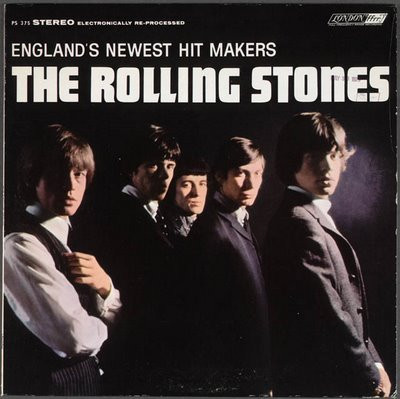
They started out as an R&B band, and it would be several years before they successfully mastered the album format (unlike the Beatles, who defined it, and the Who, who thrived in it, both during the same period). Thanks to record company miscomprehension, the first Stones albums were marketed to the teenybopper crowd, and why not. With the super-hyped title England’s Newest Hit Makers, their American debut was pretty close to their first, self-titled British LP, and therefore nicely shows what they had to offer this early.
Their own writing was neither up to snuff nor particularly encouraged. But as modern blues machines they were turning out quality, if not definitive, versions of “Not Fade Away”, “Route 66” and “I Just Want To Make Love To You” among their covers. That would be young Brian Jones blowing away on most of the harmonica (since Mick hadn’t learned it that well yet) and playing the more complicated slide guitar; it was his band in the first place, as is most obvious here. Of course, the better lifts from Chuck Berry would be Keith the Human Riff himself, and that’s the sound that would be most consistent over the next fifty years. (The wheezy organ on “Now I’ve Got A Witness” is courtesy of Ian Stewart, who always sounded better on piano, and never played anything but major chords.)
Outside of a couple of group-credited tunes, the only Jagger/Richards original here is “Tell Me”, driven by Keith’s 12-string as he mewls along with Mick on the choruses. Even for an album just over half an hour long, this one lasts over four minutes. (Another prize moment: Charlie Watts’ fills following “knock on my door”.) Lovelorn Mick doesn’t sound quite as natural as the horny toad in “I’m A King Bee” and “Walking The Dog”, while the latter does provide stereophonic proof as to why Brian Jones was usually prevented from singing.
Having been (mostly) conceived as an album (as opposed to a bunch of singles or stopgap EPs), England’s Newest Hit Makers is a strong debut, particularly for the era, suffering from little record company interference. The production was a little primitive, but Charlie’s drums crackle, and even Bill Wyman knew how to make his bass heard. A good start, and who knew how long they’d last?
The Rolling Stones England’s Newest Hit Makers (1964)—3
I put this whole thing on for the first time in decades. It’s a lot of fun, if not a major work. There’s so much energy here, which compensates for any other shortcomings. It’s easy to understand why so many teens of the time were carried away. Instead of dropping “Mona”, which was on the UK version, they should have junked that stupid instrumental. That organ is quite cheesy. Still, the only classics are the two hits.
ReplyDeleteThis was not my first exposure. One day, coming home from first grade, my mom said, “Come look at this group! They’re like the Beatles!” Well..not exactly:
https://www.youtube.com/watch?v=5pNQiUAudbs
I was utterly confused and transfixed at the same time. Now, Mick’s reaction is priceless. He seems bored and contemptuous, especially given his culture shock over the uptight Americans outside of New York City (the show was taped in Cleveland). Douglas seems at a loss on how to deal with them, since the band was not about to engage in the mutual ass-kissing that American show business was all about. Jones’ reference to homosexuality was especially daring, exposing the homophobia under the surface. The Stones, or at least Jagger would eventually be one of the agents of change around that. As for me, since the Stones didn’t get their own cartoon show (which would have been quite something, come to think of it), I myself would hear much from them for quite some time.