Showing posts with label rickie lee jones. Show all posts

Friday, August 8, 2025

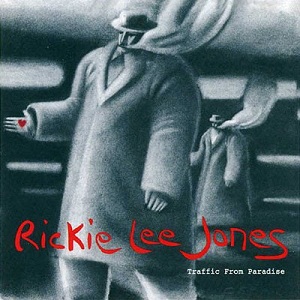
Rickie Lee Jones 7: Traffic From Paradise

Having gone through pop jazz and adult contemporary, Rickie Lee Jones chose a unique path for Traffic From Paradise. Though recorded in several places with several people—anchored by Leo Kottke, Jim Keltner, old buddy Sal Bernardi, and John Leftwich on bass and cello—there’s a spontaneous, live-in-the-room feeling, dominated by acoustic instruments. Throughout, her lyrics provoke wonder, just as her voice continually veers between happy toddler and stoned chanteuse.

“Pink Flamingos” is typical, in that it rumbles into place, finally settling on a basic riff with references to Las Vegas and other kitsch. A disturbing image of a monk opens “Altar Boy”, which soon turns into a Leonard Cohen homage. The simple folk picking of “Stewart’s Coat” is a wonderful contrast, even in its wistful longing for a past love, or so it seems. But for David Hidalgo’s south-of-the-border touch, Bernardi’s “Beat Angels” could have come from any of her earlier albums. Two of the guys from the Blue Nile are thanked for inspiration on the surreal “Tigers”, which improves with that knowledge.

The stripped-back cover of “Rebel Rebel” is unnecessary, though it did likely bring Brian Setzer some cash in the days before he rode the swing revival. “Jolie Jolie” is a sweet little number with Cajun influence, leading into the love song within the Kottke-cowritten “Running From Mercy”, featuring harmonies from Lyle Lovett. There seems to be another scary tale driving “A Stranger’s Car”, though the touch of strings (which we assume comes from a keyboard) adds to the landscape. David Baerwald—whom some might remember from David + David and “Welcome To The Boomtown”—duets on “The Albatross”, a seafaring benediction.

Traffic From Paradise wasn’t much heralded then, and hasn’t seemed to have surfaced in any retrospective appreciation. Geffen didn’t do much except release the album, since most of their money was going to Aerosmith, Nirvana, and Guns N’ Roses that year anyway. But it’s another good choice for quiet evenings or early mornings.

Rickie Lee Jones Traffic From Paradise (1993)—3

Tuesday, February 11, 2025

Rickie Lee Jones 6: Pop Pop

Female vocalists doing standards albums had become a thing by the ‘90s, but anyone who’d paid attention to Rickie Lee Jones since her initial emergence shouldn’t have been surprised by Pop Pop. What does make it stand out from, say, Linda Ronstadt’s work with Nelson Riddle or Natalie Cole’s tribute to her own father was her approach. On most of the tracks she’s accompanied by Robben Ford on a nylon string guitar, with subtle standup bass from either Charlie Haden or John Leftwich. A bandoneon appears, as does an occasional sax, but for the most part it’s all very quiet.

Her renditions of warhorses like “My One And Only Love” and “Bye Bye Blackbird” are nice and not at all blasphemous. “The Second Time Around” has the softest violin solo we’ve ever heard. However, “Dat Dere” is already based on baby talk, so we don’t need the sound of cooing infants in the mix. (“I Won’t Grow Up” is more effective in the overall context.) So when she springs Hendrix’s “Up From The Skies” on us, it fits right in. Producer David Was—the other guy in Was (Not Was) that’s not Don Was—gets extra royalties by contributing “Love Junkyard”, which is the loudest the album gets, with the most players, and the closest to her own classic sound. Jefferson Airplane’s “Comin’ Back To Me”, taken even more delicately than the original, provides a truly haunting finale.

Rickie Lee Jones Pop Pop (1991)—3

Tuesday, September 10, 2024

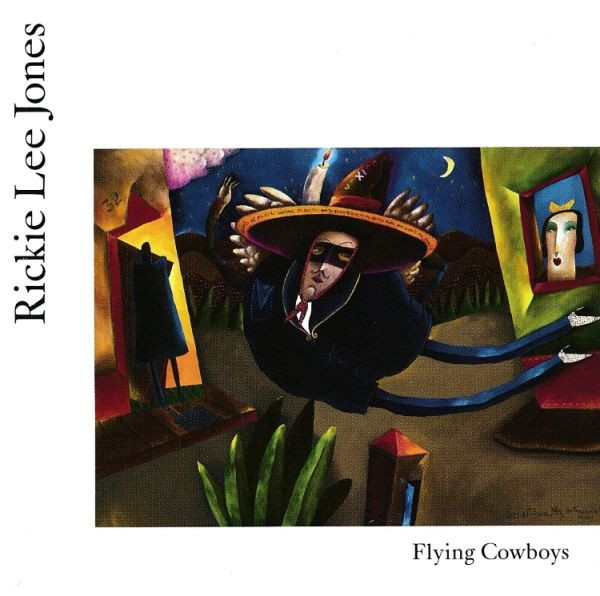
Rickie Lee Jones 5: Flying Cowboys

After a long break, during which she got married, and started a family, Rickie Lee Jones returned to public consciousness in early 1989 with a duet with Dr. John on “Makin’ Whoopee”, which went on to win a Grammy. It was a good setup for her next album. Flying Cowboys was notable for being her first album in five years, and also for production work by Steely Dan’s Walter Becker, who’d been off the radar for even longer.

“The Horses” sets the mood right away, and if it’s not a love song to her newborn daughter it works as one anyway, just as “Just My Baby” is a joyful celebration of the first twinges of excitement of new love. “Ghetto Of My Mind” celebrates a similar joie de something, and she’s playing the steel drum amidst all the other island-inspired sounds. “Rodeo Girl” is even more striking when you realize she’s singing and playing everything except the programmed drums. “Satellites” is the catchiest track, and the obvious single, as well as a stark contrast to the talking blues character in “Ghost Train”.

The title track is a collaboration with not just her husband but her old partner Sal Bernardi, who plays the infectious riff and harmonizes with her when she’s not speaking the words. Her cover of Gerry & The Pacemakers’ “Don’t Let The Sun Catch You Crying” obviously comes from a place of affection, but the processed arrangement doesn’t do it any favors. Similarly, “Love’s Gonna Bring Us Back Alive” sounds like the type of reggae groove that would bring Bonnie Raitt platinum albums soon enough. “Away From The Sky” finally brings the tender pretty one this album has needed, and “Atlas’ Marker” is as inscrutable as any of her lyrics, here colored by then-trendy rainforest percussion.

Flying Cowboys is a microcosm of VH-1 adult contemporary in the late ‘80s. This was a sound she’d always had, using many of the players she’d relied on before, but people looking for grit may be disappointed not to find it. (Footnote: To promote the album overseas, she appeared on a British TV show to perform not only the album’s title song but a “duet” with the Blue Nile on their “Easter Parade”, both with Sal in tow.)

Rickie Lee Jones Flying Cowboys (1989)—3

Tuesday, August 9, 2022

Rickie Lee Jones 4: The Magazine

Her next “real” album took some time, but apparently Rickie Lee Jones found inspiration in Paris, and managed to kick whatever her addictions to record The Magazine. The producer is different, but the sound is still slick, with the reliable Steve Gadd drumming on several tracks and various members of Toto here and there. The big difference is the use of synthesizer, which is subtle, but pronounced in the all-digital recording.

“Prelude To Gravity” is a lovely piano instrumental with light strings, whereas “Gravity” itself crashes in with drums. It’s a very complicated song, with lots of tempo shifts and accents, and poetry we can’t begin to decipher. While it begins like a nursery rhyme, “Juke Box Fury” is more along the lines of her jazz-bo hits. It even has the same hackneyed horn part from her other albums, pinning the choruses, but her vocal blend at the end of each still kills. We’re amazed that “It Must Be Love” wasn’t a hit single, either by her or anybody else, since it’s one of the most perfectly mainstream songs she’d yet written, with just enough of the right ingredients to make it original. “Magazine” recalls the sadder stories from Pirates, and we’re not sure whether the narrator is waiting for a lover or a drug connection.

Those horns return “The Real End”, which seems like a more obvious choice for a single with its simple pre-chorus hook and matter-of-fact cynical lyrics about fleeting romance. There’s a stretch where she layers her own voice like horns, which would have been enough. “Deep Space”, subtitled “An Equestrienne In The Circus Of The Falling Star”, provides another welcome see-saw shift to quiet, especially before “Runaround”, which mentions the “Juke Box Fury”, and sounds like two different songs forced together. The album closes with three pieces called “Rorschachs”. The first is a very European instrumental with trilling guitars and mandolins and a hummed melody called “Theme For The Pope (Marrants D’eau Douce)”, which translates as “sweet water fools”. (There is a version out there sung as a duet with Sal Bernardi—yeah, him again—in French, and seem to describe some lost souls between Memphis and Nashville. We had to look this up, because the lyrics aren’t included on the original vinyl.) “The Unsigned Painting” begins with a lonesome plaint, which is brushed aside by a spoken impressionistic piece. This segues into the more musical “The Weird Beast”, which continues the strange imagery via interlocking vocals.

The album works best when she’s exploring, making the more adult contemporary ear candy seem out of place. The Magazine is impenetrable to be sure, but somehow she makes it all very compelling. The listener wants to understand the songs, and that makes it worthwhile. She’s unique, all right.

Rickie Lee Jones The Magazine (1984)—3

Tuesday, December 21, 2021

Rickie Lee Jones 3: Girl At Her Volcano

The American record industry tried a few gimmicks in the early ‘80s to spur sales in the face of revenue lost to video games. One of these was the mini-album, which offered more music than a 45, but less than a full LP, and suitably priced. It didn’t exactly bring in buckets of cash, but in due time the compact disc would spur consumers to re-buy things they already had and all was well.

Rickie Lee Jones was able to use the mini-album as a stopgap while she readied her third album, plus reports suggest she was rehabbing from various addictions anyway. Girl At Her Volcano is a curious collection of covers, some live and some in the studio, and just one original. While under half an hour long, it’s still an artistic statement, and rather personal.

Billy Strayhorn’s “Lush Life” comes from a theater performance in Pasadena the year before, showing her depth and range. Her version of the ‘60s pop classic “Walk Away Renee” is enhanced by an original musical inversion apparently titled “Letters From The 9th Ward”, and it’s possibly our favorite version of this particular tearjerker. The mood of regret continues with “Hey Bub”, said to be the first song written for Pirates, but not recorded until this project. Despite the off-mic flirting with the audience at L.A.’s Roxy, the classic “My Funny Valentine” is delivered slowly and carefully, considering every word, until the sobs take over the final verse while the piano matches her timing.

In her more joyful street-corner version of “Under The Boardwalk”, she’s one of several voices singing; it’s a break from the down tone of side one, but just a little too sterile for us. While the phrase was mentioned on the title track of the last album, “Rainbow Sleeves” is a Tom Waits original supposedly written expressly for her at the height of their romance, and recorded during the sessions from the debut. Bette Midler recorded it first, and performed it in the original cinema release of her film Divine Madness, so there is some conjecture she, and not Rickie, was the intended recipient. Whatever the truth, this performance is heartbreaking. The brief benediction “So Long”, written by session man Neil Larsen with Lani Hall (former Brasil ’66, current Mrs. Herb Albert) for one of her albums, would also appear to be left over from the first album. (The cassette got a bonus in a four-year-old live performance of “Something Cool”, with Lyle Mays on synthesizer, that goes from cute to soaring to, yes, cool.)

Girl At Her Volcano was hard to find for a while, having only been released on CD in Japan, where they release everything. Now that it’s available on streaming services, this key step in her history can be more widely enjoyed. For one, this was the last of the jazzy beatnik in the beret for some time.

Rickie Lee Jones Girl At Her Volcano (1983)—3

Tuesday, August 17, 2021

Rickie Lee Jones 2: Pirates

In the wake of such one-hit wonders as A Taste Of Honey, Debby Boone, and the Starland Vocal Band, and a year before Christopher Cross, Rickie Lee Jones won the Grammy award for Best New Artist. But as anyone will tell you, an artist puts a lifetime into a first album, and suddenly has to start from scratch for the second. Luckily for her, Warner Bros. was the kind of label that was focused on building catalogs, and was happy to wait until she was ready for her follow-up.

The standard line is that Pirates details the fallout and aftermath of her relationship with Tom Waits, but that insults her as well as the material. Nonetheless, the longing expressed in “We Belong Together” is very real, from the first majestic chords through the cyclic pattern that seems to transcend tempos and time signatures. Steve Gadd is the drummer, and his performance is absolutely stellar. (We still get chills when she harmonizes so closely with herself on “climb upon the rooftop docks” and every other occasion thereafter.) “Living It Up” sports a positively infectious piano melody as it follows Eddie, Louie, and Zero, whom some have suggested are Waits, Chuck E. and Rickie again, but they could be any lost “wild and only ones” looking for something. The middle section switches gears magnificently, culminating in an almost defiant chant of the title, before returning us to the opening piano motif again. For sheer heartbreak, little beats “Skeletons”, wherein a hopeful young couple are on their way to the hospital to have their first child, only for a case of mistaken identity to shatter their dreams. That makes the transition to the finger-snapping hip jazz of “Woody And Dutch On The Slow Train To Peking” so jarring. While it revives the sound people liked so much on the first album, the character isn’t as convincing.

The slick Boz Scaggs-meets-Steely Dan vibe continues on “Pirates (So Long Lonely Avenue)”, but not for long, as the radio-friendly verse turns to the dreamier, aching transition that belongs to the subtitle. There’s a reference to “rainbow sleeves”, which will become more significant in time. A return to the jaunty theme is temporary, and we fade with the slower theme. The ache continues in the lyrics of the otherwise loping “Lucky Guy”, the melody barely hiding the bold admission of her heartbreak after telling the fellow she loves him “when I knew he didn’t care,” and you hope she really will feel better tomorrow. Following another atmospheric intro, “Traces Of The Western Slopes” opens with a verse sung by cohort Sal Bernardi, who sounds enough like Rickie Lee to confuse. (He’s the one harmonizing on the bridge in “Living It Up”, but back to our story, see.) It’s an incredibly ambitious, often impenetrable piece, with peaks and valleys that rival Joni Mitchell’s late-70s work. “The Returns” wafts in like a ballad from a Broadway musical, her voice impossibly high and fragile over the piano, not exactly a lullaby, but a peaceful closer nonetheless.

Having the lyrics printed once again on the back cover helps, not only to discern what she’s singing but to ponder the poetry. For example, is the Bird mentioned in “We Belong Together” the same as the one in “Skeletons”? Is Zero a willing companion or a hoodwinked victim of Eddie and Louie? What the hell is going on on those western slopes? Pirates is certainly more challenging than the debut, but in many ways it’s more rewarding. One can hear her voice and style developing from track to track, and while it doesn’t quite return to the heights of the first three songs, it’s one of those albums that pulls you in. Once again, the Warner Bros. instincts were correct.

Rickie Lee Jones Pirates (1981)—

Tuesday, April 27, 2021

Rickie Lee Jones 1: Rickie Lee Jones

Musician magazine once did a photo essay tracking various styles through the decades, wherein Robert Palmer descended from Bryan Ferry and Richard Harris before him in the guise of the lounge lizard, and Edie Brickell was the latest version of the girl with the beret following Joni Mitchell and Rickie Lee Jones. Chauvinism has long been a feature of the music business, but if we could think of a more clever way to introduce Rickie Lee Jones than the standard elevator pitch, we would, but until then, here’s the deal.

She did indeed wear a beret onstage, and sang in a very unique voice ranging from scat to soprano. Her songs were jazzy and had the familiarity of standards, steeped in beat poetry influences. She also happened to be romantically involved with Tom Waits, then still in his wino troubadour phase. Lenny Waronker swooped in and signed her up to Warner Bros., and produced her eponymous debut with Russ Titelman. Given the era and the caliber of session players involved, Rickie Lee Jones is very much a sophisticated ‘70s pop album, anchored by the smash hit “Chuck E.’s In Love”. That song was all over the radio in 1979, surprising for its verses of hip lingo delivered by a mushmouth. (People liked the twist at the end, despite it being pure fiction.)

The rest of the album is a mix of hep cat jive and more sensitive material, beginning with the reverie “On Saturday Afternoons In 1963”. “Night Train” is not the James Brown song, but one of many in her catalog that long for deliverance via some mode of transportation. Similarly, “Young Blood” isn’t a cover either, but a good companion to “Chuck E.”, with its mid-‘70s Joni arrangement and salsa influences. “Easy Money” had already been recorded by Little Feat’s Lowell George for his one solo album before he died, and we hear a Waits similarity here too. We’re especially taken by “The Last Chance Texaco”, which really works the metaphors related to car trouble and relationships, as she explores both ends of her vocal range and effectively works in the sound of passing cars.

“Danny’s All-Star Joint”, where the jukebox “goes doyt-doyt”, is particularly jazzy and cinematic, and takes us right back to a time of flared plaid slacks and Boz Scaggs records. By a sharp contrast, “Coolsville” is a brooding recollection of lost youth, lost friends, lost innocence. “Weasel And The White Boys Cool” concocts another scenario of characters, this time around a guy named Sal, which happens to be the first name of a future collaborator, but there we are getting ahead of ourselves again. That’s the last of the uptempo tunes, as the torchy “Company” tugs the heartstrings and “After Hours (Twelve Bars Past Goodnight)” leaves her alone by the lamppost.

Her voice is an acquired taste, to be sure, and all the hype surrounding Rickie Lee Jones kept us from paying too much attention for a long time. But her artistry is subtle, and would continue to be so, as we shall see. The rating below may be adjusted again and again until we’re absolutely sure.

Rickie Lee Jones Rickie Lee Jones (1979)—3

Thursday, December 20, 2012

Holiday Special #2: The Bells Of Dublin

The Chieftains are one of those mainstream outfits peddling their own brand of traditional Irish music, found once upon a time at most big box stores in the “Celtic” section next to the Clancy Brothers. After having something of a boost from Van Morrison, they released a series of albums that featured collaborations with a variety of established artists, all singing to their accompaniment. One of their nicer projects—surpassed only by The Long Black Veil a couple of years later, teaming them with the likes of Tom Jones and the Rolling Stones—was a Christmas album based around The Bells Of Dublin.

Besides presenting a pleasant selection of airs and graces (if you like that sort of thing), the collaborations were unexpected. Honorary Dubliner Elvis Costello contributes the gory tale of a family dinner gone wrong (not for the first or last time) in “St. Stephen’s Day Murders”. The McGarrigle sisters offer a medley of French carols, then Burgess Meredith sets up a Gaelic shepherds’ tale. Marianne Faithfull adds her sweet rasp for “I Saw Three Ships”—contrast that with Rickie Lee Jones, who sounds like she’s either on the verge of tears or a sneeze for “O Holy Night”. Jackson Browne had been quiet for a few years when he came up with “The Rebel Jesus”.

Beyond the “star” aspect, the traditional selections are the glue of the album. The Voice Squad lends support to several carols, as well as the extended dance demonstration of “The Wren” (even if singer Kevin Conneff sounds a little like Popeye on some of his scatting). The final section of blends three carols into a big finish on “O Come All Ye Faithful”, with the organist from a Belfast cathedral playing into those bells.

The Bells Of Dublin will likely irritate those who aren’t fond of Irish music, but we find it awfully soothing. As various CDs (and LPs) have gone in and out of our holiday stack over the years, this one is a constant.

The Chieftains The Bells Of Dublin (1991)—