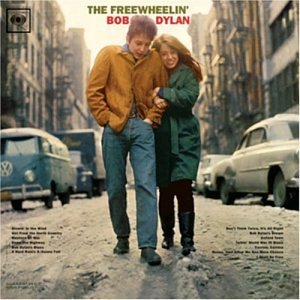
 Now we’re getting somewhere. This set the tone for at least a couple of years, from the sly visions in the lyrics to the homespun photo of Our Hero arm in arm with his long-haired lady on a snowy Greenwich Village street. The Freewheelin’ Bob Dylan was his breakthrough, loaded with songs that still get cheers today whenever anybody does them.
“Blowin’ In The Wind” opens the side, and is probably why people love this album. Even after decades of saturation, the nine questions it asks can still provoke thought if one takes the time to consider them. “Girl From The North Country” uses fairly standard changes with a variation on the “Scarborough Fair” theme. It’s heartbreaking. Then we get “Masters Of War”, which is one angry little number, and still relevant today. “Down The Highway” is a straightforward blues song in open (out of) tuning. “Bob Dylan’s Blues” doesn’t have much to offer, but it’s just a stopgap on the way to the epic “A Hard Rain’s A-Gonna Fall”. Bob’s quoted in the liner notes suggesting that each line could be the opening to another song, and he’s right. Instead it provides a litany of imagery straight out of the Bible or Kerouac.
Side two has a tough act to follow, and it succeeds. “Don’t Think Twice, It’s All Right” uses a fast picking, probably courtesy of Bruce Langhorne, to accompany the kiss-off words. “Bob Dylan’s Dream” is more worthy of a namecheck in the title than its “Blues” counterpart, as the content goes a lot deeper than just one man’s dream. It’s a truly heartbreaking song of regret, thinking back to simpler times with lost friends that seem so far away. “Oxford Town” is a matter-of-fact protest song about race relations, but with a jaunty melody that belies the serious tone. “Talkin’ World War III Blues” has its moments, but doesn’t always warrant repeat listens. It’s still one of his better attempts at the genre. “Corrina, Corrina” is one of the few tracks released from the many sessions for this album—which took an entire year—featuring a “combo” backing; his sweet tone is a nice detour as well. “Honey Just Allow Me One More Chance” seems an odd choice, as it’s a cover, and he did the song better with different words on his debut. “I Shall Be Free” gives a final shot at comedy, not contained by the other talking blues songs. And it fades away to the inner groove.
The Freewheelin’ Bob Dylan goes a long way towards establishing him as a writer, even if the tunes and words are still very derivative of the usual folk repertoire. His growing fan base was able to watch him grow as well, as they wore out the grooves of this record. It’s a good leap forward from his first album, and he’d continue to explore the protest niche in the meantime.
The album is also groundbreaking in that it’s the first Dylan album of several that would be all but complete until some last-minute fiddling. The original version had four songs that would be replaced, three of which were a year olod at time of release, and they’re a mixed bag. First, the bluesy “Rocks And Gravel”, with an uptempo backing, was in the spot that “Girl From The North Country” took, and likely was the reason for the mistake in the liner notes referring to a band. Nice as it is, the replacement is preferred. “A Hard Rain’s Gonna Fall” came next, and sounds odd in the middle of the side instead of at the end, where “Let Me Die In My Footsteps” appeared. Instead of the sublime “Bob Dylan’s Dream”, “Rambling, Gambling Willie” was the second song on side two, and not missed. And because “Talkin’ John Birch Paranoid Blues” was considered too provocative, “Talkin’ World War III Blues” replaced that. It still would have been a heck of an album had it gone out, but then we wouldn’t have had “Masters Of War”. (Original copies fetched high prices among collectors; it was reissued on vinyl for Record Store Day in 2025.)
Bob Dylan The Freewheelin’ Bob Dylan (1963)—3½
Freewheelin' stands out as one of Dylan's all time greats. I feel it deserves 5 stars (or at least 4 1/2).
ReplyDelete