Showing posts with label 1963. Show all posts

Friday, December 27, 2013

Beatles 33: Bootleg Recordings 1963

When a rumor emerges in Beatlemaniacland, the inhabitants immediately begin picking it apart, seesawing between euphoria and anger, and falling off several times into conjecture and other tangents. So it was that news of a bumper bundle of unreleased material to emerge on iTunes (now that the two companies named Apple were the bestest of buddies) sparked off a week or so of unfounded opinions. Then it was available, then it wasn’t, and then it was again.

Given the title Bootleg Recordings 1963, it’s a little over two hours of material—predominantly BBC radio performances as yet uncollected on an official Apple release, plus several studio outtakes and two demos. In all there are 59 tracks, retailing for 40 bucks American, or 67¢ a song. All of the BBC stuff has been floating around on bootlegs for years, as have the demos, while most of the studio outtakes appear for the first time in stereo.

The studio outtakes come first, peeking into the sessions for the Please Please Me album and follow-up single, and two more from later in the year. Then it’s a haphazard leap into the many radio appearances, tagged with the alleged (and often incorrect) original broadcast date. The usual suspects appear, as well as performances of some of the covers they didn’t put on their albums. If you haven’t had your fill of “A Taste Of Honey”, “Till There Was You” or even “She Loves You”, you might after this. Finally, non-professional recordings of two songs Lennon and McCartney gave away (“Bad To Me” and “I’m In Love”) round out the program.

Lots of collectors balked at spending their iTunes credits on stuff they mostly had, and cursed Apple for “ripping off the fans again”. Which is only true if something was promised and not delivered, and that didn’t happen. By boldly stating that these are bootlegs, that excuses any lack of sound quality. Considering how clean the studio stuff is, that’s not an issue either. It’s also hilarious to hear someone who can only have been familiar with this music thanks to pirates, copyright cheats and outright thieves complain about the rightful owners’ integrity.

Most tantalizing of all is the knowledge that there are several hours’ worth of studio material not included here. So if this was a gambit to protect their copyrights, as has been assumed with the existence of similar Bob Dylan compilations, what is the fate of the rest of the material? Clearly, we haven’t emptied the well.

The Beatles Bootleg Recordings 1963 (2013)—3
CD availability: none; download only

Monday, December 23, 2013

Bob Dylan 56: 50th Anniversary Collection 1963

Well, it happened again, sort of. This time, the assumed record label attempt to either protect their archives, tease the public or both resulted in a six-record set of otherwise uncollected (but mostly bootlegged) Bob Dylan recordings, with limited availability.

This time, however, the studio takes on 50th Anniversary Collection 1963 total exactly six: alternates of “Eternal Circle” and “Percy’s Song”, another extremely sloppy stab at “That’s All Right, Mama” that peters into something called “Sally Free And Easy” before stopping altogether, the slightly more interesting “East Laredo Blues” piano solo, and the legendary unreleased tracks “Hero Blues” and “New Orleans Rag”.

The bulk of the live recordings are of more historic than musical interest. “When The Ship Comes In” at the March on Washington, for example, would be a lot more palatable if it didn’t sound like a news broadcast (and didn’t have Joan Baez yodeling all the way through it). Typical is a 12-song sequence called “The Banjo Tape” (because of one of the accompanists; he appears to have acquired a 12-string). In this seemingly impromptu hootenanny, the most successful songs, and the ones that don’t break down after a minute, happen to be his own compositions.

There’s also the balance of his two legendary New York concerts of the year, at Town Hall and Carnegie Hall. Despite these having already been plundered for various Bootleg Series sets (and in one case, Greatest Hits Vol. II) with pristine sound, having been professionally recorded, the question is begged: why not issue the complete shows in sequence?

Then there are a few lost songs, some better than others. “Ramblin’ Down Through The World” began the Town Hall show, and isn’t much of anything. “Hiding Too Long” is more fascinating, if clumsy. There are a few renditions of “John Brown”, and several of “Only A Pawn In Their Game”.

Like most bootlegs, this isn’t an album sequenced for anything other than posterity, and the multiple takes of less than exciting songs gets tiresome. It still provides a fascinating glimpse at the kid trying to finish his second album and on his way to his third.

Bob Dylan 50th Anniversary Collection 1963 (2013)—3
CD availability: none; LP only

Wednesday, December 19, 2012

Phil Spector: A Christmas Gift For You

While his name today generally is associated with a murder conviction or how he ruined “The Long And Winding Road”, Phil Spector really did make an impact on rock ‘n roll in his time. His “wall of sound” made dozens of instruments sound terrific on AM radio (in glorious mono) no matter who was singing. Brian Wilson used the same musicians and studio for his albums, and even Bruce Springsteen knew that he needed the Spector approach to make “Born To Run” the anthem that it is (which indirectly led to Meat Loaf and Bat Out Of Hell). But if Phil Spector did nothing else, he put together one hell of a Christmas album.

A Christmas Gift For You follows on the formula that drove “Be My Baby”, “Da Doo Ron Ron”, and dozens of other hits. Spector knew what worked and he did it to death (sorry), relying on repeated rhythms and musical motifs. This album is just like those singles; even though there’s a prominent sleigh bell in the percussion, it’s mixed just as high as the castanets and tambourine. On every track, all secular pop standards, you can hear Teenage Steve Douglas honking away on sax, Leon Russell’s piano octaves, and Hal Blaine’s thundering drums (and we assume it’s him doing the clippity-clop effects on “March Of The Wooden Soldiers” and “Santa Claus Is Coming To Town”). Jack Nitzsche is credited with the arrangements, so thank him for such touches as the 12-string that opens “Rudolph the Red-Nosed Reindeer”, the “Heat Wave” vibe on “Sleigh Ride”, and even “I Saw Mommy Kissing Santa Claus”, which begins with a sweet intro culminating in a loud smooch before barreling through the song, ending with a quote from “Rock-A-Bye Baby”. (“Winter Wonderland” ends with “Jingle Bells”, “Marshmallow World” with “Deck The Halls” and so on.)

Partially because of the tight rein Spector had on his roster, his main milieu was the single, not the album. So rather than have one artist carry the whole thing, A Christmas Gift For You rotates between Darlene Love, the Crystals, the Ronettes and the unfortunately named Bob B. Soxx & The Blue Jeans. Darlene leads off the program with “White Christmas”; already tackled doo-wop style by the Drifters, this adds a spoken bridge acknowledging what the holidays are like in “sunny L.A.”, far from the snow witnessed by many of the album’s listeners. She sings a total of four numbers, the winner being “Christmas (Baby Please Come Home)”, the only “original” song on the album, thankfully revived by U2’s version 25 years later.

While Darlene had arguably the best voice, Phil Spector was obsessed with Ronnie Bennett; without a doubt, her beehived, eyelinered delivery of “Fwawsty Da Snow Ming” (to the best of our phonetics) is guaranteed to stir the red blood of any teenage male. The other Ronettes provide the delicious “dinga-linga-linga-ding dong ding” on “Sleigh Ride”. The Crystals hold their own (“Santa Claus Is Coming To Town” is the arrangement Springsteen made standard, and we’re still wondering what “elephant boats” are) and Mr. Soxx doesn’t stick around long enough to bother anybody.

A lot of the intros are interchangeable, but so what? If you don’t like this album, you’re a Communist. There’s no need to describe every track since you’ve heard them already. Several songs appear in Goodfellas, which is probably playing on Spike, FX, or AMC right now. Apparently it was not a huge hit in its time, but it’s stayed in print all through the years, first on the Beatles’ Apple label, then through Rhino, ABKCO, and now on Sony. It’s still 35 minutes long, and it’s still in mono. The way it should be.

A Christmas Gift For You From Phil Spector (1963)—4

Wednesday, June 15, 2011

Beach Boys 4: Little Deuce Coupe

Perhaps feeling he’d exhausted the songwriting potential surfing offered, Brian Wilson decided to focus more sharply on that other Californian teen sensation: cars. What’s more, their label had already used “Shut Down” as the title track of an album that repackaged “409” and other songs about cars by other bands, as well as Robert Mitchum. So they figured they might as well repackage themselves, which is why an album released only a month after their last one repeated four songs from previous albums, including the title track of this one. Confused yet?

That title track is still primo Beach Boys, but here it’s followed by “The Ballad Of Ole Betsy”, a maudlin plaint for an automobile on its way to the scrapyard. While it may not specifically mention cars, “Be True To Your School” is one of the better high school rah-rah songs despite itself; the music makes it more than the words, which come off as the rantings of “some loud braggart”. (Co-writer Roger Christian is responsible for most of the lyrics on the album, being Brian’s go-to car expert.) “Car Crazy Cutie” is dominated by Dion and the Belmonts-style do-run-runs, and while it’s about a girl for a change, it’s not any more exciting than “Cherry, Cherry Coupe”, which was a rewrite of an earlier track and piles on the technical references.

“Spirit Of America” was supposed to pay tribute to racecar driver Craig Breedlove and his eponymous jet-propelled trike; fittingly, Capitol Records used it a decade later as the title track of the less musically successful cash-in follow-up to Endless Summer. While three of the repeats may have been worthy of hearing again, we won’t say the same for “Our Car Club”, but “No-Go Showboat” shows Brian trying to work more complicated arrangements into their albums than the usual three chords. Somewhat along the same lines, “A Young Man Is Gone” puts new lyrics eulogizing James Dean—who, or course, died in a car crash—to the lush Four Freshman-style harmonies of “Their Hearts Were Full Of Spring”. Finally, “Custom Machine” is more grandstanding, again over some unexpected chord changes.

Musically and vocally, Little Deuce Coupe certainly stands out as competent, even influential. But with only twenty minutes’ worth of new material, it offered little except to push them as a novelty act. Luckily, it was paired with a better album for its two-fer CD, which also included the rerecorded single version of “Be True To Your School”, featuring a simulation of a high school marching band and even more cheerleader chants.

The Beach Boys Little Deuce Coupe (1963)—2
1990 CD reissue: same as 1963, plus All Summer Long album and 4 extra tracks

Wednesday, May 4, 2011

Beach Boys 3: Surfer Girl

A subtle shift in the Beach Boys story appeared on the back cover of Surfer Girl. While it wasn’t in bold type, the liner notes specifically stated that Brian Wilson was the producer of the album. While the band was still playing everything—albeit with original member and buddy Al Jardine back in the fold, but not on the cover, soon to oust the irrepressible David Marks, who still was—and the songs were still about surfing and cars, the music had begun to evolve.

Not only was the title track one of the first songs Brian wrote, it’s also one of the loveliest. While there are enough references to the lingo in the lyric, the melody and especially the harmonies make it soar, even if it is a little too close to “When You Wish Upon A Star”. “Catch A Wave” is another aggressive advertisement, but uses a classical harp for a clever oceanic evocation, alongside those cymbal washes. There’s a string arrangement on “The Surfer Moon”; it’s just too bad he felt he had to keep the lyrics on topic, just as “South Bay Surfer” is “Swanee River” with new words. (Hey, it worked for “Surfin’ U.S.A.”) “The Rocking Surfer” is an instrumental with prominent organ for a change, and Carl Wilson contributes a sufficient if generic solo. Things finally shift for “Little Deuce Coupe”, a song about a car and the title track’s original B-side.

While “In My Room” had also been a B-side, this is another gentle Brian classic, shifting from popular teenage trends and addressing actual emotions, teenage and otherwise. (There’s that harp again.) It was only natural that “Hawaii” be fodder for songs about surfing; if the rest of America thought Southern California must be paradise, kids already living there wanted to be someplace even better. This would be far from the last time the state would be the subject of a Beach Boys song. The misplaced apostrophe in “Surfer’s Rule” doesn’t make the boast any more effective, since it’s mostly a dig at Frankie Valli and the 4 Seasons, but soon enough they’re using “Our Car Club” as another vehicle to declare their superiority to anyone dumb enough to question them. “Your Summer Dream” gives Brian another chance to display his musical maturity and growth, but just to keep folks dancing, “Boogie Woodie” lets him show off on organ and piano simultaneously and in changing keys.

While Surfer Girl was certainly showed progress, it was still little more than a collection of already-released singles and B-sides, padded with filler. Which is pretty much what albums were in 1963. (Of the songs added to the two-fer CD in 1990, only one was related to this album: “In My Room” sung in German.)

The Beach Boys Surfer Girl (1963)—
1990 CD reissue: same as 1963, plus Shut Down Volume 2 album and 3 extra tracks

Wednesday, April 13, 2011

Bob Dylan 52: Brandeis University

The Dylan diehards who’d ordered either The Witmark Demos or the pricey Original Mono Recordings box set through Amazon got a special bonus CD. With the straightforward title of In Concert – Brandeis University 1963, it was a recently discovered recording of excellent quality, so rare it hadn’t even been bootlegged before.

It consists of two short sets from a folk festival, captured just after Freewheelin’ had been finished but not yet released. At this point, Dylan had yet to be a household word; as the notes point out, neither were the Beatles, and Kennedy was still alive, for that matter. The audience is attentive, clearly mesmerized by the words of “Masters Of War” and “Ballad Of Hollis Brown” (a year away from its album appearance) as they are appreciative of the sentiment in “Bob Dylan’s Dream”.

This performance is early enough that while he was bigger than the coffeehouses, he was not yet the notorious protest provocateur. Opening with a truncated “Honey, Just Allow Me One More Chance”, three of the songs performed are from his repertoire of talking blues, which pack enough wry humor in to goose the audience. Clearly, “Talkin’ John Birch Paranoid Blues” and “Talkin’ Bear Mountain Picnic Massacre Blues” work better in a live format, as they were never included on a studio album. Even the gags in “Talkin’ World War III Blues” land better when punctuated by laughter.

The disc’s status as a rarity was changed the following spring when it came out as an official standalone release. Which, when you come to think of it, is a nice gesture for the average brick-and-mortar music emporium tired of getting screwed over by Amazon. Its widespread availability would suggest that it’s some kind of seminal performance for the ages, although at less than forty minutes, it rushes by comparatively quickly. But at a ten-dollar price point, with the added bonus of photos and liner notes, it gives collectors hope that it’s the start of a trend. Considering how many of Bob’s concerts over the years were professionally recorded, possibilities abound for what else could follow (like the promo-only Carnegie Hall sampler available around the time of the No Direction Home set).

Bob Dylan In Concert – Brandeis University 1963 (2011)—3

Friday, April 1, 2011

Beach Boys 2: Surfin’ U.S.A.

Having established their brand on their first album, the Beach Boys kept giving their audience what they wanted on Surfin’ U.S.A. To double down on the genre, five of the tracks were instrumentals, nicely showing off the band as instrumentalists, especially little brother Carl Wilson. For the rest, Brian Wilson wrote on his own as well as with co-lead singer Mike Love, freelancer Gary Usher, and a new key collaborator, deejay Roger Christian, for the lyrics.

The title track is not only one of the most effective Chuck Berry rewrites; they even gave him the publishing, which is one reason why he loved the tune. Led by Brian’s falsetto, “Farmer’s Daughter” tries a little too hard and misses, as it can’t quite straddle the line between innocent and dirty. New listeners in this century may be surprised to hear them tackle Dick Dale’s classic arrangement of “Misirlou”, especially if they only knew it from Pulp Fiction. Here it’s followed by the original instrumental (save the shouted title) “Stoked”. But Brian really starts to stretch on “Lonely Sea”, the first sign of the sensitivity that would take the band beyond the beach. And just like last time, a car song closes the first side; in this case, it’s “Shut Down”.

“Noble Surfer” is supposed to be a portrait of a he-man, but the celeste solo seems incredibly incongruous; their surf-influenced cover of the “Honky Tonk” instrumental works as a good palate cleanser. “Lana” just happens to be a love song, though it needs more lyrics, and the celeste makes more sense. While “Surf Jam” is a basic 12-bar instrumental, Carl gets sole writing credit, and you’d have to listen close to their version of Dick Dale’s “Let’s Go Trippin’” to tell it apart; again, the shouted titles help. “Finders Keepers” is just plain odd, switching tempos and keys, landing somewhere between a joke track and two different Four Seasons songs.

Even more than their first album, these are the songs that made every other kid in the country (and overseas) want to move to California. The boys were still learning how to make records, and had yet to define what an album would mean. Decades later, the overall vibe paired the album well with Surfin’ Safari on its two-fer CD. The one bonus added from the album’s sessions was “The Baker Man”, a lame attempt to create a new dance craze out of the patty-cake nursery rhyme. (The two-fers have gone out of print and back from time to time. In 2012, this and their next ten studio albums were reissued individually in nice slim digipacks sporting original artwork and CDs with both mono and stereo mixes.)

The Beach Boys Surfin’ U.S.A. (1963)—
1990 CD reissue: same as 1963, plus Surfin’ Safari album and 3 extra tracks

Friday, April 17, 2009

Bob Dylan 2: The Freewheelin’ Bob Dylan

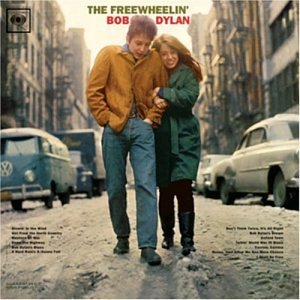
Now we’re getting somewhere. This set the tone for at least a couple of years, from the sly visions in the lyrics to the homespun photo of Our Hero arm in arm with his long-haired lady on a snowy Greenwich Village street. The Freewheelin’ Bob Dylan was his breakthrough, loaded with songs that still get cheers today whenever anybody does them.

“Blowin’ In The Wind” opens the side, and is probably why people love this album. Even after decades of saturation, the nine questions it asks can still provoke thought if one takes the time to consider them. “Girl From The North Country” uses fairly standard changes with a variation on the “Scarborough Fair” theme. It’s heartbreaking. Then we get “Masters Of War”, which is one angry little number, and still relevant today. “Down The Highway” is a straightforward blues song in open (out of) tuning. “Bob Dylan’s Blues” doesn’t have much to offer, but it’s just a stopgap on the way to the epic “A Hard Rain’s A-Gonna Fall”. Bob’s quoted in the liner notes suggesting that each line could be the opening to another song, and he’s right. Instead it provides a litany of imagery straight out of the Bible or Kerouac.

Side two has a tough act to follow, and it succeeds. “Don’t Think Twice, It’s All Right” uses a fast picking, probably courtesy of Bruce Langhorne, to accompany the kiss-off words. “Bob Dylan’s Dream” is more worthy of a namecheck in the title than its “Blues” counterpart, as the content goes a lot deeper than just one man’s dream. It’s a truly heartbreaking song of regret, thinking back to simpler times with lost friends that seem so far away. “Oxford Town” is a matter-of-fact protest song about race relations, but with a jaunty melody that belies the serious tone. “Talkin’ World War III Blues” has its moments, but doesn’t always warrant repeat listens. It’s still one of his better attempts at the genre. “Corrina, Corrina” is one of the few tracks released from the many sessions for this album—which took an entire year—featuring a “combo” backing; his sweet tone is a nice detour as well. “Honey Just Allow Me One More Chance” seems an odd choice, as it’s a cover, and he did the song better with different words on his debut. “I Shall Be Free” gives a final shot at comedy, not contained by the other talking blues songs. And it fades away to the inner groove.

The Freewheelin’ Bob Dylan goes a long way towards establishing him as a writer, even if the tunes and words are still very derivative of the usual folk repertoire. His growing fan base was able to watch him grow as well, as they wore out the grooves of this record. It’s a good leap forward from his first album, and he’d continue to explore the protest niche in the meantime.

The album is also groundbreaking in that it’s the first Dylan album of several that would be all but complete until some last-minute fiddling. The original version had four songs that would be replaced, three of which were a year olod at time of release, and they’re a mixed bag. First, the bluesy “Rocks And Gravel”, with an uptempo backing, was in the spot that “Girl From The North Country” took, and likely was the reason for the mistake in the liner notes referring to a band. Nice as it is, the replacement is preferred. “A Hard Rain’s Gonna Fall” came next, and sounds odd in the middle of the side instead of at the end, where “Let Me Die In My Footsteps” appeared. Instead of the sublime “Bob Dylan’s Dream”, “Rambling, Gambling Willie” was the second song on side two, and not missed. And because “Talkin’ John Birch Paranoid Blues” was considered too provocative, “Talkin’ World War III Blues” replaced that. It still would have been a heck of an album had it gone out, but then we wouldn’t have had “Masters Of War”. (Original copies fetched high prices among collectors; it was reissued on vinyl for Record Store Day in 2025.)

Bob Dylan The Freewheelin’ Bob Dylan (1963)—