Showing posts with label eno. Show all posts

Friday, March 27, 2026

Brian Eno 32: Lateral, Luminal, Liminal

Clearly not slowing down when he could simply enjoy the pensioner’s life, Brian Eno’s next collaborator was one Beatie Wolfe, a conceptual artist who’d done a lot of work fusing music and technology, and specifically exploring its therapeutic capabilities. Something sparked between the two, to the extent that they managed to release three albums in less than six months’ time.

Lateral consists of a single ambient track, “Big Empty Country”, split into “Day” and “Night” halves on the abridged vinyl and eight eight-minute segments in the digital files. Described by the pair as “space music”, not a lot happens over the course of it, making it not that different from Thursday Afternoon or Neroli. The same hum and triad are established for the first twenty minutes, then a few gentle guitar notes appear in the same rhythm, and other harmonics begin to emerge. Towards the last ten minutes or so, the atmosphere seems to spread wider, and eventually fades. So basically, it’s pretty and easy to get lost in as well as ignore, so it works.

Released the same day, Luminal presented “dream music”, which in this case means actual songs. Wolfe has a pleasant alto voice that melds well with her guitar and the background, as on “Milky Sleep”. “Hopelessly At Ease” is unique in the Eno catalog for being an actual love song; “Suddenly” could almost count as one, but it’s more suited to somebody in recovery. (Both of these recall Daniel Lanois’ work on the Sling Blade soundtrack thirty years earlier.) “My Lovely Days” picks up the tempo and a little jangle, but “Play On” is a little too robotic, and definitely too long. “Shhh” is an improvement, as his voice isn’t manipulated on it. “A Ceiling And A Lifeboat” ups the eeriness, and while “And Live Again” hints at more hope, “Breath March” and “Never Was It Now” are full of foreboding. At least the ticking rhythm of “What We Are” suggests that the bad dream has subsided.

Four months later, Liminal appeared, this time presenting “dark matter music”, which to them means a mix of songs and shorter, not necessarily ambient pieces. After the very slow “Part Of Us”, “Ringing Ocean” sets a slowly spiraling, tense mood, continued in the two-word phrases of “The Last To Know” before resolving on a major chord. “Procession” could well be a descriptive placeholder for this particular idea, while “Little Boy” is a lullaby over textures right out of Apollo. “Flower Women” isn’t much more than a looped two-chord phrase, the few words mixed so low as to be inaudible until the midway break. “Shallow Form” uses his favorite chord changes, as heard in “Spinning Away” and “The Big Ship”, then “Before Life” sends us off into the solar system again. “Laundry Room” is an existential crisis wrapped in a monologue a la Laurie Anderson, and “Corona” gives us more spacey music before culminating in the eerie carnival of “Shudder Like Crows”.

All of these are fine on their own, and are therefore recommended for individual use. But given the simple, uniform designs of each, one wonders if they couldn’t have simply created one really good album instead of three.

Brian Eno & Beatie Wolfe Lateral (2025)—3
Beatie Wolfe & Brian Eno
Luminal (2025)—
Brian Eno & Beatie Wolfe
Liminal (2025)—

Friday, December 5, 2025

Brian Eno 31: Eno Soundtrack

Look at streaming services like Amazon Prime, and you’ll see a handful of documentaries about Brian Eno, some more quickie than others. Yet the only one that had his active participation can’t be found online. What’s more, there’s a chance that if you have seen it—and we haven’t—you won’t be seeing the same production that was screened somewhere or some time else. In a direct reflection of its subject’s aim when creating art, Eno uses generative software so that every showing has a unique, almost random sequence.

Luckily its companion soundtrack compilation does have a standard tracklist. It begins with “All I Remember”, a new song with vocals and introspective lyrics. From there it cherry-picks from throughout his career, split between vocal and instrumental, loud and quiet, with an emphasis on collaborations with the likes of Cluster, David Byrne, John Cale, and up to Fred again… These, however, only scratch the surface, both of the people he’s worked with as well as the music he’s release over fifty years.

Rare tracks don’t appear again until the end of the program. The noisy, clattering “Lighthouse #349” is one of hundreds of instrumental tracks uploaded to his Sonos radio station from his vaults, Finally, “By This River” comes from a live performance in 2018 with his brother Roger at the Acropolis in Athens, and it is simply stunning.

Brian Eno Eno (Original Motion Picture Soundtrack) (2024)—3

Tuesday, June 17, 2025

Brian Eno 30: Secret Life

By the time he was 75 years old, Brian Eno had more than a couple generations of musicians who’d been influenced by his work. One such person was Fred Gibson, also known as Fred again.. (with two periods), a DJ and producer who worked with Eno on his collaborations with Karl Hyde. While keeping eyes and ears on each other since, the Covid pandemic gave them a chance to collaborate fully and at their own pace.

Secret Life is mostly an ambient album, in that it has little to no tempo and relies mostly on muted electric pianos and other keyboards. But Fred does provide vocals, equally inspired by those of his older partner. His other trick is to interpolate other people’s songs—as he does on “Secret”, from a Leonard Cohen song, and John Prine on two others—and sample vocals from a variety of sources. Those contributors are acknowledged in the same list as the other engineers and producers.

For the most part the album floats along, but “Enough” and “Trying” have more prominent vocals and energetic backing melodies that refuse to stay in the background, particularly when the static is mixed up. What little percussion the album has comes from the sampled voices. There’s so much Fred here it’s not clear what Eno brought to the table, but that was probably the point.

Fred again.. Brian Eno Secret Life (2023)—3

Friday, January 24, 2025

Brian Eno 29: Forever And Ever No More

Since the start of the century’s second decade, Brian Eno had kept up a fairly consistent release schedule, showing no signs of slowing down as he approached and hit his 70s. Maybe time spent locked down during the Covid pandemic inspired him to start singing again. But while ForeverAndEverNoMore indeed has vocals and lyrics throughout, it’s in no way a throwback to his first solo albums, nor even Another Day On Earth. For one, it’s very slow.

“Who Gives A Thought” rumbles into place over an ambient bed, and his sad melody wonders about the fate of the planet. The melody finds a major key for the more hopeful “We Let It In”, his daughter Darla providing the key (in this case, the sun). “Icarus Or BlĂ©riot” goes dark again, ruminating on whether we should really be exploring the skies, while “Garden Of Stars” envisions a horrible end to it all as the music increases in static and tension. The all-instrumental “Inclusion”, with violin and viola played by a musician who’d also worked for Bryan Ferry, provides respite from the gloom.

With the sounds of birds subtly in the mix, “There Were Bells” is almost poetic as it surveys the scenery, whereas “Sherry” resembles a haiku, the piano following his vocal closely. Darla returns to color “I’m Hardly Me”, her soprano helping disguise his bleak and slow words. “These Small Noises” is sung partially as a duet with Irish musician Clodagh Simonds taking the lead over Jon Hopkins’ stately, almost hymnal piano. While mostly ambient, “Making Gardens Out Of Silence In The Uncanny Valley” sports the processed voice of occasional collaborator Kyoko Inatome, whom he first met when she was a waitress at a sushi restaurant he frequented. (No, really.) It’s even more soothing than “Intrusion”, and a wonderful way to end the album. (Also, the eight-minute streaming version is five minutes shorter than the CD version.)

Just because he could, the album was remixed, tracks retitled, and released six months later in the Forever Voiceless edition, giving listeners the opportunity to get lost in the music without worrying about the planet or vocal distraction. (His, anyway; some of the other vocalists remained in the mix.) Here the album becomes a sequel more obviously in the tradition of the longer interludes on The Ship or the busier moments on Reflection—occasionally pleasant, sometimes dark.

Brian Eno ForeverAndEverNoMore (2022)—3

Friday, August 2, 2024

Brian Eno 28: Film Music

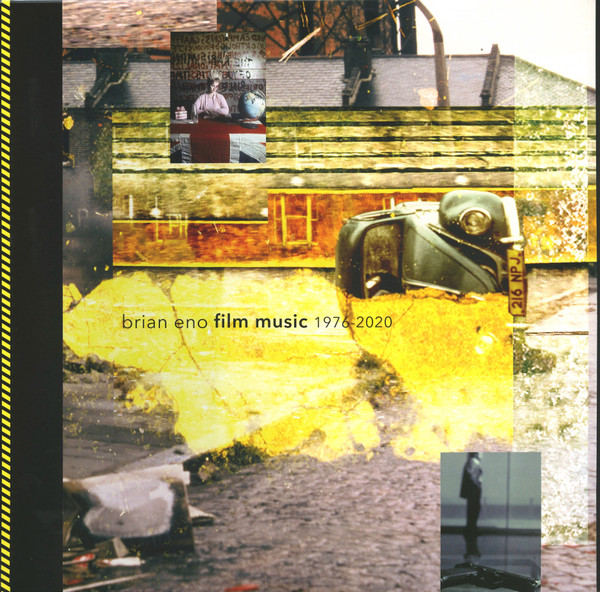
That Brian Eno’s music has been used on cinematic and television soundtracks isn’t much of a surprise, especially after almost half a century of public creativity. The full title of the Film Music 1976-2020 compilation suggests that it picks up where 1976’s Music For Films left off, and while it doesn’t tell the whole story, it does provide a wide-ranging smattering of his work over that period.

Just because he can, “Final Sunset” is repeated from Music For Films; like “Dover Beach”, it was used in a Derek Jarman film. Unlike those earlier compilations, three vocal selections are included: “Under” from the animated flop Cool World; “You Don’t Miss Your Water”, his only “song” from the ‘80s; and “Beach Sequence” from the Passengers project, one of the few pieces on that album used in an actual film, and including exactly one line sung by Bono.

A few pieces are appropriately “spacey” if not intended that way, like “Blood Red”, “Decline And Fall”, “Late Evening In Jersey”, and “Undersea Steps”. Meanwhile, “Prophecy Theme” from 1984’s Dune soundtrack (otherwise populated with music by Toto) fits right in with “An Ending (Ascent)” and “Deep Blue Day”, as first heard on Apollo, and the latter more widely in Trainspotting. Two pieces for the British crime drama series Top Boy are intriguing and suspenseful. (A full album of score music, some very reminiscent of Peter Gabriel’s Birdy soundtrack, was later released on CD in Japan, vinyl other places, and streaming everywhere.) While not from that project, “Reasonable Question” and “Design As Reduction” are of more recent vintage yet fit right in.

More than conveniently collecting stray tracks, Film Music works as an album, one to get lost in without necessarily picturing the visuals. Otherwise we mightn’t have heard such pleasant surprises as “Ship In A Bottle”.

Brian Eno Film Music 1976-2020 (2020)—3
Brian Eno
Top Boy (2023)—3

Tuesday, April 9, 2024

Brian Eno 27: Mixing Colours

We don’t know if being Brian’s younger brother has done Roger Eno any favors, but he has managed to build up a catalog of his own brand of ambient music over the decades. Mixing Colours was the Enos’ first released collaboration in decades, and it was apparently built over a period of 15 years.

The brief is very much like the albums Brian did with Harold Budd—Roger plays gentle keyboards, mostly in the acoustic or electric piano family, and Brian treats the sound or adds his own touches. Each track’s title is derived from a specific shade or tint, so whether or not they convey an accurate representation of a mood is up to the individual. That being so, we found “Snow” to be very pretty and engaging, even before we checked to see what it was called. “Celeste” seems to be one of the more musically developed pieces, as opposed to a sketch, and “Slow Movement: Sand” does convey a certain majesty as it builds. By comparison, “Desert Sand” is dominated by a Brian texture right out of 1976. “Obsidian” breaks from the mold with an organ-based sound, tempered by the more chamber-nursery tone of “Blonde”. The album is easy to have in the background, so one might not notice that the melody of “Spring Frost” turns up again an hour later as “Cerulean Blue”, for example.

Mixing Colours was released at the start of the COVID lockdown, and provided a companion for enforced solitude. Some time afterwards, the Luminous EP presented another seven tracks by the duo, which may be easier to ingest as a shorter program. These were then inserted into the album’s original sequence, which was rereleased as Mixing Colours Expanded. All together, it’s pleasant aural wallpaper from the family dynasty that invented it.

Roger Eno and Brian Eno Mixing Colours (2020)—3
Roger Eno and Brian Eno
Luminous (2020)—3

Friday, November 17, 2023

Brian Eno 26: Music For Installations

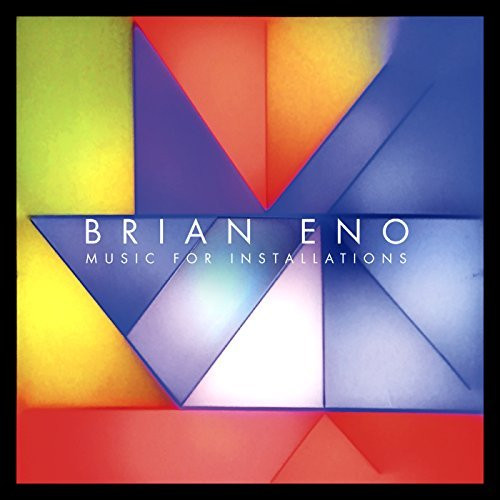
Starting with Discreet Music and making a leap forward with Thursday Afternoon, Brian Eno has continually strove (strived? striven?) to create music that would enhance a visual experience without overwhelming it. Sometimes he’s created his own visuals, but more often since the ‘90s he has been sought out by established artists and organizations to accompany theirs. This led to his own strides using software to create “generative” music.

Music For Installations gathers over five hours of content from art shows over the decades. Some of it had been previously distributed on rare and/or limited-run CDs or as part of larger book/DVD packages. Collectors will be happy to make room on their shelves previously taken up by such rarities as 77 Million Paintings, Lightness, I Dormienti, and Kite Stories, whether procured officially or downloaded from file-sharing sites.

Eno’s ambient music is usually hard to describe, and here we have six CDs’ worth to attempt, moreso without the visuals they were intended to accompany in the first place. Possibly because it’s the first track in the set, “Kazakhstan” stands out, a spooky but moving piece devised for an event in that city. Many of his pieces have chiming qualities to them, and not always demonstrated by such titles as “Flower Bells”, which itself isn’t very soothing, not that that was ever the point. “Atmospheric Lightness”, however, is soothing. “77 Million Paintings” gurgles along for 44 minutes, and we could swear we hear voices sometimes, though they’re beyond discernability. They’re more prominent and disembodied on “I Dormienti”, which is almost as long, whereas the three “Kites” pieces seem to vary on that one.

The disc titled Making Space counts here because it replicates a CD that was sold at some of his installations, but it’s much more rhythmic and involved than the other discs, more along the lines of the “juju space jazz” of his mid-‘90s albums. “New Moons” even features electric guitar purposefully strummed by Leo Abrahams, while “Delightful Universe (Seen From Above)” is almost majestic. Finally, the Music For Future Installations disc contains pieces never before utilized, not as “generative” as the earlier discs, and certainly eerie. (Good luck nodding off during “Surbahar Sleeping Music”.)

While culled from a variety of sources over the years, there’s a unity to Music For Installations, and none of it sounds dated. This music demonstrates what kept Eno occupied in solitude (mostly) throughout the late ‘90s and first part of this century, despite his less obvious output following The Drop. The set itself was available on CD and vinyl in a snazzy Plexiglas design, as well as in a more economical CD box, and the simplest of all: streaming. The latter allows the listener to have the least possible contact with the execution, and thus absorb however it works. Probably not best to have on while driving.

Brian Eno Music For Installations (2018)—3

Tuesday, May 23, 2023

Brian Eno 25: Finding Shore

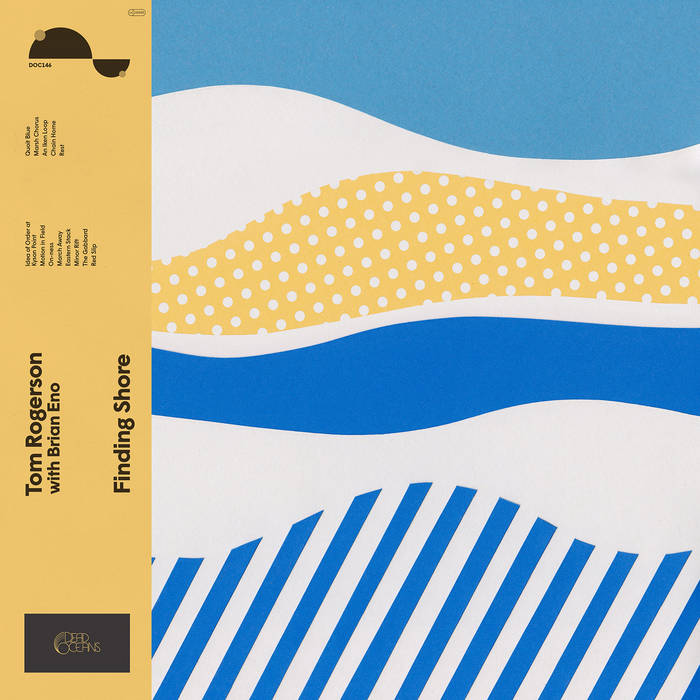
From his first collaborations with other musicians, Brian Eno has often been in the position of electronically processing the sounds other people produce. That’s how he started out with Roxy Music, and how he usually “produces” other people. His two albums with Harold Budd found him working head to head with a pianist, and that’s very much the idea behind Finding Shore, a collaboration with British keyboardist Tom Rogerson.

It’s not the best comparison, as Rogerson is a much more expressive pianist in the classical style—as demonstrated best on “On-ness”—compared to the minimalist, impressionistic landscapes Budd conceived. The listening experience is more emotional, and not as “cold” as the Budd albums could tend to be. Still, there’s a familiarity to “Quoit Blue” and “Minor Rift” that sends us back there. That said, thanks partially to the technology Eno uses, the music can sound more harsh and mechanical, as on “March Away”, “Eastern Stack”, “Red Slip”, and “Chain Home”. This makes the majestic “Marsh Chorus” and “An Iken Loop” more welcome.

The improvisatory approach covers a lot of moods, so Finding Shore can be a little disjointed. But taken individually, the tracks are certainly enjoyable.

Tom Rogerson with Brian Eno Finding Shore (2017)—3

Tuesday, January 10, 2023

Brian Eno 24: Reflection

We’ve mentioned that many of Eno’s ambient albums are so complex that they sound different on each listening. That’s tough to do with physical media, as once something is mastered it’s set in stone, for lack of a better metaphor. As many of his ambient works are designed to accompany whatever environment he’s created, he’s always longed for something that could change naturally.

He kinda does that with Reflection, but not if you buy the CD. A $40 app from the Apple Store was designed to be completely generative, with the sound adapting to time of day and even the season of the year. Even the streaming version, which had to stick with one program, was updated from time to time; as of this writing there are four “single” versions on Spotify of varying lengths.

At any rate, the CD consists of a single 54-minute track, and has not changed since first play, at least as far as we can tell. (Thursday Afternoon was also a one-track album, but more happens here.) It begins quietly, suggesting a dark landscape like On Land, but soon finds a setting more like The Ship, only without voice. The tones, similar to bass electric piano notes and sometimes vibes as heard on Music For Airports, reverberate seemingly without end, until a distant high-pitched sound seems to appear from across whatever water we’re looking at around 18 minutes in. A variation sounds about four minutes later, bringing a major-chord change that resounds, then recedes. About a half hour in there’s actually a two-chord sequence; ten minutes after that some multi-note figures appear, and what we used to call space sounds. Eventually the program fades on what we used to call a loop, and then it’s gone.

We will admit to putting on Reflection specifically for falling asleep, so it does take some effort to experience the entire program. It’s easy to ignore, but rewarding when you don’t.

Brian Eno Reflection (2017)—3

Tuesday, July 12, 2022

Brian Eno 23: The Ship

Ambient music and vocal music have been parts of various Eno albums, to be sure, but he’s rarely tried to meld them within the same piece. That changed with The Ship.

The title track is a lengthy meditation on the sinking of the Titanic. The subject is not a new obsession; back in the ‘70s Eno inaugurated his Obscure Records label with a neo-classical piece by Gavin Bryars called, yes, The Sinking Of The Titanic, which built on the idea that the orchestra on board kept playing while the boat sank. This intriguing piece incorporated taped voices and sound effects to approximate the effect of water, and so does Eno’s. After several minutes of setting a mood, he starts singing, slowly, in a very low register, and harmonized. When the voices arrive, they’re either fragmented, too low to discern, or approximate another language, until the piece fades on a repeated “wave after wave”.

The second half of the album is a suite in three parts titled “Fickle Sun”, said to be inspired by the further destruction of the first World War. The first part is almost as long as “The Ship”, but the music isn’t as soothing, with more ominous melodies in the background and the lyric punctuated by distant thuds that approach into loud clanging accompanied by brass. A churchy organ emerges, and the melody changes to a more major key. Soon the voice appears almost alone, with a female voice processed to sound like a telegraph, ending with some strings and more uncertainty. The second part, subtitled “The Hour Is Thin”, is a relatively brief, apparently computer-generated monologue read by the voice of Darth Maul, the live-action Tick, and the flatmate from Shaun Of The Dead over some otherwise pleasant piano plinking we’d prefer to hear alone. The surprising finale is a very reverent cover of the Velvet Underground’s “I’m Set Free”, helped by recent cohorts Jon Hopkins and Leo Abrahams. Whatever this has to do with the Titanic or the war is beyond us, but it’s shimmering and lovely.

Because of its length, The Ship is one of those Eno albums that sounds different every time you listen to it, thanks to all the layers and textures. And that’s probably what he wanted. It’s easy to get lost in.

Brian Eno The Ship (2016)—3

Tuesday, March 1, 2022

Brian Eno 22: Someday World and High Life

We’ve never heard anything by the electronic band Underworld, except that they had a hit in the early ‘80s called “Doot-Doot” when they were known as Freur. One of the principals is a fellow named Karl Hyde, who hooked up with Brian Eno in 2014 for what turned into two albums.

Someday World also features a lot of input from the musician not yet known as Fred Again; at this point he was basically interning for Eno, and contributed much in the way of composing and production assistance. Hyde has a pleasing voice, not as deep as Eno’s, who often uses that phased effect, but sometimes the blend blurs the singer’s identity.

This is an album of songs, not mere textures. Much of the album bubbles with the spirit of catchy synth-pop just like what Eno inspired. “The Satellites” is pinned by a cyclical fake trumpet section, which return for another hook on “Daddy’s Car”, featuring Hyde on vocals. He’s also center-stage for most of the more dated-sounding “A Man Wakes Up”. “Witness” has a promising basic track with echoes of green worlds before and after science, but the vocals spend too much time around a single note, and the spoken contributions of Eno’s younger daughter should have been saved for the extended remix. The tension in “Strip It Down” bursts through with each chorus pleasingly.

The more subdued “Mother Of A Dog” recalls Eno’s 1990 collaboration with John Cale, and so does “Who Rings The Bell” at times, but that one’s sung by Hyde, and has much more of a melody. “When I Built This World” borrows the melody from the first line of “When I Fall In Love”, but soon deteriorates into something more robotic. “To Us All” is too loud for a lullaby, but it is lilting.

Despite all the electronics, Someday World doesn’t sound at all cold; if anything, it’s cheerful. In the interest of keeping things fresh, the dynamic duo went on to record and release High Life later in the same year. This time brevity was out the window, as ideas were chased across lengthy tracks, beginning with the hypnotic “Return” followed by the much more frenetic “DBF”. “Time To Waste It” is almost funky, the groove decorated by treated and sampled vocals. “Lilac” brings to mind later Talking Heads filtered through Bo Diddley before it gets taken over by the momentum. “Moulded Life” seems to throw multiple samples into the mix at once before the track emerges as a kind of Mission: Impossible theme, while “Cells & Bells” combines ambience with distortion to predict Eno’s next step. (As was becoming a trend, the digital version included a bonus track in “Slow Down, Sit Down And Breathe”, which is far from relaxing, while the vinyl included that plus another, “On A Grey Day”, which would be welcome anywhere.)

Eno•Hyde Someday World (2014)—3
Eno•Hyde
High Life (2014)—

Wednesday, April 10, 2013

Brian Eno 21: Lux

Brian Eno’s musical adventures in the new century have predominantly been ambient collaborations, or background music designed to accompany various art installations. That’s nothing new for the guy, except to lower the level of excitement whenever there’s news of a new album from such a project. While ambient music by definition is designed to be ignored, if we’re going to spend upwards of fifteen bucks on a CD of the stuff, we’d like it to capture our attention more than not.

And he is capable of that. For example, Music For Airports, Apollo and The Plateaux Of Mirror are very listenable when your immediate plan is to stay awake; the same can’t always be said for the likes of Neroli, The Drop and even Thursday Afternoon. With Lux, however, he’s managed to illustrate “the light of day” with a full CD’s worth of content that echo the better examples above. The instrumentation is mostly keyboards, a softly pinging piano, and strings that sound both real and computerized. Split into four 19-minute sections—the equivalent of a two-record set—it’s a soft and soothing program, though there is a shift to a minor key about halfway through, and a more melancholy mood by the fourth part. If you’re going to pick and choose from the man’s catalog, this is definitely one to grab.

Brian Eno Lux (2012)—3

Thursday, November 1, 2012

Brian Eno 20: Drums Between The Bells

Suddenly busy, Brian Eno hooked up with another collaborator out of nowhere, this time English poet Rick Holland. Drums Between The Bells was billed to “Brian Eno and the words of Rick Holland”, and that’s exactly what it is—Eno music with abstract minimalist poetry recited over it, usually by a female, sometimes by himself.

Poetry readings aren’t for everyone, but then again, neither is Eno. Personally, we’d rather do without the voices, since some of the music is so nice, and some of it very familiar. “Dreambirds” and “Pour It Out” are particularly lovely piano-based pieces, and “The Real” meshes Apollo with the backwards pianos of side two of Low. “Sounds Alien” features Eno harmonizing with what a woman is reciting, but then there’s a horn break right out of an ‘80s TV cop drama. “Cloud 4” and the spooky “Breath Of Crows” involve more musical vocals as well. Leo Abrahams adds a distorted guitar to the opening “Bless This Place”, and Eno stalwart Nell Catchpole does her violin thing here and there.

The initial pressing was made available in book-like packaging that included a bonus disc of the music in a different sequence and without voices, but it cost more, naturally. A few months later, the Panic Of Looking EP presented another six tracks from the same sessions. One track, “Watch A Single Swallow In A Thermal Sky, And Try To Fit Its Motion, Or Figure Why It Flies”, is purely instrumental with treated piano. Outside of that, one cameo from his daughter and another from Bronagh Gallagher (best known from The Commitments and Pulp Fiction) it’s only for completists.

Brian Eno and Rick Holland Drums Between The Bells (2011)—3
Brian Eno and Rick Holland
Panic Of Looking (2011)—3

Thursday, November 24, 2011

Brian Eno 19: Small Craft On A Milk Sea

If anyone understands the power of branding in packaging modern music, it’s Brian Eno. Case in point: Jon Hopkins and Leo Abrahams were already busy musicians in the electronic field before meeting Eno, and worked with him on various projects throughout the first decade of the century, for such artists as Paul Simon and Coldplay. Yet when their first full-length collaboration was released as Small Craft On A Milk Sea, Eno’s name came first. Meanwhile, the liner notes show the other two as contributing keyboards and guitars, while Eno is credited with “computers”. Granted, that’s not to suggest he didn’t do anything musical with said machines, but still.

This would be more of a big deal if the album was wholly somebody else’s work, or worse, not very good. But somehow these relatively short pieces, designed with the familiar idea of creating imaginary soundtracks, hang together very well. Some cuts, such as “Complex Heaven”, “Calcium Needles”, and the title track, recall the spacescapes of Apollo; others, like “Flint March”, “Bone Jump”, and “Dust Shuffle”, bring to mind the “juju space jazz” of The Drop, but with more purpose than noodling. A guitar finally shows up in “Horse”, which sounds like a remix of certain Music For Films and the Passengers project, while “2 Forms Of Anger” bashes out a single chord right out of Joy Division.

Overall, there’s enough variety in between that makes it easy to sink into it as ambient music, or even put on shuffle and enjoy from a completely random standpoint. Again, the brevity and purpose of each of the tracks on Small Craft On A Milk Sea combine for success. (The Japanese pressing got an extra track in the closing, near-ambient “Invisible”, while a pricey limited collector’s edition added a bonus disc with four more tracks, plus an exclusive silkscreen print. All these, save the print, were eventually made available for streaming.)

Brian Eno with Jon Hopkins & Leo Abrahams Small Craft On A Milk Sea (2010)—3

Saturday, May 28, 2011

Fripp & Eno 5: Beyond Even

Robert Fripp had already pioneered a system of releasing seemingly random selections from the deep King Crimson archives by the 21st century, and his Discipline Global Mobile operation would soon make further economic inroads by offering direct downloads. These extended to various of his non-Crimson ensembles and activities, so a 2006 compilation titled The Cotswold Gnomes, credited to Fripp & Eno, was an intriguing tease.

Described as “a sequence of sketches, out-takes, work in progress and alternative mixes,” its genesis was made clearer when the music was released on CD a year later as Beyond Even (1992-2006). Those who’d found The Equatorial Stars to be less than thrilling might have been more pleased with the breadth of styles undertaken here. Most of the pieces have percussion, so it doesn’t belong to the strictly ambient pile. The first few tracks burble along, then for the aptly titled “Sneering Loop” Fripp lets loose with a nasty riff. “Timean Sparkles” benefits from no percussion, and is closest to the quieter parts of Evening Star; “Hopeful Timean” sports contributions from bassist Tim Harries and is even quieter yet spookier. From time to time we hear some atmospherics reminiscent of Fripp’s albums with Andy Summers, blurring the lines further as to who did what on those particular albums. “The Idea Of Decline” recalls the “juju space jazz” of Nerve Net, but the latter half of the album leans to the spacey. Even the occasional energy of the first half is no match for the closer, the utterly explosive “Cross Crisis In Lust Storm”, which features ‘90s Crimso Trey Gunn on what we’ll assume is his trusty Chapman Stick. (Fripp rated his own contribution to this track very highly.)

Modern technology had of course made it much easier for people who were neither Fripp nor Eno to create automated loops and textures; still, these veterans get the benefit of being old hands at experimenting. Beyond Even is a nice peek for fans into their workshop. (A limited edition package offered the music two ways: one disc separated into individual tracks, with a few seconds of silence between each, and the other as a segued yet still indexed suite of continuous music. Even the artists’ own sites disagree as to what “disc one” is, but the streaming version is continuous, so there you go.)

Fripp & Eno Beyond Even (1992-2006) (2007)—

Wednesday, April 6, 2011

Brian Eno 18: Another Day On Earth

While Eno had released the occasional album since the turn of the century, most were ambient in the purest sense of the word, in that they were designed to accompany art installations, and not be overly concerned with things like melody or chord changes. The arrival of Another Day On Earth, however, was exciting, since he actually had songs with words to them. While it’s closer to the general sound of Wrong Way Up than anything in the “first four”, it was easy to ignore the previous fifteen years of silence.

Beginning with exactly the type of rhythm box he’d used for composition, “This” is repetitive yet melodic, while “And Then So Clear” and “A Long Way Down” continue the gentle approach, the former with a processed vocal in an artificially high register, and the latter more spoken. (Speaking of which, he gives over “Going Unconscious” and the closing “Bone Bomb”—something of an anti-war statement?—to the dulcet coos of a woman, while his synth burble underneath.)

“Caught Between” is fairly adventurous vocally, showing the grasp of harmony he’d picked over the years. It even has some guitar straight out of Another Green World. “Passing Over” comes close to being spooky, and luckily the mood is lightened by “How Many Worlds”, its chamber-like backing decorated by several violins. “Bottomliners” is full of impressionistic lyrics designed to excite the imaginations of Enophiles everywhere.

By the time “Just Another Day” comes along, many of the songs have started to resemble one another, but it’s still a nice summation of the best elements of the album. “Under” continues the mood, oddly enough as it’s a re-recording of a track from My Squelchy Life, previously released on one of his box sets.

Another Day On Earth wasn’t about to set the world on fire, but again, for Eno fans, it was great to have something to add the pile that wasn’t strictly digital wallpaper. Song-based albums would be the exception to his norm, as he’d continue to go further back into the future, determined as ever to find his own way.

Brian Eno Another Day On Earth (2005)—

Sunday, March 6, 2011

Fripp & Eno 4: The Equatorial Stars

While Robert Fripp appeared on the occasional Brian Eno album in the ‘90s, it seemed that their years of intense collaboration were in the past. We were wrong.

The Equatorial Stars presents a modern but not radical departure from their initial work together. For the most part, these are ambient pieces along the lines of Thursday Afternoon and Apollo, with the latter connection underscored by the track titles, each named after an actual star or constellation. Those seeking Fripp’s more serrated style of playing will be disappointed, but it should be noted that he’d spent many of recent off years between King Crimson projects taking his Frippertronics approach to exotic locales around the world, creating “soundscapes” of improvisatory playing over prepared loops.

As with most (successful) ambient recordings, concentrated listening is rewarded by not required, but a few segments stand out. Fripp’s soloing is subtle on “Meissa” and “Tarazed”, and particularly noticeable on “Ankaa”. “Altair” is pinned to a funk rhythm that actually raises the volume and sets toes tapping. Overall, the mood borders on spooky, but The Equatorial Stars is recommended to anyone who enjoys Apollo.

Fripp & Eno The Equatorial Stars (2004)—3

Saturday, February 12, 2011

Brian Eno 17: Drawn From Life

As might have been predicted from the largely action-devoid pieces he’d dabbled with throughout the ‘90s, Brian Eno wasn’t so much interested in composing music to be merely heard as he was creating the soundtrack to interactive experiences. But by the end of the decade the ambient brand had become an actual thing, with artists like Aphex Twin taking the lead on the charts, and others bringing in beats, of all things, for a new genre known as trip-hop.

His first album of the new century, then, was a collaboration with a German composer (deejay, actually) named J. Peter Schwalm, released on the same Astralwerks label that had been mining the territory he’d discovered. Eno and Schwalm had already collaborated on art installations, as well as an appearance at a museum in Bonn, Germany with Holger Czukay of Can in 1998, released a quarter-century later as Sushi. Roti. Reibekuchen.

But back to the album at hand. Some of the music on Drawn From Life recalls the recent “space jazz” of The Drop; at other times they could be more Music For Films. The percussion certainly keeps it contemporary. Regular collaborator Nell Catchpole adds violin here and there, while Laurie Anderson’s robotic voice fits right in on “Like Pictures #2”, as does somebody named Lynn Gerlach, credited with the disembodied contribution to “Rising Dust”. The original immersive intention of ambient music is reinforced on “Bloom”, where the sound of Eno’s young daughters at the kitchen table can be heard. (A mix without the voices is also included, but it’s redundant.)

Altogether, Drawn From Life is pleasant, mostly harmless, and not at all overbearing. It’s melodic in places, which makes it a little more interesting, but it’s hardly a buried treasure. If you want to chill out, chill out.

Brian Eno & J. Peter Schwalm Drawn From Life (2001)—3

Saturday, January 1, 2011

Brian Eno 16: Spinner and The Drop

In between production gigs, Eno occasionally entertained the odd commission. One such project was the soundtrack to a posthumous Derek Jarman film called Glitterbugmusic for a film, if you will. Eno duly recorded some tracks and textures, then fobbed off the tapes to Jah Wobble, best known around these parts as the bass player in Public Image Ltd. The resultant album, Spinner, was credited to the pair, yet Eno avowed that he hadn’t heard the final product until it was pressed.

Such a half-assed approach only fuels the fire of his critics, and a lot of Spinner—save the tracks obviously overdubbed with bass and drums by Wobble—does seem as if the music is being created with zero human input. Still, tracks like “Where We Lived” and “Like Organza” will inspire comparisons to Apollo, while “Garden Recalled” previews parts of Radiohead’s Kid A. While the album has too much in the way of rhythm to be considered truly ambient, it’s also too easy to ignore.

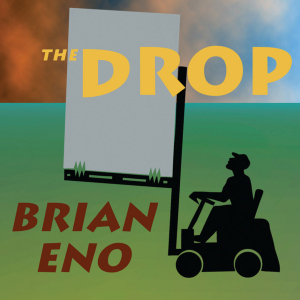
Several minutes into Spinner’s final track, the music goes silent, emerging several minutes after that with a spooky, spacey piece based around rhythm box and a couple of electric pianos. This would emerge even longer as “Iced World” at the end of Eno’s next album. He described The Drop variously as jazz played by aliens, music that “nobody asked for,” or “music that nobody wants to listen to,” which of course begs the question why we should.

This time he apparently added the rhythms all by himself, and spread them about a variety of shortish pieces that, again, are just there, with the possible exception of “Swanky”, which at least sonically resembles its title. Much of the album is rather generic sounding, although “Dear World” does weave his droning voice into the mix. (The expanded reissue shortened “Iced World” by several minutes so it would fit on vinyl, and added two tracks from an earlier Japanese release, both of which were also included in the digital version. Meanwhile, the CD was augmented by a disc containing music from one of his art installations of the time. As for Spinner, its eventual upgrade ditched the “Iced World” preview in favor of a track each from Eno and Wobble, both decent.)

Eno/Wobble Spinner (1995)—
2020 expanded edition: same as 1995, plus 2 extra tracks (and minus 1 track)
Brian Eno The Drop (1997)—2
2014 expanded edition: same as 1997, plus 9 extra tracks

Monday, May 17, 2010

U2 10: Passengers

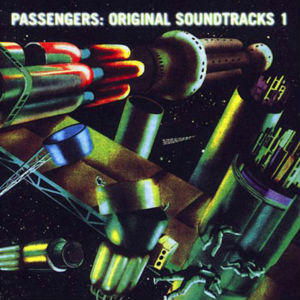
Following on from the idea of creating music for imagined films, this U2 side project could just as well be filed under Brian Eno, depending on the personal opinions of the handful of people who still own it. Instead of the more thematic title Music For Films 4, this highly experimental album was given the hopeful moniker of Original Soundtracks 1 and credited to a collective called Passengers. In reality it’s a full-on collaboration of Eno and U2, with the band appearing on all tracks and Bono singing wherever there are vocals, or just under half of the album.

“United Colors” bubbles in, an extended piece punctuated by turntable/tape effects and the occasional guitar. Bono’s voice emerges on “Slug”, and dominates on “Your Blue Room”—complete with the second-ever vocal appearance by Adam Clayton!—which would have been perfectly at home on Zooropa. “Always Forever Now” isn’t much lyrically, but luckily builds enough to surpass its similarity to Steve Miller’s “Swingtown”. “A Different Kind Of Blue” is a mostly Eno interlude before the almost romantic “Beach Sequence”.

Bono even gets out of the way to let Luciano Pavarotti to put his inimitable stamp on “Miss Sarajevo”. The song builds and builds to perfection, and the moment when the maestro takes over is just plain exhilarating. But from here, it’s a slow decline. “Ito Okashi” and “Two Minute Warning” sound more like Eno experiments, complete with Japanese vocals. Edge takes over for the plodding “Corpse”, which otherwise nicely evokes spy TV shows of the sixties. Then we come to possibly the most annoying track in their catalog: “Elvis Ate America”, something of a rapped duet with a guy named Howie B, and we’ll hear from him again, unfortunately. The three instrumentals that close the album seem almost unfinished, though “Plot 180” sounds like a Daniel Lanois track, “Theme From The Swan” could have come from Eno in Berlin, and listeners will spend most of “Theme From Let’s Go Native” waiting for the vocals to kick in.

To date there has not been a sequel to Original Soundtracks 1. While it was nice to have some new U2 material to ponder, fans looking for the next blockbuster were confused. They shouldn’t have been, unless they took the liner notes seriously.

Passengers Original Soundtracks 1 (1995)—