Showing posts with label chieftains. Show all posts

Friday, November 1, 2013

Van Morrison 21: Irish Heartbeat

On something of a roll, Van’s next album was a full-blown collaboration with the Chieftains, the venerable Irish combo. Essential for fans of both artists, Irish Heartbeat is a treat from start to finish, offering eight traditional pieces and remakes of two recent Van originals, all treated the same way. Besides being an obvious go-to pick for St. Patrick’s Day listening, it can be enjoyed all year long, assuming you find it pleasing.

Basically, they’re the band, he’s the singer, albeit one who is also credited with guitar and even drums. Half the songs are duets with Mary Black, Maura O’Connell, June Boyce and/or the band’s own Kevin Conneff. Each side begins with an infectious jig, and both “Star Of The County Down” and “I’ll Tell Me Ma” encourage singalongs. Some of the tunes, like “Raglan Road”, “Carrickfergus” and “She Moved Through The Fair” are already standards of sorts, and are welcome here. Less well-known are “Tá Mo Chleamhnas Déanta” (sung in both Gaelic and English) and the moody “My Lagan Love”, where he really lets loose with the Irish equivalent of scatting. It all comes to a joyous close with “Marie’s Wedding”.

It sounds like a no-brainer today, but this was merely the first of the Chieftains’ successful summits with singers not normally filed in the same part of the record store. But while they appeared on other Van albums after this one, Irish Heartbeat has yet to spawn a sequel, which is too bad, seeing as they don’t have as much time left. It was also arguably the last time he sounded remotely happy.

Van Morrison & The Chieftains Irish Heartbeat (1988)—4

Thursday, December 20, 2012

Holiday Special #2: The Bells Of Dublin

The Chieftains are one of those mainstream outfits peddling their own brand of traditional Irish music, found once upon a time at most big box stores in the “Celtic” section next to the Clancy Brothers. After having something of a boost from Van Morrison, they released a series of albums that featured collaborations with a variety of established artists, all singing to their accompaniment. One of their nicer projects—surpassed only by The Long Black Veil a couple of years later, teaming them with the likes of Tom Jones and the Rolling Stones—was a Christmas album based around The Bells Of Dublin.

Besides presenting a pleasant selection of airs and graces (if you like that sort of thing), the collaborations were unexpected. Honorary Dubliner Elvis Costello contributes the gory tale of a family dinner gone wrong (not for the first or last time) in “St. Stephen’s Day Murders”. The McGarrigle sisters offer a medley of French carols, then Burgess Meredith sets up a Gaelic shepherds’ tale. Marianne Faithfull adds her sweet rasp for “I Saw Three Ships”—contrast that with Rickie Lee Jones, who sounds like she’s either on the verge of tears or a sneeze for “O Holy Night”. Jackson Browne had been quiet for a few years when he came up with “The Rebel Jesus”.

Beyond the “star” aspect, the traditional selections are the glue of the album. The Voice Squad lends support to several carols, as well as the extended dance demonstration of “The Wren” (even if singer Kevin Conneff sounds a little like Popeye on some of his scatting). The final section of blends three carols into a big finish on “O Come All Ye Faithful”, with the organist from a Belfast cathedral playing into those bells.

The Bells Of Dublin will likely irritate those who aren’t fond of Irish music, but we find it awfully soothing. As various CDs (and LPs) have gone in and out of our holiday stack over the years, this one is a constant.

The Chieftains The Bells Of Dublin (1991)—

Thursday, April 29, 2010

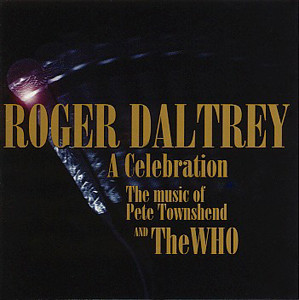
Roger Daltrey 10: A Celebration

Perhaps knowing what his legacy would always be, Roger Daltrey turned his attention to staging a pair of all-star concerts at Carnegie Hall for his 50th birthday. A Celebration: The Music Of Pete Townshend And The Who put Roger—tux-clad but tie- and sleeve-less for the first half, shirtless under a leather jacket for the second—in front of an orchestra conducted by Michael Kamen and a band featuring veterans of the 1989 tour and such Townshend familiars as Jody Linscott, Rabbit Bundrick, Phil Palmer, Jon Carin, Pino Palladino, and Simon Phillips. The set consisted of a curious mix of familiar songs and surprises, even a few solo choices, the spotlight occasionally ceded to or shared with special guest performers.

A Michael Lindsay-Hogg-directed pay-per-view special followed, while the official Bob Ezrin-produced album only presented half of the music performed at the 2½-hour shows. As Roger no longer had a solo deal of his own, it was released on an independent label the same damn day as the Who’s heralded box set.

The show opened with an “Overture”—not the one from Tommy, but a new medley of orchestrated Pete melodies. From there Roger sang some of the expected hits, but also some deep cuts. Yet the most startling and best rendition was that of “The Sea Refuses No River”, making us wish he’d explored more of Pete’s solo catalog.

Relegating contributions from Spin Doctors, Eddie Vedder, Lou Reed, and Alice Cooper to the video document, CD listeners were treated to Linda Perry, then of 4 Non Blondes, with a frankly excellent take on “Doctor Jimmy”, and the Chieftains, who augmented “Baba O’Riley” and “After The Fire”. (Sinéad O’Connor, who was still getting booed in those days, sang on the last two, but was not included in the mix.) David Sanborn was touted as a featured soloist on “5:15”, John Entwistle contributed bass to “The Real Me”, and Pete himself played a few songs without the other two; of those, only “Who Are You” was included.

A Celebration wasn’t exactly a sales smash, but the subsequent “Daltrey Sings Townshend” tour attempted to keep the party going with some of the same players, plus key additions like John Entwistle, Pete’s brother Simon on guitar, and young Zak Starkey on drums. As John always needed the money, more tours would follow, making the album something of a catalyst for future Who activity.

Roger Daltrey A Celebration: The Music Of Pete Townshend And The Who (1994)—3