Showing posts with label jane's addiction. Show all posts

Friday, January 23, 2026

Jane’s Addiction 4: Kettle Whistle

Despite fragmenting in 1991, Jane’s Addiction never really went away. Perry Farrell and Stephen Perkins formed Porno For Pyros, while Dave Navarro and Eric Avery emerged in Deconstruction, which didn’t sell as well, plus Eric didn’t want to tour. Navarro ended up in Red Hot Chili Peppers for a well-publicized couple of years, which is one reason why that band’s Flea came on board to play bass when Jane’s reunited for the cleverly dubbed Relapse tour. The occasion was promoted by something of a rarities collection: Kettle Whistle served up a CD full of demos, outtakes, live versions, and some new music, somewhat haphazardly sequenced.

The opening title track was apparently a tune that had been around for years, but not properly recorded until now. It’s more on the spacey side than most of their catalog, sounding more like Peter Gabriel than Led Zeppelin. But it’s also more musical than the noisy “So What!”, which has an obnoxious vocal over a fairly standard funk pattern, and they let Flea play trumpet again. “My Cat’s Name Is Maceo” is a fairly literal lyric over a simple riff, and somehow they got Maceo Parker himself to toot along for part of it, either in 1987 or 1997, we’re not sure which. The moody strum of “Slow Divers” is described as an outtake from their self-titled live album, with some posthumous additions, and would have been a very odd if not unwelcome departure had it appeared back then. “City” is nothing more than a Perry-and-Navarro tune recorded for the soundtrack of their Soul Kiss video.

The alternate versions of familiar tunes aren’t very illuminating, and only prove that they’d yet to figure out how to harness the power the final masters would deliver. Yet the live versions are excellent, and we’re still amazed how they could make something as basic as “Jane Says” stay interesting for six minutes. Four (out-of-sequence) songs from the Hollywood Palladium show how tight they were, though we could do without Perry’s “monologue” before “Three Days”.

Even if Kettle Whistle wasn’t stellar, the kids who had the other three albums were happy to have something else to put into the rotation, and they weren’t buying Porno For Pyros. For them alone, it did the trick.

Jane’s Addiction Kettle Whistle (1997)—3
Friday, July 4, 2025

Jane’s Addiction 3: Ritual de lo Habitual

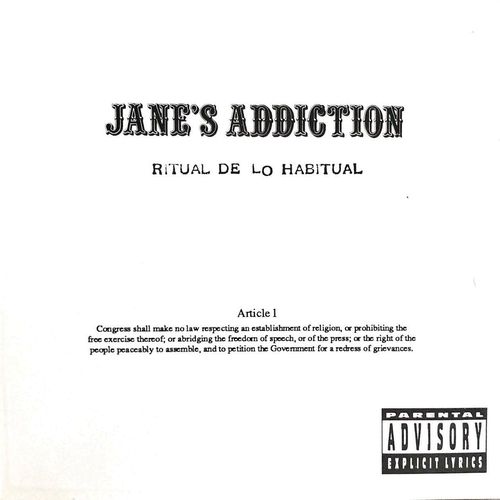
Coming off the heels of their major-label debut, and with a nutty outspoken frontman out there, the pump was primed for Jane’s Addiction next album. Ritual de lo Habitual was provocative out of the gate, starting with the cover art. Once again a sculpture designed by Perry Farrell and his partner, it depicted, well, a threesome, complete with pubic hair. (To make the album available in stores that wouldn’t stock that cover, a more stark version with the misattributed First Amendment to the U.S. Constitution was prepared.) The music is full of the Jane’s trademarks we’d expect, but in a wider spectrum that inspires positive comparison to Led Zeppelin’s more epic mid-‘70s work.

A spoken piece in Spanish introduces the band, and “Stop!” crashes through the gate with everyone firing on all cylinders. For the second album in a row Perry opens with a hearty “here we go”; the half-time bridge is very effective, as is the a cappella break. They don’t let up on “No One’s Leaving”, a slice of funk that soon turns to an all-out assault, except for when it pauses after each verse. Following a mildly atmospheric interlude underscoring defiance, “Ain’t No Right” drives the tempo back to full more of the same. “Obvious” fades in, with an incessant piano under the groove, deftly riding the wave through the bursts of accents between the dense vocals and wailing guitars. It all coasts to a close after six mesmerizing minutes, then it’s the audio-verité and barking dog opening the goofy “Been Caught Stealing”, helped along by its equally goofy video.

In an excellent demonstration of how to program albums as distinct sides, the second half is practically an entity to itself. The half-hour opens with “Three Days”, which basically fills in the details around the snapshot of the cover. One of the participants was no longer with us when the album came out, having died of an overdose and the album dedicated to her, but the fact she was likely a minor when she knew Perry likely added to his excitement. The recited prose in two speakers doesn’t help, but it’s much more interesting to hear what the band does with the music dynamically. “Then She Did…” is on a similar theme of remembrance, winding its way through trippy riffing and complementary drums for several minutes to establish a groove, with a few Big Moments, punctuated by strings and cymbals. The last such Big Moment concludes with a verse that illuminates Perry’s raison d’être: his mother’s suicide. The childhood reflection continues on “Of Course”, a gypsy stomp dominated by the Klezmer-style violin of Charlie Bisharat, recently of Shadowfax and shortly to accompany both Yanni and John Tesh. It’s a little too long—not unlike slapping yourself in the face—but the shimmering “Classic Girl” is a simple love song that ends the journey in tranquility and acceptance. He even wishes us a good night at the end.

Along with Nothing’s Shocking, Ritual de lo Habitual made the ideal side B on the Maxell tape that was their oeuvre (though you needed a 100-minute cassette to fit it all). And that would be it for a while, as the band, already fractured between the sober members and Perry’s dominance, disbanded at the close of the lengthy tour promoting the album, which included the first Lollapalooza Festival as part of its North American leg.

Jane’s Addiction Ritual de lo Habitual (1990)—4

Tuesday, January 14, 2025

Jane’s Addiction 2: Nothing’s Shocking

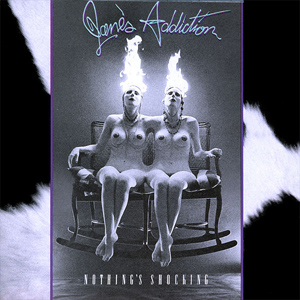
Thanks to a major label deal and a lot of press, Jane’s Addiction broke into mainstream success with Nothing’s Shocking. And right out of the gate, they were controversial, with cover art and lyrics requiring the now ubiquitous parental advisory sticker. That didn’t distract too much from the music, which sported plenty of guitars, electric and acoustic dynamics, and a vocal delivery that garnered more complimentary comparisons than other children of Led Zeppelin at the time.

The album begins, as many of their songs do, with a simple Eric Avery bass riff that barely hints at what’s to follow. A few power chords are hit and held, then drums join to match the rhythm and a melody appears. After some riffs and lyrics consisting of “here we go” and “home”, and that’s “Up The Beach”. An Arthur Lee-style acoustic intro belies the power of “Ocean Size”, and while it does reappear to help the verses breathe, it’s mostly a chance for Perry Farrell to yell in between Dave Navarro’s fretwork. “Had A Dad” is the first real song with non-abstract lyrics, in this case, the grunge generation ongoing absent parent issues. Stephen Perkins gets to explore his kit at the start of “Ted, Just Admit It…”; besides showing their predilection for ellipses, an actual soundbite from Ted Bundy is added to enforce the thesis that sex is violent and provide the album title. The double-time coda takes the tune to the next level. “Standing In The Shower… Thinking” sports a scratchy funk rhythm that would become their trademark.

It’s been something of an aural onslaught, so the dreamier, romantic “Summertime Rolls” provides a welcome change of pace, though it too amplifies for a spell. “Mountain Song” brings back the aggression big time, then to double down on the funk, “Idiots Rule” sports a horn section courtesy of two guys from Fishbone and the Chili Peppers’ Flea playing a very accomplished trumpet. “Jane Says” is upgraded from the first album, given a boost with very melodic steel drums for percussion, and still remains catchy despite, again, two chords. “Thank You Boys” is a snappy goof that serves to close the album, but only on the vinyl. Both cassette and CD got a bonus in a remake of “Pigs In Zen” for another profane rant.

While this summation may not be as descriptive as we like, the music really does speak for itself. Nothing’s Shocking deftly straddled heavy metal and college alternative, making them a band to watch. And for a while, they were. All these years later it still sounds fresh, and free of the trappings of ‘80s production standards. Not bad for a bunch of kids and their older frontman.

Jane’s Addiction Nothing’s Shocking (1988)—4

Tuesday, June 18, 2024

Jane’s Addiction 1: Jane’s Addiction

Straddling the hair metal and grunge scenes as the ‘80s turned into the ‘90s, Jane’s Addiction was one of the more striking bands of the era. Dominated as they were by banshee-voiced and self-styled artist slash poet Perry Farrell, it was easy to forget that the other three members were musicians as tight and inventive as their competition.

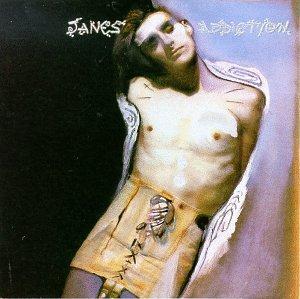
But before they went platinum they had to start somewhere, and their self-titled debut on a tiny L.A. label has never gone out of print. Co-produced by the guy who would go on to bring the Beach Boys catalog into the digital age, it was mostly recorded live at the Roxy, and copiously overdubbed.

With a drum break already patented by Pete Thomas, “Trip Away” explodes into being, providing a steady barrage of funk until an unexpected detour into a moodier middle section that leads right back into the main riff. Guitarist Dave Navarro makes his mark here. The bass intro by Eric Avery on “Whores” provides another band template of sorts, both in structure and profanity. The tempo seems a little wonky at the start of “Pigs In Zen”—not something we would expect of Stephen Perkins—but it finds its way and its dynamics, at least until Perry starts shouting his favorite four-letter word. “1%” is a protest song, not that you could tell from the buried lyrics, and the onslaught subsides for the overly romantic “I Would For You”.

Even in those days, the band played acoustic sets as well as electric ones, and “My Time” provides a catchy transition to side two. It’s even got a harmonica. “Jane Says” manages to stay interesting despite having only two chords, but this is far from the song’s best rendition. Any young band has to play covers, and their take on Lou Reed’s “Rock & Roll” is both reverent and fresh, segueing seamlessly into “Sympathy” (as in “For The Devil”). “Chip Away” provides a bookend of sorts, but consists mostly of jungle drumming and vocal effects.

Chances are most owners of this album came to it well after the fact, and considering their limited catalog, it would be cherished. But the band weren’t there yet, though it wouldn’t be long.

Jane’s Addiction Jane’s Addiction (1987)—3