Showing posts with label mary hopkin. Show all posts

Tuesday, November 19, 2019

Mary Hopkin 4: Live At The Royal Festival Hall

Having had enough of the pop music industry, and already starting a family, Mary Hopkin kept mostly to herself over the decades, surfacing occasionally on a background vocal or an album on a small label. Any Apple reissue brought her attention, and once her kids were grown they became extremely determined to promote their mum. One of the first CDs released on the Mary Hopkin Music label was a concert performed in the wake of Earth Song/Ocean Song, opening for headliner Ralph McTell.

It’s an eclectic set, touching on some of the hits but mostly on the folk songs she loved, such as “Silver Dagger”, “Once I Had A Sweetheart”, “Both Sides Now”, and “Morning Is Broken”. Acoustic guitars, plus Danny Thompson on upright bass, and a small string quartet back her gently. Just as her delivery is confident, her banter in between is witty and utterly charming. Speaking of which, one can’t help but smile as she and husband Tony Visconti duet on the Beatles’ “If I Fell”. She even does “Those Were The Days”, she says, because her in-laws had “flown in from New York” to hear it.

The sound quality is a little wonky on the last two songs, but her voice—that sweet, angelic voice—is clear as a blue sky, and shines through. Live At The Royal Festival Hall 1972 is a wonderful discovery for anyone who enjoyed her brief pop career.

Mary Hopkin Live At The Royal Festival Hall 1972 (2005)—

Friday, August 2, 2019

Mary Hopkin 3: Those Were The Days

Even though she hadn’t had a hit in a few years, somebody still cared about Mary Hopkin at Apple, which nicely capped off her stint there with a compilation. Save the title track, which was of course included on the US version of her first album, Those Were The Days collects several songs that were only ever released as singles, some of which actually charted. Besides “albumizing” several songs, it presents something of a link between her two proper LPs.

“Que Sera Sera” and “The Fields Of St. Etienne” were produced by Paul McCartney, and feature him and Ringo playing. These were also the last tracks she recorded before moving on to producer Mickie Most, whose song choices were even more single-minded. But for her voice, “Think About Your Children” and “Knock Knock Who’s There” might as well be the Partridge Family. “Temma Harbour” attempts to evoke musical echoes of various tropical islands without focusing on one. “Lontano Degli Occhi” continued the strategy of making her a multilingual superstar; this particular Italian pastry has a certain “Feelings” quality. “Heritage”, written by Gallagher and Lyle, is much more suited to her comfort level. (The album also included “Goodbye” and “Sparrow”, both of which have been appended to the Post Card reissue, as was “Kew Gardens” to Earth Song/Ocean Song.)

Much of the Apple catalog went forgotten after the label became inactive, and the non-Beatle artists went various ways. The Apple reissues of the early ‘90s included Mary’s first two albums alongside the likes of Badfinger, James Taylor, and Billy Preston, but—in the US anyway—interest thawed, so several titles were only released in the UK, including an upgrade of Those Were The Days. She actually had a hand in compiling the CD version, which collected further stray singles and B-sides that fell off the original LP, and added three tracks from Earth Song/Ocean Song (one of which actually was a single) plus one outtake from same. Just as the LP, it presents all sides of her repertoire, for better or for worse, and while its lack of availability today unfortunately leaves some gems buried once again, the label can’t blamed; she didn’t like them anyway.

Mary Hopkin Those Were The Days (1972)—
1995 UK CD: same as 1972, plus 6 extra tracks

Friday, March 29, 2019

Mary Hopkin 2: Earth Song/Ocean Song

Apple Records was still a going concern that had acts outside of various sparring ex-Beatles, and despite Paul McCartney taking zero interest in what was originally his baby, some of those acts ably carried on. After releasing some singles produced by hitmaker Mickie Most, Mary Hopkin ended up working with Tony Visconti, best known at the time for his work with T.Rex and David Bowie. (She didn’t just work with him; they got married, and that’s why her striking vocal cameo on Bowie’s “Sound And Vision” is credited to Mary Visconti.)

She didn’t like the image Paul concocted for her first album, so for Earth Song/Ocean Song Mary was determined to express her own tastes. Caught up in the English folk scene, she recruited Ralph McTell on acoustic guitar, along with Dave Cousins of the Strawbs on guitar, and Danny Thompson of Pentangle on standup bass, and hand-picked songs both familiar and unrecorded by the likes of McTell, Tom Paxton, and Cat Stevens. With more restrained string arrangements than those on Post Card, the result fits alongside contemporary albums by Nick Drake, and even dare we say the chamber elements of Nico’s Chelsea Girl.

That chamber sound is prominent on “International”, sometimes overshadowing the gently picked guitars but never her voice. “There’s Got To Be More” is an immediate improvement, with strident acoustics, that terrific Danny Thompson bass, and a defiant message in her delivery. There’s a gentle switch to “Silver Birch And Weeping Willow”, dominated by a Kingston Trio-style banjo, before “How Come The Sun” gets an excellent Visconti arrangement, and even phases the vocals on the middle section! The title track (the first half, anyway) rolls along like a leaf in a breeze, eventually landing on the ground.

With a harsh acoustic guitar thrashing unresolved chords, “Martha” fades in side two with a portrait of a neighborhood gossip justifiably ostracized by the community, which of course only compounds the problem. Skittering strings add to the unsettledness. Ralph McTell’s “Streets Of London” is legendary in the UK, and of course Mary’s take is as lovely as any. Cat Stevens’ “The Wind” is probably the most familiar song to Americans, but the arrangement is at first too literal, and then distracts from the simplicity of the original. “Water, Paper And Clay” redeems it, starting with just her lovely voice and building slowly to a pub anthem. “Ocean Song” completes the album, the same chords as “Earth Song” with different words and extended fade for an artful finale.

Mary was proudest of this album, and felt justified to leave the pop circus after its release. Without any real promotion, Earth Song/Ocean Song became easily forgotten until the ‘90s, when Apple finally started their non-Beatle reissue campaign. The initial CD release had no bonus tracks, but the 2010 version added both sides of a contemporary single (the overwrought “Let My Name Be Sorrow” and Ralph McTell’s more staid “Kew Gardens”) along with “When I Am Old One Day”, an outtake from the original LP first heard on a mid-‘90s compilation. (Another B-side, the mildly jaunty “Jefferson”, was included only in the digital download, alongside “Let My Name Be Sorrow” in French and, believe it or not, Japanese.)

Mary Hopkin Earth Song/Ocean Song (1971)—3
2010 CD reissue: same as 1971, plus 3 extra tracks

Friday, December 14, 2018

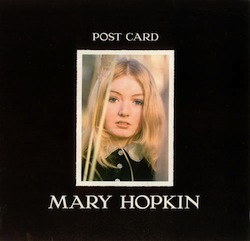
Mary Hopkin 1: Post Card

The first major hit Apple Records had that wasn’t a Beatles recording came from a young lady from Wales spotted on the 1968 equivalent of American Idol. At the time, Mary Hopkin was 18, and both looked and sounded like we imagined Eowyn from The Lord Of The Rings would. Paul McCartney foisted a song upon her, and just like that “Those Were The Days” shot to #1 all around the world.

Excited to keep the ball rolling, Paul immediately—in between finishing the White Album and courting one Linda Eastman—got to work collecting songs for her full-length album debut. Paul had yet to write a song for her; in addition to handpicking folk songs, standards, and stuff in other languages to continue her worldwide appeal, he hit up famous friends like Donovan and Harry Nilsson. When Post Card appeared the following spring, it was a wide-ranging amalgam of music, united by that high soprano that, if it’s to your taste, is just lovely.

The Donovan songs are arguably the highlight, as he (and sometimes Paul) accompanies her on acoustic. “Lord Of The Reedy River” flows along like its title, and while “Happiness Runs (Pebble And The Man)” is dangerously cute, “Voyage Of The Moon” is just lovely. Nilsson’s “The Puppy Song” sounds pretty much like all his other vaudeville homages, and fits with such oldies as “Lullaby Of The Leaves”, “Love Is The Sweetest Thing”, “There’s No Business Like Show Business” and “Someone To Watch Over Me” (replaced on the US version by The Hit Single). Some of the arrangements border on Little Rascals quality, particularly on “Inch Worm”.

Session guys provide most of the backing, but it’s sometimes possible to discern Paul’s distinct instrumental touch, such as on “Young Love” and “The Honeymoon Song”, which modern Beatlemaniacs would recognize from their BBC bootlegs. We’re pretty sure that’s Paul all over “Prince In Avignon”, which has a gorgeous melody albeit all in French, just as she harmonizes with herself on “Y Blodyn Gwyn”, which is all Welsh. The most haunting (and heartbreaking) track on the album is “The Game”, written by Beatles producer George Martin; that’s definitely his piano playing.

When it appeared on CD as part of the early-‘90s Apple reissues, “Those Were The Days” was stuck at the beginning, and the rest of the program followed the UK LP sequence, with three bonus tracks: her version of “Turn! Turn! Turn!”, which had been the B-side of “Those Were The Days”, and the smash song repeated in their Italian and Spanish vocal versions. Two decades on, the next edition of the CD once again bookended the British LP lineup with both sides of the single, but added both sides of her next non-album single: “Goodbye”, a McCartney original, and “Sparrow”, a somewhat twee tune by Gallagher and Lyle. That duo was also responsible for a future B-side, “Fields Of St. Etienne”, included here in its original overblown arrangement, wisely passed over for a quieter recording not included here. (Meanwhile, the Spanish and Italian versions of “Those Were The Days” were on the digital download of the album, along with versions in French and German. Zoot allure!)

Mary Hopkin Post Card (1969)—
1991 CD reissue: same as 1969, plus 4 extra tracks
2010 CD reissue: same as 1969, plus 5 extra tracks