Showing posts with label faces. Show all posts

Tuesday, May 12, 2026

Faces 6: Mahoney’s Last Stand

This enjoyable Faces side project snuck out four years after it was recorded, the soundtrack for a film that didn’t get a wide release either. Mahoney’s Last Stand was the brainchild of an actor best known for a couple guest star appearances on episodes of the cult TV series The Prisoner, and detailed the trials and tribulations of a man trying to get back to nature—a concept very appealing to Ronnie Lane. He and fellow Face Ron Wood recorded these tracks in 1972 while apparently “waiting around for Rod Stewart to show up to the Ooh La La recording sessions.”

Some of the music is very much along the lines of what the Faces might have done if Woody and not Rod had been so dominant. “Tonight’s Number” is a virtual Faces track, with Ian McLagan and Kenney Jones on board, along with Jim Price and Bobby Keys on horns, plus Pete Townshend on one guitar. “Title One” is a similar one-chord jam with horns, but not other Faces or Pete. “‘Mona’ The Blues” is an acoustic remake of an outtake from the first Faces album, whereas the Motown-flavored “Car Radio” could’ve come from their second.

Scattered throughout both sides, the rest points the gypsy folk direction Ronnie would pursue on his own. “From The Late To The Early” only has one verse despite several runs through the chords, mostly letting Woody extemporize on various acoustic guitars. “Chicken Wire” is a banjo-driven workout, while “Chicken Wired” is a slightly slower take with vocals and electric guitar. “Hay Tumble” and “Rooster Funeral” are another one-chord strum and a bluesy melody respectively, both with Ric Grech on violin, and “Woody’s Thing” features Ian Stewart on piano. Each side ends with a take of the wistful “Just For A Moment”, the second with a vocal.

By the time the album finally came out, Woody had already joined the Stones, while the packaging didn’t make it clear that this wasn’t a fresh reunion, that wasn’t enough to make it a hit. In the decades since it has been reissued a few times on CD, as well as streaming, so it can be appreciated again.

Ron Wood & Ronnie Lane Mahoney’s Last Stand: Original Motion Picture Soundtrack (1976)—3

Friday, August 28, 2020

Faces 7: Snakes And Ladders

It’s commonly known that once the Faces were done, Rod Stewart concentrated on his solo career and Ron Wood was asked to join the Rolling Stones (though he wouldn’t be a fully vested member of the corporation until 1990). Ian McLagan and Kenney Jones managed to shanghai Steve Marriott for a reformed Small Faces, to little excitement, and then that was really it.

Meanwhile, with both Rod and the band’s catalog on their roster, Warner Bros. compiled Snakes And Ladders, subjectively subtitled Best Of Faces to make the most of it. It’s an odd set; the cover art is a collage of photos featuring several shots of interim bassist Tetsu Yamauchi (who plays on exactly one track) but none of Ronnie Lane. More to the point, none of Ronnie’s lead vocals are included. Obviously, they knew where the money was.

The album opens with “Pool Hall Richard”, a standalone single and a decent rocker, then meanders oddly through the catalog, stopping at obvious hits like “Stay With Me” and “Ooh La La”. The instrumental “Pineapple And The Monkey” and “Around The Plynth” are particularly odd choices. Side two sports the mildly disco “You Can Make Me Dance, Sing Or Anything (Even Take The Dog For A Walk, Mend A Fuse, Fold Away The Ironing Board, Or Any Other Domestic Shortcomings)”, another standalone single, but only the original LP has the alternate single take of “Had Me A Real Good Time”.
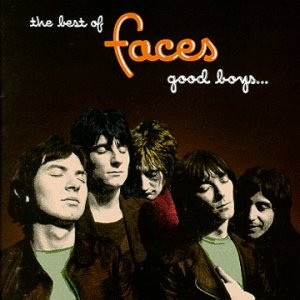
Only eight of the tracks were repeated on the superior Good Boys… When They're Asleep compilation, released 23 years later. This set moves chronologically, covering much more of the band’s breadth. It’s also a better tribute to Ronnie Lane, given the inclusion of “Debris”, “You’re So Rude”, and “Glad And Sorry”, though it pointedly hypes the connection to Rod’s solo career in the packaging. Along with “Pool Hall Richard” and “You Can Make Me Dance”, the set includes “Open To Ideas”, a soulful unreleased track from the band’s final sessions.

The set was spearheaded by Ian McLagan, whose enthusiasm also drove the next major archival release. Besides sporting the greatest box set title of all time, Five Guys Walk Into A Bar… provides an exhaustive look at the band on four discs. Less than half of the tracks were from the original albums (including the two singles and outtakes from Good Boys), filling up the balance with B-sides, alternate takes, rehearsals, live performances, BBC appearances, and unreleased stuff. Ten years later, 1970-1975: You Can Make Me Dance, Sing Or Anything… boxed up the original four albums, each bolstered with extras on the CD edition, and added a fifth disc of Stray Singles & B-Sides. And ten years after that, Faces At The BBC delivered eight hours of exactly that over eight CDs and one Blu-ray. There’s a lot of repetition, but you also get their reverent renditions of Christmas carols.

Between those sets, Faces are covered. Certainly no other band has gotten more mileage out of ellipses.

Faces Snakes And Ladders/Best Of Faces (1976)—3
Faces
The Best Of Faces: Good Boys… When They're Asleep (1999)—4
Faces
Five Guys Walk Into A Bar… (2004)—
Faces
1970-1975: You Can Make Me Dance, Sing Or Anything… (2015)—
Faces
Faces At The BBC: Complete BBC Concert & Session Recordings 1970-1973 (2024)—3

Friday, June 14, 2019

Faces 5: Coast To Coast

With Rod Stewart getting more and more attention, Ronnie Lane followed his gypsy heart and left the Faces. But they had gigs, so Tetsu Yamauchi, most recently featured in a Free offshoot, took over on bass (and presumably, his share of the bar tab). And that’s when they decided to release a live album. Coast To Coast: Overture And Beginners was billed to the Rod Stewart/Faces combination, and leaned more on Rod’s solo work than Faces material proper. In the US, Mercury distributed the album, while Warner Bros. got the tape and 8-track rights.

A pleasant stomp through “It’s All Over Now” kicks things off, followed by a driving, electric “Cut Across Shorty”. “Too Bad” is hitched up to “Every Picture Tells A Story” without much excitement or reason despite a similar tempo and Rod knowing the words. “Angel” is looser than it should be, but the crowd goes nuts for “Stay With Me”.

A cover of the Temptations’ “I Wish It Would Rain” has promise, but feels like it slows down halfway through. (Another live version with a horn section had snuck out earlier as a B-side.) The energy continues to flag on “I’d Rather Go Blind”, making “Borstal Boys” a nice change of pace, but it too stops to let Ron Wood noodle on slide for a couple minutes by himself. The band eventually stumbles back in, and somehow they find their way into “Amazing Grace”. Finally, their exposure of solo Beatles material surfaces for a stab at John Lennon’s “Jealous Guy”, Ian McLagan nicely comping Nicky Hopkins’ parts.

Coast To Coast isn’t a bad album, but it doesn’t quite capture the good time for which the band was legendary. Critics hated it, mostly because Ronnie Lane was gone, and the band must not have rated it much, because while it did sneak out on CD, it’s out of print today, and isn’t even available for (legal) streaming.

Rod Stewart/Faces Coast To Coast: Overture And Beginners (1974)—3
Current CD availability: none

Tuesday, October 30, 2018

Faces 4: Ooh La La

Even with the changing in attitudes and success, the Faces could still come through with what they did best. While stories are rife with increasing tensions between Rod Stewart and the rest—plus Ronnie Lane wanted to tour in a gypsy caravan—it’s astounding that Ooh La La is as together as it is.

Right away “Silicone Grown” sets up the boogie, a great riff and bash for two chords. Due to its similarity to “Memphis”, “Cindy Incidentally” could pass for the album’s token cover, but works its way up to a different chorus, for a superior tune. Ronnie Lane gets two minutes to shine on “Flags And Banners”, a lovely strum given some fuzz and over too soon, then it’s back to boogie on “My Fault” (Ronnie Wood soloing all the way, natch). The rollicking “Borstal Boys” is the only song we know that features a Klaxon horn, bringing back childhood memories of Cheaper By The Dozen, and not the Steve Martin atrocity. Too bad it doesn’t play through the whole song.

An already short album has an instrumental, “Fly In The Ointment”, kicking off side two, and while it has too many minor chords to be a jam, it’s perhaps a sign of the lack of camaraderie behind the scenes. Still, it’s a good setup for a quieter selection of tunes, beginning with Rod’s tender “If I’m On The Late Side”. The surprising vocal combo of both Ronnies and Ian McLagan propels “Glad And Sorry” to wonderful heights, then “Just Another Honky” has another nice riff swapped between the piano and guitar. The title track caps the album, a lovely conversation between the generations, with a lead vocal by Ronnie Wood, of all people! We can thank modern pop culture for bringing this song into wider exposure, given its appearance in movies and commercials, and we’re not sick of it yet.

Even if they didn’t know it would be their last studio album—and they probably didn’t—Ooh La La manages to be a truly grand finale, expertly sequenced, without a single throwaway. Some things are apparently just too good to last.

Faces Ooh La La (1973)—

Tuesday, January 9, 2018

Faces 3: A Nod Is As Good As A Wink

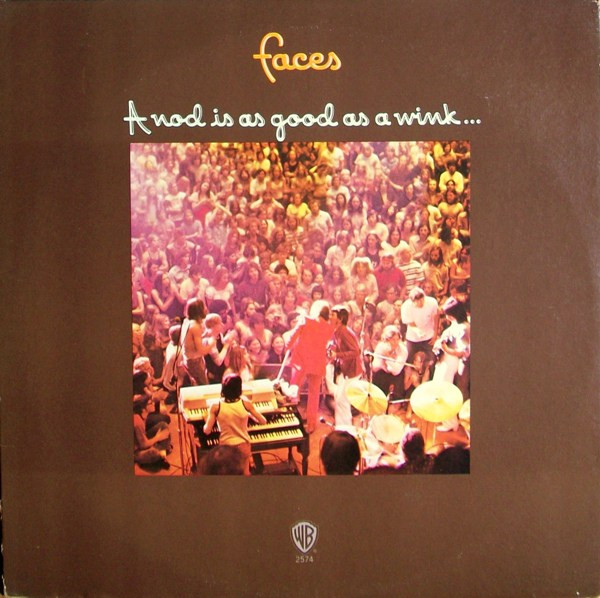
While Every Picture Tells A Story rocks with acoustic instruments, anyone who longed to hear Rod Stewart with some voltage beneath him needed only wait a few months before another Faces album. From its live cover shot and cheeky title, A Nod Is As Good As A Wink... To A Blind Horse, positively crackles.

Yet while Rod swaggers his way through “Miss Judy’s Farm”—just one of the tracks here that refuses to stick to an ABAB rhyme scheme—over those terrific Ian McLagan electric piano licks, Ronnie Lane gets his share of the spotlight too. “You’re So Rude” is a randy slice of afternoon delight, with blasts of organ and sound effects pushing the story along. Lest one think it’s all silly, “Love Lives Here” brings on the heartbreak, and while Mick Jagger would never admit to stealing the mood for “Fool To Cry”, he was wise not to borrow the harpsichord. Ronnie returns for the aftermath of the relationship—in a pub, naturally—on “Last Orders Please”, and whatever sadness Rod had two songs earlier is well gone by the groupie abuse in “Stay With Me”.

Side two begins, out of character, with the melancholy “Debris”. Sung by Ronnie, with Rod helping out on the choruses, what sounds like another sad love song turns out to be memories of his dad. It’s very sweet, but unfortunately followed by a rather tepid rendition of Chuck Berry’s “Memphis” that eventually picks up, but the lead guitar stays stuck in the Leslie speaker. The fun returns on “Too Bad”, another funny tale of Life on the Road that could have taken place earlier in their careers or that week. And fun as “That’s All You Need”, it too doesn’t make sense, from going about remembering an estranged brother, to the guy showing up mid-track for “a cup of coke” and steel drums taking the album to the spindle.

But we don’t listen to Faces albums for deep thoughts, and that’s why A Nod Is As Good As A Wink is just plain fun. Besides, it’s always nice to hear Ronnie Lane break up the monotony, isn’t it?

Faces A Nod Is As Good As A Wink… To A Blind Horse (1971)—

Friday, April 14, 2017

Faces 2: Long Player

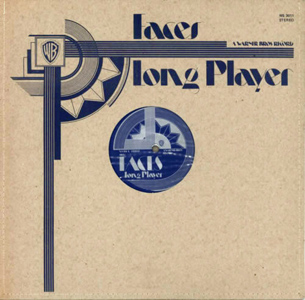
The next Faces album sported minimal cover art, a throwback to the days when records came in plain sleeves with only the label showing for identification. Interestingly, it wasn’t identical all over the globe; the British version even had “stitches” keeping the cardboard together. This is a good metaphor for the grab-bag nature of the tunes within Long Player.

“Bad ‘N Ruin” opens with a decent riff, barely bothering to change chords. Ron Wood solos constantly, as he was wont to do. “Tell Everyone” and “Sweet Lady Mary” are slower, sensitive tunes sung by Rod Stewart, but not as slow as the bottleneck-heavy “Richmond”, sung by Ronnie Lane. Then we’re transformed to the Fillmore East for a decent live version of “Maybe I’m Amazed”, less than a year after anyone heard Paul McCartney’s original recording. Ronnie takes the first verse, then Rod takes over, even starting to sing the song again after the band’s stopped. (A studio take was issued around the same time as a single.)

It’s back to the barrelhouse for “Had Me A Real Good Time”, eventually bringing in horns after the fake ending. “On The Beach” has all the audio quality of a rehearsal, but still sounds very together. It’s back to the Fillmore for a lengthy skip through Big Bill Broonzy’s “I Feel So Good”, complete with call-and-response from the crowd. Woody’s dobro rendition of the hymn “Jerusalem” closes the album, and provides something of a bridge to the next Rod Stewart solo album.

Long Player is good, and fun. Sounds like it, anyway. By not evenly laying out the slow tunes, the raveups, the acoustic ones and the boogies, it never gets stuck in a rut. We could use a little more Ronnie Lane and less Ronnie Wood, but that’s us.

Faces Long Player (1971)—3

Friday, June 24, 2016

Faces 1: First Step

So the guys in Small Faces who didn’t join Humble Pie managed to hook up with Rod Stewart and Ron Wood, fresh from the Jeff Beck Group, and since the new guys were taller than the one guy they replaced, they decided to call the new configuration simply Faces. This would be confusing on the first album, where some countries still had the band credited as Small Faces, and their new album as The First Step. (Much as we’re sticklers for detail, we’re going to keep it simple from here.)

Even though Rod was making his name as a frontman, he was up against big personalities in the way of Ian McLagan and Ronnie Lane, who would still do his share of the singing. Therefore First Step shouldn’t be considered a Rod Stewart solo album with a loud band, but it’s certainly in keeping with the album he’d released only a few months before.

In fact, the first song is a nasty electrified arrangement of Dylan’s “Wicked Messenger”, an echo of how Rod’s album opened with “Street Fighting Man”. But the dirt is brushed away by the slow gospel in “Devotion”, taken to a higher level with Ronnie comes into sing with Rod. “Shake, Shudder, Shiver” sounds more like the band playing behind Rod, though Woody must not have known there was a vocal track. Ronnie’s “Stone” might be better known to Who freaks, seeing as an acoustic duet of it appeared on Pete Townshend’s Who Came First after already having been on a Meher Baba tribute album. It’s even more of a jugband piece here, not necessarily “better”. Along similar lines, “Around The Plynth” comes from the same lyrical source as “Plynth” from the second Beck album, and goes on too long.

“Flying” brings all the pieces back together, Woody’s guitar playing well off Mac’s Hammond, and there’s even a hushed mass vocal over the bridge. “Pineapple And The Monkey” might pass off as a Booker T. & The MG’s instrumental, except that these guys have zero Stax chops. Rod and Ronnie duet again on “Nobody Knows”, which really shouldn’t continue past its fake ending, but then we’d miss Mac’s piano solo. Kenney Jones somehow gets co-writing credit on “Looking Out The Window”, another instrumental; maybe because he was playing with the tempo whilst acting out the title? Finally, “Three Button Hand Me Down” demonstrates the band at their rockin’ best, even via a rewrite of “Some Kind Of Wonderful”. It even ends sloppily, something they could do like nobody else.

Some of the songs are too long, and others could have been skipped altogether, but it was, after all, their First Step. The good outweighs the not, and they would pack a lot of playing and drinking into the next few years, together and apart.

Only 55 years later, another periodic trawl through the vault brought forth Early Steps, split between the band’s long-lost-till-now first sessions for the album and cassette recordings of songs from a rehearsal, three of which were already on their box set. Most are alternate versions of songs from the canon, but “Train”, a driving track that seems to be made up as they go along. (The CD version added two more rehearsals to the lineup on vinyl, and per tradition, the labels on all version read The Early Steps.)

Faces First Step (1970)—3
Faces
Early Steps (2025)—3

Tuesday, June 30, 2015

Small Faces: Ogdens’ Nut Gone Flake

Speaking of British bands with messy catalogs, Small Faces began as a genuine mod R&B combo before sliding into psychedelia. Besides being contemporaries of The Who, bass player Ronnie Lane would go on to collaborate many times with Pete Townshend, and drummer Kenney Jones would get the unenviable task of replacing Keith Moon. (Pianist slash organist Ian “Mac” McLagan would also marry Keith’s ex-wife, but we’re getting ahead of ourselves again.) Ronnie sang from time to time, but guitarist and lead singer Steve Marriott was likely the “star”, and not just because Paul Weller’s been copying his haircut for decades.

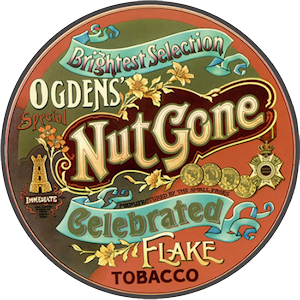
Their not-really-a-concept-album Ogdens’ Nut Gone Flake usually shows up on lists of classic albums nobody knows but everyone should hear, even without its original unique packaging based on a tobacco tin. Taking its cue from the previous year’s hit single “Itchycoo Park”, it combines Hammond-heavy swirly music with acoustic strums and music-hall silliness—and that’s just side one. The instrumental title track is something of an overture, always on the verge of becoming something bigger; they even put strings on it. Despite its loungey send-up beginning, “Afterglow Of Your Love” soon turns into a powerful Marriott belter. There’s a quick segue to “Long Agos And Worlds Apart”, sung by Mac, which has the same clap-along rhythm as the pub singalong “Rene” (rhymes with beanie) and its extended jam ending. “Song For A Baker” is a groovy rocker sung by Ronnie, before Steve comes back on the exceptionally catchy “Lazy Sunday”, delivered in a thicker Cockney accent than that of “Rene” and would one day be worn of its welcome by Phil Collins. (We’ll credit Glyn Johns for why the album sounds so good, from the flanging effects to the well-placed vocal interjections, very similar to what he’d already done for Traffic.)

Side two is where things get really wacky, with all of the songs strung together by a gobbledygook fairy tale about “Happiness Stan” looking for the moon. The narrator will remind newcomers of Michael Palin, and the side does sound like a parody, except that this was the source. The story itself is just that, hiding no real mysteries or message, except that Stan finds himself “Rollin’ Over” to greet “The Hungry Intruder”, a fly who grows giant enough to take him on “The Journey” to the cave home of “Mad John”, who tells Stan that life is as simple as “Happydaystoytown”. Of course. The songs would likely stand on their own without the narration, but it’s a gimmick that works.

Aside of the novelty of the presentation, two things stand out from Ogdens’ Nut Gone Flake. First is Ian McLagan’s mastery of the electric piano, a touch rivaled only by Nicky Hopkins. Then there’s Kenney Jones’ drumming. How could a guy this inventive and tight go on to become the Who’s metronome? (Because of the differences in mixes unique to different countries, several reissues of the album have offered mono and stereo versions, along with outtakes, but as long as the 12-song sequence is intact, anything else is gravy.)

Small Faces Ogdens’ Nut Gone Flake (1968)—3

Monday, November 24, 2008

Pete Townshend 2: Rough Mix

This exceptionally likable album is an underappreciated gem in the Who-related canon. Recorded between their last great album and Keith Moon’s last gasp, Rough Mix is a joint effort coming out of a favor from Pete for Ronnie Lane, and provides a pleasant distraction from the heavier subjects Pete had come to tackle. A lot of that influence came from Ronnie, who’d been indulging his gypsy musician longings since the demise of the Faces.

Only two songs here appear to be true collaborations: the instrumental title track which serves as a base for a smoking Eric Clapton solo; and the closing cover of “Till The Rivers All Run Dry”, a tribute of sorts to Meher Baba, their personal guru. However, their individual contributions sit comfortably together, giving the proceedings the air of a pleasant afternoon pub conversation between friends.

Of Pete’s songs, the orchestrated “Street In The City” hasn’t aged well, but the rest rank with his best: the rocking “My Baby Gives It Away”, featuring Charlie Watts on drums; the searching “Keep Me Turning”; the self-deflating “Misunderstood”; and the sinewy “Heart To Hang Onto”, wherein he trades verses with Ronnie, giving the album a needed boost towards the end. Who fans will love Pete’s songs, of course, but for the newcomer, Ronnie’s tracks will be a nice surprise, whether the jaunty “Nowhere To Run” and “Catmelody” or the sweet and charming “Annie” and “April Fool”.

Rough Mix is a minor yet pleasant album that consistently rewards future listens. Pete’s own affection for the album showed with the deluxe treatment it got upon its remastering in 2006, which includes a DVD layer with a mini-documentary, tons of photos from the sessions and a SACD audio mix of the tracks, complete with a full ending for “Annie” with jokey in-studio comments about the last chord. Of the bonus tracks, two are Ronnie’s and another, “Good Question”, is a full band version of the instrumental previously known as “Brrr”, which fanatics knew from Scoop.

Pete Townshend & Ronnie Lane Rough Mix (1977)—4
2006 DualDisc reissue: same as 1977, plus 3 extra tracks