Showing posts with label robyn hitchcock. Show all posts

Friday, August 7, 2026

Robyn Hitchcock 36: The Confuser

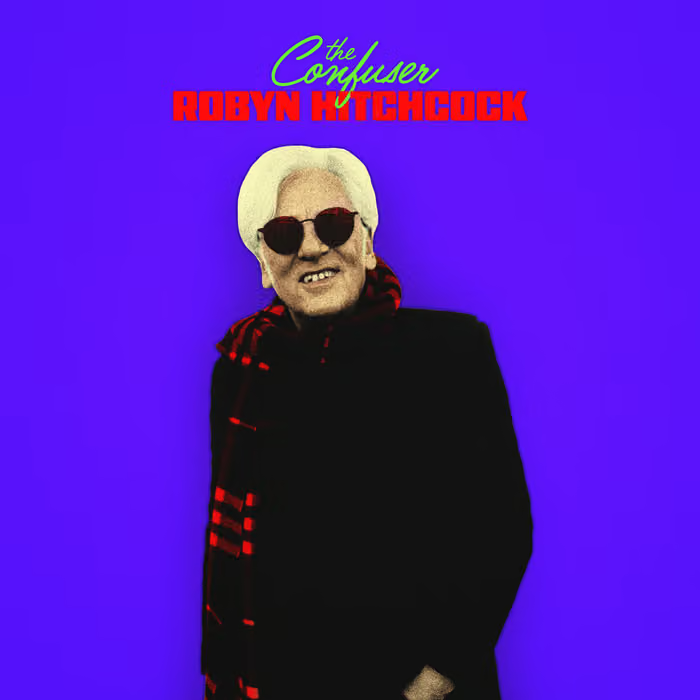
Another memoir composed on his phone coincided with a fresh batch of Robyn Hitchcock songs. The events of Stranded In The Future cover his path to becoming a songwriter and recording artist, and in many ways, his approach to the craft hasn’t really changed in the decades since. The Confuser is right in line with his brand, but something about the combination of words, melody, and performance make this one of his most satisfying albums of the century.

Right out of the gate “I Am This Thing” has a provocative opening line and the usual surprising rhymes as befit a statement of purpose. We’re not sure if the music he says he loves is supposed to “the birds” or “the Byrds”, but it’s damn catchy. The band infuses “My Dead Astronaut”—another familiar theme—with wacky space effects for another toe-tapper. Disembodied voices appear now and then, and it’s probably not best to search for meaning. The same could be said for “Yesterday’s Rain”, except that it’s the most developed of the opening three rockers, and the best track yet, but we’ve barely gotten started. Things quiet down for “Breathless”, with a sinewy arpeggiated guitar part that’s another one of his trademarks, and the band subtly comes in to fill in the borders, with Kimberley Rew presumably adding those sitar-like parts. But it’s just a setup for the haunting “Ghost In Sunlight”, wherein Robyn channels John Lennon playing electric piano. A Mellotron and what sounds like a cello are wonderful touches, and Gillian Welch provides harmonies and her own disembodied voices in both channels over the end before everything resolves.

A funky wah-wah boogie drives “Building From The Ruins”, which mostly sits on one chord but sports lots of surrealism hiding lines like “I miss democracy like my wisdom teeth.” “The Vanishing Kind” is a sweet and simple love song that features a nice wandering bass line and eventually layered vocals, while “How To Feel Alright” is more skewed, with warped imagery and Oedipal undertones over a brisk Bo Diddley beat and lots of Kimberly Rew guitar. At first we thought “Monday For Me” was resonant of Tom Petty’s “Wake Up Time”, but since that was also based on the structure of “Sad Eyed Lady Of The Lowlands”, all is fair. This one still has a great chorus with good use of the days of the week. Rather than go out on something profound, “Wasted” flirts with honky tonk while exploring the different possibilities of the meaning of the title.

The band is consistent throughout The Confuser, and it sounds like they were all playing in the same room. That gives the album a unity that ranks with the best of the albums he did with the Egyptians way back when, and makes it all worth it.

Robyn Hitchcock The Confuser (2026)—4

Friday, September 27, 2024

Robyn Hitchcock 35: Vacations In The Past

Some of his album sleeves over the years had boasted the occasional surreal short story, but not until he passed the age of 70 did Robyn Hitchcock endeavor to write a memoir. Composed entirely on his iPhone in the wee hours, 1967: How I Got There And Why I Never Left is an engrossing look back a formative year in his life, shaped by his entry into boarding school and the music that dominated the year.

It was only natural that a companion album would materialize, and one did. Recorded much like his other post-Covid work, 1967: Vacations In The Past was pieced together over the wires with the aid of frequent collaborator Charlie Francis, and featuring contributions from fellow Soft Boy Kimberley Rew and prominent but not overused sitar by Kelley Stoltz. It’s predominantly acoustic with only the occasional bongo for percussion and, with one exception, all covers.

He begins “A Whiter Shade Of Pale” in a lower register, then adding an octave harmony on the second verse, but “Itchycoo Park” is just as jaunty as the original. “Burning Of The Midnight Lamp” is particularly striking without any electricity, but it’s still got wah-wah. The Move’s “I Can Hear The Grass Grow” is nice and trippy, but then there’s Scott McKenzie’s “San Francisco (Be Sure To Wear Flowers In Your Hair)”, a moldy oldie if there ever was one. Trite as it may be to Americans, it must have meant something to that impressionable British boy an ocean and a contintent way, but we can’t condemn anyone for their guilty pleasures. Anyway, it’s wholly redeemed by “Waterloo Sunset”, a song that’s nearly impossible to ruin, and he doesn’t.

A Syd Barrett song should be no surprise, and he tackles “See Emily Play” nearly solo but for Kimberley’s slide effects. Tomorrow’s original recording of “My White Bicycle”—besides being the first appearance by Steve Howe—was loaded with backwards instruments, and there are just enough of those effects here to keep the production faithful. “No Face, No Name, No Number” has long been a personal favorite, but while the most obscure track might be the Incredible String Band’s “Way Back In The 1960s”, it’s also the one that sounds the most like him. The title track is the lone original, and sounds like it could have been recorded at any time over the previous 40 years. It’s a wonderful bit of music, complete with references to tentacles and whatnot, that the cover of “A Day In The Life” is anticlimactic. He’d played this live many times over the years, and while this recording doesn’t attempt to replicate the original, it still gets a busy mix, with a backwards loop we can’t discern over the final sustained piano chord that doesn’t dissipate but stops.

As he said on Robyn Sings, 2002’s compilation of Dylan covers, he didn’t write these songs, but they wrote him. His deft playing style and wide-eyed approach resonates throughout, and illuminates the rest of his catalog in the process.

Robyn Hitchcock 1967: Vacations In The Past (2024)—3½

Friday, April 28, 2023

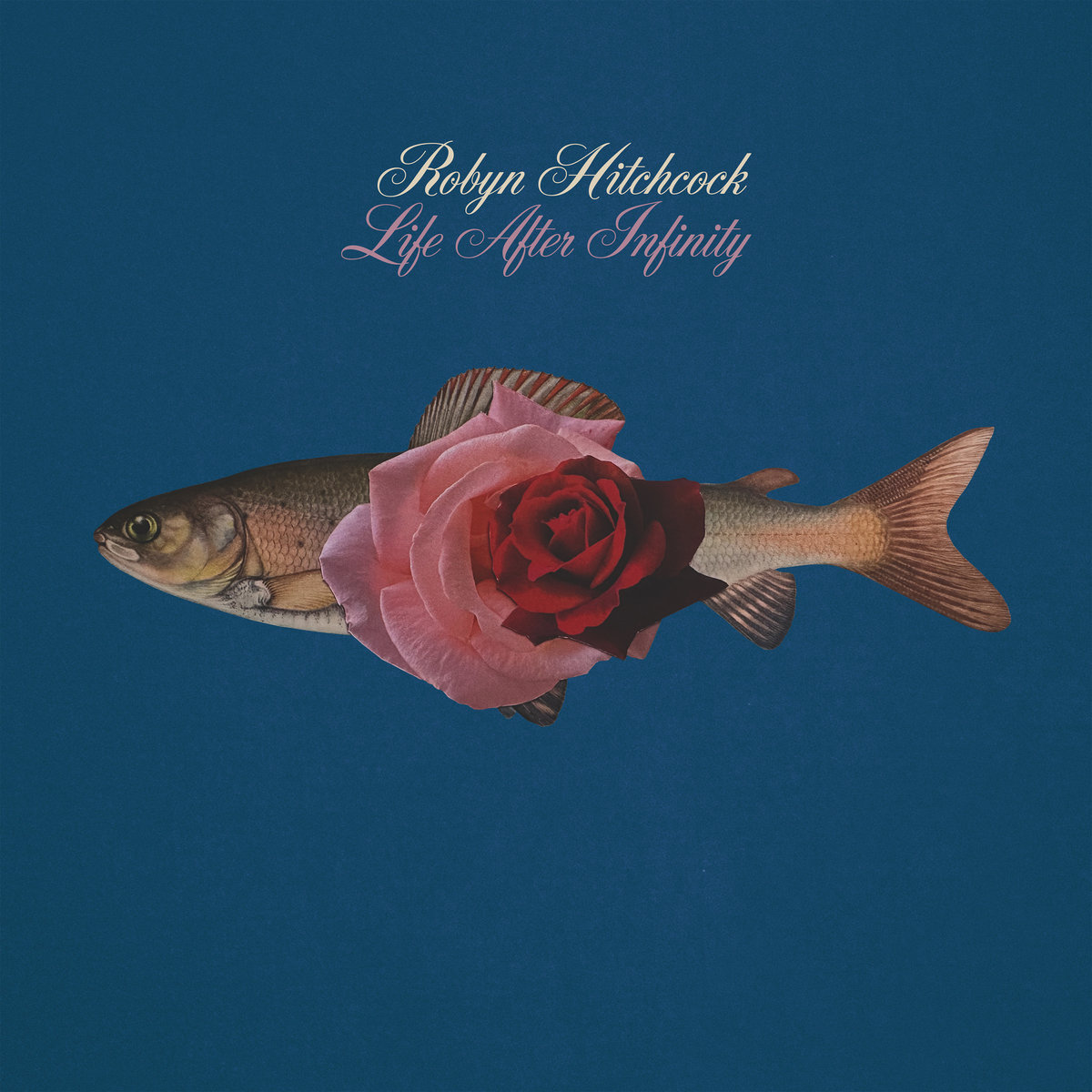
Robyn Hitchcock 34: Life After Infinity

Because his wordplay has always been so unique, Robyn Hitchcock can be easily overlooked for his fretwork. But as anyone who’s witnessed a live performance should have been able to notice, the man knows his way around a guitar. Stinging leads aren’t his forte; rather he does intricate fingerpicking and flatpicking, sometimes in arpeggios but always in distinct patterns. He’s as fun to watch as he is to hear.

Instrumental pieces have been occasional parts of his albums going back to I Often Dream Of Trains, but Life After Infinity is his first all-instrumental release, and it’s a joy. It’s mostly solo, mostly built on a few guitar tracks, with occasional bass and percussion added by Hitchcock stalwart Charlie Francis. These might well be demos, recorded simply, and that’s fine; a grainy quality pervades the overall sound, adding to the mystic quality.

“The Eyes In The Vase” is mostly a rumination on one chord with a melody on top, with distant percussion, very redolent of English folk. “Daphne, Skipping” also has one chord for its basis, but the joyful chromatic riff and happy rhythm evoke the title nicely. “Plesiosaurs In The Desert” has something of an ambient drone to support the wandering guitar before the seagulls fly in from the distance. Knowing what we do about the auteur, “Tubby Among The Nightingales” was likely inspired by one of his cats; here the strum is augmented by a twangy Telecaster. “Gliding Above The Ruins” features a trilling mandolin-style effect, while a ticking clock and a banjo(!) drive “Come Here, Little Ghost”, accented by full chord strums and what sounds like a piano.

“Nasturtiums For Anita” is just a single guitar finding its way, building to a wonderful energy; “Celestial Transgression” also begins more delicately, adding instruments sparingly, the bass nearly providing the most melody. These approaches develop further in “The Sparkling Duck”, with harmonic passages spread across the insruments. “Veronica’s Chapel” opens with what appear to be the same bells from “Big Black Smoke” and “Fat Old Sun” before giving way to backwards guitar and very psychedelic riffing. About halfway through bass, cowbell, and other percussion add more of a steady groove, and the bells see us out again. Finally, “Mr. Ringerson’s Picnic” is jaunty and tuneful before fading on what sounds like another idea entirely.

We often remark in this forum when an album is too long. Well, Life After Infinity feels too short; at least it goes by very quickly, even at 37 minutes. It’s a pleasure to hear at any time of day, in any weather, but best in solitude. Here’s hoping there will be more someday.

Robyn Hitchcock Life After Infinity (2023)—4

Friday, October 28, 2022

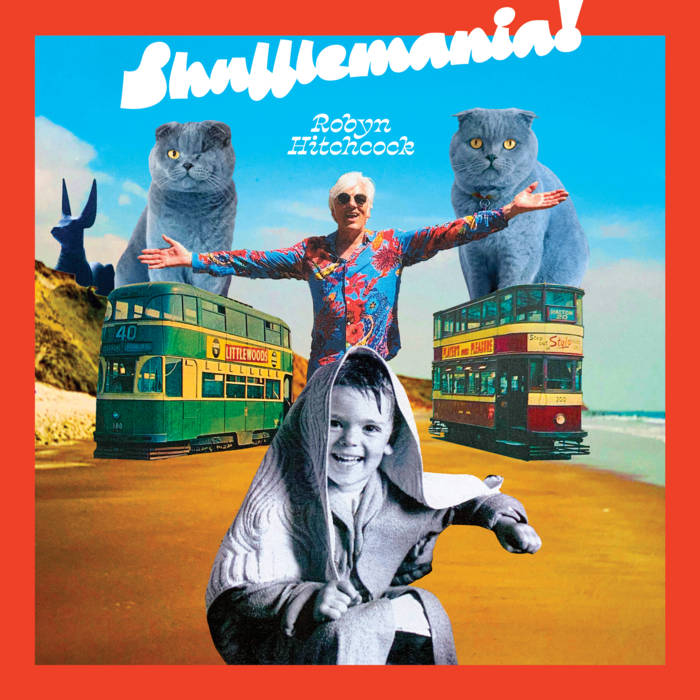
Robyn Hitchcock 33: Shufflemania!

We generally prefer Robyn Hitchcock albums either when he’s completely solo or playing with the same band on all tracks. In many cases, the albums that are pieced together from different sessions with rotating players don’t always succeed, but that can also be blamed on the songs. In the case of Shufflemania! however—though we’re still wondering how or if it’s supposed to related to another album—the scattered approach works. He’d already made the most of the 2020 pandemic to stay as creative as possible, and here he’s collaborated over the wires with 15 other players in as many studios. Some of these people include members of Wilco, the Raconteur who produced his last album, two former Soft Boys, Johnny Marr, Sean Lennon, and the lovely Emma Swift. He started with vocals and guitar, then had his guests fill in the rest.

A demo-quality strum chugs at speed and is soon taken over by a full band on “The Shuffle Man” for a snappy opener before “The Inner Life Of Scorpio” provides a calmer contrast, mostly contributed by Mr. Marr. As usual, the lyrics are inscrutable, as they are in “The Feathery Serpent God”, which is more mysterious but also more satisfying. It wouldn’t be a Robyn Hitchcock without a reference to a bygone mode of transportation, and “Midnight Tram To Nowhere” fits the bill, while “Socrates In Thin Air” returns to the more whimsical lyrics of the ‘80s but with one of his modern choruses.

The suitably moody “Noirer Than Noir” begins a quieter side two, followed by the welcome intricate picking throughout “The Man Who Loves The Rain”. “The Sir Tommy Shovell” is a rocker about an imaginary pub, but we would very much like to visit. Plus, the title is another “shuffle man,” so there you go. “The Raging Muse” is another cool rocker, amazingly cobbled together from recordings done on three continents. While generally hopeful, “One Day (It’s Being Scheduled)” could be slightly improved by not giving away the payoff in the title.

With all that, Shufflemania! holds together well. We’re still waiting for another masterpiece, but this will do in the meantime.

Robyn Hitchcock Shufflemania! (2022)—3½

Tuesday, September 29, 2020

Robyn Hitchcock 32: The Man Downstairs

Like every other musician, Robyn Hitchcock went into quarantine, lockdown, sheltering in place, whatever you want to call it, as a result of the COVID-19 pandemic. In his case, he hunkered down in Nashville with his partner Emma Swift, shared the occasional file and short story via his Patreon account, and performed regular, almost weekly acoustic shows from his kitchen on Zoom. While Emma completed an album of unique Dylan covers, Robyn’s only release was this odd snapshot from his vault.

The Man Downstairs is helpfully subtitled Demos & Rarities, and purports to be a dry run for The Man Upstairs. That album was split between evenly between covers and originals, and while his own songs tip the scales on this one, only “Recalling The Truth” made it to the final product; “I Pray When I’m Drunk” was rerecorded with a full band for the album what came after.

The cover choices shouldn’t surprise many Robyn fans—“Arnold Layne” being one of the more common Syd Barrett selections, Dylan’s “Born In Time”, and Nick Drake’s “River Man”, which he’d played onstage. “The Tower Song” by Townes Van Zandt is a surprise, and hopefully will send the uninitiated to that catalog. His own songs run the gamut of his styles, from the mildly Dylanesque “All Love And No Peace” and the mild psychedelia of “The Threat Of Freedom” to the retro (for him) approach of the disparate “Cavendish Square” and “On Seeing Your Photograph”.

An unnumbered release on his own label, the homemade charm of The Man Downstairs comes through in its minimalist packaging, topped by a truly amateurish cover collage. Yet the quality of the music puts this up there with previous solo acoustic endeavors. What’s more, the quality of the recording suggests that he should stick with this presentation going forward, if only for economic reasons.

Robyn Hitchcock The Man Downstairs: Demos & Rarities (2020)—3

Tuesday, December 26, 2017

Robyn Hitchcock 31: Robyn Hitchcock

Another one of those heritage artists we find ourselves paying attention to more as a custom than out of continued wonder, Robyn Hitchcock keeps putting out albums that occasionally recall his ‘80s heyday with a single band, but don’t always carry through every second. It took him nearly four decades in the business before he released an eponymous album, a move that always suggests A Major Statement.

He always does better when he records with a dedicated band, and Robyn Hitchcock indeed gets a boost from a cohesive sound. It also helps that the album rocks. “I Want To Tell You About What I Want” gets out of its one-chord groove in time, and while “Virginia Woolf” spends less time on her than Sylvia Plath, it follows right along with terrific guitar leads. “I Pray When I’m Drunk” is a something of a Johnny-Cash-meets-the-Byrds pastiche that works by being brief. “Mad Shelley’s Letterbox” opens the same way as the first track, but opens up with a terrific chorus. Things finally slow down for the lengthy “Sayonara Judge”.

“Detective Mindhorn” seems to be connected with the fictional star of a recent British film; catchy as it is, it’s too long to be a theme song. The country sound resurfaces on “1970 In Aspic”, another curious look back at a year from his youth, a theme he continues on “Raymond And The Wires”, another tribute to his father. Another slower song goes longer on “Autumn Sunglasses”, with plenty of Rickenbacker 12-string and a lyric that doesn’t sound too labored. Finally, “Time Coast” ends the set with toe-tapping garage rock.

Robyn Hitchcock is another one of those albums that sounds great when it’s playing, and will likely continue to. But by the time we get around to listening to it again, he’ll have another one out.

Robyn Hitchcock Robyn Hitchcock (2017)—3

Tuesday, January 26, 2016

Robyn Hitchcock 30: The Man Upstairs

Here’s something different from Robyn Hitchcock: an album that’s half covers, familiar and not so, and half originals. The big eyebrow-raiser is that it was produced by Joe Boyd, who these days tends to avoid anything that’s not considered “world music”. Nor does it mine the catalog of artists most associated with Boyd; the choice of songs is all the artist’s.

Most versions of the Psychedelic Furs’ “The Ghost In You” have been reverent, and while this isn’t Robyn’s first recording of it, the muffled bass, strings piano and high harmonies give it a quiet elegance. Similarly, he’s long admired Roxy Music’s Avalon album, and “To Turn You On” sticks to their arrangement, even the key change in the middle. The Doors’ “Crystal Ship” isn’t a big stretch for him either, with a pianist filling in some of the holes; enjoyment of any of these will be enhanced by familiarity. Occasional touring buddy Grant Lee Phillips gets a nod with “Don’t Look Down”, while “Ferries” is a cover of a song by a Norwegian band called I Was A King, with the song’s own writer providing harmonies (as she does throughout the album).

His own songs are a mixed bag. “San Francisco Patrol” is one of the loveliest and therefore unlikely songs to be inspired by a Dirty Harry movie. “Comme Toujours” seesaws between French and English and is a nicer version of a song he’s recorded already. “Trouble In Your Blood” is also quite slow and pretty, but not dull. “Recalling The Truth” isn’t as pretty, but brings everything to an unresolved end. Unfortunately, “Somebody To Break Your Heart” completely breaks from the mood, and is the album’s sore thumb.

Faithful readers have marveled at how we can stay interested in an artist whose most provocative work was decades ago. Part of it comes from an unspoken agreement with a man we’ve never met; as long as he keeps making albums that aren’t horrible, we’ll listen. And maybe, just maybe, one day something will come out of him that absolutely stuns.

Robyn Hitchcock The Man Upstairs (2014)—3

Tuesday, September 22, 2015

Robyn Hitchcock 29: Love From London

After thirty years as a solo artist, with a catalog that has sold well into the dozens, Robyn Hitchcock doesn’t inspire more than a raised eyebrow from most people, least of all those who wonder why he gets so much attention from this blog. Admittedly, his heyday is well in the past, but for those still longing for the consistency he supplied in the late ‘80s/early ‘90s, Love From Londøn comes the closest yet.

First of all, a circular piano part drives “Harry’s Song”, a mysterious number and oddly foreboding opener. “Be Still” is more upbeat, harmonious and pinned by an insistent cello part, while “Stupefied” combines a tabla effect with handclaps and dotty piano. It takes bollocks to write a song called “I Love You” at this late date, and he marries it to a pretty obnoxious backing. More successful is “Devil On A String”, with its college-rock guitar and canned sax.

Besides having a very Hitchcockian title, “Strawberries Dress” could have easily been lifted from an Egyptians album. “Death & Love” are topics he’s covered fully, but here don’t really figure past the title. “Fix You” takes the lyrical hook from the Coldplay song and turns it into a commentary on capitalism (“Now that you’re broke, who’s gonna fix you?”) with a suitably tense backing. “My Rain” is very intricate acoustically and electrically, and matches “Harry’s Song” for the gem of the album. Just to keep things constant, “End Of Time” is a happy sounding song about death, with seashore effects that recall his first solo album and a reprise of what is presumably the album’s title track.

The credits would have us believe that any drums heard on Love From Londøn are computerized, yet the album sounds just as lively as any of his recent work with a human percussionist. We hesitate to give it a higher rating than what we have, but it really is one of his better albums of this century.

Robyn Hitchcock Love From Londøn (2013)—3

Tuesday, March 17, 2015

Robyn Hitchcock 28: Tromsø, Kaptein

Another year, another album from Robyn Hitchcock. This time, however, the gimmick was that Tromsø, Kaptein was initially released physically only in Norway, but eventually downloadable or streamable anywhere. It’s a predominantly acoustic album, with the addition of a few strings, muted rhythm section and female backing vocals.

Things begin promisingly with “Light Blue Afternoon” and its timely tempo changes, but it ends abruptly. Two tracks are remakes: “Raining Twilight Coast”, with prominent cello and vocal touches similar to the demo, and “Godnatt Oslo”, a version of the title track of the second Venus 3 album, sung in Norwegian. “Savannah” fades in, clomps along for five and a half minutes, then fades out, leaving one’s mind to wander.

And that’s why the album fails to triumph. Part of it is because most tracks hover within the four- to five-minute window, and cycle through even fewer chords. And a lot of them sound alike, making it difficult to separate one title from another verse after the fact. Every now and then a melody leaps out, as in the choruses of “The Abyss”, or within the jaunty music-hall march of “Dismal City”. “Old Man Weather” sports a nice instrumental bridge, amid lots of cello. “Erasing Your Life” is an interesting hook, though “August In Hammersmith” doesn’t sound very thought through (at least until the chanting of the region’s postal code over the end).

In the end, Tromsø, Kaptein is pleasant, harmless and not immediately memorable. His level of quality prevents him from making a “bad” album, but somehow still feels like we’re not saying anything different about him.

Robyn Hitchcock Tromsø, Kaptein (2011)—3

Friday, September 26, 2014

Robyn Hitchcock 27: Propellor Time

Robyn’s work with the collective dubbed the Venus 3 was productive, in that a short amount of time together spawned three complete albums over a period of five years. As is usual with following the guy, the third (and to date, final) installment was released on the same tiny British label, run by a guy from the Higsons, that put out Shadow Cat.

Of the three, Propellor Time is the least interesting, despite who’s on it—Nick Lowe and John Paul Jones being just two of the contributors. It doesn’t help that Robyn is still trying to write songs with as few chords as possible, letting his quirky two-liners carry interest from one stanza to the next. But he still manages, usually, to make them sound pleasing, and he does right off with “Star Of Venus”. With Morris Windsor on harmonies, one drools at how it could have sounded as an Egyptians track. “The Afterlight” previously appeared on a live EP; here its studio version mostly seesaws between two chords in an inadvertent stylistic homage to Dylan’s “Tiny Montgomery”, lifting for the bridge. “Luckiness” trots along under a prominent mandolin, ending with applause, but the first real eyebrow-raiser is “Ordinary Millionaire”, featuring contributions from Johnny Marr, who is also credited with composing the music. What the CD still calls side one (and indeed, it was available in a limited release on cassette) ends with “John In The Air”, a somewhat psychedelic sea chant that truly grows.

The title track provides further inspiration for our hero, with an excellent arrangement of music composed by Peter Buck that reminds us of Eno’s “Julie With...” Contrarily, “Primitive” goes back to a three-chord vamp, but the set culminates in “Sickie Boy”, whjch (like the title track) ranks up with the best of his career, catchy and joyful, ending with recited credits and, again, applause. A lengthy pause precedes the harmonica-heavy “Born On The Wind”, which is a pale shadow of “Serpent At The Gates Of Wisdom”, just as “Evolove” seems like another tacked-on bonus.

In what’s become a trend, Propellor Time is worth playing a few times, and it certainly isn’t bad, but we still get the feeling these are leftovers. Sometimes those are worth sweeping up, but not all of these are.

Robyn Hitchcock & The Venus 3 Propellor Time (2010)—2½

Friday, July 4, 2014

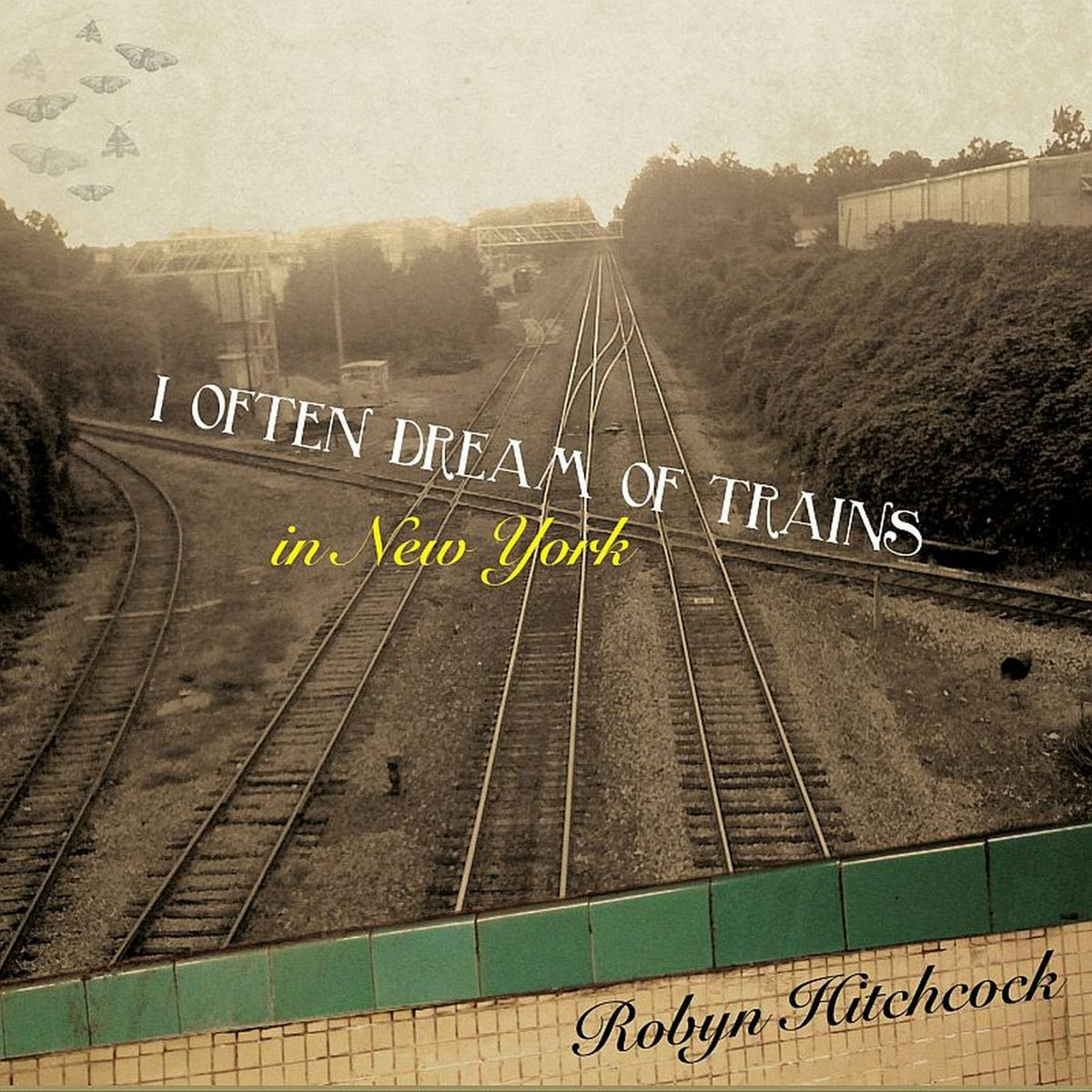
Robyn Hitchcock 26: I Often Dream Of Trains In New York

As even punk nears middle age, it’s become common for established musicians to celebrate the anniversary of one of their acclaimed albums by performing it live, in its entirety. These self-tributes are usually reserved for albums that either weren’t appreciated on original release or too complicated to perform at the time; see recent reboots by Lou Reed and Van Morrison for prime examples.

Robyn Hitchcock had just re-re-released his acoustic favorite I Often Dream Of Trains the year before doing a brief tour playing what he called “the director’s cut” of the album. The final night was filmed and recorded, eventually released as I Often Dream Of Trains In New York.

A “cassette fragment” of “Sometimes I Wish I Was A Pretty Girl” plays over the PA before slowing to a halt, whereupon our hero comes out to play “Nocturne”. From there, he and two cohorts (helping out on guitars, keys and horns) play most of the album the audience knows and loves, based on their polite but fervent applause after each song ends. Besides rejigging the order, a few changes are made: “Flavour Of Light” (as opposed to “Night”) may be a misprint, but the “tongue of fire hissing through the dark and tropical night” in “This Could Be The Day” are now “thrown by Nubian Dave”, and not slaves—perhaps in reverence of the new president, whom he’s very pleased was elected. “Mellow Together”, “Furry Green Atom Bowl” and “Bones In The Ground” are all excluded, but “Uncorrected Personality Traits” is an a cappella joy. “That’s Fantastic Mother Church” is stuck in the middle, and doesn’t pick up the pace despite its rhythm.

A few encores are included to fill out an otherwise short program: “America” (swapped on the DVD for “I’m Falling” from the recent Venus 3 album), “Up To Our Nex” (from the same album) and a rearranged “Goodnight I Say”. In all, a nice curio. Now if he’d only do a similar tour for Eye…

Robyn Hitchcock I Often Dream Of Trains In New York (2009)—3

Friday, April 4, 2014

Robyn Hitchcock 25: Goodnight Oslo

Having resigned himself to a future with a small but devoted fan base, Robyn kept writing, touring and recording, intent on staying active rather than changing the world. Goodnight Oslo wisely kept a good thing going, being his second release with the Venus 3, that tight little combo also busy being the guys not named Michael in R.E.M.

As has been his wont, he peeks around the gate before setting off. “What You Is” is a psychedelic soul number, with lines that emerge on the tenth listen, hiding behind the ladies’ vocals. “Your Head Here” sports a little whimsy like a refugee from the ‘80s, production tricks speeding up voices and even doubling Chris Difford-style. Keeping up the fun mood, “Saturday Groovers” is as catchy as anything he’s done, followed by the intoxicating “I’m Falling”. “Hurry For The Sky” is all Western, with dust and tumbleweeds permeating everything—not a common sound in the Hitchcock canon, and ultimately a gimmick.

“Sixteen Years” is more like it, with an arpeggiated guitar we expect—nay, demand from a song written partially by Peter Buck. Despite its Bo Diddley jazz intro, “Up To Our Nex” combines jangle, mandolins and mariachi horns for an addictive mix. The horns also pepper “Intricate Thing”, a pleasant little strum. The trippy “TLC” could also be an Egyptians refugee, except that the title stands for Tryptizol, Librium and Carbrital, which were among the drugs that killed Brian Epstein. Once that peters out, the title track taps insistently for six minutes, spinning mystery like a Norwegian “Year Of The Cat”.

Goodnight Oslo is the first time in, let’s say, sixteen years where he sounds like he’s making an album, rather than recording on the fly and embellishing as he goes. Maybe it’s the one-man horn section, used here as light dressing; maybe it’s Morris Windsor on backing vocals here and there. Whatever the secret ingredient, it further proves that he works best with a consistent unit supporting him. (And as had become almost automatic, early copies of the album included a bonus disc with two songs easily as good as anything else on the album proper.)

Robyn Hitchcock & The Venus 3 Goodnight Oslo (2009)—3

Friday, January 31, 2014

Robyn Hitchcock 24: Shadow Cat

Robyn’s leftovers don’t necessarily guarantee buried treasure, You & Oblivion notwithstanding. Therefore fans have grown to be wary when such a collection surfaces. Shadow Cat lists its sources as being from the mid- to late ‘90s, which wasn’t his most fertile period, but luckily the gems overshadow the clunkers.

“For Debbie Reynolds” is a sketch along the lines of “Queen Elvis”, cut short by a ringing phone, and presumably left there. “Never Have To See You Again” is driven by electric chords, and punctuated by silly horns, this time in a good way. “Love Affair” shimmers like an orphan from I Often Dream Of Trains. Anybody who bought this would already be familiar with his rendition of “The Wind Cries Mary”; this demo adds an organ part for color. The exceedingly gentle “High On Yourself” is the highlight for any fans of Trains or Eye, with the priceless line “Let’s go shopping on painkillers”. “Because You’re Over” is a cappella with layered harmonies, but sent through a vocoder or something; as distracting as that is, at least it’s tuneful (which can’t be said about “Real Dot” four tracks later). “The Cat Walks Her Kind Of Line” is an intricate, descriptive instrumental.

Two songs had been available in slightly different forms already; “Statue With A Walkman” is a wonderful find, while a rough version of “The Green Boy” doesn’t grate too much. “Nothing But Time” is intricately picked and mixed with just the right amount of echo, so that even the sillier lines fade into the ether. He’s already written plenty of songs with the word in the title, and “Beautiful Shock” gets a boost from its suggested and literal “electricity”. “Baby-Doll” is mysterious and romantic, but the title track gets to close the program, something of a relative of “Trilobite”.

Shadow Cat didn’t get the widest distribution, even from his latest label. That’s too bad, because it’s one of the better ones from a lengthening period that doesn’t always have high points. Definitely recommended to those inclined.

Robyn Hitchcock Shadow Cat (2008)—3½

Monday, October 14, 2013

Robyn Hitchcock 23: Bad Case Of History

The second retrospective Robyn box from Yep Roc was devoted to his mid-‘80s work with the Egyptians, from before their stint on A&M (now only available illegally or on eBay). Luminous Groove presented Fegmania!, Gotta Let This Hen Out! and Element Of Light! (okay, we added the exclamation point to that one) rijigged for the third time, with the usual suspect bonus tracks and positively hideous photos. But that wasn’t all.

This time, the carrot was another two-CD set of rarities, all featuring the Egyptians, most of which had never, ever been heard before. Bad Case Of History is split between studio and live tracks, providing a wealth of new music for fans hoarding their muddy dubs. The studio half is especially intriguing, as it presents a half hour’s worth of music that could have gone onto Globe Of Frogs or Queen Elvis, including the “title track”, a full band version of “Agony Of Pleasure” and the live favorite “Evil Guy”. Much of the balance comes from after Respect, providing a glimpse into the last sessions before the band stopped, including such future solo cuts as “I Am Not Me”, “Beautiful Queen” and “Zipper In My Spine”, rounded out by the holy grail among Hitchcock heads, “Surfer Ghost”.

The live disc is equally wonderful, again compiled from the A&M years, showing what a trio perfectly in sync could accomplish given the space to try it out. Along with a pile of songs from that limbo period, there are covers of “Eight Miles High” and “Chimes Of Freedom”, plus an otherwise unavailable song called “The Living Years” one place in the packaging and “The Live-In Years” elsewhere. (Either way, it’s not the Mike + The Mechanics song.)

While it does mess with the chronology somewhat, and forces completists to hold onto their Rhino reissues, Luminous Groove does deliver a wealth of new music for those of us who consider the Egyptians to be his best band—certainly inventive, and whimsically patient, at least on the surface. And it was already a long time ago.

Robyn Hitchcock & The Egyptians Luminous Groove (2008)—4

Monday, September 23, 2013

Robyn Hitchcock 22: While Thatcher Mauled Britain

Yep Roc’s joy at having Robyn Hitchcock on their label came equally from having mild critical and commercial success with his new work as it did from finagling yet another revamp of his thorny catalog. Already patronized by customers into digital downloads to go with new pristine vinyl, they and he took direct aim at people resigned to buying things they already had with two box sets devoted to Robyn’s seminal (there’s that word again) ‘80s work.

The first of these, I Wanna Go Backwards, was built around three key solo albums: Black Snake Dîamond Röle, I Often Dream Of Trains and Eye. Each got new booklets and bonus tracks, some familiar, some not. But the real attraction was the two discs of demos from the ‘80s, some familiar, some not, collected under the new title While Thatcher Mauled Britain.

One of our favorite since-deleted bloggers was kind enough to break out what makes this set essential in comparison to the Rhino program of a decade earlier, but essentially the discs shuffle a bunch of selections already beloved from Invisible Hitchcock and You & Oblivion with some of the Rhino discoveries for an even more chaotic listening experience. One’s enjoyment of these depends on the listener (and how many copies they already had) but chances are everyone went straight for the never-before heard stuff. Not all of it would have been better off unheard.

“Melting Arthur” does a lot with a simple melody, and “Parachutes & Jellyfish” is one of his better Syd Barrett impressions. “Lightplug” is something of an ancestor to “Wafflehead”, and “You’re So Repulsive” has better verses than the chorus of the title. As for the more familiar stuff, a jaunty acoustic “Flesh Number 1” has no Glenn Tilbrook but does boast Peter Buck. There’s even a live version of “Dr. Sticky”. An earlier, more primitive performance of “The Abandoned Brain” helps keep things different; the same keyboard is used for “Opiatrescence”, which is worth the wait. Likewise, it’s surprising that he never did anything else with “Lovely Golden Villians” or “Toadboy”. And after a couple of hours’ worth of spooky acoustic music, “I Wanna Go Backwards” provides some electricity to close the set.

So there’s a lot of music crammed into this set, and hardcore Hitchcock fans need it all (again). Still, one can’t help wishing the all-new stuff could have been made available in their own tidy little package, because really, did they expect a whole crop of new fans to discover him for the first time here?

Robyn Hitchcock I Wanna Go Backwards (2007)—3½

Wednesday, August 28, 2013

Robyn Hitchcock 21: Olé! Tarantula

It would seem that Robyn Hitchcock’s albums are the most consistent when he’s either working completely solo, or when he’s got a solid unit behind him for the duration. That’s the evidence one gleans from the first play of Olé! Tarantula, his most solid album since the heyday of the Egyptians. Here he’s helped out by the Venus 3, a trio of escapees from Young Fresh Fellows, Ministry and R.E.M. (longtime buddy Peter Buck). And considering that the other two guys have since been tapped to help out R.E.M. onstage and in the studio, that should suggest a certain mutual intuition.

Right from the top, “Adventure Rocket Ship” and “Underground Sun” sound like vintage Robyn; even “Museum Of Sex” works despite its saxophones and rambling lope. Speaking of which, “Belltown Ramble” sports a dotty piano over the acoustic and non-linear lyric for six minutes. The title track seems like an excuse to write a song to match said title, but it’s got all the ingredients for fun.

By now Robyn fans tend to give songs with titles like “(A Man’s Gotta Know His Limitations) Briggs” the benefit of the doubt, whatever the context. “Red Locust Frenzy” comes at the traditional spot when one of his albums starts to drag, nudged along by a riff not distantly related to “I’m Only You”. “‘Cause It’s Love (Saint Parallelogram)” was written with XTC’s Andy Partridge, and could have used some of his lyrical whimsy. “The Authority Box” is nice and trashy, in direct contrast with “N.Y. Doll”, something of a letter written from the point of view of that band’s Arthur Kane.

As we’d long begun to suspect that we were supporting this guy more out of habit than fascination with his development—not helped by pricey import-only items like Obliteration Pie and This Is The BBC—it was truly joyous to find something as, well, good as Olé! Tarantula. Clearly this was not a fluke, since he took the band on the road (pushed by some exposure from the Sundance Channel) and dug deep into his catalog. Some examples emerged on Sex, Food, Death… And Tarantulas, an EP released the following year; in the meantime, it was hoped that the Venus 3 would be able to help their boss out again, provided they could find the time.

Robyn Hitchcock & The Venus 3 Olé! Tarantula (2006)—3

Monday, July 1, 2013

Robyn Hitchcock 20: Spooked

Having basically ceased to matter in the business outside of his miniscule fan base, Robyn found a new home on Yep Roc, a label that specialized in indie rock perpetuated by such older codgers as Nick Lowe, The Reverend Horton Heat and the guy from the Blasters. For his first missive on the label, Robyn hooked up with David Rawlings and Gillian Welch, darlings of the alt.country movement. Their influence isn’t immediately overt, but they prove to be inspired collaborators.

Spooked is another acoustic album with a green cover, mostly, many of the songs coming across as demos. “Television” is sadly not about the band but the appliance, yet rates a devoted vocal. “If You Know Time” is based around what sounds like a dulcimer, evoking something like a more tuneful Incredible String Band. But around where “Everybody Needs Love” comes in, the album threatens to sound like endless variations on “The Cheese Alarm”.

People who’ve followed Robyn this long want desperately to like him, and therefore ache for an album to thrill as much as its older siblings did in earlier decades. We wanted to root for Spooked, and display it as proof that he’s just as inventive as ever. Yet songs like “Creeped Out” come across as something he’s making up on the spot, with the barest of chords, the immediate effect is that of forced whimsy, where once he sounded more natural. Meanwhile, the lengthy cover of Dylan’s “Trying To Get To Heaven”, here given its full title with the tag “Before They Close The Door”, seems like a Major Statement, coming only a couple of years after his double-Dylan tribute set, and in full acknowledgement of his mortality. (Of course, the unique modification referring to “the dinosaur’s waiting room” shows he just has to be him.)

There are enough moments throughout, like the first couple of tracks and a few near the end (like “Full Moon In My Soul” and “Flanagan’s Song”) that actually possess melodies capable of adhering to your brain. It’s hard to imagine how Spooked might have developed from first idea through composition, refinement and recording. It seems a very arbitrary album, especially considering that the two-song bonus CD that accompanied initial orders is as good as the album it accompanied. We didn’t come around ourselves for over a decade, but when heard within the context of a decade’s worth of a lot of one-shots, the album does emerge as recommendable.

Robyn Hitchcock Spooked (2004)—3

Friday, November 30, 2012

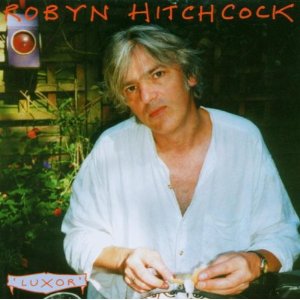
Robyn Hitchcock 19: Luxor

The direct approach suited Robyn, and continued with the next installment in his discography. Originally distributed to attendees of his 50th birthday concert, Luxor begins with promise, being completely solo and mostly acoustic, just like the best albums of his heyday.

Indeed, “The Sound Of Sound” crawls along at a lovely slow pace, but is pushed aside by “One L”, a tribute to his wife that’s a little too personal to succeed. “Penelope’s Angles” follows a plucked pattern similar to “Autumn Is Your Last Chance”, but wanders off to repeatedly insist that “I am not a yam.” There’s something of a juxtaposition in the not-quite-there-ness of “The Idea Of You” and the much superior “You Remind Me Of You”. The title track is instrumental, and happily doesn’t evoke mental images of Vegas casinos, Egyptian relics or computer games. “Keep Finding Me” beings with an enticing melody that unfortunately loses its way in the bridges (“Be true to your drum/be true to your drummer/this summer is gonna be hot—hot!”).

“Maria Lyn” has some excellent lyrics, but the one-chord blues style has never been his most comfortable approach, no matter how many times he tries it (though “Solpadeine”, which closes the program does much better in the format, mostly because it offers more chords). “Round Song” is an improvement, its ringing 12-string and vocal effects sounding very much like the English psychedelic folk we imagine him loving without having heard it ourselves. The jumpy “Ant Corridor” seems more like a demo than anything else here, making little sense. The same could be said of “Idonia”, but somehow this particular mix of sea shanty and 1966 Dylan clicks. “The Wolf House” is another pretty instrumental staying just this side of revealing its structure.

Presented with little fanfare, Luxor re-establishes the trend of Robyn Hitchcock albums that are pleasant but not very exciting. Because of the perfection of I Often Dream Of Trains and Eye—not to mention the sheer entertainment his solo shows always provided—we desperately want to like this album more than we do. The rating should therefore be taken well within context, and we’d be surprised, albeit pleasantly, if anyone fell in love with his work based on this particular album.

Robyn Hitchcock Luxor (2003)—2½

Friday, September 7, 2012

Robyn Hitchcock 18: Robyn Sings

Selling self-manufactured discs via his website seemed to be a good option for somebody like Robyn Hitchcock, who had things to say but shrinking outlets by which he could say them. And even when he wasn’t saying anything new, he could put out an album anyway.

Robyn Sings consists entirely of Bob Dylan covers. His straightforward (for him) liner notes explain how he was transfixed by “Desolation Row” at an impressionable age, sending him on his path as a singer-songwriter. The set is split into two LP-length discs, denoted “Stripes” and “Dots” in honor of Dylan’s mid-‘60s onstage choice of shirt.

Most of the Stripes disc is made up from live acoustic performances, with only the barest augmentation here and there, as shown on the versions of “Visions Of Johanna” that bookend the disc. And it’s not just the “classic” period he shows love for—“Dignity” and “Not Dark Yet” are hardly staples of Dylan tributes.

The Dots disc presents the electric half of his heavily bootlegged recreation of the “Albert Hall” bootleg on its thirtieth anniversary, recorded in a London club. The band and audience knows the songs (and performances) as well as he does, right down to the sneered twixt-song comments and muttering.

For the most part his renditions are faithful—he is, as he admits, performing a kind of karaoke to songs he’s committed to memory—but every now and then he throws in a surreal rhyme. There’s a wonderful moment in “4th Time Around” where he loses his place, then backtracks through events of the previous verses to find his way back.

Ultimately, Robyn Sings is a curio, an option for those not into file-sharing or tired of trawling eBay for the promo that offered songs for a limited time. It’s a labor of love, a worthwhile listen for fans of both gentlemen, but hardly essential.

Robyn Hitchcock Robyn Sings (2002)—3

Monday, August 27, 2012

Soft Boys 4: Nextdoorland

His solo career had turned out less lucrative than ever, but at least Robyn Hitchcock had the distraction of reissuing Underwater Moonlight (everybody’s favorite Soft Boys album) on the trendy Matador label. In a move as unexpected as it was obvious, the band reunited for a tour, which led to a new album.

Nextdoorland turned out to be one of his better albums in a while, certainly helped by a consistent, reliable unit throughout the album, as opposed to the pick-and-choose sequencing of his Warners output. There’s little of the chaos so prevalent on their albums, instead relying on tight playing, excellent guitar interplay, and Robyn’s choice of words. It would also appear that all of the songs were written or at least developed with the Soft Boys in mind.

“I Love Lucy” is perhaps one of the better illustrations of their strengths, being mostly instrumental. “Pulse Of My Heart”, “Mr. Kennedy” and “Unprotected Love” all teem with hooks, while “My Mind Is Connected To Your Dreams” recalls some of the moodier Egyptians tracks from the ‘90s.

“Sudden Town” has a riff that flirts with “Kingdom Of Love”, breaking out of its straitjacket in time for the chorus. “Strings” goes for over six minutes, mostly due to a few psychedelic trips here and there. “Japanese Captain” tries a little too hard to be odd, so “La Cherité” is a better use of evasive meaning. “Lions And Tigers” is kinda silly, but it works.

As good as Nextdoorland is, something’s still missing. Over the years, what had once seemed to come so easily to Robyn was now seeming more contrived. Plus, spending 25 years in the business not likely too careful with his throat was starting to result in a rasp.

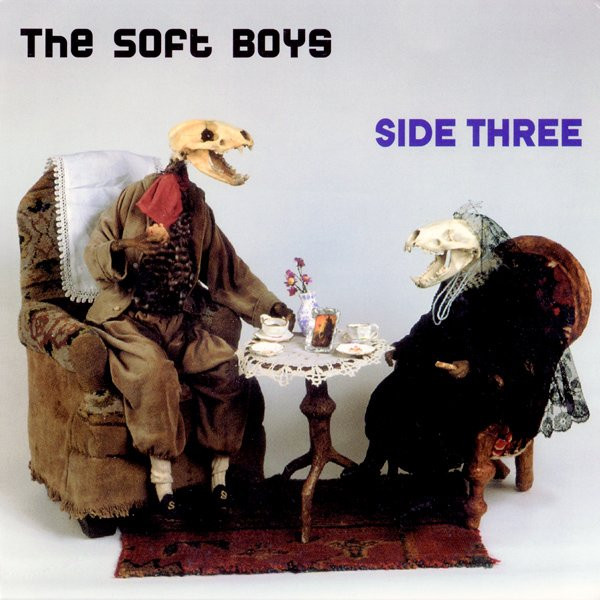
But at least he was making music, and letting it be heard. As was becoming common for him, another handful of songs was made available via direct mail order. The aptly titled Side Three offered another twenty minutes of catchy tunes, before disappearing. Of the six tracks, one is a remake of “Each Of Her Silver Wands” from an earlier offhand release, and “Evil Guy” had been a legendary Egyptians outtake. It’s out of print, but new and used copies abound on the e-tail sites.

The Soft Boys Nextdoorland (2002)—3
The Soft Boys
Side Three (2002)—3