Showing posts with label jam. Show all posts

Friday, January 1, 2016

Jam 10: Box Sets

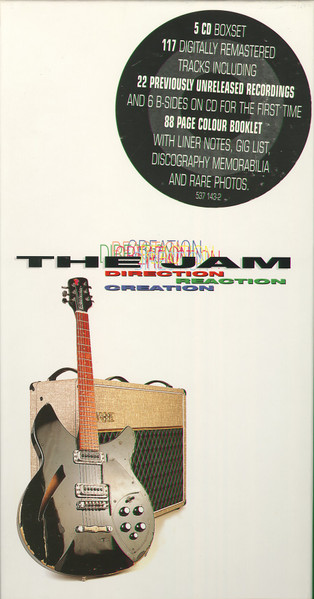
The rise of Britpop in the ‘90s got some people thinking about The Jam, at least in the UK, where Paul Weller was still somewhat popular. This was also an era when box sets abounded, and one arrived just in time for the band’s 20th anniversary.

Direction Reaction Creation crams their entire studio output onto four discs, with a fifth CD full of unreleased material. The first four discs are sequenced in rough chronological order by release date, so any singles released ahead of time throws off the flow of some of the albums proper. Still, the set just has to begin with both sides of the “In The City” single, and you can’t complain when their first two albums fit onto the first disc, along with the rare “Carnaby Street” B-side.

Disc two presents the build-up and aftermath of All Mod Cons. We can hear the growing pains in the B-sides “Aunties And Uncles (Impulsive Youths)”, “Innocent Man” and “The Night”, before they hit their stride with a string of excellent singles. This disc ends with “The Eton Rifles” (and its B-side, “See-Saw”), which takes something away from disc three, devoted to the remainder of Setting Sons and Sound Affects—plus, hello hooray, “Liza Radley”. That’s three strong discs in a row, and since we’re one of those who didn’t love The Gift, disc four doesn’t get as much play, particularly with the 12-inch single version of “Precious” taking up six precious minutes, and the un-Jam-like covers issued as B-sides.

All of disc five is previously unreleased, so you still have to hold onto Extras. Most of this disc are studio demos of songs recorded better later, though a “So Sad About Us” that predated the first album is pretty tight. “Worlds Apart” and “Walking In Heaven’s Sunshine” are otherwise unheard tracks, “Rain” a carbon copy of the Beatles’ track, “Dead End Street” a piano rendition of the Kinks song, and another demo of “A Solid Bond In Your Heart” provides an up conclusion.

Being limited to studio material, Direction Reaction Creation does miss out on a few alternate single mixes, as well as a few of the live tracks issued as B-sides. Some of the off compilations included these, but it was 18 years before the other half of the picture was filled in. Fire And Skill presented six complete concert appearance, from each of the years from 1977 through 1982—four in London, one in Reading, and one all the way up in Newcastle.

Some of the tracks have already appeared on Dig The New Breed or Live Jam, but such canonical repetition can be forgiven. Three B-sides came from the 1977 show, so it’s good to have “Bricks And Mortar” (pronounced “moe-uh” each of the three times it appears in the set, one of which segues into “Batman Theme”) and their covers of “Back In My Arms Again” and “Sweet Soul Music” in context.

The first voice you hear is that of John Weller, Paul’s dear departed dad who roadied for the band and introduced every gig. Particularly through the first five shows, the band is tight, democratic and gracious. A horn section creeps in on the fifth, providing a transition to the keyboards and backup singers added for their final shows. The Wembley gig, one of several from the last days of the band, was recorded well, but the guitar and bass are off pitch with each other—one of the pitfalls of playing arenas instead of theaters or clubs.

Sure, some songs appear in multiple renditions (some as many as three and two in four), and the title had already been used in the ‘90s for a tribute album, but Fire And Skill is a worthy, and long overdue bookend to this terrific band’s career. In the absence of a reunion, it will stand. (Two years later, the 1977 box offered the first two albums plus “All Around The World” and “Carnaby Street” remastered on two short discs, 25 minutes of demos—six of eleven unreleased, the other five also on the first box—on another, previously released John Peel sessions plus an unreleased concert on another, and a DVD of promo clips and TV appearances. And a bunch of prints, possibly to justify two discs of music spread across four.)

The Jam Direction Reaction Creation (1997)—4
The Jam
Fire And Skill (2015)—4
The Jam
1977 (2017)—3½

Wednesday, October 16, 2013

Jam 9: Extras

As evidenced by Snap!, The Jam had racked up a pile of standalone singles and B-sides that weren’t included on their albums. One would think that a collection of those “extra” tracks would mop everything up nicely. Despite the moniker, Extras does not fulfill that requirement. Instead, it follows through on its title by serving up a grab bag of B-sides, rarities and demos, making it as essential for the Jam fan as it frustrating.

Case in point: “Liza Radley” was a lovely chamber pop pastiche tucked on the B-side of “Start!” But the version included here is a raspy demo, with little of the charm of the band version. Still, some of the B-sides that are included—“Dreams Of Children”, “Tales From The Riverbank”, “Smithers-Jones”, “The Butterfly Collector”—are minor masterpieces on their own. They also covered the Who twice, first with an excellent “So Sad About Us” and later with the noisy “Disguises”, but later soul-heavy covers like “Move On Up” and “Stoned Out Of My Mind” become interchangeable with Weller’s originals on the way to the Style Council (“Shopping”, “The Great Depression”, “Pity Poor Alfie”).

Variously interesting are the unheard tracks. A demo of “A Solid Bond In Your Heart”, in contention for their final single, provides further comparison of what could have been, while James Brown’s “I Got You (I Feel Good)” is a better showcase for the whole band, as are demos of the Small Faces’ “Get Yourself Together” and the Beatles’ “And Your Bird Can Sing”, proving that only George Harrison could nail that riff. Digging a little deeper, an alternate “Boy About Town” and the half-spoken “Pop Art Poem” were fan club exclusives. To see how Weller’s ideas developed, “No One In The World” and “Hey Mister” are spare, pleasant songs that evolved otherwise. A quartet of guitar-and-voice demos of songs destined for Setting Sons show those in mostly finished state, but the most surprising revelation is “We’ve Only Started”, which shares an arrangement with “Tales From The Riverbank”.

While a few of the songs were already on Snap! (or even Compact Snap!), Extras was designed as more of a companion to 1991’s shorter Greatest Hits CD. A few years later, likely to cash in on both Paul Weller’s solo success and the emergence of Britpop, the UK got The Jam Collection, which collected some of the better album tracks and B-sides with the first-ever appearance of “Liza Radley” in full digital splendor.

The Jam Extras (1992)—3½

Friday, August 16, 2013

Jam 8: Snap!

Having already closed out their short career with a live retrospective, it was high time for a Jam hits album. Snap! was a two-record set, packed to the gills with all of their singles, plus album tracks and B-sides. That last detail is key, because while The Jam made some excellent albums, their singles put them firmly in the tradition of the Beatles before them (and the Smiths after) by ensuring that every record counted, be it a single, LP or EP.

And they had some terrific singles in between those albums. “All Around The World” combines the energy of their first two albums with a call-and-response vocal; Bruce Foxton even got his own moment to shine on “News Of The World” two 45s later. (And what came between those? “The Modern World”, of course.) All Mod Cons gets the most representation with six tracks, leading up to two superior double-sided singles. The narrator of “Strange Town” takes the guise of “a spaceman from those UFOs”, but it’s just as fitting a description of any naïf lost in the Big City. “The Butterfly Collector” is a particularly nasty speech to an aging strumpet. “When You’re Young” dispenses further wisdom to “kids” his own age, while “Smithers-Jones”, in its original B-side guise, will always inspire debate as whether it or the tarted-up version on Setting Sons is better. Those were great singles, but the top was “Going Underground”, a masterpiece of melody, anger and fear, while “Dreams Of Children” predicts the Revolver-isms of their next album with a familiar riff and what sounds like the chorus of “Thick As Thieves” run backwards over it.

“That’s Entertainment” appears in a very similar demo version, while a remixed “Funeral Pyre” (written by the whole band) conjures the image of flames over a galloping rhythm. The horn section kicks off the final phase of their career for “Absolute Beginners”, but its upbeat mood is tempered by the haunting “Tales From The Riverbank”. The band’s last two hits were as elaborate as they were foretelling; “The Bitterest Pill (I Ever Had To Swallow)” sports bright strings, intricate guitar parts and a hilariously tragic lyric, while “Beat Surrender” overturns the anger of his younger days with a determination to rise above the BS. It provides an optimistic conclusion.

The original LP set (which came with a bonus EP of songs from their final show) was soon rejigged for the emerging compact disc format; since everything wouldn’t fit, Compact Snap! has eight fewer songs, sacrificing a few B-sides and album tracks, but still including every A-side. In 1991, after the reemergence of Paul Weller as a rock artist, the label released Greatest Hits, which duplicated most of Compact Snap!, with only a few substitutions. Six years later, The Very Best Of The Jam (not released in the US) added two more songs, while 2002’s The Sound Of The Jam took another stab at compiling their best. It wasn’t until 2006 that Snap! was reissued in a full two-CD package (three if you bought the one with the live EP) with all 29 songs. Even the inclusion of “Precious” can’t diminish the quality of this music.

The Jam Snap! (1983)—5
Compact Snap! CD: same as above, minus 8 tracks

Monday, July 8, 2013

Jam 7: Dig The New Breed and Live Jam

Paul Weller finished The Jam with a farewell tour of sorts, accompanied by a live compilation. Dig The New Breed begins in 1977 with a tight version of “In The City”, then jumps to December 1979 for a trio of songs from their stint at London’s Rainbow. The bulk of the balance comes from shows in late ’81 and early ’82, when they had a horn section onstage with them.

Still, even with all the different venues and eras in their short five years, it holds together as an album. It is sequenced somewhat chronologically, but the emphasis is on songs as opposed to “live greatest hits”. While a few singles are played, many of the songs are deep album tracks, with the exception of the cover of Eddie Floyd’s “Big Bird”, an obscure Stax cut.

The original LP issue of Dig The New Breed had a unique design, with a hole in the cover to show off the special labels. It was a decent gesture, but hardly compensation for fans who were mourning the loss of their favorite band. At least the horn section doesn’t get too much in the way.

Ten years later, after Weller started releasing albums under his own name in a more guitar-based style, Polydor dug into the vaults for a few archival releases. One of these was Live Jam, not to be confused with the “Pearl” version then fascinating American youth. Half again as long as Dig The New Breed, it also doesn’t duplicate any of that album. The Rainbow in 1979 is again the source for several tracks, providing a relentless sampling from the Setting Sons era. Most of the second half includes that later horn section (and female backup singers), though Bruce gets to sing “David Watts” and they gamely inject some life into the usually robotic “Precious”. The set closes with their arrangement of “Heat Wave”, providing a nice compromise between their soul influences and the direction Weller was about to take without them.

Both albums are essential for the fan, and educational for those wondering what all the fuss about. Thankfully, the BBC had saved a few of the band’s performances, so the now-hard-to-find The Jam At The BBC delivers three discs worth of radio performances, including lengthy sets from 1978 and 1981, plus a full hour-long show from—where else?—the Rainbow in 1979.

The Jam Dig The New Breed (1982)—3½
The Jam
Live Jam (1993)—3½
The Jam
The Jam At The BBC (2002)—3½

Wednesday, April 24, 2013

Jam 6: The Gift

Their longest gap yet between albums was interrupted by a couple of singles, the latter of which included prominent horns. Not yet 24 years old, Paul Weller was moving away from the punk/mod sound that brought so many fans to his band, and was now writing songs to be performed in a funk/soul style.

That wouldn’t be a bad thing if he had a more convincing voice to carry it. While his throat had developed a huskiness, the kid we hear testifying all over The Gift seems more like a poser. And despite some excellent songs, it’s their least successful album.

“Happy Together” (announced as being “in technicolor”) begins with a dub-style toast, then settles into an urgent groove. “Ghosts” ticks gently under a nicely picked theme, with canned handclaps and some trumpets. Things go immediately wrong on “Precious”, an interminable funk jam one would expect from, say, Culture Club. When that finally ends, “Just Who Is The 5 O’Clock Hero?” celebrates the man who comes home every day “covered in sh-t and aches and pains”. Then it’s back to jamming—“Trans-Global Express” gave the tour a name, but buried Weller’s words under an echo- and delay-heavy mix. Yet another “one two free four” calls up “Running On The Spot”, another decent tune fighting against a bad mix.

The noisy instrumental “Circus” sets up “The Planner’s Dream Goes Wrong”, a faux-calypso tale. Thankfully, the rest of the album is a major improvement. “Carnation” is classic Jam, tuneful and cohesive. “Town Called Malice” was the big hit, a Motown experiment that actually works. And the title track conjures up some of the punk spirit for something of “In The Midnight Hour” turned on its head.

Some people adore The Gift, to the point where the 30th anniversary deluxe edition released in the UK was very well received, loaded as it was with contemporary singles, demos, alternates, a complete show from the final tour, and a DVD. However, we agree with the band’s own rhythm section, who were very disappointed with the direction the music was going, and were equally frustrated when Weller broke up the band in favor of the slicker Style Council. Clearly, he was on to other things, and just wanted the chance to grow. For that, we can’t blame him.

The Jam The Gift (1982)—2½

Wednesday, April 3, 2013

Jam 5: Sound Affects

Five albums in four years’ time is a lot, particularly when one calculates any in-between singles and B-sides. The Jam were still putting out inspired work, but they were evolving. The songs on Sound Affects are far away from the mod and punk influences of their earlier work (with one exception, which we’ll get to), and part of that distance comes from the implementation of more keyboards and horns.

One overt influence that gets mentioned with the album constantly is the Beatles’ Revolver—underscored in the US release, which begins with “Start!”, a fairly liberal musical theft of “Taxman”, from the bass line to the guitar solo. Likewise, it’s been pointed out that “But I’m Different Now”, the only song that sounds like 1977, is built around the two-chord hook from “Dr. Robert”. Original or not, they’re still two catchy tracks, and the parts Paul Weller did come up with on his own are excellent.

He was a fairly observant young man, concerned with the question of politics and social problems, even if he couldn’t offer any solutions of his own. “Pretty Green” is about money, whether it’s used to buy sustenance or empty entertainment. “Monday” offers a little respite in a hopeful love song, albeit one from someone who says he’s not “special”. That makes a good lead in to “But I’m Different Now”, which itself doesn’t prepare for the insistent riffing and anger of “Set The House Ablaze”—something of a conversation between those one-time friends on Setting Sons now on the opposite sides of the system. A solution is suggested by two minutes of communication in “Start!” Already a wordy album, a poem without rhymes is set to an acoustic strum in “That’s Entertainment” (except for the addition of a backwards guitar, and guess what album they got that idea from).

That’s a pretty strong album side, which can’t be said about the other. “Dream Time” begins with several seconds of muffled effects, and the structure of the tune itself isn’t any help either, instead forcing three different musical ideas together. (This strangeness is repeated two tracks later for the instrumental “Music For The Last Couple”, probably designed to drive them out of the building.) “Man In The Corner Shop” is an astute comparison of class perception over what sounds like several key changes, always going back to that wordless “la-la” hook. There’s another “la-la” break in “Boy About Town”, another should-have-been hit (maybe it’s the trumpets). Finally, there’s “Scrape Away”, built on the same complicated riff design as “Set The House Ablaze” and covering much of the same territory.

Sound Affects is not an easy album to “get into”; the overall tension and uncertainty illustrate the frustration Weller was starting to feel with his band’s capabilities. But that would only be seen in hindsight. The better songs stand out—and if you were one of the five people who bought it in America, you got a bonus 45 of “Going Underground” and “Dreams Of Children”, their excellent stopgap single from earlier in the year.

The Jam Sound Affects (1980)—3

Friday, March 15, 2013

Jam 4: Setting Sons

The Jam had more or less found their way, with a handful of edgy singles keeping them in the charts until their next LP, but even that was uneasy going. Setting Sons was envisioned as a concept album, and while such a thing may have seemed perverse after a decade of prog-rock, which punk was supposed to have destroyed, recall that it was the “mod” bands (The Who, The Kinks, Small Faces) that had made the first stabs at the “concept” concept a decade earlier. (In the US, the sides were swapped, which jumbled the thin concept even more, while “Strange Town”—a standalone single from earlier in the year, was added as the second song on side two.)

Perhaps it was just as well it didn’t work, since the songs hang better, together and on their own, without being tethered to a song cycle about three boyhood friends whose lives went in markedly different directions. Such an idea is obscured by the opening track about the “Girl On The Phone” (complete with sound effects) stalking the singer because, well, he’s a singer. That out of the way, the back story is set up in “Thick As Thieves”, a catchy look back at the boys’ lost youth. One of them pens the letter paraphrased in “Burning Sky”, bragging about his busy corporate life. Another could be the angry military pawn of “Little Boy Soldiers”, pushed through several tempo changes. Somebody else is stuck in the “Wasteland”, trying to maintain hope in the face of economic decline.

The rest of the songs, while topical, are worthy vignettes outside the original idea. “Private Hell” is a fitting title for the situation holding an aging housewife hostage, her kids grown and distant, her husband merely a reason to shop for groceries week after week. The youth of the day are dismissed as “Saturday’s Kids”, but still seem more appealing than the snobs attacked in “The Eton Rifles”.

The most striking song on the album is arguably “Smithers-Jones”. Written by bassist Bruce Foxton and already heard as a straight rock B-side, it got a major makeover with classical strings, an inspired match for such a vivid portrait of an office drone, worthy of Weller and Davies—and even more effective coming after the businessman’s spiel in “Burning Sky”. That said, the slightest song could be their closing Who-heavy cover of “Heat Wave”, familiar to ‘70s kids from Linda Ronstadt’s version, and here featuring a horn section in a harbinger of albums to come. (Guesting on piano was one Mick Talbot from the Merton Parkas, in another harbinger.) Bringing the album in at 32 minutes, it’s still a good performance.

And that’s the point—the parts make the sum. In a short amount of time, the band had become something of spokesmen, with two strong songwriters offering wry observations of society. Not bad for three yobbos in their early 20s.

The Jam Setting Sons (1979)—3½

Wednesday, February 20, 2013

Jam 3: All Mod Cons

A whopping twelve months passed between Jam albums, and it was worth the wait. Appetites were whetted with two excellent singles—first, a faithful cover of the Kinks’ “David Watts”, which helped in that band’s New Wave revival, while the B-side spoke of an “‘A’ Bomb In Wardour Street”, continuing the link to the Mod generation while staying firmly in the present (spelling out the word “apocalypse” and ending with an explosion). It was their next single that grabbed the attention. “Down In The Tube Station At Midnight”, quite simply, is a first-person real-time account of a mugging in the London Underground. The sound effects aside, it’s a harrowingly edgy song, from the jagged guitar slashes to the funk-noise bass. The verses extend the tension, and each chorus shows the victim more helpless than the last, up to the final realization that his wife may not be safe.

All three of these songs were included on All Mod Cons, a title that combined with the cover art for a clever British pun. They certainly enhance the program, just as the writing and musicianship has gained sophistication.

It would appear that the tribulations of fame are top of mind, with the blink-and-you’ll-miss-it title track questioning the motives of fairweather friends, and “To Be Someone (Didn’t We Have A Nice Time)” already looking back at success that has passed. In both cases, the words are spit out and garbled under catchy chords and riffs. “Mr. Clean” looks at success from another angle; this time the object would appear to an upwardly mobile businessman, a subject not alien to Kinks fans, but here the singer threatens to topple him at first chance. The Kinks connection is underscored by the placing of “David Watts” next, but what follows is another departure. “English Rose” fades in on the sound of foghorns and lapping waves, before a gently picked acoustic helps sing to the “one true love” of the title. (Paul Weller was apparently so embarrassed by the words that he purposely left them off the lyric sheet.) The excellent “In The Crowd” ends the side, an ambivalent ode to the comforts and trappings of conformity. It’s shows the effect age has on the teenage drive, recalled over the second half of the song, an extended one-chord Who homage incorporating backwards guitars masking the transition from the repeat of “in the crowd” to “away from the numbers”. A tour de force.

“Billy Hunt” would appear to be the name of the young lout complaining about his job, showing his immaturity with revenge fantasies based on Superman, James Bond and even Steve Austin. “It’s Too Bad” is a decent pop song nicely influenced by The Who’s “So Sad About Us”, which The Jam had covered quite well for the “Tube Station” B-side. “Fly” is cut from similar cloth as “English Rose”, but with an electric coating on the acoustic base. “The Place I Love” is a Weller (read: defiant) interpretation of the “In My Room”/“There’s A Place” lyrical theme. The ending segues well as a setup for “‘A’ Bomb In Wardour Street”, itself leading well to “Tube Station”, which couldn’t really go anywhere else on the album but the end.

All Mod Cons is an excellent progression for this young band, with the slower songs just as strong as the fast ones. Hearing different guitars adds dimension, as does the subtle touches of piano and organ here and there. It seemed they’d finally found “their” sound.

The Jam All Mod Cons (1978)—4½

Friday, February 8, 2013

Jam 2: This Is The Modern World

Ah, the good old days when you’d only have to wait six months for a band’s next album, and with a single or two in the midst as well. This Is The Modern World was considered by some as a step back, and while it doesn’t have the high-speed energy of In The City, there are still some excellent songs.

For starters, there’s the near-title track, with its Townshend scrape and two-finger retort in the final bridge (on the single, Paul Weller doesn’t give “a damn”, but on the album, he’s more specific). More defiance surfaces in “Standards”, a nice rearrangement of the “I Can’t Explain” riff. “The Combine” continues the questioning of “Away From The Numbers”, ending appropriately with an unresolved chord sequence.

The big difference was that Weller had a steady girlfriend, which colored his approach and the energetic commentary in “In The Street Today” and “London Girl”. Now he was writing songs like “Life From A Window” and “I Need You (For Someone)”, which hinted at sensitivity, while “Here Comes The Weekend” is a pop song disguised as mod disgust. Then there’s “Tonight At Noon”, with its jokey beginning, prominent acoustic guitar and poetic exploration of the “In The Midnight Hour” theme. To make the point obvious, the song is followed by their version of that very soul classic.

Doing a cover wasn’t a big deal, but allegations of Weller’s lack of productivity are supported by the two songs written by bassist Bruce Foxton, but only if you paid attention to such things. “London Traffic” and “Don’t Tell Them You’re Sane” sound enough like Weller songs to not stand out like sore thumbs. (In the US, the order was shuffled, and the otherwise non-album single “All Around The World” followed the single version of “The Modern World” that still opened the album.)

So even if it doesn’t make leaps and bounds, This Is The Modern World still delivers enough bite in its 31 (or 34) minutes, making it recommended. Dig that homemade mod sweater on the cover, too.

The Jam This Is The Modern World (1977)—3½

Monday, January 28, 2013

Jam 1: In The City

While they emerged amidst the punk scene, The Jam weren’t exactly a punk band. They didn’t dress in ripped shirts or leather, preferring dark suits and ties. (The bass player even sported a near-mullet.) Their music—generated by Rickenbackers through Vox amps—was influenced by “mod” bands from a generation earlier. They weren’t a power trio per se, but played just as loud as one. But Paul Weller’s sneered, slightly mushmouthed delivery of his own lyrics displayed anger and defiance, typical yet atypical of an 18-year-old kid whose Dad was the band’s road manager.

“In The City” was their first single, followed a month later by the album of the same name. In just over two minutes their sound is established: slashing guitar, pulsing bass and cracking drums at top speed. While they were never fully appreciated by Americans in their time, this song’s influence was obvious when only six months later the Sex Pistols stole the riff and slowed it down for “Holidays In The Sun”.

The early pop-art Who runs through this album, though not overtly. “In The City” itself shares a title but nothing else with the B-side of “I’m A Boy”. “Art School” opens the album with a power chord flourish. “I’ve Changed My Address” has a midsection of skittering drums and toggle-switch feedback right off the first Who singles. “Slow Down” was famously covered by the Beatles, but The Jam run their version through “My Generation”. (“Takin’ My Love” is another interpretation, and was also the B-side to the “In The City” single.) They even serve up a cover of the Batman theme.

Those mod bands, like the rest of the British Invasion, were fascinated by Motown, and “I Got By In Time” swings and swaggers, right down to the response vocals. This is not to suggest that they were copycats. Paul Weller established himself as a songwriter with the songs on this album. “Away From The Numbers” speaks out against following trends and fake friends; it even breaks the four-minute mark, unlike the compact tracks on the rest of the album. “Sounds From The Street” and “Non-Stop Dancing” evoke excitable youth, while “Time For Truth” and “Bricks And Mortar” are near protest songs (the former especially, spitting the f-word in the first verse).

In The City is an excellent debut, with barely a clunker in the batch. Its 32 minutes fly by with little relief, which is great for air-drumming. Besides, as young as they were, there was plenty of time to get introspective.

The Jam In The City (1977)—4