Showing posts with label nick drake. Show all posts

Friday, August 29, 2008

Nick Drake 7: Family Tree

Because Nick Drake’s official catalog was so small and finite, fans naturally clamored for any other music he played that they could find. Bootlegs of home recordings, copied from cassettes gifted by Nick’s parents to occasional pilgrims to their home, made the rounds, their tentative performance quality and dodgy sound kept them from being little more than footnotes. Yet, even into the new century, converts had to have them.

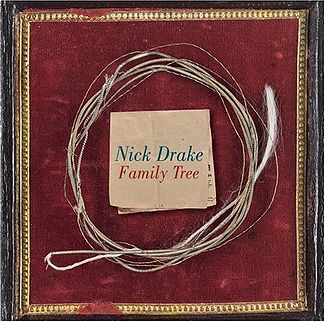
Around the time that Made To Love Magic was released, the estate announced another planned companion album of sorts, which emerged after a three-year gap. More of a gamble for non-fanatics, Family Tree collected a variety of these home recordings—two of which had been included on Time Of No Reply, and welcome here in their absence since that album’s deletion. They even took the bold step of including performances by Drakes other than Nick to show his “musical education”. He duets with sister Gabrielle on a rendition of “All My Trials”, and there’s a brief Mozart trio piece with Nick on clarinet and his aunt and uncle on viola and piano respectively. Mother Molly’s “Poor Mum” is suggested as a template for “Poor Boy”, which it isn’t, while “Do You Ever Remember?” is a sad reverie used to close the disc. (More complete collections of Molly’s recordings have been issued for those looking to dig deeper; frankly, they’re quite charming.)

Fully half of the tracks are folk and blues covers, showing the development on his picking style. Along with the usual suspects, like “Cocaine Blues”, he was not unusual among young folkies who were fascinated by Jackson C. Frank (“Here Come The Blues”, “Blues Run The Game”, “Milk And Honey”), Bert Jansch and John Renbourn, Dave Van Ronk, and Bob Dylan (“Tomorrow Is A Long Time”). There are oddities: “Time Piece” is a brief monologue delivered to the accompaniment of a metronome, while “Paddling In Rushmere” is a children’s piano exercise that dissolves in giggles after 24 seconds.

He’s somewhat tentative on those, but most listeners would be more fascinated by his otherwise unreleased originals, like “Blossom”, “Rain”, and especially “Bird Flew By”, which is played way too fast. (The curious should seek out Drake disciple Scott Appel’s superior arrangement on his Nine Of Swords album; also, a piece Appel adapted as “Far Leys” is included here in the form of a minute-long instrumental called “Sketch 1”.) “Come Into The Garden” appears first as a teaser at the start of the disc, then again in a full version toward the end. “Been Smoking Too Long” and “Strange Meeting II” appear in even better quality than before, the latter including some intro chat and a restored segment where he lost his place. “Day Is Done” and “Way To Blue” come, once again, from Robert Kirby’s dorm room, likely to give him an idea how to arrange them in the studio.

As it represents a mere smattering of what had been circulating for years, Family Tree is only necessary if you’ve already inhaled everything else and have to have more. It didn’t have everything, of course, but the estate didn’t owe us anything in the first place.

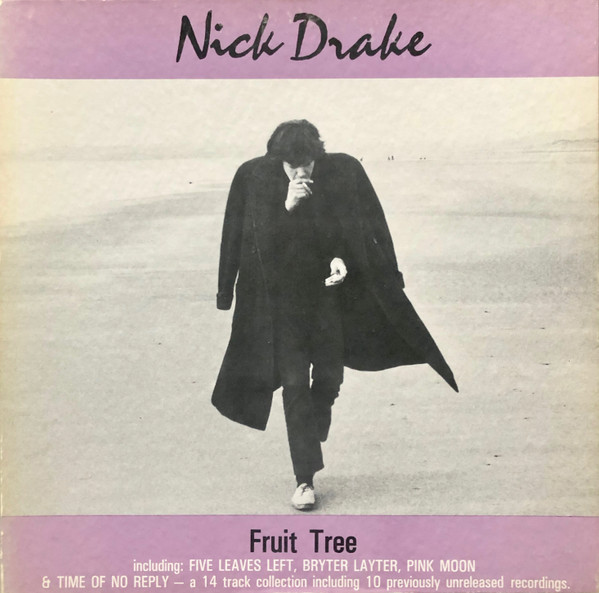
Since we gotta mention it somewhere, the Fruit Tree box was reissued shortly after this album came out, pared back to just the three original albums, supplemented with a DVD featuring the A Skin Too Few documentary. (A few years earlier, the three albums had been repackaged with unique outer sleeves that were attractive, but hid the actual cover artwork, just as the 1993 Jimi Hendrix reissues had.) Six years after that, Tuck Box offered the three albums plus Made To Love Magic and Family Tree in a package designed to look like the parcels containing cakes and sundries Molly would ship to Nick in his boarding school days. As far as the estate is concerned, his legacy consists of these five albums, and nothing more.

Nick Drake Family Tree (2007)—3

Friday, May 9, 2008

Nick Drake 6: Made To Love Magic

The Internet did a lot to spread the word about Nick Drake and his music, but once Volkswagen stopped running their “Pink Moon” commercial, there hadn’t been much to add to the story. That changed in 2004, with the release of Made To Love Magic.

The album was designed as a belated companion to Way To Blue, and something of an overhaul of Time Of No Reply. It covers much of the same ground as that album—with six identical tracks—but just enough to make it different and frustrating, yet still essential for the Nick fanatic. With seven out of 13 songs previously unheard, it’s not entirely redundant, but it did mess with what had been a pretty tidy legacy.

“Magic” is a completely new version of “I Was Made To Love Magic” that retains the vocal from the original take, and adds a newly recorded arrangement originally composed back in the day by Nick’s friend and arranger of choice, Robert Kirby. Purists may cry foul, naturally, but these strings do suit the song better than the original, ultimately discarded accompaniment, giving the song something of a lift. Similarly, “Time Of No Reply”, which was just fine as is, was also embellished by a newly recorded Kirby arrangement of the same vintage. “Three Hours” is an earlier alternate from the Five Leaves Left sessions, featuring Reebop Kwaakhu Baah (later of Traffic) on congas and an unknown flautist, and provides a fresh view. “River Man” is a 1968 solo demo, the earliest recording of this song, captured on a tape of a performance in Kirby’s dorm room at Cambridge. “Mayfair” comes from the same tape, and doesn’t sound as bashful as the Time Of No Reply version. (“Joey” and the alternate “Thoughts Of Mary Jane” are the same takes we’ve heard, the former with the flub in the final verse intact, though the latter is faded for some reason. Also, “Voice From The Mountain” is retitled “Voices”.)

But the big news was saved for the end. While preparing this set, the engineer let the tape run on after an alternate version of “Hanging On A Star”—a striking, hypnotic take from the last sessions, and included here at the expense of the one we already knew—and another song was discovered. No notation of it was on the box, and so remained unknown for 30 years. Fragments of other ideas had emerged from his bootlegged home recordings, but “Tow The Line” was truly the Holy Grail—an actual unreleased Nick Drake song, never heard before. While hardly destined to replace any other as someone’s favorite, it is certainly of a piece with the other 1974 recordings, and very welcome. If you listen closely at the end, you can hear him putting his guitar down for a fitting conclusion: the absolute last recording of Nick Drake.

As wonderful as Made To Love Magic is, it sadly obliterated Time Of No Reply, which had some excellent tracks now available nowhere else. At 42 minutes, there’s plenty of room here for more. But hindsight can be a pain, and had that collection not existed, we could find little fault with this. And we really don’t.

Nick Drake Made To Love Magic (2004)—4

Thursday, May 8, 2008

Nick Drake 5: Way To Blue and A Treasury

From the start, Nick Drake was championed by his producer, the legendary Joe Boyd, who ensured Nick’s albums stayed in print via his Hannibal Records imprint. A distribution deal with Rykodisc in the early ‘90s resulted in the albums on CD in improved quality over their original budget releases a few years earlier in the U.K. He also took the opportunity to curate a compilation of music culled from the four albums.

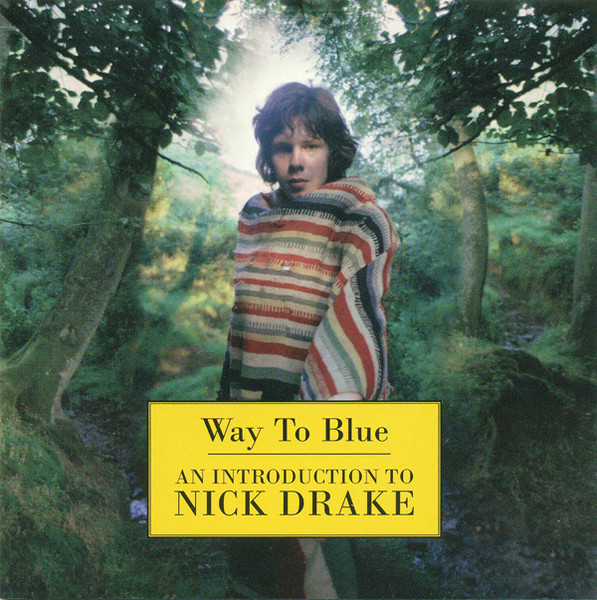
Way To Blue is presented as an “introduction” to Nick Drake, which is a tall order. But if anyone could distill two and a half hours of known official Nick recordings to a single CD in a fresh sequence, it would be Joe Boyd. Five songs each from the first two albums are shuffled among four from Pink Moon and two from Time Of No Reply—one of which is “Black Eyed Dog”, in a bold move.

Considering the quality of the music to begin with, Way To Blue certainly delivered on its agenda. It sold very well through the rest of the ‘90s, particularly in the wake of the “Pink Moon” Volkswagen commercial. But in 2004, in conjunction with another catalog revamp, a collection called A Treasury appeared in something of an attempt to upgrade Way To Blue, which didn’t need it, even in the SACD format. This was compiled by the estate, swapped out a few songs, and—most maddeningly—included a hidden track at the end of the European pressings. “Plasir D’Amour” was a brief instrumental recorded during the Pink Moon sessions but deliberately left off that album; it’s best known to Americans as the melody to Elvis Presley’s “Can’t Help Falling In Love”. By then there were other, more convenient places to put this, and it was frankly careless of the estate, which has generally avoided exploitation, for not making it easier and cheaper for fans to find. Of course, whatever causes anyone to find and then ingest all of Nick’s music is a good thing.

Nick Drake Way To Blue: An Introduction To Nick Drake (1994)—4½
Nick Drake
A Treasury (2004)—4

Wednesday, May 7, 2008

Nick Drake 4: Time Of No Reply

Any success that might have followed the release of Pink Moon was moot, as Nick Drake sank into depression, moved back in with his parents, and barely played any music at all, outside a pair of sessions in 1973 and 1974 where he had to record the guitar parts and vocals separately. These did not lead to a fourth album, and an overdose of a prescribed antidepressant ended his life in November.

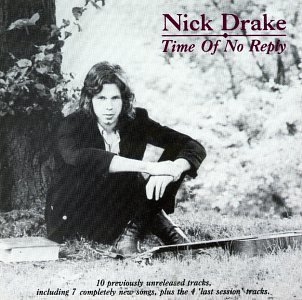
His albums never went out of print, and five years went by before the label compiled the Fruit Tree box set consisting of his three albums, with his four known completed recordings from those final sessions added to Pink Moon. In 1986, the set was reissued with Pink Moon in its original sequence, plus a fourth LP, Time Of No Reply, which supplemented those four “new” songs with outtakes from Five Leaves Left and various home demos. (It was also released separately, which was nice of them.)

Those outtakes start the set, and are generally strong. The title track is a classic, with very clear, ringing guitar lines. It’s another pretty, deceptively cheerful-sounding melody. The middle section hints at the turmoil; he has pertinent things to say about the world around him, simple observations, but it seems to him no one wants to hear. However, “I Was Made To Love Magic” was given a dated arrangement with an uncomfortably affected vocal, and understandably cast aside, though a certainly pleasant ditty. “Joey” has a very mysterious mood, reminiscent of Leonard Cohen’s Suzanne. The subject is described as a guilty pleasure, though it’s hard to say if this siren can be considered a pleasure in the slightest. We can understand how and why Nick was so beguiled. “Clothes Of Sand” is one of his best, played in basically standard tuning with the B string tuned down to A for some enticing tones. The images are vague, but the overlying message that just enough has changed to turn everything in its wake upside down is clear. Either the person has changed, or his own perspective has been distorted that he doesn’t recognize what he once held familiar. “Mayfair” is a cute little sketch, possibly the single cheeriest song in his oeuvre. We can even hear him chuckle following a vocal flub before the “instrumental bit”. (Part of this was used later in a MetLife commercial, paired well with the animated image of Snoopy skipping happily across the screen.)

The versions of “Man In A Shed” and “Thoughts Of Mary Jane” included here are more relaxed, almost demos, and pleasant alternatives to their album counterparts; the latter features Richard Thompson on guitar. The home demo of “Fly” appears fully formed as we know it, with chirping birds and breezes taking the place of the keyboard and viola but not taking away the desperation in the vocal. Two earlier demos make an interesting transition. “Been Smoking Too Long” was written by a friend of his about the dangers of opium. The music is very close to Davy Graham’s “Anji”, which was the springboard for 90% of what is considered modern folk music. While “Strange Meeting II” dates from the same era, the sound is better, as is the writing. (And why isn’t he concerned about her “clothes of sand”? Another hidden gem.)

The final four 1974 recordings close the collection. The juxtaposition of these songs with the stark pieces on Pink Moon made some sense at the time, but tarnished the hopeful end of that album. They work much better in this context. “Rider On The Wheel” is very pretty, if a little basic and vague. You can hear just a hint of how weak his voice has become, a clue that is even more revealing in “Black Eyed Dog”. It has simple accompaniment with something of a dulcimer approach, but once he changes the melody in the middle section to a keening wail it’s clear he doesn’t consider the dog an ordinary stray. His delivery of “I wanna go home” is unsettling, and the instrumental break after this admission picks up the pace, distracting him from the turmoil, but as the song ends, the dog is still at his door. “Hanging On A Star” is very much in the vein of the transitional songs on Pink Moon; short and repetitive, yet effective. The middle verse, where he’s left abandoned at sea, is incredibly poignant in itself, made more so by his weary voice. Truly, he didn’t understand why the fame forbode in “Fruit Tree” evaded him. “Voice From The Mountain” has a claustrophobic, straitjacketed arrangement in standard tuning, with his rigid fingerpicking a contrast to his more fluid style. The solo section varies the theme enticingly, in a similar manner to the bridge in “Northern Sky”. Hearing this at the end of the album, one can really sense the strain in his voice.

It’s said that an artist’s entire life goes into the first album, with discarded songs only occasionally being revived down the road. Nick said for each of his subsequent sessions that there was nothing more, which is why few outtakes have emerged from the other two albums. For the longest time, Time Of No Reply was the last we heard of Nick Drake. Those wishing to hear more could only turn back to Five Leaves Left. This album has since been superseded by another, and is now out of print, but it’s still a special collection.

Nick Drake Time Of No Reply (1986)—3½
Current availability: none

Tuesday, April 15, 2008

Nick Drake 3: Pink Moon

The first album was a statement of purpose; the second stretched his view. The music on Pink Moon, Nick Drake’s stark third album, is generated by only his vocal and guitar, with one brief and simple added piano passage. The words are just as stark, but that’s not to say the images displayed are clear-cut.

The deceptively cheery opening of the title track lulls the listener into a pastoral country scene (extended in the famous Volkswagen commercial). His moon is foreboding, hinting at certain doom; whatever it is, all he tells us is that it’s “gonna get ye all”. Something’s about to go wrong, and it’s not going to be pleasant. “Place To Be” has a pretty swingset opening, suggesting a wistful longing for the simplicity and carefree, lazy days of childhood, where he was shielded from the “truth hanging from the door”. What starts out as a reverie of youth is transformed after the variation in the interlude into either pining for an estranged lover (if you’re a romantic) or the pit of addiction (if you’re not). An excellent illustration of his genius simplicity, “Road” is a repetitive guitar piece with an equally repetitive vocal. He asserts that he knows the sun isn’t shining, so don’t try to tell him otherwise. His glass is half-empty. Easily one of his best, “Which Will” is an example of a list that works. It’s quite a heartbreaking portrait of the jilted lover asking simply where his beloved will go, do, and choose now that her life doesn’t revolve around him. By the end the questions become firm, almost scornful; less a query and more of a challenge. As instrumentals go, “Horn” is brief, simple again, and highly effective. The melody seems so familiar, almost a fanfare had it been played on an actual horn instead of two strings on the guitar. As an interlude, it distracts us from what’s next, another minor-key worrisome admission. “Things Behind The Sun” starts ambiguously with a suspended 2nd chord, the type that could go into a major key, but here chooses the minor instead. A rarity for Nick, it’s in standard tuning, albeit capoed, yet he still finds unusual fingerings and voicings within the structure. Typical of his work, the words carry a lot of alliteration and assonance. The mood alternates between reassurance and caution, telling himself to guard against change but stay open for beauty, to cover weakness and show strength despite what others say. “The movement in your brain sends you out into the rain” suggests the possibility of exploring the outside world to escape the downward spiral of isolation, but it also hints of teetering on an insanity so potentially dangerous to others that he’s best locked away.

Things aren’t much sunnier on the second side. “Know” on paper is as black as it gets here. A shuffling boogie beat under four pissed-off lines framed by the wordless “ooh”s at both ends, this is the closest he gets to blues, and it’s more Delta than Chicago. The hypnotic “Parasite” has a very common chord sequence with voicings that pull it above mere reiteration. The city he documented on Bryter Layter has left him beaten and feeling truly in the way, not insignificant enough to just be ignored, but swatted aside, yet he feels no empathy for people hanging themselves with “rope too short” or dealing with their own day-to-day problems. “Ride” has an almost rocking quality that could easily accommodate a ticking high-hat and snare with “Taxman” bass in an arrangement. Whatever was bothering him wasn’t keeping him from playing at a fluid pace; listen to those fingers go! The beginnings of the vocals have long held notes echoing those in “Know”, and then mimic the guitar parts perfectly with meaningful lyrics to match. (It’s also an interesting juxtaposition on the side: the “Parasite” is asking for a “Free Ride”.) “Harvest Breed” is similar to “Road” and “Horn”, existing just long enough to create a transition. Whatever the harvest breed is, it conjures up images of autumn, and end of the years when living things are cut down or dying, “falling fast and falling free”. “From The Morning” is just as beautiful in its own way as “Northern Sky”, and ends the album on the same glimpse of hope. He looks at the entire day and finds beauty in every moment, in every aspect of every light and shadow, providing a soothing finale to an unsettling record. (Nick’s tombstone even includes words from this song as his epitaph: “And now we rise, and we are everywhere.”)

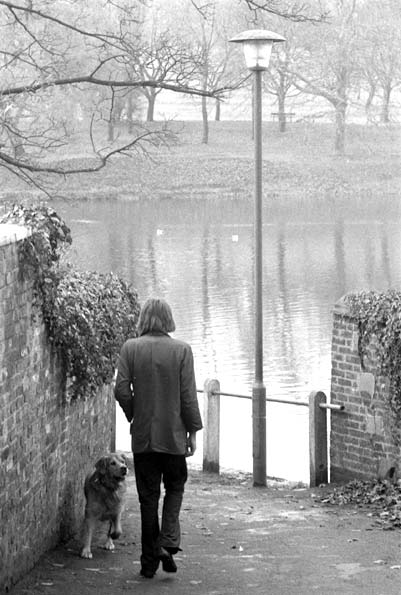
The story behind Pink Moon is that he recorded it, quickly, and dropped it off at the label office for them to press and release, which they did, happily. At just over 28 minutes it still manages to hold one’s interest, and its economy would be something more “artists” should emulate. (The cover art is just as unsettling as some of the music, with an impressionistic painting that attempted to illustrate some of the song titles on the front and back, the gatefold featuring a photo negative from a commissioned session held at the time. Personally, we’re more enchanted by a now-famous snap from that session of Nick walking alongside a friendly dog.)

Nick Drake Pink Moon (1972)—4½

Friday, April 11, 2008

Nick Drake 2: Bryter Layter

Having translated his experiences at Cambridge and the English countryside to music on his debut, Nick Drake turned his eye to London. What he found there was alternately enlightening and confusing.

Bryter Layter opens much like his first album, with delicate fingerpicking and warm strings. The instrumental “Introduction” has themes that will turn up two songs later; on further listening you realize the guitar stays the same, while the strings bring the actual melody, the type of thing Brian Wilson would have done. “Hazey Jane II” is the first real song, and frankly weaker than its namesake later on the side. The breathless vocals with the car-horn brass show that he’s definitely in another place, and unsure of his footing, but in the second half of the song he tries to get his bearings and settle in. In “At The Chime Of A City Clock”, he’s still wandering the city streets, then chooses to “stay indoors, beneath the floors” since most people consider him “either weird or lonely”. The chorus has a way of rising, giving the feeling of the brisk breeze on your face through city streets, and the saxophone is a nice touch without being as obtrusive as horns can be. There’s a very effective change after the second chorus, setting us up for the third, quieter chorus and the climax of the final chorus. “One Of These Things First” starts out as a meditation on karma and reincarnation, but soon turns into a list instead of a song, to the point where one might tune out and miss the more effective middle section, which redeems the track. Then “Hazey Jane I” comes cascading in, soon joined by the strings. Whether or not this Jane is the same hazey one as before, or if she’s related to Mary Jane on the first album—the line that suggests she’s “riding a new man” in particular raises an eyebrow—it’s a very gentle song despite the urgency of the guitar, and just gorgeous all the way through.

Side two begins with the title track, another instrumental. Neither as dramatic nor moving as the “Introduction”, it leaves one wishing for more to grab onto, or at least lyrics. Yet the idea that things will be brighter later suggests a bit of hope. “Fly” chimes in with a lovely stairstep guitar figure echoed by John Cale’s perfect viola. The words are pleading, with music that gives the sensation of falling or sinking. Notice how he strains at every “please”, and relaxes for every “now” or “come”. It’s set up, and seems just about to resolve, but instead floats away. The only recording of Nick playing an electric guitar, the jazzy “Poor Boy” also seems to be more of a list, but the half-mocking backing vocals (also the only backing vocals in his catalog) keep the song rolling for six-plus minutes without dragging. (“Nobody knows how cold it goes” is right out of A.A. Milne, another touchstone.) “Northern Sky” is one of his loveliest songs, and one of the most hopeful. After all the discomfort of adjusting to the city and the people he’s met and missed, he still finds someone he thinks he can trust, wants to trust. John Cale’s keyboards color the song beautifully, especially the poignant middle section. One might think it really is going to get brighter later. But “Sunday” creeps in with a hint of concern, the minor key and flute carrying this third instrumental, closing the album. A slight buildup hints at a turn for the better, then a pause, but it’s back to the sad, quiet theme from before.

Where the first album was mostly down, which masked the bemusement, Bryter Layter nearly suggests that change is good, and that the journey was worth it, but it nevertheless ends warily. The instrumentals and some similarities between songs suggest a limited well, suggest that it lacks the breadth and spectrum of Five Leaves Left. But that’s how he planned it, and it truly works better as a whole entity, the best tracks illuminated by those around them. (The cover art is another good match. The portrait of the artist on the front is only slightly let down by the dated groovy lettering, and the shot on the back observing the nighttime freeway is another wonderful portrait. In recent years another allegedly proposed cover emerged, and we can’t decide if it’s better.)

Nick Drake Bryter Layter (1971)—3½

Tuesday, April 8, 2008

Nick Drake 1: Five Leaves Left

It seemed as if he just floated in. And then he was gone.

Nick Drake took elements of a variety of influences, from Dylan folk to English guitar, jazz to classical, yet emerged with something somewhat indescribable, something that has to be heard to be appreciated. Five Leaves Left, his debut album, is a showcase for his soft voice and inspired guitar—in several non-standard tunings—and an excellent place for the curious to start.

The opening song, “Time Has Told Me”, is a perfect introduction to Nick Drake. So many of the elements of what he’s about are contained in these four minutes, from the intricate picking to his trademark third-beat phrasing. It’s a deceptively hopeful song, with underpinnings of forbidding amidst the declaration that the narrator has found his soulmate. Equally mysterious is “River Man”, which lopes along in and out of C and C minor in 5/4. We hear strings for the first time, and the effect is very river-like, with sweeping and urgent yet subtle movements. (The arranger was only used on this track; all other arrangements would be pointedly different. Nick could not be accused of repeating himself.) “Three Hours” is almost Indian in flavor, with its droning undercurrent, alternate-tempo midsection and conga from a guy who’d one day play with the Stones. The lyrics are even more impenetrable that the ones that have come before; apparently they make perfect sense if you’ve traveled three hours from London at sundown, which we haven’t. Already three songs in, we’ve heard music that is incredibly unique and different. The dramatic, somber string accompaniment of “Way To Blue” nonetheless provides something of a lift. There is no guitar here; just Nick singing to Robert Kirby’s masterful baroque arrangement. One of his rare songs performed in standard tuning, “Day Is Done” teems with the despair and edgy regret that comes with an unfulfilled day. By this time he has left an impression as something of a mysterious sad sack, the kind girls mooned after on campuses. The strings come to a halt with a slight ritard, closing side one.

“Cello Song” starts side two, and builds a string at a time until suddenly shifting into a new theme on which the rest of the song lies. It’s similar to “Time Has Told Me” in its reassuring hopefulness to the owner of the pale, frail, strange face who he sees as far away from him, but able to lift him to a “place in the cloud”. “The Thoughts Of Mary Jane” is very much in the fey Donovan mode, with a shrill flute in the mix. It’s reminisicent of some of the songs on the first Mary Hopkin album with their delicate, fragile China cup quality. (The Mary Jane here could be a woman, or what he was smoking; biographers lean towards the latter.) Despite its jaunty, almost vaudeville accompaniment, “Man In A Shed” is a fable as old as the hills. It may be his most blatant statement of pining, but it’s hardly the saddest, as you can hear the wink in his delivery. The music on the coda nicely echoes the relaxed opening, with a variation that’s very effective. “Fruit Tree” also starts with a slowly building figure that turns into something else entirely. This rumination on fame, notoriety and lasting memory is rather profound for a 20-year-old that hadn’t become close to a star at this point. Still, we can’t but think he harbored some desire for that hollow, fleeting recognition. With its piano suggesting last call, “Saturday Sun” finishes the album. He lived much of his life in a climate where it rains everyday, sometimes several times on the hour. The sun is a virtual wake-up call, with people rubbing their eyes, realizing what’s changed, what’s gone, what’s really happening. This track is the most like Astral Weeks—one contemporary album to which this album is compared—with its use of vibes and brushed drums. The silly couplet at the end (and again, you can hear him smiling through his vocal) glides though the jazzy rhythm section, and the album floats away.

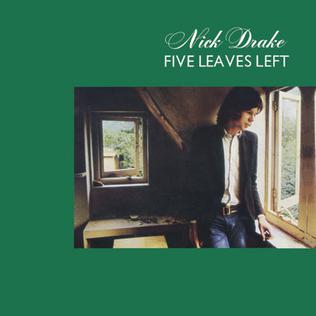
Five Leaves Left is subtle, yet shows a lot of breadth and depth in its simplicity. That’s not to say it’s simple; it just is what it is and nothing is wasted. It is a nearly perfect album. His music can be considered timeless, yet it was very much a product of its time. Even the cover photos work—the woodsy suggestion on the front, and the passive observer on the back. In both cases, his face is bemused.

Save for two similar but different posthumous compilations, his estate resisted any kind of dig through the vaults to celebrate the album, even past its 50th anniversary in a time when seemingly every album that age got a deluxe treatment. So it was very surprising when The Making Of Five Leaves Left was released in 2025. This wasn’t a forensic trawl through the sessions, but a carefully curated (and packaged) selection of recently unearthed studio sessions and demo recordings, culminating in the most recent remaster of the album itself. All the extras could have been contained on two CDs instead of three, but record companies like to have them match the vinyl sequence as closely as possible and jack up the price at the same time. They’re also not sequenced chronologically, making for a disjointed listen at times.

The alternate takes are illuminating, if only because he sounds engaged, focused, and in good spirits throughout. We get to hear some tracks with discarded arrangements, and even some parts that were adjusted along the way, mostly showing that his instincts served him well when something clearly wasn’t what he wanted. There’s a wonderful moment before a take of “River Man” where he’s experimenting with a possible intro, and finds a chord sequence that would one day turn up in “Things Behind The Sun”. A tape recorded whilst still at university to help Robert Kirby write arrangements includes the first official release of “Mickey’s Tune”, a jazzy number similar to but bettered by “Joey”, as well as a brief dramatic, cascading yet untitled instrumental that might have worked to set up “Made To Love Magic”. (The previously released alternate take of that and “Clothes Of Sand” are glaring in their absence.) These are the only buried treasures, if any. The compilers could easily have included vocal-and-guitar-only mixes, or some with just the strings backing, but for the most part they try to keep it organic.

Nick Drake Five Leaves Left (1969)—4½
2025 The Making Of Five Leaves Left: same as 1969, plus 32 extra tracks