Showing posts with label humble pie. Show all posts

Tuesday, September 25, 2018

Humble Pie 6: Smokin’

Now that they’d finally “arrived”, Peter Frampton was gone on his own, so Steve Marriott’s new guitar foil was Clem Clempson. The band soldiered on, continuing their foundation of heavy boogie and sludge on Smokin’.

Covers slowed down beyond recognition are still their thing, with “C’mon Everybody” on one side and “Road Runner” on the other, with Stephen Stills mangling the Hammond organ. He’s also prominent on the opening “Hot ‘N Nasty”, which is one of the few tracks we suppose could be danced to, if only for the inspired rhyme of “feeling” and “ceiling”. “The Fixer” follows on the slow riffs that drove Rockin’ The Fillmore, but ends with a wonderful triplet phrase right out of Jimi Hendrix’s last recordings. “You’re So Good For Me” rises above its dull beginning and Faces impersonation to incorporate Doris Troy and Madeline Bell on backing vocals. Blues legend Alexis Korner helps out on the out-of-place skiffle shuffle “Old Time Feelin’”.

The song that sold the album starts side two. “30 Days In The Hole” opens with a snippet of the boys practicing their harmonies for the chorus, before Steve details all the wonderful varieties of drugs that got him where he is. The lengthy “I Wonder” is supposedly based on a little-known blues side, but good luck noticing the similarities. The solos are masterful, but in case anyone falls asleep from the pace, “Sweet Peace And Time” bludgeons its way to the end, and a good way to clear your sinuses.

Smokin' is worthy of the albums that came before, but once you dig deep, Frampton’s balance is sorely missed. Still, these guys weren’t trying to create fine art.

Humble Pie Smokin' (1972)—3

Friday, January 12, 2018

Humble Pie 5: Rockin' The Fillmore

While Humble Pie remained relatively obscure throughout the U.S., somebody had the bright idea to record their residency at New York’s Fillmore East, and then release a double live album from it. (This in a calendar year that already saw similar albums from the Allmans to Zappa.)

But most bands rose to the occasion at the Fillmore, particularly when their diehard fans went to every show, and the Pie truly kick their butts on Performance: Rockin' The Fillmore. Building on the volume of Rock On, which they were supposed to be promoting. Starting with the swapped vocals on “Four Day Creep”, it’s a punishing plow through “I’m Ready” and “Stone Cold Fever”. Every track is loud and most are pretty long, two even taking up a side each—one of those is an incredibly slow but fascinating drag through Dr. John’s “I Walk On Gilded Splinters”, the other an equally muddy “Rollin’ Stone”. Side four picks up the pace, and is given over to two songs usually associated with Ray Charles, “Hallelujah I Love Her So” and the terrific “I Don’t Need No Doctor”.

Mysteries remain about the album, such as why they needed a two-part title, and if they went through all the trouble about including special labels on two of the sides, wouldn’t it have made more sense to have them be photos from the actual show, rather than an outdoor concert somewhere far from the venue being commemorated? Then, over 40 years later, the upstart Omnivore label managed to curate a set of all four shows from this stint, which spelled out which tracks came from which shows. As it turns out, “Stone Cold Fever” was played only the once, and all the sets began with the same four songs, close to the same length, though there was a little stretching on the encores, which varied. Unfortunately, Steve Marriott’s patter didn’t always vary, and the third time he describes “Gilded Splinters” as his favorite boogie isn’t as funny as the first. But if you loved the original album, the complete set is a must.

Humble Pie Performance: Rockin' The Fillmore (1971)—

Friday, August 25, 2017

Humble Pie 4: Rock On

Rock On is a fitting title for the fourth Humble Pie album. At this point they’d traveled away from the light-and-shade juxtapositions of the first album, and concentrated on heavier-sounding tunes. That meant a little less Peter Frampton, but he’s still there.

Some kind of law decreed that every band needed a song called “Shine On” in their repertoire, and Frampton delivers here. Shaky Jake returns for a cameo on “Sour Grain”, a pretty ballsy tune that slows down profound near the end, and effect that’s immediately dispelled by the barroom boogie of “79th And Sunset”; per usual Steve Marriott gets in some good rhymes. The first great riff of the album arrives on “Stone Cold Fever”, everybody contributing to the overall feel, and then some, since Marriott couldn’t blow hard and play guitar like that at the same time. It’s an immediate segue to their ultra-slow take on Muddy Waters’ “Rollin’ Stone”, which only encourages tastier fretwork and an inspired (comparative) rave-up.

That only makes “A Song For Jenny” seem even more tender, but the band soon kicks in along with the so-called Soul Sisters (the eternal voices of P.P. Arnold, Doris Troy, and Claudia Lennear). “The Light” isn’t one of Frampton’s better tunes, but he was still ahead of the game. Besides, Greg Ridley’s “Big George” is so dopey it’s fun, and that would indeed be Bobby Keys on sax. The jazzy piano lead-in to “Strange Days” again recalls Traffic of the same era, even with the delay effect of the vocals. A drawn-out ending seems to lead directly to another tune, this time the ‘50s-inspired “Red Neck Jump”, complete with “shoo-waddy” backups.

Developments in due time would lead to this album being just slightly overshadowed, and we’ll get to that. Rock On is good fun, even if it takes a while to get there. Again.

Humble Pie Rock On (1971)—3

Friday, November 4, 2016

Humble Pie 3: Humble Pie

Still trying to find their way by their third album, Humble Pie at least had a major label behind them. Their self-titled debut for A&M lands all over the place, but eventually coalesces.

To begin with, “Live With Me” is a slow slog over two chords, building from simple organ to glissandos and crashing drums, thankfully coming to life at the end of each “verse”, traded off between three of the guys. The other one, Jerry Shirley, proves why he didn’t sing much on “Only A Roach”, a country parody about weed. Then it’s back to the boogie on “One Eyed Trouser Snake Rumba”, an obvious euphemism with more rotating vocals. Frampton’s “Earth And Water Song” offers some embarrassing metaphors as lyrics, but it builds on the acoustic promise of the earlier albums, adding enough crunch when called for.

The sound that sold tickets at the Fillmore appears at the top of side two, a powerful blast on Willie Dixon’s “I’m Ready”. In what seems an echo of side one, we have another country pastiche in “Theme From Skint (See You Later Liquidator)”, an industry lament heavy on inside references. The amps turn up again on “Red Light Mama, Red Hot!”, and just like on side one, go off again for “Sucking On The Sweet Vine”, an overly sensitive plaint from Greg Ridley. (Incidentally, pedal steel hotshot B.J. Cole is all over this album, when the quieter tunes call for him.)

The credits and content give the impression of a band trying to figure things out while the tape rolled, but despite a shaky start, Humble Pie redeems itself. If anything, it’s more simple than the first two, so it’s easier to absorb. But the first two are better.

Humble Pie Humble Pie (1970)—3

Tuesday, June 21, 2016

Humble Pie 2: Town And Country

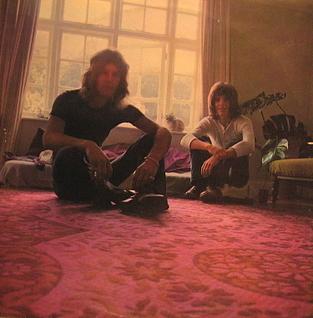
With its cover photos of two of the band in a front room and the other two out in nature, one might think Town And Country is Humble Pie’s play on the idea behind the first Traffic album—to wit, guys getting together away from civilization, living communally and making music. The album doesn’t immediately display the same power as the first album, but don’t be deceived by the acoustic guitars.

All this time later it’s easy to forget the legacy that put Peter Frampton on the map. Barely 19 years old when the album came out, his guitar, vocals and songwriting deserves discovery, beginning with “Take Me Back”, “The Sad Bag Of Shaky Jake” is another Steve Marriott Western pastiche, but “Down Home Again” at the end of side one delivers the boogie much more effectively, if generically. “The Light Of Love” begins with sitar droning and tablas, a sensitive tune from Greg Ridley, while Jerry Shirley’s “Cold Lady” begins moodily before diverting into a boogie climax. (A banded, copyrighted snippet called “Ollie, Ollie” is credited to the full band and the engineer, for no apparent reason.)

“Every Mother’s Son” is a curious little strum, starting as a country lament, moving into the travails of a rock star on the road (and would also be the title of a Traffic song a year later, oddly enough). There’s a terrific cover of Buddy Holly’s “Heartbeat”, recorded right around the same time Blind Faith did “Well All Right”, the song’s original B-side. “Only You Can Say” begins like one of David Crosby’s latter-day Byrds songs, but when the bass comes in, it’s all Pie. “Silver Tongue” is probably the “heaviest” song on the album, just ‘cos it’s mixed so densely. It’s all Marriott, so Frampton’s and Ridley’s combined input on “Home And Away” makes a big difference. Stick around for a coda of sorts, a slow variation on the same theme, and what sounds like a warning from the engineer.

Thanks to their inept label, it would be a few years before the album was properly released in the U.S. When it was, it was as the first disc of a two-record set with a truly ugly cover; at least it made the first two Humble Pie albums available for re-evaluation. Put in the same package, both As Safe As Yesterday Is and Town And Country sound better in each other’s company. They just might fit on a single CD, but then there wouldn’t be room for singles, B-sides and bonus tracks. Both albums deserve better exposure.

Humble Pie Town And Country (1969)—3

Tuesday, February 16, 2016

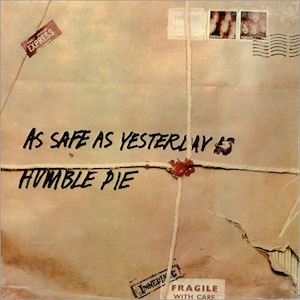
Humble Pie 1: As Safe As Yesterday Is

After Steve Marriott left the Small Faces to themselves, he horned in on a new project started by teenage heartthrob Peter Frampton, teenage drummer Jerry Shirley, and non-teenage bassist Greg Ridley of Spooky Tooth, and thus began Humble Pie. At a time when several “supergroups” were coming together (Led Zeppelin, Blind Faith, etc.), the band was pigeonholed upon formation, but they responded by immediately jamming and recording. From the start, the guitar players dominated the songwriting, and both were highly adept at coaxing sheets of sound from a Hammond organ. For the most part, their dense mix and heavy approach defines As Safe As Yesterday Is, the band’s first album.

Most new bands build both repertoire and mutual comfort by jamming on songs everybody knows, which could be the reason for opening the album with the pounding rock waltz of “Desperation”, a Steppenwolf cover, of all things. (Those Brits really had a knack for digging out obscurities, didn’t they?) The singers harmonize and swap lines, as they do throughout the album. Frampton dominates “Stick Shift”, a driving tune of a different tempo, and in case you hadn’t had enough Steppenwolf, “Buttermilk Boy” begins just like “Born To Be Wild”, but improves greatly as the guitars pile on and the three guys in front swap lines of the lyrics. On the British LP, a predominantly acoustic tune with prominent flute and bongos called “Growing Closer” (written by Marriott’s old bandmate Ian McLagan) came next, but in America, it was replaced by the generic “Natural Born Woman”, which was already known as a single called “Natural Born Bugie”, and frankly inferior to the rest of the album. Luckily, Frampton’s title track, with its constructed sections and transitions, balances the rock with some of the acoustic touches.

“Bang!” (or “Bang?”, depending on the label or back cover) continues the onslaught, with syncopated riffs and an insistent piano. “Alabama ‘69” provides variety via a jokey acoustic country blues (particularly in the US sequence), with some terrific vocal blends, but even more striking is an unlisted instrumental that combines sitar, tablas, flute and both acoustic and electric guitars. Any other album would use this as a coda, but here it leads into “I’ll Go Alone”, which recycles one of Frampton’s pet chord changes but not until they borrow the riff from “Communication Breakdown”. And yes, that’s a harpsichord buried under there. As with the rest of the album, the vocals and lyrics are particularly buried on “A Nifty Little Number Like You”, but the focus is on the playing, even the drum solo. The slower modulations of “What You Will” make for a smooth conclusion.

As Safe As Yesterday Is has gone in and out of print countless times over the years, mostly because the band’s original label was so badly run, and most CD versions have been pressed with a minimum of budget. However, those that have come out use the British sequence, tacking the “Natural Born Bugie” single and “Wrist Job” B-side onto the end. That provides both a wider picture, and a better balance of music.

Humble Pie As Safe As Yesterday Is (1969)—