Showing posts with label warren zevon. Show all posts

Friday, July 10, 2026

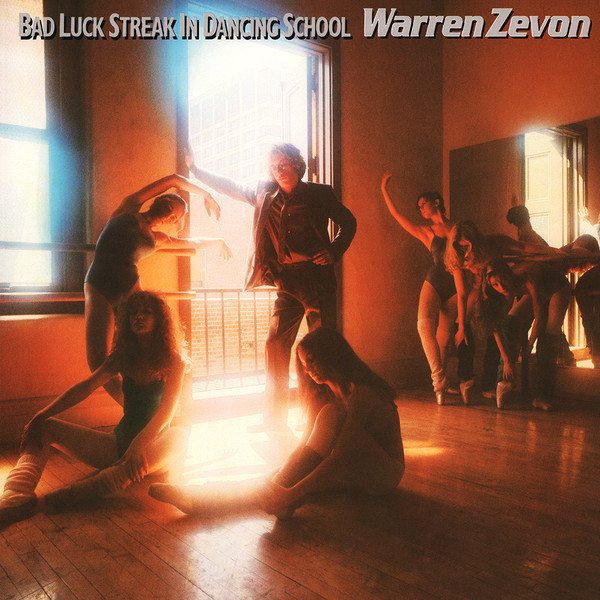
Warren Zevon 4: Bad Luck Streak In Dancing School

Most of the best songs he’d written were spread across his first two albums for the Asylum label, so when it came time for his next, Warran Zevon had to start fresh. As a result, Bad Luck Streak In Dancing School exhibits some water-treading, and some unfortunately dated production. Four Eagles appear throughout the album, and Jackson Browne is still around, but the drummer is Rick Marotta instead of the expected Russ Kunkel.

A brief snatch of a string quartet is a harbinger of sorts, then two shots from a gun start the title track proper. Somehow we don’t believe when he swears he’ll “change”, and that’s the point. A cover of Allen Toussaint’s “A Certain Girl”—probably most notable by the Yardbirds’ version—has fairly enthusiastic vocals with help from Jackson Browne, but it’s still a cover. “Jungle Work” might appeal to fans of a certain headless Thompson gunner, but it’s mostly one riff beaten into the ground. We’re due for a heartbreaker, and “Empty-Handed Heart” delivers. Regret seeps through every line, and when Linda Ronstadt appears in the bridge to offer the departed one’s response, it’s a killer. The first of two instrumental interludes provides a bridge to the Southern rock skewering of “Play It All Night Long”; not only does it begin with the incomparable “Grandpa pissed his pants again”, it’s also the only song we know of that mentions brucellosis. (If he’d lived long enough to hear what Kid Rock did to “Werewolves Of London”, there may have been a murder charge.)

One track that could have been a lot bigger is “Jeannie Needs A Shooter”, a title he picked up from Bruce Springsteen, and finished with his help. Where the Boss’s song seems to be a modern tale of obsession, protection, and revenge, this one takes a more traditional approach, with a mild Old West setting, right down to the strings, and a surprise ending. Considering Bruce’s growing stature, it’s odd that this one seems to have been mostly forgotten. The second interlude lasts almost as long as “Bill Lee”, an ode not to William S. Burroughs’ pen name but to the Boston Red Sox pitcher known as Spaceman for his outlandish behavior, and with whom Zevon shared mutual admiration. It’s a sparse piece with only piano and harmonica plus harmony, but still seems incomplete. One of his favorite words returns in “Gorilla, You’re A Desperado”, a surreal tale of switched identity that’s not entirely clear unless you really concentrate on it. The island-like lilt of the synth seems to link it to the Kinks’ “Apeman”, which it doesn’t need. “Bed Of Coals” was written with T-Bone Burnett before he became more ubiquitous. It’s more than a little bit morose, and he decided Ben Keith was more appropriate to deliver the pedal steel guitar. David Lindley returns to his familiar lap steel seat for “Wild Age”. Here the harmonies are all southern California, though he throws in some off-key yells over the fade.

Most of the successful Zevon ingredients are in place on Bad Luck Streak In Dancing School, when he hasn’t run out of ideas. It’s not as immediately impactful, and only got cursory attention, but the moments exist.

Warren Zevon Bad Luck Streak In Dancing School (1980)—3

Friday, March 13, 2026

Warren Zevon 3: Excitable Boy

Jackpot. If Warren Zevon was ever typecast, it would be because of this album. Excitable Boy is full of unique imagery, sardonic humor, and sociopolitical commentary, sometimes in the same song. And it’s damn catchy, too.

To wit, “Johnny Strikes Up The Band” is fairly tame, a simple paean to the redemptive power of music. It’s probably just as well, as “Roland The Headless Thompson Gunner” is one of the nuttiest fables ever to be set to plastic. We especially like how the first verse is missing a certain word, as the plot point hadn’t happened yet. (We also wonder what Patty Hearst thinks of this song.) The title track is even cheerier, though many radio programmers probably balked at the third and fourth verses describing the junior prom, even with Linda Ronstadt and Jennifer Warnes cooing the song title and Jim Horn’s best Coasters sax. But everybody’s heard “Werewolves Of London”, all three chords of it, and not just on Halloween. (Another fun fact, that’s the Fleetwood Mac rhythm section.) Lest you think he’s all about laughs, “Accidentally Like A Martyr” is another one of his patented heartbreakers, and that’s how you finish a perfect album side.

Back when vinyl was the way to go, a sense of calm could pervade until you moved the needle. On CD and streaming, unfortunately, the disco thump of “Nighttime In The Switching Yard” wrecks it, with a groove co-opted later that year by the Grateful Dead. If there’s symbolism here, we can’t find it. It makes “Veracruz” all the more poignant, as he sings of the American occupation of that Mexican city while the rest of the world was at war, complete with authentic instruments backing him. After that, “Tenderness On The Block” (co-written with co-producer Jackson Browne) is almost uplifting, the exact opposite of a cautionary tale about a girl coming of age. And where else can we go but the international intrigue of “Lawyers, Guns And Money”? This masterpiece of comedy and economy features not one but two classic punchlines to the request in the title.

While Excitable Boy comes in at just over a half-hour, it doesn’t seem short at all, particularly when the songs and performances are so stellar. The expanded CD three decades later didn’t add much timewise. The alternate take of “Werewolves” isn’t much more than an early sketch, and “I Need A Truck” is only two short verses sung a cappella. But “Tule’s Blues” is a lovely remake of a song from his first album, and “Frozen Notes”, another early song, is cast with a lovely string arrangement.

Warren Zevon Excitable Boy (1978)—
2007 remaster: same as 1978, plus 4 extra tracks

Tuesday, December 16, 2025

Warren Zevon 2: Warren Zevon

After several years working with the Everly Brothers, together and apart, as their musical director, Warren Zevon found his way to L.A. where he hooked up with the usual cast of characters who played on albums on the Asylum label. Jackson Browne produced his eponymous debut for the label, and this is really where Warren Zevon as we came to know him began.

It’s all there from the first track—his piano and distinctive croon, Waddy Wachtel peeling off leads, David Lindley on whatever string instrument he pleased, and lyrics worthy of a hard-boiled crime novel. Following a stately piano intro, “Frank And Jesse James” seems too clichéd a choice of subject matter in 1976, but it sets a bar low enough for him to vault over, and soon. “Mama Couldn’t Be Persuaded” very much has the signature Asylum sound, and a catchy chorus. “Backs Turned Looking Down The Path” sticks out, mostly because it’s so obviously based around an acoustic guitar rather than a piano, and the wistful lyrics have us thinking this was an older song that was sitting around. It seems very much a detour leading into “Hasten Down The Wind”, a heartbreaking portrayal of the end of a relationship without being cloying. (It’s also just one of four songs here that would be covered by Linda Ronstadt, and this one even gave her an album title.) Any sentimentality is smacked away by the raucous “Poor Poor Pitiful Me”, which is loaded with terrific couplets, not all of which Linda would use. Glenn Frey and Don Henley provide trademark harmonies on “The French Inhaler”, which they probably wish they wrote. With the swelling strings, it could pass for an Eagles track, though they would never write a lyric like “Your face looked like something death brought with him in his suitcase.”

Lindsay Buckingham and Stevie Nicks harmonize on “Mohammed’s Radio”, a truly bizarre lyric with wonderful imagery that encapsulates the city of Los Angeles, or so we’re told. With frequent collaborator Jorge Calderon interjecting just below the level of discernability, “I’ll Sleep When I’m Dead” is the first of many statements of purpose, though we probably shouldn’t take it seriously. By the same token, if the junk den scene so vividly described in “Carmelita” is from personal experience, it’s a wonder he made it this far. The dirty delivery in “Join Me In L.A.” is hardly enticing, and the gang female backing vocals are just plain too much. While it does accurately portray what’s wrong with the city, it’s one we like to skip. Much better is the closer, on all fronts. A vivid portrait of alcoholic waste, “Desperadoes Under The Eaves” is the first use of a word that will recur in several song titles, and boasts a wonderful segment where the main musical arrives out of a description of a humming air conditioner. Clearly, this guy was smart.

Again, there’s nothing on Warren Zevon that compels us to visit Southern California, but we sure like listening to him describe the world around him. And he really was just getting started. (The album was expanded in the 21st century with a bonus disc including demos, alternate takes, and one song from a live radio broadcast, providing a little more insight into the album’s creation and discarded arrangements.)

Warren Zevon Warren Zevon (1976)—3
2008 Collector’s Edition: same as 1976, plus 15 extra tracks

Friday, June 13, 2025

Warren Zevon 1: Wanted Dead Or Alive

The man who would one day be called one of the best American songwriters of his generation had a slow start to notoriety. Warren Zevon’s first recordings were as part of a Sonny & Cher-styled psychedelic duo called lyme & cybelle, then he wrote some songs for the Turtles. In 1970 his first album came out, credited under his surname and produced by entrepreneur and sexual predator Kim Fowley. While Wanted Dead Or Alive does have some of the style and idiosyncrasies that would become his hallmark, it’s very much stuck in its time. With backing mostly by future Byrd Skip Battin and onetime Love drummer Drachen Theaker, it’s got a clunky sound that occasionally veers into studio trickery. The man himself plays all the guitars, mostly in a blues style, and piano.

Fowley supplied the title track, which is still suited to Zevon’s vocal, even where double-tracked. “Hitch-Hiking Woman” also drives a simple riff into the ground, but the first real showcase for his talent is “She Quit Me”, which had already been covered for the Midnight Cowboy soundtrack, and here is just his acoustic guitar, voice, and wailing harmonica. (Thankfully, he’d back off from the vibrato in the future.) “Calcutta” is another dirty blues, supposedly written by one Xavier Fletcher and something of a prediction of the first Crazy Horse album. And then there’s his cover of “Iko Iko”, wherein his signature piano flair is drowned out by kids singing along playground-style.

On side two we get music that most resembles his later work, from the lyrics to the arrangements, though some of the embellishments on “Traveling In The Lightning” are a bit much. “Tule’s Blues” is a mostly country strum with all the instruments mixed high, which is also the case with the darkly humorous spoof “A Bullet For Ramona”, though somebody else supplied the lyrics. “Gorilla” is more sludge over mostly one chord that kills three minutes on an already short album, whereas “Fiery Emblems” is an intricate instrumental with changing time signatures, a swirling coda, and what sounds like backwards drums throughout.

While he did have his champions at this early stage, Wanted Dead Or Alive didn’t have enough of an original sound, nor the industry clout, to make much of an impression. Much like Harry Nilsson’s debut album, it remains a curio.

Zevon Wanted Dead Or Alive (1970)—