 It’s fairly inarguable that Americans and Europeans love cheese. Whether it’s cheddar, Brie, Camembert, or Gouda, somebody somewhere is sinking his or her teeth into it and feeling immediate satisfaction. And when it comes to musical cheese of the ‘80s, few morsels are as tasty as Asia.
Based on the ingredients, they might have been considered prog-rock, but a cursory listen to the music they created put paid to that fairly quickly. This was arena-rock plain and simple, and a welcome infusion into the music scene at a time when disco was dead and metal hadn’t become mainstream. It’s very possible that the eponymous debut “saved” the record industry, giving boys in high school parking lots something to talk about until Led Zeppelin’s Coda snuck out that fall.
But it had its roots in prog, causing those family trees to become even more entangled. On bass and lead vocals was John Wetton, who’d made his name with one of the mid-‘70s King Crimson lineups. On drums was Carl Palmer, having shed the albatrosses of Emerson and Lake. The other two guys came from Yes—Steve Howe, who’d been their lead guitarist for all of the ‘70s, and Geoff Downes, who’d been on exactly one Yes album (without Jon Anderson) fresh from the “success” of the Buggles. (The other Buggle, Trevor Horn, kept himself busy producing the band still known as Yes, along with ABC, Frankie Goes To Hollywood, and others.)
Asia is masterfully sequenced, putting the first two singles at the top. Anyone who remembers when “Heat Of The Moment” and “Only Time Will Tell” were on constant MTV rotation will have trouble refraining from singing along. Both songs are chock full of fast guitar, keyboard beds, and dramatic shifts, and are pure pop. Past that, there’s still high comedy in the way John Wetton never quite hits the high notes on “Sole Survivor” and “One Step Closer”. “Time Again” begins with a painfully plodding riff, speeding up and slowing down before going to full gallop in the song proper.
“Wildest Dreams” begins the second side with the type of suspended chords favored by old Genesis, before finding its base in the electric piano couplets that shortly would be stolen by Bon Jovi on “Runaway”. “Without You” is the requisite sensitive lost love song, while “Cutting It Fine” begins with a tasty acoustic trill soon picked up by the keyboards, then trampled into the relative minor key. More strained high notes carry the song through to its extended dreamy ending. They pull out all the stops for “Here Comes The Feeling”, lifted nearly wholesale from The Who’s “Had Enough”, throwing in several key changes at the end and finishing on a pointedly stupid flourish.
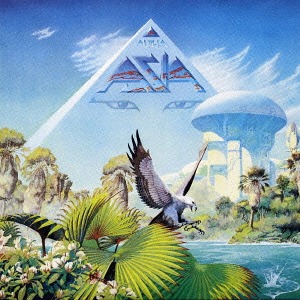
They were barely out of the gate before having to replace Wetton on the “Asia in Asia” tour with Greg Lake, of all people, who apparently wasn’t thrilled enough with his old comrade to keep his next band from turning into Emerson, Lake & Powell. A very long two years went by before Wetton was back for Astra, but now Steve Howe had gone off to another prog supergroup (the hilarious GTR, which was produced by Geoff Downes) only to be replaced by a guy from Krokus.
Anytime you see Asia these days, you can bet on having Geoff Downes scowling behind his keyboards, but it’s anyone’s guess whether any of the original other three will be along for the ride. Or, you can look for a guy named John Payne, who was the band’s singer in the ‘90s and has managed to ride that rocket this far into the 21st century. But those of us who remember will pull out our copies of the first two albums, once the pride of the fledgling Geffen label, and smile, and then laugh and laugh and laugh.
Asia Asia (1982)—3½
Asia Alpha (1983)—2½