Showing posts with label john entwistle. Show all posts

Tuesday, September 14, 2010

John Entwistle 7: Music From Van-Pires

Sporadic reunions with The Who helped keep John Entwistle’s wine cellar stocked, but it wasn’t enough to scratch his performing itch. While he waited, he took part in a supergroup with Keith Emerson, Joe Walsh, Jeff “Skunk” Baxter, and Simon Phillips, but even they didn’t make it past a tour of Japan. He toured with Ringo’s Third All-Starr Band, and filled a similar role in an Alan Parsons-sponsored Beatles tribute. But his most consistent supporters Stateside were the other members of the John Entwistle Band, anchored by Steve Luongo on drums and vocals, and featuring a guitarist who happened to have the surname of Townsend. The combo made the rounds of clubs and small theaters, as well as the “emerging artist” stage at Woodstock 99, with a mix of new numbers and Who favorites. Outside of their Left For Live album (first released in 1998 and expanded following his death in a so-called deluxe edition) the only studio work the band did was for the soundtrack of an animated kids’ TV series.

We’ve never seen Van-Pires—and apparently we’re not alone in that—but it reads like a cross between Transformers and Mighty Morphin Power Rangers. Supposedly John was asked to provide a new song per episode, more as a friendly gesture, yet it’s unclear how they thought, given the dark humor in his catalog, his stuff would fit. Nonetheless, well after the show was cancelled, he finally found a distributor for Music From Van-Pires, and had something else he could sell at shows.

The album did give him a chance to indulge his love of spooky movie music and macabre lyrics. “Horror Rock” is the instrumental theme for the show, and like a lot of the rest of the album has the guitar double the bass line, a habit he never quite shook. Likewise, Luongo’s drumming style encourages his boss’s worst arena rock tendencies, and just about everything is just too loud. “Bogey Man” stands out because it utilizes an unused Keith Moon drum track, but we only know that from the liner notes. Leslie West shouts and shreds on “Don’t Be A Sucker”. The piano-based “Back On The Road” is another plaint of the touring musician, and more along the lines of what we know he could do, though what it’s doing in a kids’ TV show is unknown, just like most of the rest of the album. Unfortunately, most of the rest of the album is also too much the same, lacking dynamics or variety, and when he’s not singing, it’s hard to care, frankly.

The John Entwistle Band Music From Van-Pires (2000)—

Saturday, May 15, 2010

John Entwistle 6: The Rock

Back in 1985, both Pete Townshend and Roger Daltrey were enjoying solo success, particularly in the wake of The Who’s reunion at Live Aid. But John Entwistle didn’t have the same luck. He put a band together, first with Barriemore Barlow of Jethro Tull on drums, soon replaced by young Zak Starkey. Other musicians came and went, eventually settling on a lineup fronted by singer Henry Small and dubbed The Rock. In between wine deliveries and excursions to various pubs, an album was completed, but Entwistle didn’t have any pull at the labels, and there it sat.

Ten years later, the Canadian label Griffin Music had made some inroads releasing CDs of licensed BBC sessions and reviving careers of various classic rockers and hair metal refugees needing a home. That made it a perfect place for The Rock, which went from a limited self-produced release sold at club shows to wider distribution. But what people finally got to hear likely didn’t impress them. Instead of John Entwistle’s unique style and sense of humor, he was reduced to the level of sideman. He doesn’t sing at all anywhere, and only plays horns on one track, though his distinctive bass is discernible in the busy mix, and most prominently on the four songs he actually wrote. “Last Song” even shares something of a keyboard hook with “Had Enough”. Of the rest, “Stranger In A Strange Land” has a decent hook, probably because it was co-written by Eddie “I Think I’m In Love” Money and the guy responsible for “Take My Breath Away” from the Top Gun soundtrack. “Suzie” would appear to be another horny love song, but the “spank the monkey” chant gives away the plot. The overall effect is an album that could have been recorded by the late ‘80s version of Bad Company. That didn’t prevent it from being reissued ten years later, with bonus tracks (including a demo with his own vocal on “Love Doesn’t Last”) and repackaged with its older brothers in a box set in 2024.

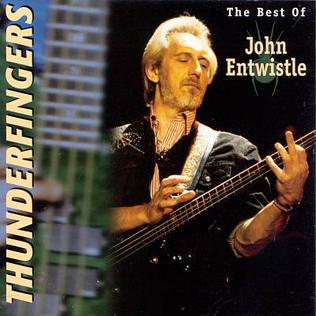
It also didn’t stop Rhino from getting in the act the same year with a solo compilation. Thunderfingers purported to offer “the best of John Entwistle”, which in their minds meant two-thirds of the album devoted to selections from his first two solo albums. The next three albums were represented by two songs each, but at least they had the brains to end with “Too Late The Hero”. The liner notes also included commentary from the artiste for each of the songs therein, which was nice, particularly since these albums had yet to make it to CD in America. (A decade later, as they had with Roger Daltrey, the Sanctuary label followed the expanded reissues of John’s albums with a double-disc anthology that went a little deeper, but also relied on later live performances for filler.)

John Entwistle The Rock (1996)—2
2006 Sanctuary reissue: same as 1996, plus 5 extra tracks
John Entwistle Thunderfingers: The Best Of John Entwistle (1996)—3

Saturday, February 14, 2009

John Entwistle 5: Too Late The Hero

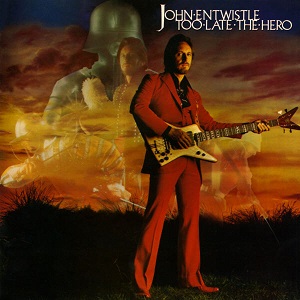
A lot had changed in the Who world since John Entwistle’s last solo album, and with those albums mostly forgotten, he gladly took the money offered via the band’s latest deals to surface with another. Too Late The Hero was more in line than the occasional song he’d given to the last few Who albums, and pointedly free of gimmicks. It also helped that the band consisted of him, plus Joe Walsh on all the guitars—and there are a lot of them—with Walsh crony Joe Vitale on drums, lending to a lean, tight, cohesive mix throughout.

Right up to date, “Try Me” begins with a riff slightly pinned synthesizer bed under a clever chorus. Six years made a big difference, as his voice is noticeably huskier, but he can still harmonize with himself. A more aggressive riff drives “Talk Dirty”, with nicely layered vocals—not too dissimilar from Pete Townshend’s solo work—that the chorus doesn’t quite pay off. “Lovebird” almost qualifies as sensitive, a regretful farewell to an affair. Humor returns on the otherwise ordinary “Sleeping Man”; it doesn’t help that the vocals are mixed too low to catch all the words, but that’s why they print lyrics on inner sleeves. “I’m Coming Back” is another “life on the road” song; he’s done better, but Ray Davies did more, some of which were worse.

The disco thump of “Dancing Master” (or “Dancin’ Master”, depending whether you read the back cover or the record label) forebodes nothing good except lengthy dueling bass solos that invite Joe along for few bars. The mildly cautionary “Fallen Angel” follows his familiar trope of changing chords over the same single bass note, but the key change helps. “Love Is A Heart Attack” begins with his other trope, the descending and ascending chromatic scale, but this time it’s over the Walsh-Vitale pulse, and it’s generally more interesting than all that, even if the metaphor isn’t very thought out. But the majestic title track makes up for all the shortcomings. From the chords to the lyrics, with the verses, choruses, bridges, and coda all of the same high quality, this may be his greatest-ever song (“Boris The Spider” and “My Wife” notwithstanding).

Considering we hadn’t expected much, Too Late The Hero is surprisingly enjoyable, and only dated where noted. Moreover, it’s an excellent showcase for Joe Walsh in between Eagles albums and his own solo career.

He’s not on any of the demos included as bonus tracks on the eventual reissue, but we are going to assume that’s Kenney Jones on the drums, since he was thanked for his help on the original back cover. Four of those are runthroughs for the album, but “Love Is A Heart Attack” is a completely different, and superior tune. There’s also a gothic “Overture”, performed on piano and synthesizers, that may or may not be from the project that gave us “905”. It’s another example of his classical training, and a shame he didn’t pursue it more.

John Entwistle Too Late The Hero (1981)—3
2006 Sanctuary reissue: same as 1981, plus 5 extra tracks

Saturday, November 15, 2008

John Entwistle 4: Mad Dog

While Pete Townshend and Roger Daltrey remained occupied with the Tommy film, John Entwistle gathered most of the band known as Rigor Mortis, renamed them John Entwistle’s Ox, and recorded another album, this time with the intention of touring behind it. Mad Dog has its moments, but falls back on the parodic ‘50s influence from the last album, and the jokes, albeit clever, don’t bear up to repetition. If you like horn sections, buckle in, because there’s plenty of them.

The album starts mostly strong with “I Fall To Pieces”, while “Cell Number Seven” is an amusing recount of the night the Who and their entire road crew were arrested in the wake of damage Pete and Keith Moon had done to a hapless hotel room in Montreal. “You Could Be So Mean” is a little too literal in terms of the power of sticks and stones, and succeeds only because it comes before “Lady Killer” and its unrestrained bullfight trumpet. Just to mix things up, “Who In The Hell?” is delivered in a jokey hoedown arrangement with Eddie Jobson’s violins taking the place of the horns.

The title track is possibly the most daring, its Spector-girl group sound topped off by the vocals, delivered in their entirety by the female backup singers, for a result that predicts Bananarama crossed with Tracey Ullman. A mildly Shaft-style instrumental with clavinet and strings is titled “Jungle Bunny”, and we really hope that wasn’t meant to be a joke. “I’m So Scared” and “Drowning” repeat the formula of the other twisted love songs on side one, but at least the latter has an excellent melody.

Obviously John had plenty to offer, so the novelty of hearing him perform music not written by Pete Townshend was enough to get some people to listen. But when it came down to it, as long as the Who were still around and Pete was still creating, audiences didn’t pay as much attention to his solo work. Mad Dog was a mild improvement, but didn’t help his case any. (The eventual upgraded CD added two extras in the form of single mixes of the title track and “Cell Number Seven”.)

John Entwistle’s Ox Mad Dog (1975)—
2006 Sanctuary reissue: same as 1975, plus 2 extra tracks

Thursday, October 16, 2008

John Entwistle 3: Rigor Mortis Sets In

It is rather telling that in the time between proper Who albums, John Entwistle had recorded and released three albums of his own. That does not suggest that he was just teeming with songs tragically stifled within the group context, because as each succeeding solo album demonstrated, he wasn’t.

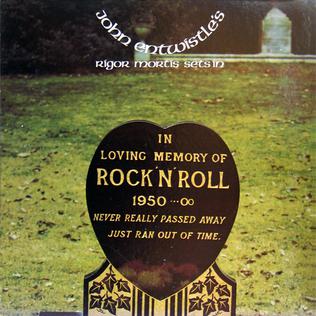
He should of course be commended for keeping busy while waiting for Pete to need his services, and unlike Keith Moon, who didn’t have much else to do but drink, he put his own band together, christened Rigor Mortis in keeping with his black comedy reputation. Naturally, the American record label added his name to the cover and spine, to make it more clear to the casual consumer just who the artists were. From that sleeve, Rigor Mortis Sets In operated from the hypothesis that classic rock ‘n roll was dead, and therefore they needed to commemorate it while the body was still warm. The result was an album peppered with covers of standards soon to be familiar to anyone who watched Happy Days, surrounded by sarcastic originals performed in the same style. So if you wanted to hear what Entwistle would do with the likes of “Hound Dog”, “Lucille”, and “Mr. Bass Man”, the answer is not much.

“Gimme That Rock ‘N Roll” would be tolerable if the rest of the album didn’t sound like it. “Do The Dangle” gets its title from the dance craze described in the third verse (it involves getting a rope and kicking out a chair); the others are the Wheezy and the Strike, and are funny the first time. In the tragedy tradition is “Roller Skate Kate”, directly descended from Paul Anka’s “Donna" and loaded with sound effects and a monologue describing her demise. Following an interlude that sounds a lot like Keith Moon laughing in tune, we meet “Peg Leg Peggy” who, like the other afflicted girls in the same song, offers appeal similar to that of “Mary Ann With The Shaky Hand”. Of mild interest is “Made In Japan”, a somewhat jingoistic ditty bemoaning the lack of local manufacturing that is at least catchy. For further proof he didn’t have enough ideas, witness the whole unnecessary, near-carbon copy remake of “My Wife”. The closing “Big Black Cadillac” is a riff and a drum solo tasked with a non-story to support. (The expanded CD added early takes of two songs, plus two versions of an original jingle for BP gasoline.)

Not to sell the band short, as they were certainly competent, else he wouldn’t have hired them. There are clever moments throughout the album, but they don’t bear repeated listens. Rigor Mortis Sets In wasn’t exactly dead on arrival, but had little chance of recovery.

John Entwistle’s Rigor Mortis Rigor Mortis Sets In (1973)—2
2005 Sanctuary reissue: same as 1973, plus 4 extra tracks

Tuesday, October 14, 2008

John Entwistle 2: Whistle Rymes

Once the promotional aftermath of Who’s Next ended, John went back into the studio to record another solo album. This time he added a few more friends to record Whistle Rymes, which cleverly played on the most common misspelling of his surname. A little harder than the first one, with more sardonic songs about divorce and voyeurism, but the laughs are spread thinly.

“Ten Little Friends” is a one-chord rocker that seems mostly an outlet for Peter Frampton to shred, but the absolute high point for us is “Apron Strings”, with incredible layered harmonies and another terrific guitar solo, this time from Jimmy McCulloch. John’s idiosyncratic piano also drives “I Feel Better”, another humorous breakup tune. “Thinkin’ It Over” continues the path of the rejected to contemplating suicide on a track dominated by a bass synthesizer, which probably sounded awesome in 1972. “Who Cares?” presents more standard rock in the mode of “Heaven And Hell” and “My Wife”, but now with electric piano fighting for space in the mix with organ, and Frampton soaring into the fade.

In the era of album sides there was a respite before “I Wonder”, which despite a decent bridge demonstrates a decline of originality. The synth bass returns for “I Was Just Being Friendly”, which gets points for laughs but finds him trying to reach impossibly high notes, and also on “The Window Shopper”, a musically similar portrait of a different kind of fetishist. The slowly rolling piano on “I Found Out” provides a change of pace, but the album has become something of a treadmill. There are no happy endings here, as “Nightmare (Please Wake Me Up)” presents a musical collage designed to cause nausea.

Whistle Rymes is fairly dark, and a little mean, as demonstrated by the fractured fairy tale in the gatefold and the deranged animals depicted on the cover. Again, there are only a couple of songs that might have worked with the Who, and given the bar that had been set, the album probably would have been ignored if it wasn’t him.

The album finally appeared on CD alongside its elder brother, but with no extras. The version that emerged in 2005 added four tracks called demos, but appear to be full band takes. “I Wonder” is a warmup for the album track, but “All Dressed Up”, “Back On The Road”, and “Countryside Boogie” are all of equal quality to what made it to the album. (The latter two date from later in the decade, so they don’t really belong here.)

John Entwistle Whistle Rymes (1972)—
2005 Sanctuary reissue: same as 1972, plus 4 extra tracks

Saturday, September 27, 2008

John Entwistle 1: Smash Your Head Against The Wall

With the Who’s newfound success, the other members had more time on their hands and creativity to burn while Pete enjoyed the luxury of waiting until his next big concept came to him. Fans had already gotten a taste of John Entwistle’s brand of black humor with the occasional album track and B-side, and Smash Your Head Against The Wall served up nine original songs alternating between both wistful and heavy. Outside of Who roadie Cy Langston on guitar and Humble Pie’s Jerry Shirley on drums, John played everything else, including keyboards, brass and, of course, all the basses.

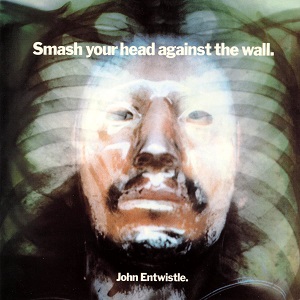
The album’s title comes from the opening “My Size”, which boasts a terrific riff with a Neil Young influence (whose “Cinnamon Girl” was covered for the album, but not released until the ‘90s), and even ends with a quote from “Boris The Spider”. “Pick Me Up (Big Chicken)” condenses a night of binge drinking and the aftermath into a dense couple of minutes, while “What Are We Doing Here” is an insightful lament about Life On The Road way more convincing than cowboys riding steel horses a generation later. It’s elbowed aside by the car horn fanfare that opens “What Kind Of People Are They”, a kind of observational standup comedy routine about authority figures. Having been disappointed with the Who’s version, his own rendition of “Heaven And Hell” takes the place of honor at the bottom of side one. (We still think the Who version kicks butt.)

“Ted End” shows an awareness of mortality not often exhibited by rock stars, in this case the matter-of-fact summation of a friend’s death and the subsequent arrangements. Both “You’re Mine” and “Number 29 (External Youth)” approach the concept of Faustian bargains somewhat, the former with a pointedly dissonant bridge and the latter a more conventional rocker along the lines of “My Wife”. Finally, “I Believe In Everything” punctures a certain guitarist’s idea of a guru by embracing all things mystical, ending with a chorus of “Rudolph The Red-Nosed Reindeer”, with Keith Moon high in the mix.

Throughout Smash Your Head Against The Wall we hear evidence of John’s skill at musical arrangement, with a gift for harmony and juxtaposition. The album is a good outlet for his creativity, as only a few of these songs might have found their way onto Who albums, where Roger gave voice to Pete’s more universal ideas.

The album has been reissued twice in the digital era, first by boutique reissue label Sundazed, which added an alternate mix of “What Are We Doing Here” and a cover of Neil Young’s “Cinnamon Girl”, which fits John perfectly. That was also included on the next go-round, with an extra half-hour of music, including an early, drier mix of “My Size”, hideous-quality demos of four songs, and three other demos of songs that never made it to the studio. Of these, “It’s Hard To Write A Love Song” has the most promise, and would eventually lend a bridge to the closing track on a later solo album.

John Entwistle Smash Your Head Against The Wall (1971)—3
1997 Sundazed reissue: same as 1971, plus 2 extra tracks
2005 Sanctuary reissue: same as 1971, plus 9 extra tracks