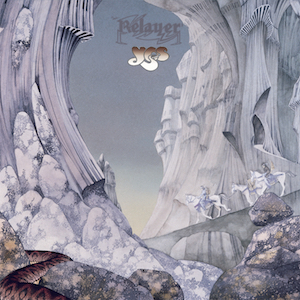
While he does have a distinct style, what he provides Relayer is very much in line with the Wakeman brand to date. It’s a cold album, matching the gray landscapes in the cover art. It’s back to the Close To The Edge template of an epic on one side, and two shorter tracks (albeit nine minutes each) on the other.
“The Gates Of Delirium” is that side one epic, and something of a piece with Tales Of Topographic Oceans. Jon Anderson allegedly wanted to base the whole album on Tolstoy’s War And Peace, but was talked back to just the one track referencing just one battle. It begins with a whirlwind of sound, with a lot of harmonics on guitar, that soon turns into something of a fanfare. When the lyrics arrive, they’re more direct than impressionistic, and darker, as befits impending bloodshed. The bulk of the track is instrumental, with lots of activity and polyrhythms to illustrate the scenery, and Moraz is given plenty of room to stretch. (We even hear what sounds like crowds cheering, but maybe those are merely supposed to be bombs bursting in air. Also, it’s clear the sections have been edited together rather than played straight through, which is fine.) About fifteen minutes in the action finally calms for a more dreamy atmosphere, for lack of a better term. While it’s not notated as such anywhere in the packaging, a piece referred to ever after as “Soon” provides both a finale to the piece as well as a moment of beauty capping a very dense side of music. Hearing this part on its own is nice, but it really is more powerful in the context of the full piece.
Flip over to side two and it’s easy to think you put on a fusion album by mistake, with rippling electric piano, diminished chords right out of Bitches Brew, and panned paradiddles, despite Chris Squire’s distinctive bass. But once the guitar and vocals kick in, “Sound Chaser” is clearly a Yes tune, albeit a frenzied one. Everyone is playing at top speed, yet still well in sync, with Jon and Chris singing on top. About three minutes in the others drop out, leaving Steve Howe to wander around his fretboard towards more pastoral themes and a suitable Jon melody, but the respite is shortlived, bringing back the fusion and discord of the intro. It actually seems to speed up and slow down, punctuated occasionally by a very loud “JAH JAH JAH, CHA-CHA” motif that’s frankly pretty annoying. After all that, “To Be Over” is a breath of fresh air, with a gentle melody played on quiet keyboards, volume pedal guitar and even a sitar; by the middle Howe has added pedal steel as well as his trademark riffing and solos. While still intricate, it's not anywhere near as harsh or jarring as the rest of the album, and doesn’t even seem to take up nine minutes.
Relayer is Yes at their proggiest to date, if you can believe that. It’s not an easy listen, nor very accessible, and requires as much attention as Topographic Oceans did to sink in. The instrumental interplay can be very dense at times, to the detriment of the players, each of whom add a lot when you notice them.
The eventual expanded edition added the single edits of “Soon” and “Sound Chaser”—the former simply that excerpted segment of “The Gates Of Delirium”, the latter the last three minutes of the song and entirely instrumental save the “JAH JAH” chant—plus a “studio runthrough” of “Gates”. Only the two single edits were carried over to the CD of the later “definitive edition”, which sported a modern Steven Wilson mix lacking some overdubs. In addition, runthroughs of not just “Gates” but the entire album were included with new and surround mixes on the DVD and Blu-ray; the latter offered even further mix variations and live material. (The Wilson mixes for this and the previous four studio albums were eventually released on vinyl in a box set, as well as streaming, where the side-long tracks are split into parts, or their stated segments in the case of Close To The Edge. The guy does good work.)
Yes Relayer (1974)—3
2003 remastered CD: same as 1974, plus 3 extra tracks
2014 Definitive Edition: “same” as 1974, plus 2 extra tracks (plus DVD or Blu-ray)
So, Yes decided to try and get beyond the wall they ran into with their last album by incorporating jazz influences in a much bigger way. In his autobiography, Bill Bruford said that Wakeman “doesn’t have a jazz bone in his body”. Rick knew that, too, so out he went. Moraz was the guy for the job, having trained in both jazz and classical.
ReplyDeleteOf course, the jazzy influences are most evident on the insanely fast “Sound Chaser”. “And to know that tempo will continue” – Jon got that one right. Moraz’s rippling electric piano is the first time that instrument was heard on a Yes record, I believe. Neither Wakeman nor Kaye were much on it, apparently.
The focus that was missing on the “..Topographic..” epics was almost fully regained on “The Gates of Delirium”. Howe’s cacophonous shredding on “The Ancient” served no purpose. Here, the noise evokes the chaos of war. The concluding section “Soon” is the most accessible part of the album, so it was really the only option for a single.
In the early 21st century, the band wanted to bring back “To Be Over” into the live set, but Wakeman balked. That’s too bad, because it’s the one song that he could have made work. It’s the one that most resembles their prior work. No jazz here – just dreamy keyboards and stringed instruments. Maybe a bit too dreamy and diffuse. It’s a bit like “The Remembering” in tempo, but it’s half as long. So, it’s less likely to lose the listener’s interest.
I don’t find the album cold, but it is quite harsh and dark and, by far, the strangest they have ever released. It is Eddie Offord’s weakest production for them. I read at one point something about incorrect grounding from the mobile studio, or something like that, which caused some sort of very low pitched grumbling in the original recording. My ears aren’t good enough to hear if that is true or not.
In any case, this is the one album that was definitely improved by the Steven Wilson remix. Through headphones, the drums on “Sound Chaser” run circles around the listener (if you think White was inferior to Bruford, just listen to this mix). More importantly, Wilson brought the vocals on “To Be Over” much more forward. They are much more audible because they aren’t overwhelmed by the backing track. It would have been nice if the “cha-cha-chas” could have been mixed out of “Sound Chaser”, but you can’t have everything.
Yes got beyond the wall, only to find another. Where to go from here? Out further to where Return to Forever and Weather Report were? “Relayer”, incredibly, was yet another Top 5 smash, so it seemed at the time that their audience might follow them anywhere. The group temporarily avoided the issue by touring, solo albums, and yet more touring. Something would have to give.