 Maybe it’s just us, but the distance between 1983 and 1988 seems a lot wider than other five-year spans within decades. So when it came out, the double-LP retrospective The Story Of The Clash, Vol. 1 seemed like an overdue look back to a much different time. The back cover nicely noted the release dates of each track, while the gatefold liner notes in miniscule print by one Albert Transom (aka Joe Strummer) bordered on stream of consciousness without really illuminating the music. (The UK version of the album had custom labels with each member’s face on a different side, while the US were stuck with stock Epic labels.)
The chronology seems to go backward, but still has something of a logic to it. Anyone who only knew Combat Rock might have been thrown by the near-disco opener in “The Magnificent Seven” before getting to the songs they already knew. Another funk-dub hybrid, “This Is Radio Clash”, makes its first album appearance, and “Armagideon Time” is nicely given a bigger platform. Side two further explores the pop-leaning side, via such favorites as “Train In Vain” and “I Fought The Law”, but also curveballs like “The Guns Of Brixton” and “Bankrobber”.
The other two sides of the album are mostly devoted to the first two albums and the earliest punk singles; of course, some of those had been included on the American version of the first album, so they weren’t as rare for us. (Also, “Capitol Radio” is the original UK EP version with the interview snippet at the top.) But for a jump to “London Calling” and “Spanish Bombs”, the set ends well on “Police And Thieves”.
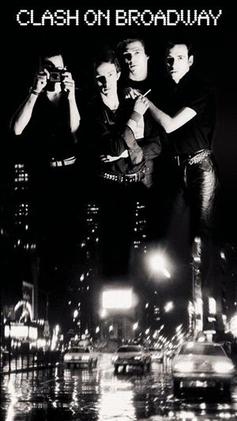 Naturally, anybody would say that four sides of Clash music would leave something out—only two tracks from Sandinista!?—but a Volume 2 never happened. Instead, once everybody started getting a box set, the Clash did too. Clash On Broadway was designed for CD as opposed to vinyl or cassette, and therefore at three discs had than double the capacity of Story Of The Clash.
Along with all the key albums, singles, and B-sides, box sets had to have rarities. Disc one delivers with demos of “Janie Jones” and “Career Opportunities” produced by Guy Stevens, and live versions of “English Civil War” and “I Fought The Law”. American consumers would have appreciated the songs from the first UK album, which hadn’t made it to CD yet. Disc two is dominated by Give ‘Em Enough Rope (plus the decent outtake “One Emotion”) and London Calling, while the third disc features a live “Lightning Strikes (Not Once But Twice)”, a soulful cover of “Every Little Bit Hurts”, the outtake “Midnight To Stevens”, and the unedited take of “Straight To Hell”. While not listed anywhere, “Street Parade” ends the set.
In the 21st century, box sets were expected to include absolutely everything if consumers were going to buy them again. Sound System—cleverly designed like a boom box—offered the first five albums on eight discs, plus two discs mopping up singles, B-sides, and outtakes, rounded out by alternate mixes of Combat Rock material. Another disc had nine early demos and six live songs from the Lyceum in 1978. Even with all that, only six of the rarities from Clash On Broadway were included in the set, making that first box a keeper.
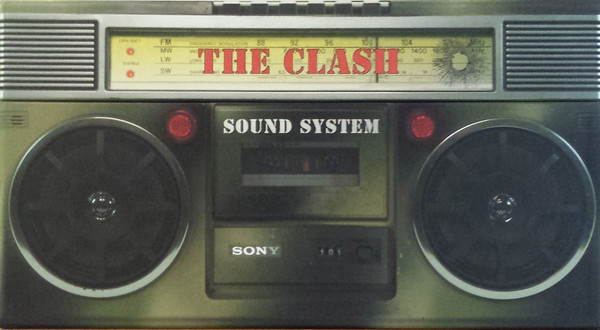
Sound System also contained a DVD and piles of ephemera, which made the eight-disc 5 Album Studio Set, designed like a road case, a cheaper option. Or you could spring for the newly curated, less obvious The Clash Hits Back two-disc set, which was derived from a 1982 gig setlist, and we’d be interested in hearing the actual gig. It was also 20 minutes shorter than 2003’s more chronological The Essential Clash, which happened to be the only one of these compilations to include anything from Cut The Crap.
The Clash The Story Of The Clash, Vol. 1 (1988)—4
The Clash Clash On Broadway (1991)—4
The Clash The Essential Clash (2003)—3½
The Clash Sound System (2013)—3½
The Clash The Clash Hits Back (2013)—3½
A major bonus of Sound System was the remastering. Strummer's vocals were infinitely clearer.
ReplyDeleteI traded in “Story…” for “..Broadway” because it, partly because it did, indeed go short on “Sandinista”. Random thoughts:
ReplyDeleteThe disadvantage of that trade in, of course is that we got demos of “Janie Jones” and “Career Opportunities” and a live “I Fought the Law” instead of the album versions. The box contains, except for one song, all the rest of both versions of the first album. Of course, that brought me to get it eventually.
Listening to the first disc through headphones is like being assaulted with a barrage of sound. At least until “Police and Thieves”. That’s a good thing, unlike, say, listening to an Iron Maiden album. That showed what good punk music should sound like; it also showed its limitations as a longer-term strategy.
Of course, the complete “London Calling” is an album that everyone should have. The box did pick the biggest highlights. I was contemplating the lyrics of “Clampdown”: “In these days of evil presidentes/working for the clampdown.” Strummer was far more prescient than he could have imagined when he wrote those lyrics.
I give a score of 6 out of 8 for the choices from “Sandinista”. But, as the three outtakes indicate, it was very hard to summarize an album so eclectic and all over the place.
They should have put “Cool Confusion” and the unedited version of “Straight to Hell” on “Combat Rock” instead of “Sean Flynn” and “Death is a Star”. On the other hand, I’ve always liked “Red Angel Dragnet”, one of the instances when their desire to be weird and experimental worked. Although it is odd to hear Paul Simonon narrate this tale of New York City with his Cockney accent.
The whole package is very generous, with all the lyrics (especially useful for disc 1, where energy outpaces diction many times); a booklet with comments on every song; and an essay by Lester Bangs on his tour with the band. I found that to be more illuminating about Bangs than about The Clash. Bangs, apparently, was a man who put too much faith in, as the cliché went, “the power of rock and roll”. Unfortunately, when one puts too much faith in something of this world, that invariably ends up in disappointment. Bangs was an immature individual, and he died before he could get to another realization. R.I.P.