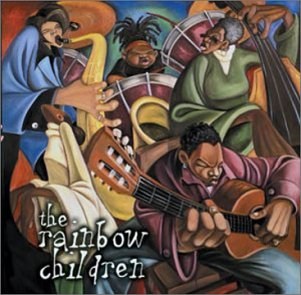
 Once in the new century, Prince did a few things. First, he started using his name again. Then he decided to license his new albums rather than signing a longterm label deal he’d one day regret. He also got divorced, and had embarked on a relationship with the woman who’d become his next wife. But perhaps most significantly, he became a full-fledged Jehovah’s Witness.
 This last detail wasn’t quite as earth-shattering as, say, Bob Dylan’s religious conversion. After all, Prince had grappled with religion and sex and whatever twain shall meet throughout his previous albums, but this shift would send him on a decidedly more puritan (for lack of a better term until we find one) path. And because he had to be him, his journey would manifest in his new music.
The Rainbow Children is a parable of sorts about good conquering evil, full of imagery, metaphors, questionable viewpoints, and most unfortunately, narration by a processed voice pitched even lower than that of the guy in “Bob George”. But beyond all that, the most striking aspect of the album is the music, which as a whole is unlike anything he’d previously put out under his own name or even symbol. He played everything as usual, with the exception of the drums, horns, and some backing vocals, but the music borders on jazz fusion.
The title track sets up the story with some narration—helpfully transcribed in the included lyrics—but mostly exists for a lengthy guitar exploration, which is fine with us, and modulations of the main vocal theme, which exhorts said Rainbow Children to rise, before switching to a much more subdued theme very reminiscent of late-‘60s Miles Davis. That makes a smooth transition to the just-as-smooth “Muse 2 The Pharaoh”, which begins as something of a love song, but slides over to expound on religious theories. (From here the tracks are shorter, for a while anyway.) “Digital Garden” is almost ambient jazz until he starts singing, and the narration moves the story further. That entails people going door to door a la Jehovah’s Witnesses, so “The Work Pt. 1” extols this via a James Brown workout. “Everywhere” is begun very sweetly by one of his female backup singers before escalating into a joyful number with lots of drums, then the instrumental “The Sensual Hereafter” would appear to be something of a seduction scene, which continues into the apt “Mellow”.
More narration insists that we understand “1+1+1=3” over another funky groove, with a Camille-style voice modulation in the mix. “Deconstruction” is an orchestrated segue leading into “Wedding Feast”, an incredibly silly fanfare right out of The Wizard Of Oz. (See, he still has a sense of humor.) With “She Loves Me 4 Me” we finally get a track that can easily insist outside of the narrative, even if some of the words might rankle the former Mrs. Nelson. From here the tracks get longer again, beginning with “Family Name”, which sports a different kind of computerized narration and other vocals dealing with the history of African Americans and other marginalized minorities, with a Martin Luther King sample for good measure. “The Everlasting Now” is more preaching, but it’s over yet another infectious groove, and not at all tossed-off. And since he likes to have grand finales regardless of the subject matter, “Last December” fills that purpose with a slowish groove and a gospel-tinged chorus, and a very Hendrixian break. Just for good measure, the album fades to silence before returning with an a capella reprise of the final notes.
It’s redundant to say The Rainbow Children is a very personal album for Prince, since they all are. Unfortunately, unless you’ve fully subscribed to his bag, the message can be a bit much. But musically, it’s terrific, especially if you like hearing him play guitar. If only there was a strictly instrumental mix of the album somewhere.
Prince The Rainbow Children (2001)—3
No comments:
Post a Comment