Showing posts with label style council. Show all posts

Friday, May 8, 2026

Style Council 2: Internationalists

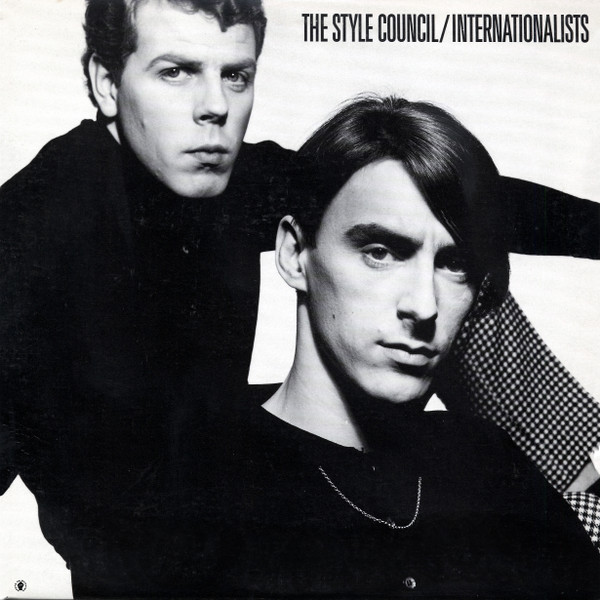
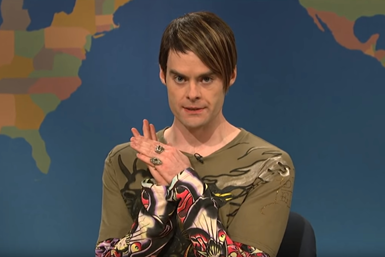
Straight out of the gate, the Style Council kept fans busy with singles, 12-inches, and a second album. As with its predecessor, Internationalists differed from the British version in title and cover—Paul Weller’s haircut clearly the influence decades later for Bill Hader’s Stefon—but only the mildest of track substitutions, which actually helped. Pointed political stances colored the lyrics, making it almost necessary to read along on the inner sleeve, where they appeared out of order and incomplete. (Like most Brits his age, Paul Weller really, really hated Margaret Thatcher.)

Just to be different, Mick Talbot takes the lead vocal on “Housebreakers”, probably because Weller’s phrasing wasn’t generally that measured. The jazz pop is about what we’d come to expect, but even from these guys, the bossa nova beat and harmonized flute solos in “All Gone Away” seem like parody. “Come To Milton Keynes” gets a more straightforward arrangement, but it’s a terribly sarcastic slam of a British town that didn’t deserve it any more than any others going through the same growing pains. (The trumpets always remind us of “Just Who Is The Five O’Clock Hero?”, which might have been intentional.) Weller pulls out the guitar and wah-wah pedal for the title track, but is accompanied by only a string quartet on the mournful “A Stone’s Throw Away”. The gravitas is killed by “The Stand Up Comic’s Instructions”, which are recited by comedian Lenny Henry over, though the chorus is catchy. “Boy Who Cried Wolf” is a little more standard, but the overly synthy backing is a matter of taste, but would appeal to fans of Sade and future pop stars Simply Red.

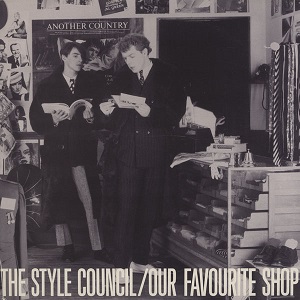
Side two is a little more consistent. Church bells right out of the Kinks herald “A Man Of Great Promise”, a surprisingly buoyant song for what’s essentially an obituary. “Down In The Seine” continues their Francophile tendencies, right down to the accordion solos. Besides being bestowed with another typically unwieldy title, “The Lodgers (Or She Was Only A Shopkeeper’s Daughter)” also features a front-and-center vocal by D.C. Lee, who got star billing when it was re-recorded in an inferior version for the single; here it’s solid R&B underneath more social commentary. With “Luck” we finally get a straightforward upbeat love song, and then “With Everything To Lose” brings back the bossa nova undercut by more complaints about the government. Here in the US, likely thanks to its appearance on the Vision Quest soundtrack, the Philly-infused “Shout To The Top!”—a single from the previous fall—replaced “Our Favourite Shop”, the instrumental title track of the UK version of the album. It makes a good lead-in for the equally snappy and punctuated “Walls Come Tumbling Down!” (By the time the album was issued on CD, it was the UK sequence, with “Shout To The Top!” added at the end.)

The best parts of Internationalists are the toe-tapping ones, but it’s still a very breezy and slick album, and Americans didn’t know what to do with it. They loved it in the UK, of course, where the eventual Our Favourite Shop Deluxe Edition was loaded with contemporary B-sides (of which there were always plenty) and some demo versions, a few of which were previously released elsewhere.

The Style Council Internationalists (1985)—

Friday, February 6, 2026

Style Council 1: My Ever Changing Moods

Anyone who’d listened to the final recordings of the Jam would have noticed that Paul Weller was turning sharply away from the guitar, as well as their punk roots. Once he broke up that band he decided to pursue those passions further, and inaugurated a collective dubbed the Style Council. From here on his main collaborator would be keyboard whiz Mick Talbot, who’d also spent time in mod revival bands (he’d also played piano on the cover of “Heatwave” that closed Setting Sons). Together they would craft very un-mod music, leaning heavily on soul and jazz, using real drums but other synthesized instruments, adding guest players more often than not. Weller even played bass from time to time. Their image was very “European”, flirting with the New Romantic movement both in music and, in Weller’s case, questionable hair styles. Politics often reigned the message in between the beats—just as in The Jam—but for the most part, it was all about getting lost in making music.

Tracks from their first three UK singles (and 12-inches) were selected for the Introducing The Style Council EP, and make for a slightly schizophrenic listen, particularly if you hadn’t heard each single in real time. Each side begins with a nearly seven-minute mix of the brooding “Long Hot Summer”, neither exactly made for dancing. “Headstart For Happiness” is a snappy strum, stripped down to not much more than a demo for guitar and organ. “Speak Like A Child” was their breezy, horn-laden first single, with vocals from protégé Tracie Young, who Jam fans knew from “Beat Surrender”. “The Paris Match” is a truly hidden gem, a soulful reverie for piano and a nice backing, complete with a coda sung in French, while “Mick’s Up” is an instrumental showcase for the other guy over party noises. A lengthy club mix of “Money-Go-Round” updates “Precious” with an anti-Thatcher rant, while liner notes by the mysterious and shortly ubiquitous “Cappuccino Kid” attempted to provide context, or not.

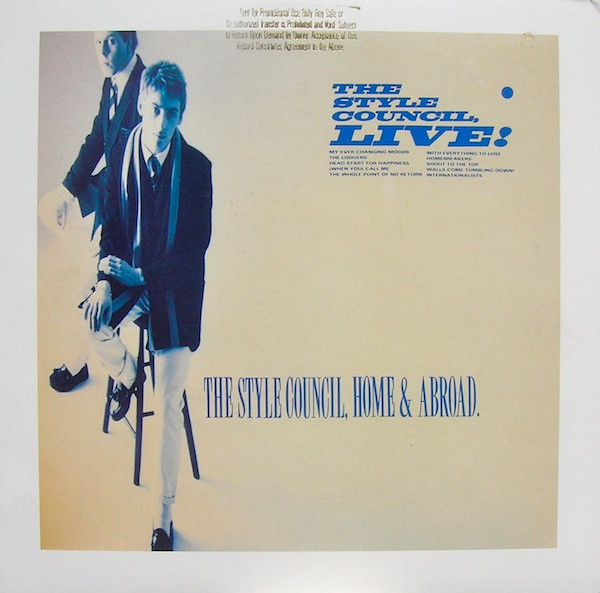
When the full-length Café Bleu album was released in the UK, it further confounded expectations, with side one nearly full of instrumentals and Weller’s voice only heard on two of seven tracks, and somebody else rapping to start side two. Per tradition, the version released in the US as My Ever Changing Moods—on Geffen, of all labels—sported a rejigged lineup with substitutions that tried to balance things but was still just as odd. (It also lacked the color booklet of photos, lyrics, and notes.)

The catchy eponymous hit single starts the album, instead of the lovely vocal-and-piano alternate from later on side one of the UK LP. “The Whole Point Of No Return” is just Weller singing softly over a picked electric guitar, and “Blue Café” is another slow jazz piece for guitar with strings, which sets up a cocktail jazz version of “Paris Match”, sung here by Tracey Thorn of Everything But The Girl. Its suggestive title aside, “Dropping Bombs On The Whitehouse” is simply a bebop excursion with a horn section. They added “A Solid Bond In Your Heart”, another catchy single, to finish the side; a musical cousin of “Beat Surrender”, it came this close to being that band’s last release.

They also moved up the blue-eyed soul of the romantic “You’re The Best Thing”, which was good, because nobody was ready for the rap experiment in “A Gospel”, much less nearly five minutes of it, nor the funk jam of “Strength Of Your Nature”. But the jaunty violin sawing throughout “Here’s One That Got Away” provides something of a break from the overt soul. Dee C. Lee, most recently in Wham!, takes the other vocal on a full band version of “Headstart For Happiness”, and we’ll be hearing a lot more from her. The piano solo “Mick’s Blessings” closes the proceedings, instead of opening them as it did on the UK LP. (Two of its other instrumentals—“Me Ship Came In!” and “Council Meetin’”—were added to the US cassette, one at the end of each side.)

The handful of Americans who still cared about the Jam—even those who came in via such videos as “Town Called Malice” and “Absolute Beginners”—were mostly confused by this new band. Now there was a video depicting the Council men riding bicycles, and they mostly ignored My Ever Changing Moods, which simply doesn’t succeed where the UK version did, however slightly. (The chummy images in the “Long Hot Summer” clip wouldn’t have passed muster in Reagan’s America either.)

Over forty years later, these first releases by the band were gathered and greatly enhanced in a deluxe edition of Café Bleu. The first disc was devoted to an expansion of Introducing, including every single and B-side that predated the album, which is on the second disc. A third disc was devoted to further singles and mixes, a fourth to unreleased tracks ranging from interesting to tedious, and two more to BBC sessions and concerts. Those are interesting, as we can hear how proficient they were live, for the most part, though Weller must’ve loved the geezers doing the “we are the mods” chant during the Chippenham gig. Just the first two discs alone, being chronological, better show Weller’s progression from one band to the next. He was, after all, still a kid who wanted to make music with a guy with serious keyboard chops, and found one in Mick Talbot.

The Style Council Introducing The Style Council (1983)—3
The Style Council
My Ever Changing Moods (1984)—
2026 Café Bleu Special Edition: same as 1984, plus 79 extra tracks