Friday, January 30, 2026

Aerosmith 3: Toys In The Attic

The third time was and is a charm for a lot of bands, and on Toys In The Attic, Aerosmith had definitely figured it out. They had the tunes, they had the chops, and they had a producer who got them, all of which backed up their attitude.

The title track predicts speed metal, and even though there’s only one verse, one pre-chorus, and one chorus, each repeated twice and split up with a one-chord jam that serves as a middle eight, that’s all it needs. “Uncle Salty” is an early piece of social commentary, fifteen years before another song about Janie and a gun, that gets more heartbreaking with every listen. “Adam’s Apple” brings back the strut, giving Tyler’s wordplay plenty to lie on; we can probably credit him for coining the phrase “love at first bite”. But that’s nothing on “Walk This Way”, a motormouth showcase with an unstoppable riff and funky backbeat. In case you didn’t get the humor, “Big Ten Inch Record” shows their jump blues roots as well as their fascination with the Dr. Demento radio show. Even the horn section doesn’t get in the way.

It’s always good to start side two with a hook, and “Sweet Emotion” does just that with its extended intro that turns into a full-fledged riff and two-word chorus. The lyrics are as packed as anything on the album but a little obscure, while “No More No More” delivers more of it, already showing weariness at Life On The Road. It’s got an excellent build before the final chorus, and goes out on another glorious solo, and we’re not sure whose. If there’s a clunker on the album, that would be “Round And Round”, five minutes of sludge credited to Tyler and Whitford only redeemed but the one melodic deviation from the bludgeoning. All is forgiven for “You See Me Crying”, an orchestrated power ballad that comes just this close to being sappy but isn’t.

With two bona fide classics and enough deep cuts to justify the purchase, Toys In The Attic still delivers everything an Aerosmith fan could want. Even if you know the hits, they’re even better in context.

Aerosmith Toys In The Attic (1975)—4

Tuesday, January 27, 2026

Jayhawks 10: Mockingbird Time

Apparently Mark Olson and Gary Louris found recording and touring together again to be so easy that they reconvened what some would call the classic lineup of the Jayhawks for a new album. Maybe Olson needed the money, and Louris’ sole credit for the production raises an eyebrow, but if the credits are to be believed, Mockingbird Time was a pure collaboration.

Right away on “Hide Your Colors” it seems they’re trying to recapture the genre blending that made Tomorrow The Green Grass so good. The harmonies go unexpected places, and the strings are present but not overpowering. Once Olson’s voice cuts through the mix on “Closer To Your Side”, it feels like home. “Tiny Arrows” is one of several tracks here that has a gothic undercurrent, but this one is nicely smoothed over by the mildly Byrdsy “She Walks In So Many Ways”, which is really a rewrite of Manfred Mann’s “Pretty Flamingo”. “High Water Blues” has some more striking imagery, but surprisingly goes into an extended dueling acoustic solo that would sound a lot better on stage than in the middle of an album focusing on songwriting. The title track meanders through several melancholy sections, but again, runs too long to keep interest.

“Stand Out In The Rain” is more like the old sound, with the same riff as “Wichita” from Hollywood Town Hall, but it goes to another place for the solo. In the same vein, “Cinnamon Love” is another one that mixes riffing with major-seventh chords and unique imagery, and a tendency to repeat a phrase for some kind of emphasis. “Guilder Annie”, whoever she is, has a mild jangle in a waltz tempo for a nice change of sound. It’s followed by another ode to a woman of mystery, in this case “Black Eyed Susan”, which was one of the fabled “mystery demos” from two decades before. “Pouring Rain At Dawn” is a welcome piece of picking after all the mythology that’s come before, and “Hey Mr. Man” takes us out on a rocker.

Throughout Mockingbird Time we hear their inimitable harmonies, Karen Grotberg’s wonderful piano (and voice), and that terrific rhythm section. They didn’t exactly pick up where they left off, and the reunion wouldn’t last, but it’s still a worthy chapter in the saga. Better to have it than not.

The Jayhawks Mockingbird Time (2011)—3

Friday, January 23, 2026

Jane’s Addiction 4: Kettle Whistle

Despite fragmenting in 1991, Jane’s Addiction never really went away. Perry Farrell and Stephen Perkins formed Porno For Pyros, while Dave Navarro and Eric Avery emerged in Deconstruction, which didn’t sell as well, plus Eric didn’t want to tour. Navarro ended up in Red Hot Chili Peppers for a well-publicized couple of years, which is one reason why that band’s Flea came on board to play bass when Jane’s reunited for the cleverly dubbed Relapse tour. The occasion was promoted by something of a rarities collection: Kettle Whistle served up a CD full of demos, outtakes, live versions, and some new music, somewhat haphazardly sequenced.

The opening title track was apparently a tune that had been around for years, but not properly recorded until now. It’s more on the spacey side than most of their catalog, sounding more like Peter Gabriel than Led Zeppelin. But it’s also more musical than the noisy “So What!”, which has an obnoxious vocal over a fairly standard funk pattern, and they let Flea play trumpet again. “My Cat’s Name Is Maceo” is a fairly literal lyric over a simple riff, and somehow they got Maceo Parker himself to toot along for part of it, either in 1987 or 1997, we’re not sure which. The moody strum of “Slow Divers” is described as an outtake from their self-titled live album, with some posthumous additions, and would have been a very odd if not unwelcome departure had it appeared back then. “City” is nothing more than a Perry-and-Navarro tune recorded for the soundtrack of their Soul Kiss video.

The alternate versions of familiar tunes aren’t very illuminating, and only prove that they’d yet to figure out how to harness the power the final masters would deliver. Yet the live versions are excellent, and we’re still amazed how they could make something as basic as “Jane Says” stay interesting for six minutes. Four (out-of-sequence) songs from the Hollywood Palladium show how tight they were, though we could do without Perry’s “monologue” before “Three Days”.

Even if Kettle Whistle wasn’t stellar, the kids who had the other three albums were happy to have something else to put into the rotation, and they weren’t buying Porno For Pyros. For them alone, it did the trick.

Jane’s Addiction Kettle Whistle (1997)—3

Friday, January 16, 2026

Yes 12: Drama

While Yes and their fans should have been accustomed to personnel changes by now, in a rather shocking development, not only did Rick Wakeman leave the band, but Jon Anderson did too. Wakeman had bolted before, of course, but this was the first time Yes wouldn’t have their iconic lead singer. (Don’t worry about Jon; he put out two albums on his own, and three in collaboration with synth wizard Vangelis, all over the next three years, none of which will be explored in this forum.)

Even more baffling, especially in hindsight, is that the remaining trio—of which Chris Squire was the last founding member—joined forces with the two main members of the Buggles, who’d made quite the splash with “Video Killed The Radio Star” even before MTV happened. Since Trevor Horn could sing and Geoff Downes played keyboards, they slotted into the vacancies. The aptly titled Drama was the result.

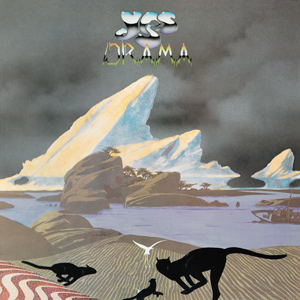
The music glides in like the creature on the interstellar landscape on the cover, then a proto-King Crimson crunch riff plows us into “Machine Messiah”, with a few modern synth swoops. While Horn’s voice with Squire’s always underrated harmonic counterpoint sports enough of the established Yes brand, and there’s a bit of acoustic guitar, the pastoral fairy tales of old are nowhere to be found. After ten minutes of that, “White Car” is an odd little interlude that showcases the two Buggles and naught else. Then Chris hits his bass and Steve Howe slashes power chords for the arena-friendly “Does It Really Happen?” There’s a lot of Hammond organ that reflects Fragile while veering into Kansas territory. Again, Squire’s vocals remind you what band this is.

As with the first side, another attempted epic kicks off the second. “Into The Lens” was developed from a Buggles idea, and it shows, from the new wave touches to Horn’s solo vocal, and frankly, the robotic chorus (“I am a camera/Camera camera”) invites ridicule. (Once the Buggles reverted to just being Buggles instead of Yes men, the song would be re-reworked into the first single from their next album, retitled, naturally, “I Am A Camera”.) “Run To The Light” has Horn sounding somewhere between Jon Anderson and Sting vocally, and while Alan White handles the stop and start rhythms fairly well, it’s a little plodding. The Kansas swirls return for “Tempus Fugit”, and except for the overuse of the Vocoder, the tune rocks. Everyone is engaged, Chris is back in the vocal mix, and they can even get away with ending each verse with the word “yes”.

Despite everything going against it, Drama really isn’t a bad album, particularly because it sounds like Yes as they’d evolved after a decade. Roger Dean even contributed the artwork, though we couldn’t possibly explain what’s with the “hands up” poses in the gatefold. But this lineup couldn’t last, and the group soon splintered yet again. With the aural equivalent of hindsight, the album is a throughline to the next project involving Howe and Downes. (The eventual expanded CD included two single edits, two unfinished tracks without vocals, two “tracking versions”, and four refugees from the first sessions with Jon and Rick still on board, all of which pale compared to what ended up on the album.)

Yes Drama (1980)—3
2004 remastered CD: same as 1980, plus 10 extra tracks

Tuesday, January 13, 2026

Steve Howe 2: The Steve Howe Album

Seeing as his first solo album didn’t really show him at his best, Steve Howe started fresh with his second outing, even giving it a more bold title in The Steve Howe Album. Naturally it had a Roger Dean cover, where he looks like he’s drowned, and not necessarily swimming. (This unfortunate figure would be removed on some but not all later CD editions.) Inside were photos of all the guitars and other stringed instruments he used, and a handy chart showing which tracks had what. Both Yes drummers helped out, as did the exiled Patrick Moraz. Best of all, he kept the singing to a minimum.

He starts out rockin’ and riffin’ with “Pennants”, though we wonder where the vocals would go if there were lyrics to fit, and “Cactus Boogie” is a more countrified piece for several guitars. “All’s A Chord” sports a gentle, classical-tinged theme that’s soon taken over by other styles until it sounds like an unused Yes track, complete with falsetto vocals as if he’s trying to sound like Jon Anderson. “Diary Of A Man Who Vanished” has all the hallmarks of a television theme song, perhaps something involving cowboys. Guest vocalist Claire Hamill takes the mic for “Look Over Your Shoulder”, even harmonizing with herself, while Ronnie Leahy’s Hammond organ also makes a Yes contender.

Side two is even more disparate, beginning with another descendant of “The Clap” in “Meadow Rag”, while the jaunty “The Continental” came from a Fred Astaire and Ginger Rogers movie 45 years earlier, for which it won an Oscar®. Here it has a Reinhart/Grapelli feel, thanks to Graham Preskett’s violin. “Surface Tension” is an original Spanish guitar piece, and something of a prelude to “Double Rondo”, where he’s accompanied by a 59-piece orchestra. Ambitious as it is, it pales in comparison to the closing rendition of the second movement of Vivaldi’s concerto in D major, originally composed for lute rather than the Les Paul he plays here, and one of the loveliest classical pieces ever composed. It’s a fitting conclusion to a surprisingly cohesive album.

Steve Howe The Steve Howe Album (1980)—3

Friday, January 9, 2026

Kinks 33: Lost And Found

Just because the Kinks only released three albums with MCA, that was no reason for the label not to anthologize them. Yet even in the one country in the world where it was released, Lost And Found only fulfilled the first half of its title. (London Records in the UK didn’t bother.)

That said, it did collect some of the better songs of the period, beginning with “The Road”. “UK Jive” still wouldn’t make sense to Americans, but the virtual title track and “Working At The Factory” still belong on any Kinks anthology. Unfortunately, “Think Visual” and “Welcome To Sleazy Town” don’t invite any empathy. “How Do I Get Close” still sounded contemporary in 1991, but why would any compiler choose “The Video Shop” instead of, say, “Rock ‘N Roll Cities”, which actually got airplay? (Our guess: Dave Davies wrote it, not Ray, but that doesn’t explain “Now And Then” over “Down All The Days”.)

The well was pretty shallow to begin with, but they attempted to lure the unsuspecting with three tracks from Live: The Road. One of those is Dave’s “Living On A Thin Line”, but while “Apeman” thrills the small crowd, “Give The People What They Want” isn’t meant to be ironic. Even by cherry-picking from three lackluster sources, it’s unnecessary.

The Kinks Lost And Found (1986-89) (1991)—2

Tuesday, January 6, 2026

Mike Campbell 2: Wreckless Abandon

Having spent his entire adult life working as Tom Petty’s right hand man on stage and in the studio, Mike Campbell waited a good three years after his boss died before finally starting his solo career. (A stint touring with Fleetwood Mac alongside Neil Finn kept him busy as well.) He’d already formed the Dirty Knobs as a side project, so they were ready to back him up on Wreckless Abandon.

As was clear from the exactly two songs wherein he sang lead with the Heartbreakers and Mudcrutch, he was never exactly a singer. But years of writing for and with Tom certainly helped shape his voice into a vehicle for lyrics, and we’re here for the guitars and hooks anyway. The title track has lots of them, fitting nicely between classic Heartbreakers and the Stones’ “Happy”, framed by atmospheric effects. On “Pistol Packin’ Mama” his drawl gets easily lost against guest Chris Stapleton’s, and if it’s a little derivative, “Sugar” makes up for it in bite and attitude. “Southern Boy” stomps a little too long, but the pounding “I Still Love You” shows what was missing on the last couple Heartbreaker albums. Stapleton comes back to harmonize on “Irish Girl”, which rhymes “mutiny” with “scrutiny” and otherwise sounds like 21st-century Mudcrutch.

He tells it like it is on the Stapleton co-write “F-ck That Guy” (censorship ours), but isn’t the most arresting storyteller on the John Lee Hooker pastiche “Don’t Knock The Boogie”, which improves once the solos start. “Don’t Wait” stays in the swamp even longer, so the pretty and quiet “Anna Lee” is certainly a respite. Benmont Tench shows up to lend a little welcome piano to “Aw Honey”, and “Loaded Gun” brings back the classic Campbell sound from all those records. The last minute of the album is dedicated to an acoustic slide rendition of “Don’t Knock The Boogie”.

The band is clearly comfortable backing him, since they’d been together twenty years already, and Wreckless Abandon has a fresh live sound thanks to George Drakoulias. Most of it clearly came to life on stage, but that doesn’t mean some editing mightn’t have helped. We’re just glad he’s still writing and playing. (He blows a mean harmonica too. And he got Klaus Voormann to design the cover.)

The Dirty Knobs Wreckless Abandon (2020)—3

Friday, January 2, 2026

Todd Rundgren 34: Disco Jets

For a guy who always seemed to be recording, one might think Todd Rundgren would have a vault of unreleased music rivalling that of Prince or Bob Dylan. Yet for the longest time, he only had one “lost album” to speak of. A goofy celebration of disco and sci-fi, Disco Jets was recorded by the first quartet incarnation of Utopia shortly after Faithful, but was seemingly shelved to be replaced soon enough by Ra, which was only unintentionally silly.

The album is predominantly instrumental; while the title track does sport lyrics in the form of a repeated chant, it’s really more of a general fanfare. “Cosmic Convoy” picks up on the CB radio craze (and novelty song) of the time, complete with “breaker, breaker” conversation, only six years ahead of Neil Young’s own futuristic mashup. “Time Warp” rearranges a jazzy Rick Derringer instrumental from a few years earlier and adds sound effects that sound like Space Invaders two years before the game even came out. “V.H.F.” is clearly considered something of a TV theme song, and just for good measure, their arrangement of the familiar Star Trek theme song follows. (This would’ve been a top ten single had it been released then.)

Speaking of fads, the funky “Pet Rock” is a cross between K.C. and the Sunshine Band and “Car Wash”. “Space War” proves that titles could be interchangeable on this album, but this one has more prominent lead guitar than the keyboards that dominate elsewhere. It’s odd that he didn’t seem to find any more lyrics for “Rising Sun”, even with what would soon end up on their next album. “Black Hole” brings back the funk, punctuated by laughter and shouting deep in the mix. Finally, the overlapped melodies of “Yankee Doodle”, “The Star-Spangled Banner”, and other patriotic tunes in “Spirit Of ‘76” remind you what year they recorded all this.

Despite the constant thump and seemingly random bloops and bleeps, Disco Jets is still in line with their earlier prog excursion. It’s also very melodic, with pieces short enough to digest. One must have a sense of humor to enjoy this album, and just accept it as it is. It is not for everyone.

Todd Rundgren & Utopia Disco Jets (2012)—3