Showing posts with label 2026. Show all posts

Friday, September 25, 2026

David Bowie 48: The Shel Talmy Recordings

Back in 1965 somehow an 18-year-old kid got the attention of Shel Talmy, the expatriate American producer who’d already started making hits with The Kinks and The Who. First as the long-haired frontman of the Manish Boys, then with a mod coif in Davie Jones & The Lower Third, he gamely tried to become the next big thing, and those attempts can be heard throughout The Shel Talmy Recordings. While his voice is certainly recognizable, he hadn’t become David Bowie yet, literally or figuratively.

The Manish Boys only managed one single; on “I Pity The Fool”, the band is augmented by horns and a certain Jimmy Page on noticeable guitar, while “Take My Tip” features his own saxophone. The later sessions as the Lower Third yielded eight tracks in addition to another single, “You’ve Got A Habit Of Leaving” and “Baby Loves That Way”. Besides being two of the best songs here, they would be revisited 35 years on during the Toy sessions. Both of these also sported some of the distortion and feedback familiar from tunes like “Anyway, Anyhow, Anywhere” and “You Really Got Me”. That’s even more blatant on the unreleased “I Want Your Love” and “Keeping Up With The Jones” instrumental. The other tracks, all written by him, aren’t exactly buried treasure, from the one-chord slog of “Cupid” to tough-guy love laments like “Leave Her To Me”, “You Gotta Tell Her”, and “Glad I’ve Got Nobody”. When any piano is heard, it’s Nicky Hopkins; the other musicians are competent but average.

The set presents the dozen Talmy productions out of chronological order; alternate vocals for the four songs released on singles are included at the end of the CD version. The handful of acoustic demos with an unknown accompanist show he wasn’t tied to R&B, as predict his infatuation with crooners like Anthony Newley and Scott Walker. “Today” is rather striking, from its sophisticated chords and harmonies, “I Live In Dreams” is an idea he’d keep pursuing, and “Bars Of The County Jail” is ahead of its time, to be polite.

Some of this material, along with his first single with the King Bees and songs from a later period with producer Tony Hatch, made up Rhino’s Early On (1964-1966) compilation in 1991. It’s probably just a matter of time before the estate repackages those somehow. As for The Shel Talmy Recordings, the sound is as good as it will likely get, and the liner notes tell the most complete story of this era yet.

David Bowie The Shel Talmy Recordings (2026)—2½
Friday, August 7, 2026

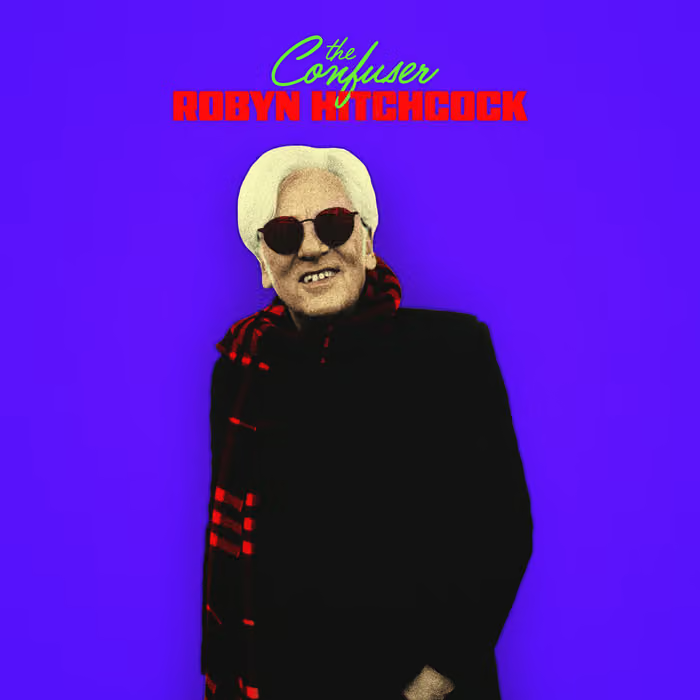
Robyn Hitchcock 36: The Confuser

Another memoir composed on his phone coincided with a fresh batch of Robyn Hitchcock songs. The events of Stranded In The Future cover his path to becoming a songwriter and recording artist, and in many ways, his approach to the craft hasn’t really changed in the decades since. The Confuser is right in line with his brand, but something about the combination of words, melody, and performance make this one of his most satisfying albums of the century.

Right out of the gate “I Am This Thing” has a provocative opening line and the usual surprising rhymes as befit a statement of purpose. We’re not sure if the music he says he loves is supposed to “the birds” or “the Byrds”, but it’s damn catchy. The band infuses “My Dead Astronaut”—another familiar theme—with wacky space effects for another toe-tapper. Disembodied voices appear now and then, and it’s probably not best to search for meaning. The same could be said for “Yesterday’s Rain”, except that it’s the most developed of the opening three rockers, and the best track yet, but we’ve barely gotten started. Things quiet down for “Breathless”, with a sinewy arpeggiated guitar part that’s another one of his trademarks, and the band subtly comes in to fill in the borders, with Kimberley Rew presumably adding those sitar-like parts. But it’s just a setup for the haunting “Ghost In Sunlight”, wherein Robyn channels John Lennon playing electric piano. A Mellotron and what sounds like a cello are wonderful touches, and Gillian Welch provides harmonies and her own disembodied voices in both channels over the end before everything resolves.

A funky wah-wah boogie drives “Building From The Ruins”, which mostly sits on one chord but sports lots of surrealism hiding lines like “I miss democracy like my wisdom teeth.” “The Vanishing Kind” is a sweet and simple love song that features a nice wandering bass line and eventually layered vocals, while “How To Feel Alright” is more skewed, with warped imagery and Oedipal undertones over a brisk Bo Diddley beat and lots of Kimberly Rew guitar. At first we thought “Monday For Me” was resonant of Tom Petty’s “Wake Up Time”, but since that was also based on the structure of “Sad Eyed Lady Of The Lowlands”, all is fair. This one still has a great chorus with good use of the days of the week. Rather than go out on something profound, “Wasted” flirts with honky tonk while exploring the different possibilities of the meaning of the title.

The band is consistent throughout The Confuser, and it sounds like they were all playing in the same room. That gives the album a unity that ranks with the best of the albums he did with the Egyptians way back when, and makes it all worth it.

Robyn Hitchcock The Confuser (2026)—4

Friday, July 24, 2026

Rolling Stones 53: Foreign Tongues

The experience making Hackney Diamonds was apparently so positive that the old geezers just kept going. Some of Foreign Tongues had been started during (and before) the sessions for that album, so good on them for not stepping back, and riding the momentum. Granted, they did issue two archival live albums of theater shows bookending the turn of the century in the interim, but this was still the fastest turnaround between studio albums in decades.

“Rough And Twisted” was the not-so-secret sneak peek track, a fairly pedestrian stomp over mostly one chord, so it’s nice when they add a bridge. It sets the stage. “In The Stars” has a terrific intro, which is also the chorus, but the verses and solo section recycle the same riff-chords from “You Got Me Rocking” from 32 years before. It’s still a winner. Mick turns on his falsetto for “Jealous Lover”, a decent soul tune. Steve Winwood plays the Nicky Hopkins slash Billy Preston keyboards role here and throughout the album, but they’re generally buried in the mix under all the guitars. “Mr. Charm” is pretty odd, Mick spitting out a monologue that borders on rap, but the secret weapon is the supporting vocals by a woman credited only as NaƤrai. “Divine Intervention” would be another strong Stones rocker with their trademark interlocking guitars, except that one of those is played by Robert Smith of the Cure. And yes, it’s another great chorus, and you can just hear the horns over the coda. They pointedly use a pokey country arrangement for “Ringing Hollow”, which has just the three surviving Stones with the rhythm section of Steve Jordan and Darryl Jones, and only Winwood adding his touches, which you can actually hear, along with Keith’s harmony. Mick’s political lyrics don’t always land, but it’s still a good track.

You can hear Winwood again on “Never Wanna Lose You”, which has a funky Jones bass line, but also Robert Smith again and Bruno Mars credited on cowbell. “Hit Me On The Head” stands out because it’s another rescued Charlie Watts drum track—and his touch is obvious—and for its frankly hilarious chorus. They hadn’t done a soul cover on an album of Jagger/Richards originals in a long time, so it’s surprising that they tackle Amy Winehouse’s “You Know I’m No Good”; Mick wails on harmonica, but mostly it underscores her loss. “Some Of Us” is Keith’s token solo spot, and another one of his slow burners. Mick supports him well without overpowering the track, and that’s Benmont Tench on the organ, alongside Winwood’s piano. Paul McCartney returns to play bass on “Covered In You”, which can’t decide if it wants to be yearning or yelling, a romantic plaint or political rant. But Mick sure plays a lot of harmonica on this album. After an intricate riff, probably played by Ronnie, “Side Effects” recycles the chords from “Covered In You” a step down, but it’s got an okay bridge. The best parts of both songs could have been combined, but they didn’t, so it’s a step back. But they redeem themselves on “Back In Your Life”, which is loaded with passion, one of Ronnie’s best-ever solos, and a horn section that evoke the spirit and splendor of the Jimmy Miller era. As with last time, they end with an acoustic bluesy cover, this time of Chuck Berry’s “Beautiful Delilah”, which they’d done on the BBC but never on an album. Chad Smith of the Red Hot Chili Peppers is credited with bass drum.

The removal of a few extraneous tracks, plus some tightening, would make Foreign Tongues a solid, two-sided single LP instead of surpassing an hour. Yet what it comes down to is that it’s nice to get excited about a new Rolling Stones album, especially when they seem into it. Their enthusiasm here is truly infectious. (In a nice touch, the label is the same color yellow as the ‘70s Stones albums. But the cover art is hideous, even by their standards.)

Rolling Stones Foreign Tongues (2026)—3½

Friday, June 26, 2026

Paul McCartney 40: The Boys Of Dungeon Lane

History has shown that the time Paul McCartney spends making an album is no indication of the subsequent quality. His pace has slowed since the busy ‘70s and first half of the ‘80s, so now a five-year gap isn’t that big a deal between releases. Besides, he’s gotta slot all those colored vinyl variations of albums that have already been reissued into the schedule.

For most of this century he’s eschewed the band that still tours with him since they recorded Driving Rain together, preferring to work with young hip producers who can help him do it all himself. For The Boys Of Dungeon Lane, instead of relying on a pool, he chose Andrew Watt, whom he supposedly recommended to the Rolling Stones, who managed to get two albums out of that collaboration. Much has been made about the theme of looking back, from the title to the packaging and many of the lyrics, but that’s not the only thing going on. (Consider also that “Now And Then” was finally completed while this album was being formulated.)

“As You Lie There” begins with a guitar part that’s coincidentally close to an Andy Summers and Robert Fripp collaboration. The spoken sections put the song in a creepy light that the more rockin’ parts dispel. Mostly it’s odd to think of one of the most famous men in the world still wondering if someone he had a crush on as a teen ever thinks about him. Apparently “Lost Horizon” was started, abandoned, and forgotten decades ago, and it’s fine, but would work better onstage if he sped it up a bit. The lead track, “Days We Left Behind”, got a lot of notice for its gentle acoustic sound and heart-tugging content. While it’s not new territory for him—three straight songs on New addressed the same ideas—it is a lovely tune, and tugs the right strings. The poppiest song is “Ripples In A Pond”, an unabashed love song like he hasn’t done in years, but then there’s “Mountain Top”, wherein he’s chatting up a fellow sun-kissed festival-goer. The music revs up apparently when their gummies kick in, giving an image of grandpa skeeving on girls one quarter his age. “Down South” is a rewrite of “Confidante”, musically but not quite lyrically; the earlier song was a guitar, and this one looks back at hitchhiking with George or John. It’s short and simple, whereas “We Two” returns to romantic ruminating. Then, right at the halfway point of the album, we’re treated to the sound of tape rewinding.

“Come Inside” isn’t the most convincing heavy-sounding track, especially as it conjures memories of Egypt Station, but amid the fuzzy guitars are terrifically pounded and tickled acoustic and electric pianos. “Never Know” would seem to be cut from similar cloth as “We Two”, but the little touches in the chorus and especially the recorder solo that heralds the drums for the coda are ultimately rewarding. Ringo Starr appears on a Paul album for the first time in almost thirty years for “Home To Us”, a charming rocker—again, about the old days—built around his drums and an actual duet. Sure, it’s cheesy, but they sound terrific together and we just can’t help grinning, even with the addition of Chrissie Hynde and Sharleen Spiteri on extra vocals. “Life Can Be Hard” has him teetering at the top of his register, which somehow works in tandem with the old-fashioned clarinet arrangement. A truly hidden gem is “First Star Of The Night”, another gentle acoustic pick-and-strum inspired by rain on a vacation, with the slightest embellishments. The retro sound, along with a Spanish-sounding trumpet and swing horns, returns to dominate “Salesman Saint”, another look back at his childhood with clever time juxtapositions adding to the dreamlike memory feel. It’s a pointed juxtaposition with the big finale. “Momma Gets By” is a melancholy portrait of another struggling family, but as observed by a child. Unless that’s supposed to be young Mary’s observations from mid-1970, it’s striking imagery, heartrendingly orchestrated, and wholly unexpected.

And there it ends—no joke or afterthought like “Her Majesty”, “Crossroads Theme”, “Cosmically Conscious”, “Nod Your Head”, “I’ve Only Got Two Hands”, etc. Fourteen songs in 47 minutes may seem like a lot, but the album never feels overlong or padded. What makes The Boys Of Dungeon Lane succeed is that, as we’ve tried to point out, every track has a hook that elevates it, making even the more ordinary ones worth hearing. The production is excellent; Watt plays a few instruments, and another guy does the trumpet, but the album does not have the one-man band vibe, even when we know Paul’s doing just about everything else. Basically, the old man’s still got it.

Paul McCartney The Boys Of Dungeon Lane (2026)—3½

Friday, June 12, 2026

Pink Floyd 22: 8-Tracks

The 8-track tape music format dominated the industry for a few decades. These bulky plastic cartridges split an album’s program into four stereo segments, but they didn’t always match the vinyl sequence, or even the sides. In order to cut down on excess silence and conserve actual tape, songs were often shuffled, many times in baffling combinations. From time to time a rare mix would sneak through, but for the most part, the 8-track’s appeal was more from convenience and mobility than pristine fidelity: cars had players, and portable players were available in a variety of designs. By comparison, the cassette’s smaller size was that much more fragile, and the thin tape could threaten to unwind and stretch if you weren’t careful. Even those took liberties with album sequencing, but that’s not important right now. Eventually people decided it was a lot easier to dub albums and songs from the radio onto a cassette, which was just one of the factors that helped hasten 8-track’s demise.

Like most kings of the high school parking lot, Pink Floyd sold a lot of albums on 8-track, and a new compilation of favorites that likely got a lot of play in that format appeared for no real reason, on the heels of the 50th anniversary of Wish You Were Here and its various expansions. Despite the hyphen, 8-Tracks offered exactly that: eight tracks from the ‘70s sequenced and mixed by Steven Wilson, and something of a mutant cousin of A Collection Of Great Dance Songs.

Like that album, it begins with “One Of These Days”, only this time the wind fades into “Wots… Uh The Deal”—a wonderful song, to be sure, but not the most expected choice for a “hits” album. That’s soon taken over by the coins and cash register of “Money”, this time the original track and not the rerecorded version. “Another Brick In The Wall, Part 2” is also the extended single mix, with the extra bars at the top and with the schoolmaster’s ranting over the end. “Wish You Were Here” begins from the tuned radio, and its wind at the end turns into the ticking clocks of “Time”. The “Breathe” reprise conveniently ends on the same chord that opens “Comfortably Numb”, and that fades into the sheep sounds to preface “Pigs On The Wing”.

And that right there would seem to be the big deal of this album, from the title to the concept. This is the version of the song that appeared on the 8-track version of Animals—both verses, separated by solo played by auxiliary touring guitarist Snowy White. Why this did not appear in 2018 on that album’s sonic and visual overhaul made no sense, but here it is now. Beyond that, everybody who cares already knows these songs, and might even be tired of them.

Pink Floyd 8-Tracks (2026)—3

Tuesday, June 2, 2026

Neil Young 75: As Time Explodes

Clearly excited by his latest band of older and newer friends, Neil Young took the Chrome Hearts on a “world tour” in the months before he turned 80, playing dates in Europe and the U.S. A live album followed, appearing first as a Record Store Day vinyl release, then given more widespread distribution on CD and via streaming about six weeks later.

What sets As Time Explodes apart from his other timely tour souvenir live albums is of course the song selection. “Daddy Went Walkin’” and “Looking Forward” from the late ‘90s and “Harvest Moon” have gentle accompaniment, while the louder “Ohio” is appropriately ragged. The more obscure “Name Of Love” is driven by his pump organ, and given a better treatment than its original, just as “Be The Rain” is about half the length of other versions. Current events inspired many of the song choices on the tour, as well as the new rant “Big Crime”. “Long Walk Home” is resurrected after almost forty years, with revised lyrics and widely missed notes, though “Vampire Blues” has been a regular since he first took up with Promise Of The Real. From there it’s some familiar warhorses: “Cortez The Killer” runs almost fifteen minutes, colored nicely by Spooner Oldham’s organ, but is most notable for the appearance of its long-missing final verses. “After The Gold Rush” now has Mother Nature on the run on in the 21st century. “Like A Hurricane” goes for almost eleven minutes, with the band doing their best Crazy Horse while also giving Neil room to stretch the dynamics. Finally, he tells the story of writing “Silver Eagle”, which gets a little more twang from guitarist Micah Nelson.

Considering the thirty-odd other songs from the thirty-odd shows on the tour, why he picked these particular selections and performances is known only to him. As Time Explodes is a perfectly serviceable live album in a catalog full of many others that are better just because they are.

Neil Young & The Chrome Hearts As Time Explodes (2026)—3

Friday, April 17, 2026

Joe Jackson 22: Hope And Fury

It’s always encouraging when Joe Jackson emerges with a set of songs that aren’t specially part of a grand concept. Hope And Fury finds him keeping it basic yet again—another good sign—with his current trio backing him, anchored yet again by the staunch bass of Graham Maby. The music is described as “bicoastal Latin jazz funk rock”, which pretty much sums up his more commercial albums.

That description isn’t immediately apparent on the opening to “Welcome To Burning-By-Sea”, where the tribal rhythm doesn’t support any kind of melody until the chorus. If there is a theme to the album, it would be the state of the world, particularly in comparison to life in the same place in another time. (And frankly, the cover photo looks just a little too much like bad AI.) His defiance comes through on the more melodic “I’m Not Sorry”, a slap at cancel culture from a guy still miffed he can’t smoke in bars. “Made God Laugh” is the first really constructed and arranged song here, incorporating echoes of previous decades and a killer chorus. Speaking of previous decades, “Do Do Do” (which rhymes with “no no no”) begins with a cop on “Twist And Shout” sports cheesy Farfisa organ and guitar stabs while having a lot of fun with wordplay. The saga of Billy exploring alternate lifestyles in “Fabulous People” may or may not be autobiographical, but boy, is it catchy. (The percolating bass and doubled piano and xylophone evoke that of “Stepping Out”.)

Unfortunately the main guitar riff of “After All This Time” immediately resonates of “Smooth” by Santana, and it’s a shame he couldn’t have found a better hook, since the pre-choruses and choruses are worth getting to, to the point where one doesn’t notice the deliberately pointed clichĆ©s stacked in the verses. “The Face” is another anthem for the timid, with a terrific call-and-response bridge and extended solos highlighting almost Klezmer violins, progressive guitar, and his own piano. On an album with already sophisticated ideas, “The End Of The Pier” stands out with its precise juxtaposition of families a century apart, even if the earlier one doesn’t seem that far back. (In fact, “Sunday Papers” would fit lyrically at the halfway point.) “See You In September” is thankfully not the near-bubblegum hit from the ‘60s, but something more resonant of the Great American Songbook, with its Ellington chords and shades of “As Time Goes By”. It would have been better served with just the piano and strings, and without percussion, but he really likes that percussion.

While Hope And Fury is short and sweet at under 35 minutes, there’s enough here for sinking one’s teeth. Although it doesn’t grab with the immediacy of Rain or Fool, it’s another fine installment in what seems to be a career without end.

Joe Jackson Hope And Fury (2026)—3

Tuesday, March 24, 2026

Talking Heads 13: Tentative Decisions

A good half-century after they were formed, Talking Heads continued to be appreciated, and not just by people who liked them in the first place. David Byrne had continued to find interesting ways to apply performance art to his catalog, and interactions with his former bandmates had become much less strained, even cordial.

The band’s catalog had also become subject to deluxe editions on top of earlier expansions, as well as live recordings issued for various Record Store Days. Tentative Decisions: Demos & Live was one such release, but what was first a single LP plus a bonus 45 was expanded by a degree of three.

The first disc, which replicates the vinyl release, consists mostly of demos recorded by their sound guy, and offers early versions of songs that would go on to populate their first two albums. The tracks on the second disc were recorded as an audition for Columbia Records, who didn’t sign them, and features a lot of the same songs again. They were only a trio at this point, but already Tina Weymouth has learned how to maneuver through Byrne’s angular, non-standard riffing and chording. His voice is almost there, but sounds more, well, tentative than the eventual brand. There’s even two songs by the Artistics, the first version of the band before Chris Frantz got his girlfriend to learn the bass.

The third disc is all live, split between a show at Max’s Kansas City recorded from the audience, and another in much better fidelity a few months later and hours away in Syracuse. By this time they’d gotten their record deal, and have beaten the tunes into shape. Jerry Harrison still hadn’t joined, but “Take Me To The River” is already in their set, along with Jonathan Richman’s “Pablo Picasso” and “1, 2, 3 Red Light” by the 1910 Fruitgum Company.

Tentative Decisions comes in a handsome book-bound package, with hype incorporated into the artwork, and should fit comfortably on the shelf alongside its siblings. Historically it’s very interesting, showing both how formed the band was at this stage, and demonstrating just how much Jerry would bring to the dynamic.

Talking Heads Tentative Decisions: Demos & Live (2026)—3