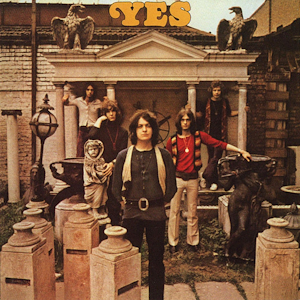
While their fantasy sci-fi approach would take a few albums to take firm hold, much of their eponymous debut sounds like the band they’d become. It’s not immediately apparent on “Beyond And Before”, which begins with a staccato attack on the same note, first on guitar, then doubled on Chris Squire’s extra-trebly Rickenbacker bass. Tony Kaye leans on the Hammond organ, while Bill Bruford explores his drumkit under precise three-part harmonies that disguise Jon Anderson’s part. Of course, most bands start out playing covers, and surprising choices would define Yes at the beginning. The jazz potential of the Byrds’ “I See You” is stretched for nearly seven minutes, particularly in the hands of Peter Banks on guitar. The soft and pretty “Yesterday And Today” provides a sharp contrast in dynamics, before “Looking Around” blasts through the speakers again.
Side two follows the basic pattern of side two—raveup, cover, ballad, big finish. “Harold Land” stands out, being something of a harbinger of the type of character sketches Genesis would cook up in the Peter Gabriel era. In this case the titular protagonist is ravaged by the harsh realities of—you guessed it—war. Notice also the striking contrast between the pomp of the intro before descending into the more mournful chords of the main song. The cover slot is sneaky here, with a complicated introduction soon melding into a tarted-up extension of the Beatles’ “Every Little Thing”, which still finds an excuse to throw in the riff from “Day Tripper”. “Sweetness” is this side’s sappy romantic tune, a song in a pastoral hippie style much like that which Led Zeppelin would abandon around the same time. “Survival” probably comes closest their future sound, thanks to the underwater wah-wah effect on the bass (or is it the guitar? we don’t know) and the multiple shifts in tempo.
Those who come at this album after the fact may have to remind themselves that Steve Howe wasn’t in the group yet. Peter Banks was just one of the secret weapons of this fledgling band, and he remains underappreciated except by the most rabid Yes fans, who will likely disagree with a lot we’ll have to say about these albums. (When Yes was remastered in the new century, it was standardized with the original album art, and offered up two early versions each of a future album track and a future B-side, as well as two versions of their rearrangement of “Something’s Coming” from West Side Story. We wonder if Todd Rundgren was familiar with it.)
Yes Yes (1969)—3
2003 remastered CD: same as 1969, plus 6 extra tracks
I would tend to think that Todd hadn’t heard Yes’s version of “Something’s Coming”, since it had only been released on a couple of European singles. I don’t think there’s any real difference between the early mono version and the stereo single version, but my ears aren’t good enough to tell, I suppose.
ReplyDeleteAs for the album, psychedelia was still very much an influence, evidenced by Tony and Pete’s playing. The lyrics aren’t quite as far out as they would become later, but “Beyond and Before” and “Looking Around” are also very much part of the “acid” aesthetic. The hippie-esque ballads “Yesterday and Today” and “Sweetness” remind me of similar stuff Pink Floyd would do on “Atom Heart Mother” and “Ummagumma”. It was all in the British air, I guess.
As good as Banks and Kaye were, what made the band more unique were the voice of Jon Anderson and the rhythm section that absolutely explodes out of the speakers. The songwriting here doesn’t quite give them the ability to sing and play up to their potential. Nontheless, taken as it is, it’s an enjoyable album. It shouldn’t just be looked at as a launching pad.