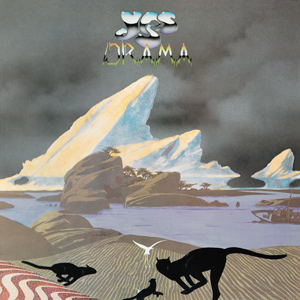
 While Yes and their fans should have been accustomed to personnel changes by now, in a rather shocking development, not only did Rick Wakeman leave the band, but Jon Anderson did too. Wakeman had bolted before, of course, but this was the first time Yes wouldn’t have their iconic lead singer. (Don’t worry about Jon; he put out two albums on his own, and three in collaboration with synth wizard Vangelis, all over the next three years, none of which will be explored in this forum.)
 Even more baffling, especially in hindsight, is that the remaining trio—of which Chris Squire was the last founding member—joined forces with the two main members of the Buggles, who’d made quite the splash with “Video Killed The Radio Star” even before MTV happened. Since Trevor Horn could sing and Geoff Downes played keyboards, they slotted into the vacancies. The aptly titled Drama was the result.
The music glides in like the creature on the interstellar landscape on the cover, then a proto-King Crimson crunch riff plows us into “Machine Messiah”, with a few modern synth swoops. While Horn’s voice with Squire’s always underrated harmonic counterpoint sports enough of the established Yes brand, and there’s a bit of acoustic guitar, the pastoral fairy tales of old are nowhere to be found. After ten minutes of that, “White Car” is an odd little interlude that showcases the two Buggles and naught else. Then Chris hits his bass and Steve Howe slashes power chords for the arena-friendly “Does It Really Happen?” There’s a lot of Hammond organ that reflects Fragile while veering into Kansas territory. Again, Squire’s vocals remind you what band this is.
As with the first side, another attempted epic kicks off the second. “Into The Lens” was developed from a Buggles idea, and it shows, from the new wave touches to Horn’s solo vocal, and frankly, the robotic chorus (“I am a camera/Camera camera”) invites ridicule. (Once the Buggles reverted to just being Buggles instead of Yes men, the song would be re-reworked into the first single from their next album, retitled, naturally, “I Am A Camera”.) “Run To The Light” has Horn sounding somewhere between Jon Anderson and Sting vocally, and while Alan White handles the stop and start rhythms fairly well, it’s a little plodding. The Kansas swirls return for “Tempus Fugit”, and except for the overuse of the Vocoder, the tune rocks. Everyone is engaged, Chris is back in the vocal mix, and they can even get away with ending each verse with the word “yes”.
Despite everything going against it, Drama really isn’t a bad album, particularly because it sounds like Yes as they’d evolved after a decade. Roger Dean even contributed the artwork, though we couldn’t possibly explain what’s with the “hands up” poses in the gatefold. But this lineup couldn’t last, and the group soon splintered yet again. With the aural equivalent of hindsight, the album is a throughline to the next project involving Howe and Downes. (The eventual expanded CD included two single edits, two unfinished tracks without vocals, two “tracking versions”, and four refugees from the first sessions with Jon and Rick still on board, all of which pale compared to what ended up on the album.)
Yes Drama (1980)—3
2004 remastered CD: same as 1980, plus 10 extra tracks
My first Yes album, and thus always a favorite in my heart, even if admittedly, albums like "Fragile" are probably better in a traditional (and a prog) sense. But I always loved the proto-prog metal of "Machine Messiah", the freaky little vignette "White Car", the new wave of "Into The Lens" (which arguably works better in its single edit) and the straight up rock of "Tempus Fugit".
ReplyDeleteI'd throw at least half a point on top of the three here, long live the BugglYes!
(And we agree that the songs tried out with Anderson sound absolutely atrocious, something clearly had to give...°
i bought the album in 2005 and played many versions of it till they were scratched, i don't know, it's just the feeling was there since horn and downes are joining yes, i do love the mixing of new wave and progressive rock first made by rush and permanent waves, even genesis have a bit of new wave in the preview to the next album with the top 40 hit turn it on again, whereas yes, have the buggles duo seems like a nice touch, i don't whine about jon not being here nor rick, i follow their solo careers. one thing i dislike is the comeback album that is so overplayed its not even funny, even naming the album 90125 seems cheap, i still can't stand owner of a lonely heart and the other trevor is too much like EVH meets vinnie vincent, meh!
ReplyDeletetempus fugit is a 5 minute blast of bass that sounds like the terminator, way better use of synth bass than tormato, machine messiah is like a cyberpunk version of sound chaser does it really happen sounds like new wave but it has bass solos and cool synths. i like the live version of white car as a synth solo even adding video killed the radio star. sadly the lineup never lasted but thankfully in 2011, they remaster the suite fly from here and they sound like the 1980 yes and has modern tough guitars and synths that don't date that much, even mister horn sounds like he took care of his voice. i give it a 5.
At one point, Wakeman said that he hoped that the material from the Paris sessions would eventually come out. He thought that there was good stuff there. As the bonus tracks here indicate, he was flat wrong. Even accounting for the fact that these are demos/rehearsals, the material is awful. Chintzy synths and childish lyrics. It’s amazing that some of them were eventually salvaged for future projects.I recently watched an interview with Trevor Horn. He mentioned that their mutual manager snookered him and Downes into joining the group. At first, the Buggles thought they were only supplying material and that Jon and Rick would be back. To top it off, according to Howe, Eddie Offord began to exhibit signs of severe mental illness. So, the Buggles also had to step in and finish the production, too.
ReplyDeleteI ended up loving the album from the start, especially after the mess of “Tormato” and the occasional lack of focus on the three before that one. The hooks are catchy and the musicianship as solid as ever. Howe might have been less of an influence on the songwriting than the other four (maybe because of his solo album), but his playing is diverse. Of course, the egotistical liner notes had to let us know exactly what instruments he played on every single track – except for “White Car”. I hear what sounds like a mandolin there. Played by Horn, or a Fairlight sample?
Hardcore Yesholes weren’t happy with Downes, since there weren’t endless arpeggios flying up and down the songs. He showed admirable restraint and was far more intelligent in his choice of keyboards. What do you mean, he sounds like Kansas? Chris Squire’s playing is hot. Horn’s lyrics dealt with somewhat more concrete imagery than Anderson’s. As well as being darker – the melancholia of “Into the Lens”; the disorientation of “Does it Really Happen?;” the vague dystopia of “Machine Messiah”. On the other hand, they aren’t much like he wrote for The Buggles. I assume that he felt that he had to be weird because it was Yes. This was a bit forced. “Run Through the Light” was the biggest offender in this regard. This was also his most direct attempt to cop Anderson’s vocal style. Good song, anyway. No surprise that it was the only song from the album not sung on the tour.
“Tempus Fugit” was the song that I heard the most on the radio (one DJ called it the album’s “Roundabout”), even though it was never a single. I never heard the single version of “Into the Lens”. I did hear the single remix of “Run Through the Light”. I find this version interesting. Chris’s piano is much more prominent, where it’s barely audible on the album version.
I caught a show on the tour. “Does it Really Happen” was an exciting opener. But when Horn sung “Yours is No Disgrace”..oh, my. He really had to strain to hit those high notes on a predictable selection of older material, and he frequently missed. Despite that, the audience was excited. Five songs from the album, although Downes sang “White Car” through a vocoder during his solo spot. The crowd cheered him on like a conquering hero. Chris’s bass solo, “Amazing Grace/The Fish” also went down well.
Despite all of this, Horn’s voice further deteriorated, infamously resulting in badly received shows in the U.K. at the end of the tour. He once described this period as "the worst year of my life!” And no one ever paid him for the tour! On top of that, the album was their worst seller since “Yesterdays.” I was looking forward to their next album with the new songs, but most of the band had burned out. I would also point out that, retrospectively, this also was a “throughline” to the next project with Horn and the rhythm section. Of course, they had to stop and pick up an important passenger on the way…
I also love the cover. One of Dean’s best. I supposed that it’s “interplanetary,” but it’s less surreal and more stripped down than his later work. Almost stark, matching the music. Rumor has it that the panthers are Squire, Horn and White, chasing away the egrets (Anderson and Wakeman). Just a coincidence? Maybe.
Yesholes. Heh.
DeleteAs for Kansas, Downes' Hammond organ swirls always remind of the ones in either "Point Of Know Return" or "Carry On Wayward Son".