Friday, July 24, 2026

Rolling Stones 53: Foreign Tongues

The experience making Hackney Diamonds was apparently so positive that the old geezers just kept going. Some of Foreign Tongues had been started during (and before) the sessions for that album, so good on them for not stepping back, and riding the momentum. Granted, they did issue two archival live albums of theater shows bookending the turn of the century in the interim, but this was still the fastest turnaround between studio albums in decades.

“Rough And Twisted” was the not-so-secret sneak peek track, a fairly pedestrian stomp over mostly one chord, so it’s nice when they add a bridge. It sets the stage. “In The Stars” has a terrific intro, which is also the chorus, but the verses and solo section recycle the same riff-chords from “You Got Me Rocking” from 32 years before. It’s still a winner. Mick turns on his falsetto for “Jealous Lover”, a decent soul tune. Steve Winwood plays the Nicky Hopkins slash Billy Preston keyboards role here and throughout the album, but they’re generally buried in the mix under all the guitars. “Mr. Charm” is pretty odd, Mick spitting out a monologue that borders on rap, but the secret weapon is the supporting vocals by a woman credited only as NaƤrai. “Divine Intervention” would be another strong Stones rocker with their trademark interlocking guitars, except that one of those is played by Robert Smith of the Cure. And yes, it’s another great chorus, and you can just hear the horns over the coda. They pointedly use a pokey country arrangement for “Ringing Hollow”, which has just the three surviving Stones with the rhythm section of Steve Jordan and Darryl Jones, and only Winwood adding his touches, which you can actually hear, along with Keith’s harmony. Mick’s political lyrics don’t always land, but it’s still a good track.

You can hear Winwood again on “Never Wanna Lose You”, which has a funky Jones bass line, but also Robert Smith again and Bruno Mars credited on cowbell. “Hit Me On The Head” stands out because it’s another rescued Charlie Watts drum track—and his touch is obvious—and for its frankly hilarious chorus. They hadn’t done a soul cover on an album of Jagger/Richards originals in a long time, so it’s surprising that they tackle Amy Winehouse’s “You Know I’m No Good”; Mick wails on harmonica, but mostly it underscores her loss. “Some Of Us” is Keith’s token solo spot, and another one of his slow burners. Mick supports him well without overpowering the track, and that’s Benmont Tench on the organ, alongside Winwood’s piano. Paul McCartney returns to play bass on “Covered In You”, which can’t decide if it wants to be yearning or yelling, a romantic plaint or political rant. But Mick sure plays a lot of harmonica on this album. After an intricate riff, probably played by Ronnie, “Side Effects” recycles the chords from “Covered In You” a step down, but it’s got an okay bridge. The best parts of both songs could have been combined, but they didn’t, so it’s a step back. But they redeem themselves on “Back In Your Life”, which is loaded with passion, one of Ronnie’s best-ever solos, and a horn section that evoke the spirit and splendor of the Jimmy Miller era. As with last time, they end with an acoustic bluesy cover, this time of Chuck Berry’s “Beautiful Delilah”, which they’d done on the BBC but never on an album. Chad Smith of the Red Hot Chili Peppers is credited with bass drum.

The removal of a few extraneous tracks, plus some tightening, would make Foreign Tongues a solid, two-sided single LP instead of surpassing an hour. Yet what it comes down to is that it’s nice to get excited about a new Rolling Stones album, especially when they seem into it. Their enthusiasm here is truly infectious. (In a nice touch, the label is the same color yellow as the ‘70s Stones albums. But the cover art is hideous, even by their standards.)

Rolling Stones Foreign Tongues (2026)—

Tuesday, July 21, 2026

Byrne & Eno 2: Everything That Happens Will Happen Today

In 2006, David Byrne and Brian Eno’s My Life In The Bush Of Ghosts, which had long been hailed as “seminal”, was reissued with the requisite extra tracks. Then the two collaborated on an album for the first time in decades. The bigger surprise, given their previous work together, was that Everything That Happens Will Happen Today was a collection of songs as opposed to groundbreaking experimentalism. Considering the recent work both men had done on their own, this shouldn’t have been too much of a surprise, but still. The overall theme was the relief of domesticity, yet with subtle undercurrents, as depicted in the artwork.

Right away “Home” begins with trilling acoustic guitars, and a chorus that’s descended from recent Eno collaborator Paul Simon’s “Homeward Bound”, but with more pointed lyrics. “My Big Nurse” has a similarly loping rhythm and odd imagery, while “I Feel My Stuff” is more unique, lined with discordant piano and a more quirky vocal from Byrne, who sings all the leads throughout. “Everything That Happens” returns to the dreamy sound hinted at in the first songs, and we finally hear the gospel influence the fellas had been talking about while making the album. “Life Is Long” adds a brass section to support the affirming message, which seems to pervade through “The River” despite the imagery linked to the devastation of Hurricane Katrina.

More familiar beats we’d expect from this dynamic duo emerge on the danceable “Strange Overtones”, not just the first single but offered as a free download. “Wanted For Life” is mildly robotic but builds to a more, well, human sound, with hooks everywhere. The liner notes mention the inspiration for “One Fine Day”, that being the story of a refugee who manages to hold onto hope through all kinds of adversity, and that runs through the album. He turns on his soulful voice for the polyrhythmic “Poor Boy” with those fake horns Eno liked to use, and “The Lighthouse” is a mildly languid closer, still on the idea of finding a home, with some odd counterpoints to underscore the difficulty of achieving same.

While occasionally cold, just like the cover art, Everything That Happens Will Happen Today does eventually fulfill its aim, to unite these partners again, and make the world feel a little better about itself. Naturally they were drawn to the promotional possibilities of doing it all themselves, and Byrne even went on tour to promote it. Eno did not join him.

A deluxe edition of the album was released a few months later, in a circular tin topped with a model of the house and yard from the front cover and containing a book, an antacid pill, a six-sided die of short phrases, and a bonus enhanced CD with an film, screensaver, and four extra songs. “Never Thought” is a lush pop song that should have been on the main album, and we’d even say the same for “Walking On The River”, “The Eyes”, and “The Painting”. The lyrics seem to be thematically linked, but maybe they didn’t want a three-sided album.

David Byrne & Brian Eno Everything That Happens Will Happen Today (2008)—3

Friday, July 17, 2026

Prince 27: Xpectation and N.E.W.S.

Without a major label trying to tell him what to do, Prince continued to follow his muse—or whatever it was—to the neighborhood of jazz for a pair of releases. More to the point, both featured the phrase “new directions in music by Prince”, which everyone will tell you was similar to what Miles Davis had on the cover of Bitches Brew. Both were also entirely instrumental.

Xpectation came first, as a digital download, and would remain that way, with no physical release, ever. Ranging from quiet and dreamy (“Xhalation”, “Xcogitate”, “Xotic”) to upbeat and funky (the title track, “Xpand”, “Xpedition”), with a prominent electric piano on all tracks, this is dinner music jazz. He does play some guitar, the rhythm section of Rhonda Smith and John Blackwell is consistent, and some tracks feature Candy Dulfer and/or Vanessa Mae on violin. And yes, all the track titles follow that theme. We don’t know why the last jam ends with a baby crying, but maybe that’s none of our business.

N.E.W.S. followed a few months later, and was considered important enough that it was available on CD. Four improvised jams at exactly 14 minutes each—with the same rhythm section, plus one Renato Neto on keys and the stalwart Eric Leeds on misspelled “saxaphone”—were captured live on tape in one day, each named after a point on the compass; hence the album title. “North” does have some spacey elements resonant of certain Jan Garbarek albums, “East” sports Saharan instruments and effects until it doesn’t, “West” takes a while to find something of a groove then switches to a more typically Prince slow groove melody about halfway through, and “South” is pretty much straight funk.

These are even more meandering than tracks on Xpectation, which each are at least shorter, and more focused. The fact is, his music shouldn’t be background music.

Prince Xpectation (2003)—3
Prince
N.E.W.S. (2003)—2

Tuesday, July 14, 2026

Van Morrison 54: Accentuate The Positive

For his third release of 2023, Van fans were able to exhale in relief yet again. Not only was Accentuate The Positive another collection of covers, with zero political stands or even general complaining, but it was only an hour long.

The focus is once again mostly on pre-’60 rock ‘n roll and blues, in a distinctly R&B approach. Therefore the old chestnut “You Are My Sunshine” is more of a dare than homage, and the Everlys’ “When Will I Be Loved” and “Problems” are more jump blues. “Hang Up My Rock ‘N Roll Shoes” might be familiar to Band fans from Rock Of Ages, but this “The Shape I’m In” is not theirs. “Flip, Flop And Fly”, “A Shot Of Rhythm And Blues”, “Shakin’ All Over”, and “Bye Bye Johnny” are all faithful to the originals, while “Red Sails In The Sunset” could have come from one of his late-‘80s albums. “Sea Of Heartbreak” has a harmony part with one of the backup singers, who’s limited to two notes. Jeff Beck adds some rockabilly guitar to “Lonesome Train”, sung in unison with Chris Farlowe, and Taj Mahal helps close the proceedings on “Lucille” and “Shake, Rattle And Roll”, though he seems to need prompting on the latter. In between the selections range from obscure to well-trod.

We’re glad he took his own advice on Accentuate The Positive. He seems to have picked these songs just because he liked them, hadn’t recorded any of them for an album before, and uses the same band for most of it. So it’s another decent Van Morrison album that won’t stand out much otherwise.

Van Morrison Accentuate The Positive (2023)—3

Friday, July 10, 2026

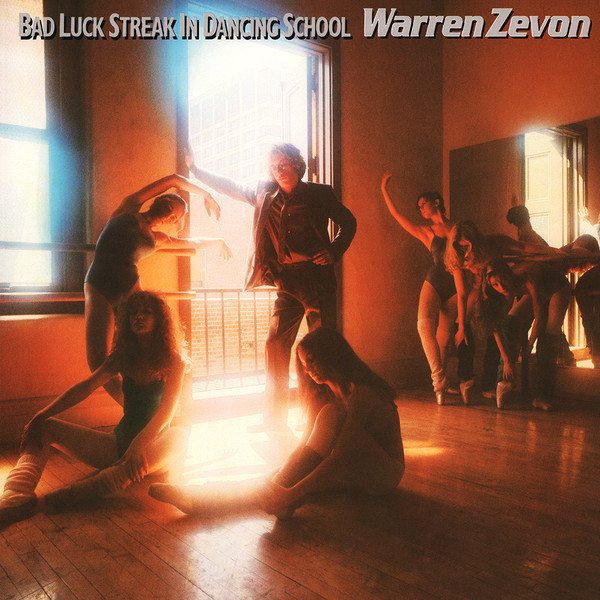
Warren Zevon 4: Bad Luck Streak In Dancing School

Most of the best songs he’d written were spread across his first two albums for the Asylum label, so when it came time for his next, Warran Zevon had to start fresh. As a result, Bad Luck Streak In Dancing School exhibits some water-treading, and some unfortunately dated production. Four Eagles appear throughout the album, and Jackson Browne is still around, but the drummer is Rick Marotta instead of the expected Russ Kunkel.

A brief snatch of a string quartet is a harbinger of sorts, then two shots from a gun start the title track proper. Somehow we don’t believe when he swears he’ll “change”, and that’s the point. A cover of Allen Toussaint’s “A Certain Girl”—probably most notable by the Yardbirds’ version—has fairly enthusiastic vocals with help from Jackson Browne, but it’s still a cover. “Jungle Work” might appeal to fans of a certain headless Thompson gunner, but it’s mostly one riff beaten into the ground. We’re due for a heartbreaker, and “Empty-Handed Heart” delivers. Regret seeps through every line, and when Linda Ronstadt appears in the bridge to offer the departed one’s response, it’s a killer. The first of two instrumental interludes provides a bridge to the Southern rock skewering of “Play It All Night Long”; not only does it begin with the incomparable “Grandpa pissed his pants again”, it’s also the only song we know of that mentions brucellosis. (If he’d lived long enough to hear what Kid Rock did to “Werewolves Of London”, there may have been a murder charge.)

One track that could have been a lot bigger is “Jeannie Needs A Shooter”, a title he picked up from Bruce Springsteen, and finished with his help. Where the Boss’s song seems to be a modern tale of obsession, protection, and revenge, this one takes a more traditional approach, with a mild Old West setting, right down to the strings, and a surprise ending. Considering Bruce’s growing stature, it’s odd that this one seems to have been mostly forgotten. The second interlude lasts almost as long as “Bill Lee”, an ode not to William S. Burroughs’ pen name but to the Boston Red Sox pitcher known as Spaceman for his outlandish behavior, and with whom Zevon shared mutual admiration. It’s a sparse piece with only piano and harmonica plus harmony, but still seems incomplete. One of his favorite words returns in “Gorilla, You’re A Desperado”, a surreal tale of switched identity that’s not entirely clear unless you really concentrate on it. The island-like lilt of the synth seems to link it to the Kinks’ “Apeman”, which it doesn’t need. “Bed Of Coals” was written with T-Bone Burnett before he became more ubiquitous. It’s more than a little bit morose, and he decided Ben Keith was more appropriate to deliver the pedal steel guitar. David Lindley returns to his familiar lap steel seat for “Wild Age”. Here the harmonies are all southern California, though he throws in some off-key yells over the fade.

Most of the successful Zevon ingredients are in place on Bad Luck Streak In Dancing School, when he hasn’t run out of ideas. It’s not as immediately impactful, and only got cursory attention, but the moments exist.

Warren Zevon Bad Luck Streak In Dancing School (1980)—3

Tuesday, July 7, 2026

Beach Boys 5: Shut Down Volume 2

If you’ve been paying attention to the narrative, you might remember that the Beach Boys’ label—the ever resourceful Capitol Records—had put out a compilation against their wishes called Shut Down. So when it was time for their next album, somebody had the bright idea to name it Shut Down Volume 2. It did continue their tropes of surfin’ and drivin’, and the boys looked all clean and collegiate on the cover (except for Mike Love, who was already balding, and Brian Wilson, who can’t quite pull off a Beatle fringe in compensation). While they were under a lot of pressure to keep new product on the shelves and on the radio, Brian delivered some of his greatest works yet, and some of the band’s worst.

The hit single “Fun, Fun, Fun” starts us off with a bang. From Carl Wilson’s guitar intro through the story running through the verses, this is a wonderful Chuck Berry pastiche, and Brian can’t help throwing in some key changes. As good as it is, it’s immediately bettered by the Phil Spector pastiche that follows. “Don’t Worry Baby” is ostensibly about a guy nervous over an upcoming drag race, but is really a masterwork of a love song. Amazingly, it was released as a B-side.

And from there, the album sinks. “In The Parkin’ Lot” begins and ends with a lush display of harmonies, but in between is merely a lame rewrite of “Fun, Fun, Fun”, complete with the same “blue now/dew now” rhymes. Even worse, “‘Cassius’ Love Vs. ‘Sonny’ Wilson” purports to be a peek into their wacky recording sessions, with scripted insults between the band’s Clay and Liston stand-ins over their vocal idiosyncrasies, taking up three-and-a-half precious minutes where obviously there wasn’t a song available. Perhaps it was here because Brian was self-conscious about “The Warmth Of The Sun”, an astoundingly beautiful reverie with some of his most unique chord changes. “This Car Of Mine” exists solely to give Dennis Wilson a spotlight vocal.

While the remake of “Why Do Fools Fall In Love” has a Spector-style production and some interesting vocal inversion, it’s further proof that Brian was low on material. (A half-century later, an interesting, complex, and unused instrumental track emerged on Keep An Eye On Summer, a copyright dump release.) It made sense for Carl Wilson, who was still in high school, to take the lead on the horny “Pom, Pom Play Girl”, as Mike was already getting creepy, and “Keep An Eye On Summer” is another slow one like “Surfer Girl” and the like, but again, in both cases the harmonies and changes are let down by the lyrics. “Shut Down, Part II” brings back surf-style instrumentals; outside of some sax honking at the top, it’s notable for Carl and Al Jardine trading licks in different tones over more complicated modulations. But “Louie Louie” is a dull cover of the previous summer’s frat house hit by the Kingsmen, except that they try to get the words right, and Brian can’t help throwing in some key changes. Once again Dennis closes a side, this time with the competent stick work in “Denny’s Drums”.

The good songs on Shut Down Volume 2 stand so tall, but the clunkers overshadow them in the original context. But again, nobody was crafting albums as works of art in those days. That would change, and soon. (This album was paired out of order with Surfer Girl in the 1990 two-fer campaign to avoid that album’s song repetition with Little Deuce Coupe; the slightly longer single version of “Fun, Fun, Fun” and the big production outtake “I Do” were the bonus tracks related to this one.)

The Beach Boys Shut Down Volume 2 (1964)—
1990 CD reissue: same as 1964, plus Surfer Girl album and 3 extra tracks

Friday, July 3, 2026

Frank Zappa 58: LƤther

As we’ve learned from the various reissues and forensic work done by scholars, Frank Zappa loved to edit and re-edit. One prime legendary example was the saga of LƤther. Pronounced “leather”, this was a four-record (eight vinyl sides) box set that Frank said he delivered as a complete unit to the label, only for them to reject it, whereupon he re-sequenced them into the albums released as Zappa In New York, Studio Tan, Sleep Dirt, and Orchestral Favorites. In actuality, he delivered those four albums in one batch, but the label didn’t want to shell out for all of them, whereupon he then converted them into the box format for another label, which was also quashed. In the end, the four albums were released individually over the space of a year or so, and well after the tracks were originally recorded.

The legend of LƤther persisted for a couple of decades for a number of reasons. For one, at the height of the dispute, Frank appeared on an LA radio station and played the whole thing, resulting in various bootlegged copies that circulated. But fanatics soon discovered that while most of the songs did appear on those official albums, many of the mixes and edits were different, there was music that was exclusive to the box, and a Lumpy Gravy-style conversation, mostly between bass player Patrick O’Hearn and drummer Terry Bozzio, along with other percussive blasts from the past, appeared between tracks as “grout”, which was also heard throughout Sheik Yerbouti and other later albums.

So it was a nice surprise when the estate officially released the album as a three-CD through their arrangement with Rykodisc two decades after it was first mooted. And while it’s a lot for anyone to ingest, it’s still a better way to hear the music than as they appeared on those four albums, even though those had material that was not on LƤther. Confused yet?

A snippet of the “leather conversation” heralds “Regyptian Strut” in its original mix, not with the replaced drums from the Sleep Dirt CD, for a great start. “Naval Aviation In Art?” provides a nice interlude before an earlier version of “A Little Green Rosetta”, which is just Frank singing the familiar melody over a tack piano, switching sharply to the guitar solo one day known as “Ship Ahoy”. That eventually becomes “Duck Duck Goose”, 45 seconds of another solo over “Whole Lotta Love” that’s engulfed by more conversation and other grout from the archives. “Down In De Dew” is a reconstituted snippet of a jam with Jim Gordon from the Apostrophe sessions, and “For The Young Sophisticate”, the first real “song” on the side, is an earlier version of similar vintage, and pretty good until Ricky Lancelotti’s vocals.

That would have been a pretty strong first side, but then it gets a little more, shall we say, challenging. “Trying To Grow A Chin” and “Broken Hearts Are For Assholes” are even more obnoxious versions than the ones on Sheik Yerbouti, followed by “The Illinois Enema Bandit”, complete with Don Pardo’s narration. What would become side two of Studio Tan is next, and aren’t any more exciting in this context; after “Lemme Take You To The Beach” the focus is more instrumental, through “Revised Music For Guitar & Low Budget Orchestra” and “RDNZL”.

What would have been side four is made up of Zappa In New York tracks, kinda. “Honey, Don’t You Want A Man Like Me?” is a different edit, including some jousting with a heckler; “The Black Page” is the musical portion after the drum solo; “Big Leg Emma” is pretty much the same; “Punky’s Whips” is the edit from the original LP before the label axed it. Continuing the balance of ridiculous to less so, “FlambĆ©” is a shorter edit and different spelling without the later vocals, then some entertaining grout is the bridge to “The Purple Lagoon”, the same as side four of New York. “Pedro’s Dowry” and “Duke Of Orchestral Prunes” are from Orchestral Favorites, surrounding the title track (a gratefully better title for “I Promise Not To Come In Your Mouth”) and “Spider Of Destiny”, again without the later overdubs.

In the home stretch there’s a slightly edited “Filthy Habits”, its fusion grandiosity followed by a minute of grout that somehow leads to a slightly edited “Titties & Beer” that still retains its puerility. A few minutes of noodling are chopped off the beginning of “The Ocean Is The Ultimate Solution”, so than most of the track features the full band. The final side was given over to “The Adventures Of Greggery Peccary” with mild cosmetic differences; while it actually works better ending a journey than starting one, it’s still an acquired taste.

So all in all there are some strong sides’ worth of music here, predominantly when there are no vocals. While each of the original four releases made sense in their own buckets, Frank did a remarkable job of sequencing this material into a different perspective. And yes, we like the grout.

The original Rykodisc release included four bonus tracks at the end of disc three, containing 16 more minutes of music, bracketed by more grout and some of Frank’s announcements from that radio show. “Regyptian Strut (1993)” is an alternate mix with different drums, while “Time Is Money” is merely the original track from Sleep Dirt without the added vocals. More interesting was “Leather Goods”, a longer excerpt of the solo that spawned “Duck Duck Goose”, and “Revenge Of The Knick Knack People”, an excerpt from a collage featuring snorks and percussion by the original Mothers, edited and sped up. (Some of this would end up as grout elsewhere.) None of these were included on the 2012 reissue, which still spread what was left across three discs, and also used different artwork.

Frank Zappa LƤther (1996)—3