Friday, August 14, 2009

David Bowie 13: Low

His experiences in film and onstage had left him feeling more claustrophobic than ever, so just like that, Bowie packed off to Europe to dry out and record the first of three albums influenced by Brian Eno. “Influence” is an important word to emphasize here, because while the so-called “Berlin trilogy” looms large in Eno’s biography, he was never the producer per se, but a collaborator and catalyst. Eno had been busy of late recording his own “music for films”, and a partnership with Bowie seemed almost inevitable.

To add another ingredient to the mix, Low also sports the influence of Iggy Pop, whose albums The Idiot and Lust For Life were recorded immediately before and after, and using many of the same musicians. (Both are highly recommended for Bowie enthusiasts.) The result was one of Bowie’s most experimental albums to date, and one of his most successful, if not commercially then critically.

Side one is immediately striking, with the in-your-face rhythm section dominating nearly every track without drowning them out. “Speed Of Life” spurts in with something of an opening-credits theme-song motif, and don’t bother waiting for the vocals since there aren’t any. “Breaking Glass” is over before it gets started, while “What In The World” burps along with crazy synth percolations. “Sound And Vision” is of the same cloth as “Speed Of Life”, but puts some vocals on halfway through. (Listen for Mary Hopkin’s cameo!) “Always Crashing In The Same Car” drives home the despair, which is lifted for a moment in “Be My Wife”. The vocal-less “A New Career In A New Town” closes the side on a transitory note—a little traveling music if you please.

The second side is called the instrumental side, which is accurate since the only vocals are wordless. Here is where Eno’s influence seems most pronounced, starting with “Warszawa”, which sets the tone with its portrait of the bleak capital of Poland. The grey is only slightly dissipated a bit with the changes in “Art Decade”, but “Weeping Wall” brings back the despair in the vibraphone, dancing underneath a minor-key variation on “Scarborough Fair”. “Subterraneans” is one track that is said to have derived from the soundtrack to The Man Who Fell To Earth, which Bowie had just filmed in his mainstream acting debut, and it really lends a mysterious, otherworldly end to the proceedings.

Low is a fascinating album, full of pop songs that would never get played on the radio and longer songs that would influence a generation of punks with synthesizers. Bowie may not have been actively looking to fill the role of resident alien, but there was no question that he was creating music that seemed to come from the future. (As they did with the rest of the so-called Berlin Trilogy, the Ryko bonus tracks include some mostly-instrumentals of inexact vintage, as well as some unnecessary remakes and remixes. In this case, “Sound And Vision” took all the life out of the drums and added modern synth effects while extending the track another couple minutes, while the spooky “Some Are” and the Kraftwerk influence on “All Saints” complemented the rest of Low nicely.)

David Bowie Low (1977)—
1991 Rykodisc: same as 1977, plus 3 extra tracks
Wednesday, August 12, 2009

Tom Petty 4: Hard Promises

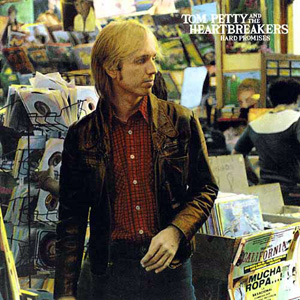
A funny thing happened to Tom Petty on the way to his fourth album. For one, his growing fame turned his band into reliable hired guns for Stevie Nicks, who was recording her first solo album. And since he’d been cultivating a faithful fan base, MCA wanted to put his next album out at a $9.98 list price. Not wanting to saddle those fans with the extra dollar, Petty held his ground and eventually won that game of chicken. (Apparently he threatened to change the album title from Hard Promises to $8.98, and you can just barely make out that price on a cardboard box on the album’s cover.)

“The Waiting” is another in a growing line of fantastic Petty album openers, rife with singalong interjections and a compact but perfect Mike Campbell solo. And he delivers another one-two punch with “A Woman In Love (It’s Not Me)”, an exercise in dynamics. (It also helped that the fledgling MTV network kept these songs in heavy rotation back when they didn’t have many other clips to show.) “Nightwatchman” throws a little funk into the mix, but it’s far surpassed by “Something Big”, a short story that hints at a much larger situation over a drop-D tuning. From there, “Kings Road” serves much the same purpose as “Century City” on the last album.

“Letting You Go” is a slight song not helped by a self-conscious video, but “A Thing About You” has such a joyous sound, as summed up by the note on the lyric sheet: “raise both arms and repeat chorus”. “Insider” was supposed to be the album’s centerpiece, being a duet with Stevie Nicks, except that her recording of “Stop Draggin’ My Heart Around” confused consumers as to which album had which song. “The Criminal Kind” is another tough showcase for Mike Campbell’s slide under a Dylanesque vocal, and the album ends tentatively with “You Can Still Change Your Mind”, which is something of a tribute in itself to Brian Wilson’s “Caroline No”. A great way to finish.

With Hard Promises, Tom Petty started the ‘80s just as strong as he left the ‘70s, and his band looked like they were here to stay. But as shouldn’t be too surprising, the truth was not as perceived. For the time being, though, he could coast with another great album under his skinny belt.

Tom Petty and the Heartbreakers Hard Promises (1981)—4

Monday, August 10, 2009

Tom Petty 3: Damn The Torpedoes

Having been shuffled against his will around a couple of record companies, Tom Petty was under pressure to produce something of substance. With Damn The Torpedoes, he succeeded.

He found something of a kindred spirit in producer Jimmy Iovine, who’d cut his teeth engineering for John Lennon and would soon become a major mover and shaker in the business. Together they created a bond that would last through several albums, beginning with this fantastic collection of hit singles, should’ve-been-hits and downright great songs.

Starting off with “Refugee”, the band sounds tougher than ever, and Petty’s voice has finally found a palatable range. “Here Comes My Girl” sports a droning undercurrent supporting the Rickenbackers that would be heard as a trademark sound, while the vocals go from spoken to shouted to harmonic. “Even The Losers” is something of a statement of purpose, while “Shadow Of A Doubt (A Complex Kid)” manages to encompass both the Drifters and Bob Dylan. That’s four strong songs right there, to the point where the somewhat slight “Century City” can be forgiven.

“Don’t Do Me Like That” crashes open side two, and while it’s the best song on the side, it carries “You Tell Me” and “What Are You Doing To My Life?” through the snippets of ambient noise and studio sounds to “Louisiana Rain”, a pleasant stab at a Big Number. (Note: the original MCA cassette swapped the postions of “Shadow Of A Doubt” and “Don’t Do Me Like That”, which didn’t lessen the quality of either album side, but didn’t improve them either.)

Damn The Torpedoes was a breath of fresh air at the end of the ‘70s, going up against the likes of Led Zeppelin and Pink Floyd while Donna Summer and Gloria Gaynor held reign on the charts. With a couple of hit singles and strong radio support, his label wouldn’t try dumping him now.

Thirty years on, the people who decided such things put together an expanded version of the album for a Deluxe Edition. Rather than putting everything on a single disc, the bonus material was put on its own to jack up the list price. Two B-sides are repeated from the Playback box, along with a live B-side and two more songs from the same show. Much more interesting are the legendary outtake “Surrender” and an early take of “Refugee” that demonstrates how much it’s missing without Jim Keltner’s shaker.

Tom Petty and the Heartbreakers Damn The Torpedoes (1979)—4
2010 Deluxe Edition: same as 1979, plus 9 extra tracks

Friday, August 7, 2009

Tom Petty 2: You’re Gonna Get It

Rather than a quick follow-up, the second album from Tom Petty and the Heartbreakers took a while. You’re Gonna Get It! followed much of the same mold as the debut, with the added menace of the entire band staring down the listener on the front cover. There was only one song about “rockin’” this time, and a little more variety in the styles of the songs, which gives it the slightest edge over the debut.

“When The Time Comes” sets a blueprint for success, getting an awful lot out of three chords, then the title track gives Benmont Tench chance to add color in between the vocals, which teeter between menacing and longing. “Hurt” suggests a kind of deliverance from whatever misdeeds transpired in the first two songs. “Magnolia” is a template for a song he’d rewrite again and again, and better, while “Too Much Ain’t Enough” is built around a snaky riff pummeled into the wall.

Two big radio hits, “I Need To Know” and “Listen To Her Heart”, start off side two. The latter is another blatant Byrds homage—save the line about cocaine—while “No Second Thoughts” takes its influence from “Factory Girl” off Beggars Banquet, of all things. “Restless” makes the mildest dalliance with funk, and “Baby’s A Rock ‘n’ Roller” is really the only wince-inducing track here.

You’re Gonna Get It! is even shorter than the first album, so if somebody wanted to do us a big favor, they would put both albums on a single CD, as they really do go together. But record company shenanigans loom large throughout Petty’s story, and while the band was off to a good start, they couldn’t afford a third strike.

Tom Petty and the Heartbreakers You’re Gonna Get It! (1978)—3

Thursday, August 6, 2009

Tom Petty 1: Tom Petty and the Heartbreakers

Few performers have been more successful and consistent with minimal chords as Tom Petty. After spending the first part of the ‘70s trying to get signed out of Florida—up against the typical “Southern rock” fare in the area—he emerged on the national scene with a decidedly anachronistic sound and look for the time. With a band dubbed the Heartbreakers (not to be confused with Johnny Thunders’ group), he blazed a path of simple rock ‘n roll influenced equally by the ‘50s and the ‘60s. Petty’s songwriting made him the face and voice of the group, but without the support of the Heartbreakers it’s doubtful his career would have been so lucrative. Just ask Dwight Twilley, a contemporary of Petty’s just as interested in making a splash with a power pop sound, but without the gang of support Petty had. (He and buddy Phil Seymour would cross paths with Petty’s band repeatedly.)

Again, the band made the sound—Mike Campbell, one of rock’s best guitarists and Petty’s right-hand man; Benmont Tench, whose keyboards usually consisted solely of piano and organ, and that was all that was needed; Stan Lynch, with the killer touch on the drums and deft harmonies, at odds with his gruff antagonism to get Petty to rock harder; and Ron Blair, who had the unenviable position of playing bass in a band that had three others with experience on the instrument (everybody except Stan). But despite all that charisma, the skinny guy with thinning hair, spindly fingers and a strangulated voice was their frontman.

Their debut album made their mission pretty clear, with not one but two songs about “rockin’”. Songs like “Strangered In The Night” and “Fooled Again (I Don’t Like It)” add some dynamics, particularly when put up against such slower, soulful tracks as “The Wild One, Forever”, “Mystery Man”, and “Luna”. The mushmouthed “Hometown Blues” has something of a party atmosphere but goes by pretty quickly. But if the album is remembered for anything, it would be for “Breakdown” and the Bo Diddley-meets-the Byrds pastiche of “American Girl” (which Roger McGuinn said he heard on the radio and wondered when he’d recorded it). Either song will probably be played on an FM station near you sometime in the next hour.

It’s a short album, with ten songs totaling a half-hour. Here’s a case where sequencing is key, as the cassette version completely jumbles the lineup, with only the side-starters constant and ending with “American Girl”. As with most MCA cassettes, avoid that one.

Tom Petty and the Heartbreakers Tom Petty and the Heartbreakers (1976)—3

Wednesday, August 5, 2009

Paul McCartney 16: Press To Play

It had been less than two years since his last album, yet it seemed like eons since we’d heard from Paul McCartney. When the abysmal “Spies Like Us” single was released on Capitol, there was hope that the Columbia years were the result of a temporary jinx, even if the song itself didn’t take away our dread. Naturally, there was the usual talk that this new album would be a return to form. Press To Play didn’t exactly take the world by storm, but at least it was encouraging.

“Stranglehold”—not the Ted Nugent song, but that would have been interesting—is a strong, subtle start, but “Good Times Coming/Feel The Sun” is his latest feeble attempt to stick two songs together. “Talk More Talk” has various spoken word segments going in and out of it in an attempt to be surreal and is predictably annoying as a result, “Footprints” is a pretty folk tune that would have fit right in on Back To The Egg. (This, like the bulk of the album, was written with Eric Stewart, who’d been hanging around since Tug Of War and was under the mistaken impression that he’d fill Denny Laine’s old role.) The side is redeemed with “Only Love Remains”, the album’s big ballad. Had it come out when he was still the king of the Top 40 single it would have been huge.

Instead, “Press” was the first single, and it still isn’t very good, though this could be because we still remember the video wherein Paul rides the Tube to appear inconspicuous while singing the song at his fellow travelers. “Pretty Little Head” is another strange experiment (Hillmen? Ursa major?) that pulls together various disparate parts for no discernable reason. Luckily, “Move Over Busker” and “Angry” take us back to the Rock before it’s too late. The big finale “However Absurd” is supposed to bring Sgt. Pepper psychedelia to mind, but it tries too hard to be obscure. (George would do it much better with “When We Was Fab”, but thumbs up to Paul for anticipating the following year’s Sixties nostalgia.)

As a unit Press To Play isn’t as awful as it sounds, and certainly was a step up from his recent worst, but it just doesn’t gel like it should. The packaging was uninformative but made the most of the gatefold sleeve, with Paul’s drawings showing the stereo spectrum for each track so you can listen to the album through headphones and follow along with the mix. (The CD has some extra tracks—”It’s Not True”, “Write Away”, and “Tough On A Tightrope”—that only make it worth buying over the LP version for completeness’ sake.)

He was about to take his longest sabbatical yet. By the time his next album came out, Neil Finn (with Crowded House) had released two albums that both out-McCartneyed the man himself.

Paul McCartney Press To Play (1986)—3

Monday, August 3, 2009

U2 3: War

Ah yes, the third album. The album where a band who made such an impact with their debut only to stumble on the follow-up has to really stretch to ensure that they’ll be allowed to make a fourth, fifth, tenth and so on. With War, U2 were under a lot of pressure, and luckily for them—and their fans—they succeeded.

There’s still plenty of so-called “Christian” content here, but it takes a back seat to the local and world politics with which Bono (mostly) would be known for stirring up. Ten years after John Lennon wrote about “Sunday Bloody Sunday”, this band made it a household phrase, under a tattoo of drums and a riff so simple it’s amazing nobody else had come up with it first. “Seconds” is another anti-war tune, sung by The Edge in a voice that still sounds like Bono. “New Year’s Day” was suitably released as the album’s first single that January, and it still evokes images of the boys standing shivering in the snow from the video. While it’s the piano most people remember, the bassline shows Adam Clayton to be the band’s most consistently underappreciated member. Speaking of which, “Like A Song…” is a buried anthem that doesn’t get as much exposure. The side, while not quite perfect, ends with the much gentler, haunting “Drowning Man”.

On CD, the mood is killed by the tribal plodding of “The Refugee”, the one track on the album not produced by Steve Lillywhite, but rather a guy whose claim to fame would be unleashing Riverdance on pop culture. Luckily, “Two Hearts Beat As One” stabilizes the equilibrium with an actual love song. The female voices that start “Red Light” also seem out of place, but don’t they sound hot? “Surrender” is longer than it should be, but nods to the types of pyrotechnics The Edge would explore on future albums. And it all fades down with “40”, a reinterpretation of an actual Psalm that audiences would continue singing long after the band finished their final encores.

War resonated with fans old and new, some of whom actually took the time to study some of the political issues Bono was yelling about. Almost 30 years later it doesn’t sound dated, but retains a cohesive sound that we’d forgotten had been so influential. Now U2 had gained the clout to explore new sounds and ideas, but first they had tours to complete. (The bonus disc on the deluxe edition is unfortunately a disappointment, with too many remixes of the same two songs taking up two-thirds of the program. But at least the remainder included some elusive B-sides, including the moody “Endless Deep” and some live versions that tax Bono’s throat. “Angels Too Tied To The Ground” is an unfinished outtake from the album sessions, and welcome.)

U2 War (1983)—
2008 Deluxe Edition: same as 1983, plus 12 extra tracks