Friday, January 15, 2010

David Bowie 22: Never Let Me Down

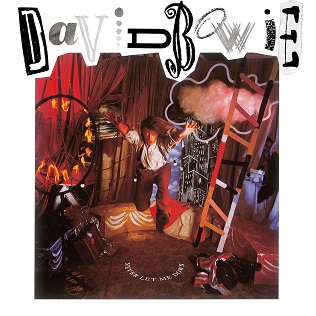
It seemed that just when fans thought Bowie couldn’t put out a worse album, he did. Never Let Me Down had very little to recommend it, except as a showcase for guest lead guitarist Peter Frampton, who got ovations on the heavily theatrical tour that followed.

The opening singles “Day In Day Out” and “Time Will Crawl” made a strong one-two punch, and still set toes tapping today, despite the dated sound. Unfortunately, they were about as good as the album got, which isn’t saying much considering all that follows. “Beat Of Your Drum” starts out in a mysterious tempo (for this album, anyway) before giving way to a plodding, generic midtempo rocker that beats the metaphor into a pulp. The title track got some play on FMradio, being something of a love song with a Lennonesque falsetto, but much speculation was given to “Zeroes”, with its nostalgic opening reference to a performer named Ziggy and the electric sitar chiming through the verses.

The rest of the attention went to “Glass Spider”, which was the centerpiece of the big expensive tour. All the storytelling of Labyrinth is distilled into a big production involving a narration that deflates any tension that the eventual chorus is supposed to ride, which is too bad, since that chorus is pretty catchy. Strangely, the mood segues neatly into “Shining Star (Makin’ My Love)”, up until the baffling appearance by Mickey Rourke rapping on the bridge. “New York’s In Love”, “’87 And Cry”, and “Too Dizzy” are indistinguishable from each other, making the side seem even longer; up until “Bang Bang”, a cover of an obscure Iggy Pop song (surprise!), the rest of the album is intolerable. (Turns out the LP version is shorter than the CD by about five minutes; maybe he was doing us a favor?)

We once called this album “a waste of space,” and while it’s still a low point, some perspective has treated it more kindly, but not excusing it. At this point in time, Bowie had finally become the brand name he’d spent his early years dreaming of being, but his lack of substance had become quite worrisome. The music he chose to support his songs was canned and sounded uninspired, and has since dated horribly. Even the man himself wasn’t too kind to this album over the years; when it was reissued with bonus tracks (two B-sides better than the album tracks plus yet another song from a soundtrack) he even went so far as to remove “Too Dizzy” from the original sequence. This only improved side two by making it that much shorter.

A drastically remixed version of “Time Will Crawl”—which was probably the track that aged the best of all of them—emerged on a compilation during Bowie’s semi-retirement, and he apparently was so keen on redoing the album that some of his final collaborators did just that following his death. As included in the Loving The Alien box set, Never Let Me Down (2018) was a gastronomical deconstruction of the album, preserving the vocals, replacing synth drums and canned horns with real ones, adding real strings, and halving tempos. A few tracks weren’t that different, though “Zeroes” was turned inside out, “Glass Spider” and “Bang Bang” given more gravitas, and Laurie Anderson redid the rap on “Shining Star”. “Too Dizzy” is still absent. Even listening to it from this fresh perspective only underscores that the songs weren’t that good to begin with.

David Bowie Never Let Me Down (1987)—2
1995 CD reissue: same as 1987, plus 3 extra tracks (and minus 1)
Wednesday, January 13, 2010

David Bowie 21: Tonight

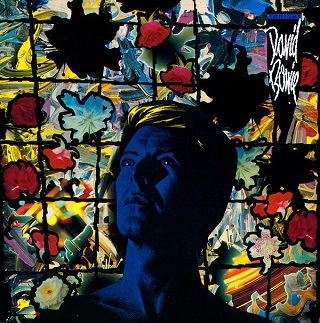
Amidst his newfound—or rather, regained—superstar success, Bowie managed to throw together another album. The continually derided Tonight wasn’t much of a departure sonically, leaving some critics and fans to accuse him of playing it too safe. In addition to the horn section, that damn marimba is on practically every track. Once again it’s a grab-bag of truly bizarre remakes, along with some collaborations designed to send some royalties the way of his old friend Iggy Pop.

The opener, “Loving The Alien”, is his own composition. It’s something of a muddy meditation on organized religion, and suffers from dated production, but it’s still worth revisiting. A jazzy reggae take on Iggy’s “Don’t Look Down” has a nice groove, but the version of the Beach Boys’ “God Only Knows” is just hideous. The recently revived Tina Turner, in the midst of her own comeback, joins him for a tepid version of “Tonight” in a dull reggae arrangement that doesn’t include Iggy’s original intro, which made it clear that the song was being sung to an overdose victim. So a strong start, and a letdown.

Side two also teases promise. “Neighborhood Threat” is a faster version of Iggy’s superior grungy track; it has a few good lines, but that’s it. But finally, with “Blue Jean” we get a song that’s up there with his best of the decade, even if it did get lashed to an overindulgent video. The remainder of the album isn’t really worth mentioning, but we have to: two more co-writes with Iggy—the travelogue “Tumble And Twirl” and a duet on “Dancing With The Big Boys”— sandwiching a horrible version of the old ‘50s chestnut “I Keep Forgettin’”.

Since the good parts were so good, it was truly a shame that the rest of Tonight was so disappointing. Perhaps his enjoyed sobriety kept him from getting too out there, preferring to do guest spots like the embarrassing “Dancing In The Street” with Mick Jagger for Live Aid. Some extracurricular soundtrack work was added as bonus tracks to a reissue of Tonight in the ‘90s, including “This Is Not America”, his collaboration with Pat Metheny for The Falcon And The Snowman, the superior theme for the otherwise ignored Absolute Beginners, and one track from the Muppets-meet-the-Ewoks experiment that was Labyrinth. (He contributed a total of five slick songs to that soundtrack, along with his “acting” services.) These were not included on the 1999 reissue.

David Bowie Tonight (1984)—2
1995 CD reissue: same as 1984, plus 3 extra tracks

Monday, January 11, 2010

New Radicals: Maybe You’ve Been Brainwashed Too

One of the better one-hit wonders of recent years came from a guy so used to being rejected that he turned his back on stardom once it came knocking. New Radicals—hardly new, nor that radical—was largely the work of one Gregg Alexander, who’d already put out two albums nobody bought under his own name on two major labels. Somehow the third time was the charm for this band, which consisted mostly of studio musicians (one of whom has been playing with Paul McCartney since the turn of the century) plus Danielle Brisbois, a singer/actress known mostly for her work on Broadway in Annie, on TV in Archie Bunker’s Place, and on Skinemax in Big Bad Mama II.

If they’re remembered at all these days, it’s for “You Get What You Give”, which most people think is called “You Got The Music In You”. It’s an incredibly infectious tune, even if you don’t dance, endorsed by people as diverse as the Edge, Ice-T and Joni Mitchell. At first few listens, the rest of Maybe You’ve Been Brainwashed Too sounded like an unholy cross between World Party and Jamiroquai: great grooves but you’d heard them all before. But after a while, it was hard to ignore pop this tasty.

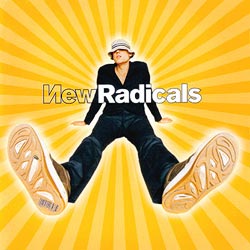
Vocally, Alexander occasionally resembles Karl Wallinger, the one man behind the band World Party, making that a good frame of reference for New Radicals. For the most part the album has a clean sound, with lots of guitars and piano, and few production tricks. Not everything works; the “title track” is mostly a mumbled jam with printed lyrics not even close to what he’s really saying. For the most part you don’t want to listen to the words anyway. The “hip” drug references seem typically contrived for the bucket-hatted white kid on the cover, and in the case of “I Hope I Didn’t Just Give Away The Ending”, the story isn’t worth paying attention much deeper than the music. “Mother We Just Can’t Get Enough” and “Jehovah Made This Whole Joint For You” continue the promise of the groove in “You Get What You Give”, while “Someday We’ll Know” (later covered by Hall & Oates, on a version featuring Todd Rundgren), “Gotta Stay High” and “I Don’t Wanna Die Anymore” are almost pretty, and even romantic. Somehow nobody figured out that “Crying Like A Church On Monday” is actually “Sweet Sweet Surrender” by Beck, Bogert & Appice with a hook in the chorus.

Just as the album was about to really take off—around the time of the second single—Alexander pulled the plug. Since then he’s concentrated on production work and songwriting for the likes of Carlos Santana in his modern-day big-name collaboration phase. In other words, he came, he saw, and he went away. But as long as “You Get What You Give” still sounds so good, we can be glad he bothered to show up.

New Radicals Maybe You’ve Been Brainwashed Too (1998)—4

Friday, January 8, 2010

David Bowie 20: Ziggy Live

In the wake of the phenomenal success of Let’s Dance, RCA strove to prove they were no dopes when it came to cashing in on their onetime golden boy. First came Golden Years, a collection of some of the more obscure songs he’d performed on that summer’s Serious Moonlight tour, complete with a contemporary photo that screamed exploitation. Much more effective was Fame And Fashion; subtitled “David Bowie’s All-Time Greatest Hits”, it was an enjoyable expansion of Changesonebowie, with a handful of welcome singles from the latter half of the ‘70s.

In between, however, came the long-awaited film of the final performance of the Spiders From Mars from 1973, accompanied by the soundtrack album. Ziggy Stardust: The Motion Picture delivered most of the show from the Hammersmith Odeon, from the opening crunch of “Hang On To Yourself” to the closing “Rock ‘N Roll Suicide”, before which Bowie famously announced Ziggy’s retirement. It’s a good gig, covering the singles and album tracks and adding a few live-only rarities, like Jacques Brel’s “My Death”, the Velvet Underground’s “White Light/White Heat”, and even his own “All The Young Dudes”, which somehow fits into a medley incorporating “Wild-Eyed Boy From Freecloud” and “Oh! You Pretty Things”. The band had also expanded to include a two-man horn section, plus old friends John Hutchinson on guitar and Geoffrey MacCormack (the future Warren Peace) on backing vocals. (Unfortunately, Jeff Beck’s special appearance for the encores was not included until the third reissue of the album.)

It may not have been the Spiders’ greatest performance—Mick Ronson is a little out of tune, as usual—but it was a historical one. Fans who’d already shelled out for David Live and Stage might have wished they hadn’t had to wait ten years for this. The film itself is worth a watch too, though we wonder why the lighting seemed to consist of a single red bulb.

The album has been issued on CD twice, first by Rykodisc in the ‘90s rollout, and again ten years later in a “30th anniversary mix” by Tony Visconti, which not only better balanced the sound but restored the program to the actual setlist, adding more spoken passages (but not the Jeff Beck portion) plus intro and outro music by Wendy Carlos borrowed from the Clockwork Orange soundtrack, and extending the songs to their complete lengths. Twenty years after that, the film was digitally restored, and both that and the upgraded album finally got to use the Jeff Beck segment, possibly in the wake of his death that year. Now we can finally hear him duel with Ronno over a medley of “The Jean Genie” and “Love Me Do”, and add his talkbox magic to a frenzied “Round And Round”.

David Bowie Golden Years (1983)—3
David Bowie
Ziggy Stardust: The Motion Picture (1983)—
1992 Rykodisc: same as 1983
2003 30th Anniversary 2CD Set: same as 1983, plus 14 minutes of content
2023 50th Anniversary Edition: same as 2003, plus 2 extra tracks
David Bowie Fame And Fashion (1984)—4

Wednesday, January 6, 2010

David Bowie 19: Let’s Dance

After what seemed like an eternity, Bowie resurfaced with his wackiest image to date: he was just a normal guy! Let’s Dance seemed to be designed to get people to do just that, with a slick production courtesy of Nile Rodgers and a commercial sound spiced up with horns and a new hot guitarist named Stevie Ray Vaughan.

Side one is simply stellar. “Modern Love” is the rousing opener, complete with honking sax; it still holds up today as one of his best, even though the whole “church on time” thing doesn’t make much sense. “China Girl” is a remake of an Iggy Pop song from The Idiot, and was a surprising hit single. The title track was the world’s first introduction to his new sound, and it was better absorbed in the single edit. (However, you do get a bit more Stevie Ray on the album version, if you like that sort of thing.) The underrated “Without You” ends the side with a low-key love song.

Side two isn’t as strong, unfortunately. The impenetrable “Ricochet” is about as experimental as this album gets, and it’s much too long. “Criminal World” is a cover of an older New Wave song that sounds very much like him, while “Cat People (Putting Out Fire)” is an inferior remake of his way cool movie theme from the year before. The album limps to a close with “Shake It”, which is just dumb. You’ll want to go back to the hit singles on side one, and likely leave that side on your turntable.

In addition to the sound, Let’s Dance was something of a gamble in that only five of the eight songs were “new”; this would prove to be a trend. When it appeared, it seemed a little too mainstream than what we’d expect, but he was rewarded with his biggest sales ever, along with stadiums of new screaming fans. Today it seems a little silly, and exists to give diehards something to argue about. (A mid-‘90s reissue upped the ante by including the classic “Under Pressure” collaboration with Queen as a bonus track; this has since been replaced with the standard eight-song program.)

David Bowie Let’s Dance (1983)—3
1995 CD reissue: same as 1983, plus 1 extra track

Monday, January 4, 2010

Rolling Stones 14: Let It Bleed

Let It Bleed finds the Stones in transition. Recorded over the better part of a year, it straddles the brief period where Brian Jones was on his way out and Mick Taylor was on his way in. But while the band was in flux, they made every song count.

“Gimme Shelter” creeps in with that spidery guitar and spooky backing vocals, setting a tone of genuine unrest. Then it’s back to the Delta (just like on Beggars Banquet) for the lonesome blues of “Love In Vain”. The difference is that this time, he’s watching the train leave instead of getting on it. “Country Honk” is a cowpunk version of “Honky Tonk Women” (the current single, not on the album) with different lyrics and a nice little strum. “Live With Me” gets its fire from Keith on bass and a few stolen Chuck Berry licks along the way. The side ends with the title track, filthy as ever, and thankfully that Amstel Light commercial went out of rotation before we had to kill someone. (While we’re at it, we still haven’t forgiven Elton John for stealing its melody for “Sad Songs (Say So Much)”.)

“Midnight Rambler” is a mini-blues opera in four parts, with that wailing harp and Charlie keeping time like a clock. This one would gain power onstage. Keith shines like a dirty diamond on “You Got The Silver”, in a way that’s almost gentle. (The story goes that Keith had to sing this because Mick wasn’t around; however, a Mick version does exist, but it pales compared to Keith’s.) “Monkey Man” is a tour de force, with every instrument doing its part, plus Nicky Hopkins keeping up on piano. This is easily one of their best-ever songs, and certainly one of the least known. On this album, however, it’s only a setup for the grand finale in “You Can’t Always Get What You Want”. Prefaced for some reason by the London Bach Choir, the song builds and builds through its verses before bringing the choir back in as counterpoint. Your enjoyment of this say may be tempered by how many times you’ve heard it, or how many times you’ve sung it drunkenly while staggering through New York City.

Let It Bleed fits perfectly in the catalog, part of the suite from Beggars Banquet to Sticky Fingers, but we’re getting ahead of ourselves. It’s a classic, right down to the deceptively innocent cover. (Just so you know, that old-fashioned record changer includes a cake, a bicycle tire, a pizza, a clock, a tape canister, and a plate. The photo on the label was retouched to include Mick Taylor instead of Brian.) There’s not a clunker in the bunch. At this point they truly were contenders for the best band in the world, and headed off to Altamont to claim the title. (As with Beggars Banquet, the anti-Beatles continued their own 50th anniversary campaign with another box that included the album in stereo and fold-down mono on both CD and vinyl with a book and a 45 replica. No outtakes.)

Rolling Stones Let It Bleed (1969)—5

Friday, January 1, 2010

Joni Mitchell 1: Song To A Seagull

She’d already gotten royalty checks from other people doing her songs, but with this simple debut, Joni Mitchell became a household name. Accompanied mostly by an acoustic guitar in inscrutable tunings, her clear soprano weaves in and out of delicate melodies and allegories, mostly going back to the idea of a young woman finding her independent way in the world, repeatedly asserting her need to be “free”.

While the album’s producer is listed as David Crosby, to this day he insists that his involvement consisted solely of keeping anyone from getting in her way, thus enabling her music to appear without distraction. Joni says that his inexperience guided his decision to have her sing into the piano, resulting in a mix that often sounds very murky. Luckily, it doesn’t hamper the quality of the music.

In classic album fashion, it’s split not only in two sides, but two themes, beginning with the city. From the first song, she proclaims where she’s already been (“I Had A King”) and declares repeatedly “I can’t go back there anymore.” But “Michael From Mountains” suggests that nothing is final. “Night In The City” turns up what little volume there is on the record, before the twin haunting portraits of lonely people in “Marcie” and “Nathan La Freneer”—the former a single woman, the latter a touchy cab driver.

Side two literally takes us down to the seaside, presumably by way of “Sisotowbell Lane”. “The Dawntreader” puts us on a ship, gently rocking through the verses. “The Pirate Of Penance” is tough to follow without the lyric sheet; someone may or may not have been murdered, but there has certainly been a seduction. “Song To A Seagull” restates the theme of each of the album sides, putting us back on a boat and soaring overhead. The final chord is exhilarating. But it’s “Cactus Tree” that will stick in your brain, not just because it’s the last song on the album, but because of its portrayal of a woman, despite the best efforts of several suitors, who’s simply “too busy”—and therefore happy—“being free.”

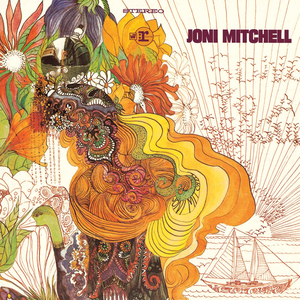
Song To A Seagull is the album’s actual title, spelled out by the birds on the cover, though it was known simply as Joni Mitchell for about thirty years. The mistaken title works just as well. It is her own creation, right down to the artwork. This is a special album, and set a high mark for her to follow.

Joni Mitchell Song To A Seagull (1968)—