Saturday, March 5, 2011

Big Star 4: Live

While Big Star wasn’t well known in their time, those that had experienced them firsthand generally agreed that their few live performances weren’t exactly stellar. But when the band became trendy in the early ‘90s, Rykodisc managed to pad their catalog with a live performance recorded by a Long Island radio station two months after Radio City was released, and after bass player Andy Hummel had quit.

Live presents the band, now reduced to a power trio with an unfamiliar bass player, plowing through two short sets of songs from their two albums, stopping halfway through for a quick interview and an acoustic set by Alex Chilton. The fluctuating levels inherent in most radio studio performances can be distracting, making the band sound even shakier than they already are. Alex is still depending on the same Strat tone he used all over Radio City, but he does a good job of covering all the guitar parts while straining to hit some of Chris Bell’s high notes. His disdain for the record business is apparent in both his between-song comments and the interview, and he gives the most of himself in a cover of Loudon Wainwright III’s groupie anthem “Motel Blues”.

While not as essential as their studio albums, people clamoring for anything from Big Star were happy to ingest Live, as it was the only official record of the band (well, part of them, anyway) in concert. That would change.

A few years later, another CD snuck out on a tiny label. Nobody Can Dance is split between a March ’74 rehearsal for that Long Island radio show and a short, pitch-problematic Memphis set from a few months after. The sound is even better (for the most part) than the Ryko set for the first half, while the second half provides proof that they not only played “Baby Strange” back then, but even included “The Letter”, presumably by audience request, an acknowledgement of Alex’s teenybopper past. Typically perverse, they do it in the slower Joe Cocker arrangement.

Big Star Live (1992)—3
Big Star
Nobody Can Dance (1999)—3½

Friday, March 4, 2011

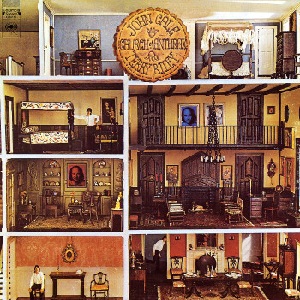
John Cale 2: Church Of Anthrax

Terry Riley is best known among casual rock fans as the titular (and musical) inspiration for the Who’s “Baba O’Riley”. Those who dug deeper from another part of the spectrum might have caught his name on a collaboration with John Cale, late of the Velvet Underground.

While it was recorded before Vintage Violence, Cale’s solo debut, Church Of Anthrax is very much in the shadow of that comparatively conventional release. Being funded by CBS Masterworks (the classical arm compared to Columbia), this is a pointedly experimental album, at times challenging, but occasionally mesmerizing. (The pair had met some years previously, when both were involved with avant-garde composer LaMonte Young.)

The title track is very reminiscent of Riley’s “A Rainbow In Curved Air”, the direct influence on Pete Townshend’s “Baba” synth work. A burbling bass plus drums holds down the drone while Riley’s organ wanders on top and various horns punctate. Soon a soprano sax can be heard, sometimes resembling a viola, and the track continues to build, before finally coming to something of a conclusion that predicts King Crimson’s “Sailor’s Tale”. Some distant piano chords herald “The Hall Of Mirrors In The Palace Of Versailles”, which is a showcase for two weaving soprano sax tracks. But for a few discordant moments, it’s hypnotic.

“The Soul Of Patrick Lee” is the only “song” on the album, its lyrics as dense as Cale’s back liner notes. It’s also the only track that sounds of a piece with Vintage Violence. Interestingly, the vocalist is not Cale, but one Adam Miller, whose voice and phrasing strongly resembles that of the auteur, if a tad smoother. The duelling pianos and frenetic drums on “Ides Of March” will likely try anyone’s patience, while “The Protege” is a more tightly constructed one-chord vamp that stays steady until it’s abruptly snuffed out in a burst of electronic feedback.

With the appearance of improvisation, much of Church Of Anthrax is more in keeping with Cale’s background, and the direction he preferred for the Velvet Underground. The album goes in and out of print fairly regularly, but there’s enough interest from people with the clout to keep it available to make it so.

John Cale and Terry Riley Church Of Anthrax (1971)—3

Wednesday, March 2, 2011

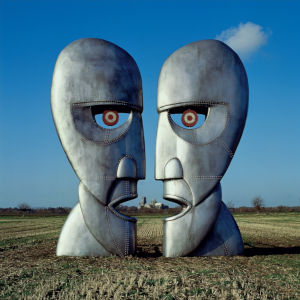
Pink Floyd 16: The Division Bell

Seven years is a long time between albums for anybody, but since the Roger-less Pink Floyd had toured for about two of those years, their follow-up wasn’t that long in coming. But what made The Division Bell a better album was that it was pretty good; designed as a band collaboration with all three members on board—albeit with Gilmour’s wife given several co-writing credits—it has enough of the classic Floyd vibe throughout to make it a worthy successor to their old albums.

It starts, as it should, with a lengthy instrumental to set the mood. “What Do You Want From Me”, driven by an electric piano, doesn’t have to stretch too far to resemble “Have A Cigar” to remind the kids who this band is. The first real surprise is “Poles Apart”, with its spiraling acoustic guitars and smooth steel, marred only by a midsection that visits a carnival midway for some reason. “Marooned” is another instrumental that’s just plain bleak, followed by the recent history lesson of “A Great Day For Freedom” and the redemption of a lush chorus. And Rick Wright gets his first solo vocal in decades on the depressing “Wearing The Inside Out”.

The second half of the album is a little more cheery. “Take It Back” is built around trademark delayed guitar riffs, delivered in a style more akin to U2. There’s something about the way the tempo cuts in half for the last lines of the chorus, setting up for the dreamy intro to “Coming Back To Life”. The cowbell on that track gets maddening after a while, but the solos are classic Gilmour. “Keep Talking” is the most blatant expression to be the theme of the album, a plea for communication, and notable for the computerized appearance of Stephen Hawking. “Lost For Words” brings back the jaunty acoustic, and despite another bridge that travels to a boxing ring, brings the album down to earth with the blunt description of what his “enemies” told him when he asked “to wipe the slate clean”. The finale returns us to Grantchester Meadows amid the tolling of Parliament bells for “High Hopes”, which, despite its morose grandiosity, still yearns for a simpler time.

Naturally, Waters dismissed the album as the sloppy work of imposters, pretenders to his throne, and in some ways, he’s correct. But while it doesn’t reach the same level as the band’s ‘70s peak, The Division Bell—as does, to a much lesser extent, A Momentary Lapse Of Reason—succeeds by capturing some of the Pink Floyd magic that was sadly missing from nearly everything Waters had done since going on his own. Thus, the band gave the people what they want. (Waters, in comparison, tended to tell the people what they want, and pouted when no one agreed with him.)

By spearheading the revival of Pink Floyd, David Gilmour made the smart move. As the guitarist, composer and singer, he was able to sell his solo work via the Pink Floyd label; work that wouldn’t (and didn’t) sell much outside of the core Floyd audience. That’s a shame, as his actual solo albums were just as melodic and commercial as either of the two last Floyd albums, but without the pretension.

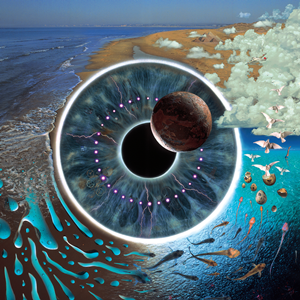
But following the release of the obligatory double live album Pulse, which repeated half of Delicate Sound Of Thunder but sported a complete performance of The Dark Side Of The Moon as well as a great take on “Astronomy Domine”, Gilmour must have felt that his mission was accomplished. Outside of continual repackages, it seemed like there was never to be another new Pink Floyd album.

Pink Floyd The Division Bell (1994)—3½
Pink Floyd Pulse (1995)—2½

Sunday, February 27, 2011

Roger Waters 3: Amused To Death

Undeterred in his quest to strive forward without his former bandmates, Roger Waters first mounted an all-star performance of The Wall in recently liberated Berlin. “All-star” is up to personal preference, with appearances by the Scorpions, Van Morrison, Bryan Adams, Joni Mitchell, Cyndi Lauper, Thomas Dolby, and of course, Jerry Hall.

In the absence of the other guys, he went back to work at an album kicking around since the end of the Radio K.A.O.S. tour. Amused To Death started out as a continuation of that story, but morphed in the process into a more general rumination on the effects of mass media, and how it’s dumbed down society. Without a linear plot to shackle its progress, the listener doesn’t feel forced into trying to follow whatever story is buried between the lines and within the obligatory sound effects. Naturally, war is still front and center of his main complaints, framing the program with an interview with a veteran of the First World War, and mixing in references to recent battles in the Gulf and Tianenmen Square. Throughout we can hear the sound of TV channels changing.

Having already used Eric Clapton, this time he turned to Jeff Beck to have a distinctive lead guitarist in the absence of David Gilmour. (Steve Lukather from Toto shows up too, among other “special guests”.) After the opening montage—including a heartbreaking narration by an old soldier speaking of leaving a comrade to die in no man’s land—“What God Wants” combines pounding drums, a one-note theme and a list-style lyric, but there are a couple of bridges that weave in a decent transition. An abrupt switch to “Perfect Sense Part I” wanders for a while underneath a backwards message—kind of futile when most listeners wouldn’t have a way to decipher it on their cassette or CD players. The vocals make a welcome switch to the soulful voice of P.P. Arnold (reminiscent of “Home” from K.A.O.S.) “Part II” of the song then becomes a setup for a Marv Albert commentary on an oil rig attack, complete with cheering crowd effects, continuing over the “In The Flesh”-style arrangement (booming drums again, and Hammond organ) of “The Bravery Of Being Out Of Range”. “Late Home Tonight” marries an acoustic guitar to chirping bird effects for hardly the first time in a Waters anti-war statement, but the strings are lovely and literally blown away for an even sadder second part. “Too Much Rope” even gets Floydian towards the end, but his delivery works against the novelty of profanity to keep it from being catchy.

“What God Wants Part II” continues the litany of the first part, without much variation; “Part III” has a nod to “Echoes”, then works around the bridges from the first part at a mournful tempo. Don Henley shows up to duet on “Watching TV”, an otherwise excellent attempt to humanize the Chinese massacre that’s undermined by the title and repeated references to the victim having “yellow” and “perfect breasts”. Something of a dark Dire Straits song, “Three Wishes” takes far too long to deliver its theme (surprise! The singer forgot to wish for love) and the vocal effects on the genie’s voice are distracting. “It’s A Miracle” is even slower, wandering for eight minutes before culminating in a rant against Andrew Lloyd Webber. Finally, the title track works in a mood similar to “The Tide Is Turning”, but with a much less hopeful theme.

While not exactly uplifting, Amused To Death is certainly the least annoying of his non-Floyd albums. The thing is, unlike the band he left, he wasn’t able to devise more than a handful of songs with memorable hooks. Also, being designed for the CD format, it’s lengthy at 72 minutes, with individual tracks in the six- to nine-minute range. It could easily have been shorter, but just as Roger insists on singing his own lyrics (P.P. Arnold on “Perfect Sense Part II” notwithstanding) he’s never been his own best editor. It must have irked him no end to see the album only sell a million copies, while the other guys made a mint two years later with The Division Bell. It also must have taken its toll, as for over two decades following this album, he would only release a handful of new songs, concentrating instead on an opera and various restagings of The Wall.

Some 23 years later, at a time when the human condition hadn’t seemed to improve any, a remastered version of the album was released, sporting not only different cover art, but a few sonic tweaks throughout. Where the 1992 CD utilized QSound for what was then state-of-the-art realistic sound reproduction, the ubiquity of 5.1 surround and other advances aimed to even out a very crowded sonic template. To the ordinary ear, the biggest difference was the substitution of the originally planned sample from 2001: A Space Odyssey at the start of “Perfect Sense Part I” that was refused by Stanley Kubrick, replacing the backwards message inserted in response. Jeff Beck fans will also be keen to hear the revamped guitar parts on “The Bravery Of Being Out Of Range”, while Don Henley is a little more audible on his featured track. It’s still a harrowing listen.

Roger Waters Amused To Death (1992)—3

Saturday, February 26, 2011

Beach Boys 1: Surfin’ Safari

The legend of the Beach Boys began modestly, with a novelty song about surfing that few could have dreamed would kick off careers that would last decades. Equally unlikely was the band’s name, almost arbitrarily concocted to help sell the one record. Naturally, any follow-ups would have be along the same theme, right?

The Beach Boys were a family affair, led by middle-class musical genius Brian Wilson, with his younger brothers in the band, their cousin Mike Love singing most of the lead vocals, and a friend helping out on guitar. They played basic rock ‘n roll, but with the added bonus of multipart harmonies influenced by doo-wop and the Four Freshmen. Something else to consider was just how young these kids were. Brian had just turned 20; Mike was 21 (and already losing his hair). Lead guitarist Carl Wilson was not yet 16, drummer Dennis Wilson not yet 18, and rhythm guitarist David Marks had just turned 14. And they made a pretty rockin’ little combo.

Despite the strides made by Frank Sinatra and Johnny Mathis in the evolution of the long-playing record, in 1962 albums basically collected hit singles, their B-sides, and whatever else hurriedly recorded to fill up two sides. The dozen tracks on Surfin’ Safari filled that requirement, but as Brian was determined to make great records that would endure as art, he tried harder than most people under the thumb of a manager—who was also his and his brothers’ father, as well as the singer’s uncle—and the producers more concerned with simple commerce than whether the album was any good. Brian cared about the kids who would buy and listen to his records, because he was one of them.

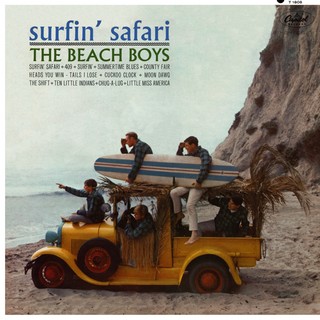
While Brian wrote and arranged all the music, he had help in the lyrical department, mostly from Mike, and also from one Gary Usher, an aspiring musician who would one day become a producer of note. For now, he would help Brian concoct the vignettes that would support the cover photo of wholesome suburban white boys in search of the next wave, or maybe a beach bunny or five to keep them company on the shore.

The title track is a catchy call to arms, loaded with all the right lingo and namechecks, as good an advertisement for the surfing industry as any. “County Fair” describes a different kind of summer fun, the verses broken up by a carnival barker and a sweet lovely begging her fella to win her a prize. However, “Ten Little Indians” has not aged well, being a nursery rhyme dotted with further racist references, and “Chug-A-Lug” is an ode to the pleasures of drinking root beer. Dennis takes the dreamy lead vocal on a cover of “Little Girl (You’re My Miss America)”, and a hint to their depth of subject matter is “409”, a song about a car with actual engine-revving sound effects.

The indie single that led to their Capitol contract, “Surfin’”, starts off the second side, and it’s clear that Brian had already progressed, just as “Heads You Win, Tails I Lose” shows he hadn’t yet figured out how to write about romance. “Cuckoo Clock” is even squirmier, a lament about the wall adornment that interrupts woo-pitching attempts. Their cover of “Summertime Blues” is very close to the Eddie Cochran original, and “Moon Dawg” was a surf instrumental from a few years earlier, livened up by some Beach Boys dog-barking. Finally, “The Shift” attempts a novelty song about a dress.

Seeing as most of the early Beach Boys albums were less than a half-hour long, their first release on CD had them wisely packaged as “two-fers”, offering two consecutive titles in stereo (when available) with bonus tracks and liner notes. This certainly provided value for one’s dollar when the albums couldn’t always stand alone. Of the extras added from the Surfin’ Safari sessions, “Land Ahoy” would be reworked a year later as “Cherry, Cherry Coupe”, and “Cindy Oh Cindy” begins with their overbearing (to say the least) father Murry barking, “Knock it off.” (Note: Surfin’ Safari was originally released in mono and what Capitol called Duophonic, which everyone else called “fake stereo”. Every CD version of the album has had the mono mix, two-fer or not.)

The Beach Boys Surfin’ Safari (1962)—2½
1990 CD reissue: same as 1962, plus Surfin’ U.S.A. album and 3 extra tracks

Friday, February 25, 2011

George Michael: Listen Without Prejudice

While it took the second Wham! album to make George Michael a household name, he’d had a pretty busy couple of years in the spotlight. Yet despite his success, and perhaps thanks to some controversy along the way, he just wasn’t happy, as evidenced by all the photos of him sporting a knotted brow.

He obviously wanted to be taken seriously as An Artist, as opposed to the pretty boy with the tight jeans and stubble. Therefore, the marketing campaign for his sophomore solo album, the dangerously titled Listen Without Prejudice, Vol. 1, was stark and simple, with barely a photo of the boy anywhere. The music, he warned, was a little more subdued as well. But it really wasn’t that much a departure, considering such slow jams as “Father Figure” and “Kissing A Fool” had been among the several hit singles from Faith. There was, however, a whole lotta acoustic guitar on the album, mixed as high as the “Funky Drummer” samples that drive the faster songs.

Still, those seeking another fun CD to listen to on the way to aerobics class would have been a little impatient, and that’s their loss. The focus is on melody and message, as evidenced by the first single, the lovely and dare we say Beatlesque “Praying For Time”, slathered in guitars and bathroom tile echo. Chances are they skipped ahead to “Freedom! ‘90”, which separated itself from the earlier Wham! song by concentrating on his own beefs. (The risqué supermodel-heavy video helped distract from the angst.) A reverent cover of the obscure Stevie Wonder song “They Won’t Go When I Go” adds to the feeling of defiance, and the preaching continues on “Something To Say”, which today seems to have inspired Extreme’s “Hole Hearted”. The jazzy “Cowboys And Angels” was probably just too long for people to grasp, smooth as it is.

“Waiting For That Day” might have been a bigger hit if it hadn’t quoted from “You Can’t Always Get What You Want”, thus jettisoning half the royalties to Allen Klein. Similarly, the anti-war sentiments of “Mother’s Pride” jarred with the patriotism during the Gulf War. Another upbeat acoustic track, “Heal The Pain”, made more sense some eighteen years later when it was rerecorded as a duet with Paul McCartney; here the layered voices can distract. “Soul Free” brings back the beats, before an even more understated reprise of “Waiting” closes the big statement.

Already pissed off at his label, George was even more irritated when Listen Without Prejudice failed to sell by the bucketful, prompting him to shelve plans for a more upbeat Vol. 2 and pout about the injustice of it all for several years. While he would put out the occasional single, he made more headlines for his fights with the label and the various policemen who caught him misbehaving in public restrooms. Meanwhile, now that Faith has been expanded in a deluxe remaster, perhaps some of the curious will take the opportunity to truly listen, with or without prejudice, to its troubled follow-up. Given the chance, it deserves to emerge as a collection of excellent, caricature-free pop, and a lot better than they might expect.

George Michael Listen Without Prejudice, Vol. 1 (1990)—3½

Wednesday, February 23, 2011

Rolling Stones 37: Rock And Roll Circus

Way back in 1968, around the time of the original release of Beggars Banquet, the Stones decided to promote it with a TV special built around the concept of a variety show, with guest performances and their own mini-concert set. It was then shelved immediately after filming completed, ensuring that Rock And Roll Circus became one of the most legendary unreleased projects of the rock era. (Incidentally, Michael Lindsay-Hogg can claim involvement in two such deals.)

Its legend only grew when one of the performances, the Who playing a fantastic version of “A Quick One”, was included in their 1979 movie The Kids Are Alright. With its status as a notoriously incomplete event, it was particularly surprising when the film (and matching CD) was released intact a good 28 years after the original taping.

It was worth the wait. Rock And Roll Circus is an amazing snapshot in time, showing the Stones at a key place in their development, playing “Jumpin’ Jack Flash” and four songs from Beggars Banquet, and previewing “You Can’t Always Get What You Want”. Even Brian Jones played with enthusiasm, adding some slide guitar despite one hand in a cast. (He’d be dead the following July; indeed the liner notes make mention of all the participants who’d passed on in the interim.) And of course, we always like hearing Nicky Hopkins play piano.

The guests are revealing, as well. Taj Mahal wasn’t well known anywhere yet, and Jethro Tull still sounds like a blues band. Marianne Faithfull sings one song sweetly, and the Who did indeed blow everyone else off the stage with their definitive take on “A Quick One”. The most surprising performance was that of the Dirty Mac, a supergroup involving Eric Clapton, Mitch Mitchell, and Keith Richard (on bass) backing John Lennon for a rendition of “Yer Blues” from the just-released White Album. Unfortunately, the same combo continues playing behind Yoko Ono, in a sloppy jam you’ll be happy to skip.

When it finally came out, Rock And Roll Circus did indeed live up to its hyped legend. One only wishes that the bands could have played more songs, and longer. They did, after all.) But what’s there is what there was, and the program flows nicely on CD. Finally.

Over the years various DVDs offered bonuses in the way of additional footage and multiple angles, but it took another two decades for any further audio to be released. Nothing was added to the main program, but the deluxe expanded package added a second CD with three further Taj Mahal songs and Brian’s introduction of two pieces by classical pianist Julius Katchen (who would beat Brian to the grave by a couple of months due to cancer). Most exciting are three more performances by the Dirty Mac: an alternate take of “Yer Blues”, a long-bootlegged “Warmup Jam”, and even a passable attempt at “Revolution” that breaks down when John says he doesn’t remember what to do for the solo; why he didn’t just ask Nicky Hopkins, who played it, is lost to the ages.

The Rolling Stones Rock And Roll Circus (1996)—4
2019 Deluxe Edition: same as 1968, plus 9 extra tracks