Monday, February 13, 2012

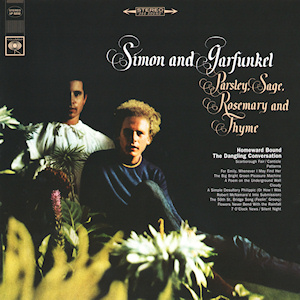
Simon & Garfunkel 3: Parsley, Sage, Rosemary & Thyme

Helped along by well-timed singles, Simon & Garfunkel reached a level of excellence on their third album. Parsley, Sage, Rosemary & Thyme exists in a private world of chamber pop, wherein traditional folk melodies mesh with suburban angst and wry commentary. If there’s anything negative to be said about it, it’s that it’s so short. But there’s a lot of quality crammed into those quickly played songs.

“Scarborough Fair/Canticle” is possibly the most famous version of this old English folk song, already borrowed heavily by Bob Dylan for “Girl From The North Country”. Here the haunting melody is juxtaposed against an original Simon anti-war lyric. “Patterns” interrupts with percussive guitar, insistent bongos and spooky organ, and the music finally lifts on “Cloudy”, despite its uncertain mood. “Homeward Bound” was already a hit single, recorded during the sessions for the second album, a vivid portrait of the lonely modern troubadour that doesn’t seem false in the least. Taking a step away from soul-searching, “The Big Bright Green Pleasure Machine” skewers commercialism (such as that which might even sell a few LPs). And “The 59th Street Bridge Song (Feelin’ Groovy)” was embraced by pot-smokers and pre-schoolers alike, possibly due to Simon’s second use, in a title even, of that archaic word.

“The Dangling Conversation” gets knocked for its pretentious tone, but that’s to be expected from the characters in the song. It’s still a lovely, sad song. The equally well-constructed “Flowers Never Bend With The Rainfall” wouldn’t sound out of place on a Monkees album, but it was actually recorded the previous year alongside “Homeward Bound”. A title like “A Simple Desultory Philippic (Or How I Was Robert McNamara’d Into Submission)” already sounds like a Dylan parody, which it is. Some of the pop-culture rhymes are very clever, and the impression is so pointed that Simon comes off of as just a little envious of his labelmate. It’s only fitting that this piece is followed by “For Emily, Whenever I May Find Her”, an excellent candidate for Art Garfunkel’s greatest performance and an ode to the ultimate imaginary woman. The guitar strums faster and faster to an unresolved end, only to give way to a portrait of a graffitist in “A Poem On The Underground Wall”. And lest anyone get too comfortable, “7 O’Clock News/Silent Night” pits a typically harrowing modern news broadcast against a pastoral reading of the Christmas carol.

Its generally down atmosphere notwithstanding, Parsley, Sage, Rosemary & Thyme is an enticing album, a work of art. Despite the rock combo heard on the songs that require one, the overall sound comes from the voices and acoustic guitar, with the barest embellishments, putting Simon & Garfunkel on a tier all by themselves. They knew they had something special, and the album’s importance in the biz was underscored by Ralph Gleason’s small-print liner notes, which may help illuminate some of the references.

Simon and Garfunkel Parsley, Sage, Rosemary & Thyme (1966)—4
2001 CD reissue: same as 1966, plus 2 extra tracks

Friday, February 10, 2012

Pete Townshend 13: Quadrophenia Demos

Following the overblown and heavily expensive Live At Leeds Super Deluxe Edition, Pete revived another old project for a similar expansion. Unlike the Lifehouse Chronicles box, which he sold through his own e-commerce site, Quadrophenia got the full support of one of the last remaining major labels. A Deluxe Edition presented the album bolstered by eleven of Pete’s demos, but real fans would be tempted to skip that for the so-called “Director’s Cut” version, which retailed for about $150. This doorstop of a box included the 1996 remaster of the album, a DVD of some 5.1 surround sound tracks to emulate how the original quadraphonic mix might have sounded, a 45 of the “5:15”/“Water” single with the French picture sleeve, a poster and a packet of replica documents (a la Leeds). Oh, and there was also an inch-thick LP-sized book of liner notes by Pete, and two CDs of original demos.

That right there was the kicker. We’d heard teasers from his tape cache on the Scoop albums, but a glimpse into the evolution of his last true masterpiece hadn’t gone beyond a couple of tracks, and only a smattering had made it out on bootleg. While marketed as a Who album, Quadrophenia: Director’s Cut offers up 25 of Pete’s demos chronicling the development of the concept, including several ideas that, in the long run, were wisely abandoned.

The sequence mirrors the final album, with some of those alternate threads placed within an approximate context. What’s more, many of the Who’s completed versions were built from Pete’s demos, so we can hear how much was in place to start with. As expected, many of the intricate synthesizer parts were carried over, while John and Keith were able to lend their respective bass and drums stamps in place of Pete’s guides. Similarly, John’s multiple horn parts are only hinted at on the demos.

As mentioned, Quadrophenia is more of a portrait than a story with plot, but that didn’t prevent Pete from trying to give Jimmy the Mod some history. Many of the discarded songs were intended to flesh him out somewhat, and they certainly would have slowed the album down had they stayed. Interestingly, the three “new songs” included on the film soundtrack LP made up that back story: “Get Out And Stay Out” is a simple sketch sung by Jimmy’s parents, “Four Faces” explores the split personality angle, and “Joker James” (written years before) showed his failure with women. Another romantic song, “You Came Back”, had been on Scoop with no info on when it was recorded, so this context gives it and entirely new perspective. “Get Inside” and “We Close Tonight” (the latter included on the expanded Odds & Sods with vocals by Keith and John) were supposed to depict Jimmy as a frustrated musician; luckily this was replaced by the confrontation of “The Punk And The Godfather”, which here is sung as a dialogue simply titled “Punk”.

The remaining “three sides” worth of songs follow as we’re used to them, with a few exceptions. “Anymore” is a soul-searching ballad replaced by the already-completed “Is It In My Head?”, and two unreleased instrumentals fill the spot where we’d expect to hear “5:15”. (There was never a demo for that song, as it evolved from a studio jam.) The book reveals “I’ve Had Enough” to be a dialogue between Jimmy and his father. Another dialogue comes in “Is It Me?”, which concerns the Ace Face turned “Bell Boy” and his father; the Broadway delivery doesn’t do justice to the theme, which was eventually only presented as part of “Doctor Jimmy”. “Drowned” appears fully formed from a March 1970 demo session. (In another revelation, “The Rock” was originally supposed to end the album, swapping places with “Love Reign O’er Me”, the loud finale of which was spliced from the original band take of “The Rock”.)

If there’s a quibble about these discs, it’s that several pieces are missing. Two tracks that appeared on Scoop aren’t here, and his liner notes make references to additional demos that would be available on Q-Cloud, an online repository of photos and documents related to the project. As of this writing, a message on the site declares that those extra demos “have had to be omitted.” (Pete always did have trouble talking before thinking.)

Quadrophenia was never a happy album, though generations of confused teenagers have been able to take strength from it. Listening to the elements of the Director’s Cut, we’re left feeling even more sorry for Jimmy, with so many of his conflicts spelled out instead of merely mentioned. Indeed, the process of writing and completing the album took its toll on Pete’s sanity and threatened the future of the band. But overriding all that is the wonder that a guy in his late-20s, armed only with instrumental ingenuity, a fertile imagination and the latest technology he could cram into a room in his house, could create something so universal all on his own.

Pete Townshend Quadrophenia: Director’s Cut—The Demos (2011)—4

Wednesday, February 8, 2012

Velvet Underground 9: Peel Slowly And See

The catalog department at PolyGram was especially fond of the Velvet Underground, and just in time for their induction into the Rock and Roll Hall of Fame came the box set. Peel Slowly And See attempts to present the most complete portrait possible of the band, and does a pretty good job at it. Each of their four albums are included in their entirety—the third album in its alternate “closet” mix, and Loaded, licensed from Atlantic and featuring, for the first time, the full-length takes of “Sweet Jane” and “New Age”. A few of the more important selections from VU and Another View appear in context, as do two tracks from Nico’s Chelsea Girl.

Naturally, it wouldn’t be a box set without unreleased rarities. Of immediate historical significance is the entire first disc, a distillation of a recorded rehearsal held around 1965 by Lou, Sterling and Cale. It consists of several takes each of “Venus In Furs”, “Heroin”, “Waiting For The Man” and a hootenanny-style “All Tomorrow’s Parties”, along with the tedious “Wrap Your Troubles In Dreams” (later given to Nico) and the Dylanesque “Prominent Men”. It’s not exactly fascinating, but gives an idea of what they sounded like before meeting Maureen and Andy Warhol.

Other demos scattered throughout the set include “Here She Comes Now”, “Countess From Hong Kong” and a few pre-White Light songs that sound downright folky. Seven outtakes from Loaded were a big deal (until Rhino’s expanded version of the album went even deeper), being mostly songs Lou would later rerecord on his own.

The set also includes a few live recordings, such as the experimental “Melody Laughter” and “Booker T”, both edited from longer improvisations and both of which led to “Sister Ray”. “What Goes On” comes from Doug Yule’s first appearance with the band.

While it’s not absolutely complete, Peel Slowly And See is an excellent, comprehensive overview of the band. By including all four albums, it saves the trouble of having to buy each of the albums on their own. (Unless, of course, you need all the alternate versions on the expanded Nico and Loaded CDs, and later anniversary expansions.) It even featured a peelable banana on the box top. Hence the name.

The Velvet Underground Peel Slowly And See (1995)—4

Monday, February 6, 2012

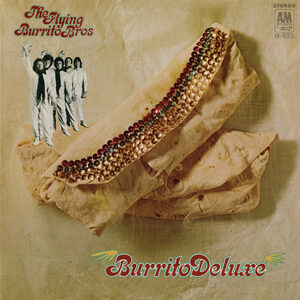
Flying Burrito Bros 2: Burrito Deluxe

For a while there it looked like the Flying Burrito Brothers would be around for a while. They even played at Altamont, thanks to Gram Parsons’ friendship with Keith Richards. (They can be seen for about two minutes in the Gimme Shelter film, right after the naked fat guy, playing “Six Days On The Road” before fights start in the crowd.)

As tight as the first album was, Burrito Deluxe is not as focused, and a little disappointing. Despite Chris Hillman moving back to bass and introducing future Eagle Bernie Leadon on guitar, Parsons didn’t do as much, and the lousy mix obscures the novelty of having fellow former Byrd Michael Clarke on lackluster drums.

There are some okay moments, like the stellar cover of the Stones’ “Wild Horses” released before their version. The other covers are more rote country songs, except for the chaotic stab at “If You Gotta Go”, an obscure Dylan song people started covering around then. At just over a half hour of music, one is left feeling unsatisfied. What made the debut so striking—the originals, the odd R&B transformations—is absent here, so everything sounds very ordinary.

Some people worship every note that Gram Parsons played, so this album is fine for them. True to form, he barely stuck around for the Burritos either; they fired him after Burrito Deluxe, which gave him more time to do smack with Keith Richards, and eventually recorded two of his own albums before succumbing to alcohol and morphine. As for the Burritos, they had two more albums that most notably added a guy who would eventually start Firefall, before sputtering out, then reforming without Hillman and revolving through several other members, including the occasional latter-day Byrd. Nitpickers will likely only care about the first two albums, which are nicely compiled in toto on Sin City: The Very Best Of The Flying Burrito Brothers, alongside three other tracks from the original band.

The Flying Burrito Bros Burrito Deluxe (1970)—2

Friday, February 3, 2012

Police 5: Synchronicity

“Every Breath You Take”, “King Of Pain”, and “Wrapped Around Your Finger” were the soundtrack of the summer of ’83. Or at least that’s how it seemed in the northeast corner of America. Three songs about troubled relationships provided something an antidote for the music from Flashdance otherwise stinking up the airwaves. And they all came from the pen of one man, who considered himself the face of The Police.

Stingy had a pretty strong hold on the band at this point, even considering his high-profile acting gigs, so it’s likely out of weariness to argue that that other two let him drive the direction of Synchronicity. A photo of him perusing the theory was prominent in the packaging, though even people who’d heard of Carl Jung before might have wondered what all the hubbub was.

A cycling synth and short phrases reels off “Synchronicity I”, which manages to rock despite a minimum of chord changes. “Walking In Your Footsteps” isn’t much more than a drum pattern with guitar effects and a basic melody about dinosaurs. The whole thing sounds pretty prehistoric. “O My God” at least sounds like a decent jam, with a reference to “Every Little Thing She Does Is Magic” at the fade. Despite its intricate backing, the awful vocal on “Mother” is guaranteed to clear any room anywhere within five miles, to the point where the deceptively short yet catchy “Miss Gradenko” sounds like the band of old. “Synchronicity II” matches a suburban nightmare with a mysterious beast signifying doom. It’s an excellent performance from the whole band, the drums and particular that buried guitar flourish on the fade offsetting Sting’s vocal.

“Every Breath You Take” follows a I-vi-IV-V sequence, proving once again that the simplest ideas will endure. And yes, it’s about stalking, and not at all romantic, but that melody is just so pure and so sweet, it’s no wonder this got to be so huge. “King Of Pain” takes a long time to get rolling; was it that important to repeat the entire first verse? And why does he pronounce “thing” like Ricky Ricardo would? Luckily the choruses provide relief, and the brief guitar solo mirrors the melody nicely. Bookended by another lengthy atmosphere, “Wrapped Around Your Finger” mines additional literary territory, with a cool, menacing lyrical twist at the end and another killer chorus. Those three songs are so strong that “Tea In The Sahara” seems barely there. Predominantly a bass-and-vocal song, if the other guys added anything, it’s mostly been mixed out except for Stewart’s hi-hat work.

Released with seemingly infinite artwork variations, Synchronicity was a huge hit, driven by a high-profile tour. (The warm-up act for seven dates? R.E.M.) It truly works as an album, with even the most jarring segments fitting within the flow. People who bought the cassette—or the CD, if they were early adopters—got a surprise ending in “Murder By Numbers”, a nicely macabre B-side that profoundly changes the album’s frame. It was certainly a long way from the punky trio of Outlandos d’Amour. Synchronicity showed how the band had truly developed. However, they’d had it with each other.

A year after its 40th anniversary, it became the first Police album to receive the deluxe expanded treatment. The basic double-CD included a remastered version of the album (including “Murder By Numbers”), which unfortunately made some of its once-cool sounds come off as dated, plus a second disc of B-sides and rarities. Most of these hadn’t been available for ages, including several live performances, a so-called “remix” of “Truth Hits Everybody”, the Sting-sung parody “Every Bomb You Make” from a Spitting Image TV episode, backing tracks for “Every Breath You Take” and “Roxanne”, and two odd remixes by Stewart Copeland. But for fans, the real meat is in the Super Deluxe Edition, which devotes two discs to demos and alternate versions of each of the album’s tracks, as well as tracks that didn’t make the album. Two more discs contain a live show from the tour, and different from the one that was already used for some of the aforementioned B-sides and sampled for 1995’s Live! double-disc.

The Police Synchronicity (1983)—3½
2024 Deluxe Edition: same as 1983, plus 18 extra tracks (Super Deluxe Edition adds another 55 tracks)

Wednesday, February 1, 2012

Simon & Garfunkel 2: Sounds Of Silence

Since Dylan had successfully made the leap from acoustic to electric, producer Tom Wilson experimented with a song from the first Simon & Garfunkel album that was getting some airplay. By adding electric guitar, bass and drums to the song in question, all of a sudden the duo had a number-one hit with “The Sound Of Silence”. Which meant it was time to make another album.

Luckily for the new folk-rockers, Simon had been busy busking around London and writing new material (as displayed on his UK-only solo album released that fall, and subsequently mined back in America). So Sounds Of Silence came together in time for the new year, with the hit single version of “The Sound Of Silence” and its B-side, the dated “We’ve Got A Groovey Thing Goin’”, and “Somewhere They Can’t Find Me”, itself a rewrite of the title track of the first album, recorded earlier in the year and initially shelved. There is some further repetition within those; the “Anji” theme is previewed on “Somewhere They Can’t Find Me”, and adds the riff from “Groovey Thing” towards the end. Additionally, Simon seems to have a fixation on suicide: “Richard Cory” (based on a 19th-century poem) shoots himself, while “A Most Peculiar Man” succumbs to self-inflicted natural gas poisoning.

Nitpicking aside, Paul Simon was turning into an excellent songwriter. “Kathy’s Song” is a hypnotic love letter, while “Leaves That Are Green” and “April Come She Will” are stellar in their simplicity. “Blessed” is a little too dissonant for our tastes, but “I Am A Rock”, another hit single, is a catchy and telling in its defiance.

Sounds Of Silence rises past the certain curse of the quick cash-in. Not every tune is a gem, but the homework Paul had done busking in London pays off with excellent songwriting that strays from folk into the type of social commentary that would be his hallmark. (His only contemporary at the time was Ray Davies, whose tongue was much further into his own cheek. Where Simon saw despair and desolation, Davies suggested that a retreat to the old days would solve everything.) It’s also easy to see that the pair, now forced by commerce to work together, had already started to follow their own paths. Some songs are sung by one or the other, and many times Artie’s harmony seems like an afterthought. Because of the rushed nature of the album, the expanded CD from 2001 adds exactly one outtake from the main album sessions (a lovely reading of “Blues Run The Game”), padding the rest with three traditional songs recorded at their very last recording session in 1970.

Simon & Garfunkel Sounds Of Silence (1966)—3
2001 CD reissue: same as 1966, plus 4 extra tracks

Monday, January 30, 2012

Velvet Underground 8: Live MCMXCIII

Following Lou and John’s collaboration on the Andy Warhol tribute, one of the more improbable reunions occurred in 1993 when the original band, including Sterling Morrison and Maureen Tucker, got together for a tour. Unfortunately, it didn’t last long enough to make it out of Europe intact. (John blamed Lou, Lou blamed everyone else, and the other two had the class to keep their mouths shut about it all.)

Thankfully for those of us who missed out, their shows at L’Olympia in Paris were recorded by Lou’s team, and released later that year as a double-disc set (and a single disc distillation, also available in a limited edition covered in tiny peelable bananas). Their set pretty much stuck to the “hits”, with Cale taking the lead on two songs generally associated with Nico, as well as “I’m Waiting For The Man” and a giddy recitation of “The Gift”. Ever the professional, he even gamely learned the parts for the later songs they’d recorded without him. Maureen gets the spotlight for her two showpieces, to raves from the crowd, but the two new songs—the jokey “Velvet Nursery Rhyme” to introduce the band and the closing “Coyote”—don’t impress. In reflection of his career renaissance, Lou dominates Sterling on guitar, and peppers several of the songs with his more current vocal inflections. Still, the band sounded pretty good. “Hey Mr. Rain”, which hadn’t been played since they recorded in 1968, and had only resurfaced in 1986, gets a lengthy workout, beginning with nine minutes of Reed and Cale playing at each other, while Moe keeps the beat going like nobody else on the planet.

Live MCMXCIII also had a video counterpart, which is perhaps the best way to experience these four older, craggier figures interacting like jazz virtuosi. They’re very tight, if occasionally stiff, and we can be happy this particular moment was captured.

Sterling Morrison died two years later, and given Lou’s hamfisted control of the band’s legacy, as well as Cale and Maureen’s exasperation with him, the band was basically, finally over. But interest in the Velvets would continue to grow, just as it had in the ‘70s and ‘80s, and there would be more product to follow.

The Velvet Underground Live MCMXCIII (1993)—3