Saturday, April 19, 2014

Roger Daltrey 11: Going Back Home

What was left of the Who had been touring somewhat steadily with the idea that they’d keep showing up as long as tickets were sold, but they weren’t playing hundreds of dates a year. While Pete Townshend would occasionally mention some long-gestating project he was working on, Roger Daltrey had learned long before that he couldn’t just sit and wait for Pete to give him something to sing.

Still, once he got to his 70s and was all too aware that his voice might not last forever, Roger embraced the “if not now, when?” mentality common to rockers his age and got to work. A chance meeting with pub-rocker guitarist Wilko Johnson, who started out in Dr. Feelgood and had a brief stint with Ian Dury’s Blockheads, led to Going Back Home, Roger’s first solo album in twenty years, and first full-length non-Who collaboration ever.

With the exception of a surprising cover of Dylan’s “Can You Please Crawl Out Your Window”, the album consists mostly of rerecorded Johnson originals, taken from all eras of his career. (The photos throughout the packaging come from all eras too.) This is straight guitar-based rock ‘n roll, with no effects or pedals. The songs are all pretty tough, chock full of defiant lyrics over standard changes, though the regretful “Turned 21” is sung almost sweetly. The band includes two former Blockheads as well as Mick Talbot, once of the Style Council, on piano and organ. Sadly, it’s not Roger blowing harmonica at all, but he struts and growls his way through the tunes like he must’ve back in 1964. Meanwhile, Wilko plays guitar like he’s hitting the strings with a brick, and never misses a note.

At just under 35 minutes, Going Back Home gets the job done. Besides giving Roger some songs worthy of his voice, the album also raised Wilko’s profile at a time when he needed a boost, having been diagnosed with inoperable cancer. As it turned out, he would outlive the original terminal diagnosis by almost ten years. (About six months after its initial release, a Deluxe Edition offered an extra disc filled up with one session outtake that should have made the album, one radio edit, three songs from the album sung by Wilko and not Roger, six live tracks without Roger, and six tracks with.)

Wilko Johnson/Roger Daltrey Going Back Home (2014)—3

Friday, April 18, 2014

Jimi Hendrix 24: Valleys Of Neptune

Jimi had been dead nearly forty years when the family switched up their licensing yet again. A new deal with Sony Legacy worldwide meant snazzy new digipack editions of the three Experience albums, plus several of the MCA titles from the ‘90s. And of course, they also offered something “new”.

Valleys Of Neptune attempts to present a possible follow-up to Electric Ladyland, focusing mostly on material recorded in 1969 with the original Experience. Because technology had advanced to perform all kinds of magic, and because the Experience was splintering at the seams, such an album would not have existed in this form. Several tracks are re-recordings of earlier material, showing off how they’d developed on stage over time, and three even include overdubs added by Noel and Mitch in 1987. That means we have further variations on “Stone Free”, “Hear My Train A-Comin’” (both previously cannibalized in the mid-‘70s), “Fire” and “Red House”—each with their own charms, but “definitive”? Hardly, especially when they fade mid-song. “Bleeding Heart” was tried several times that year, and this one is tight and funky.

The title track promises buried treasure, being an unreleased song, and it’s pretty good. However, it matches a 1970 Billy-and-Mitch take with a vocal from nine months earlier. Still, this is what purists call an “out-fake”. “Mr. Bad Luck” is an earlier version of “Look Over Yonder”, just as “Lover Man” doesn’t have its “Here He Comes” subtitle. (Both were overdubbed in 1987; negligibly superior versions are on South Saturn Delta.) A lengthy instrumental version of “Sunshine Of Your Love” includes a conga break and a bass solo to fill up the better part of seven minutes. A title like “Lullaby For The Summer” suggests something entirely different to the raucous riffing it actually contains, while “Ships Passing In The Night” is a sloppy precursor to “Night Bird Flying”. Finally, “Crying Blue Rain” begins like another slow blues, with some “amen” vocalizing along the lines of “Power Of Soul”, eventually picking up speed and fading out. (If you bought the CD at Target, you also got a de-Douglased “Trash Man”, plus an Experience jam titled “Slow Version”.)

Thanks to the aforementioned technological magic, everything on Valleys Of Neptune sounds terrific. But each installment of release-worthy studio tracks only muddies the picture further, ultimately sinking the attempt to create a hypothetical “lost album”. The world will never know what he might have done with all these recordings; luckily the above-average quality of it all makes it worth hearing.

Jimi Hendrix Valleys Of Neptune (2010)—3

Tuesday, April 15, 2014

Van Morrison 25: Hymns To The Silence

The key to a successful double album (which, until CDs took over, meant a two-record set of four sides) is that it maintains cohesiveness over its length, whether by a unifying concept or story (i.e. Quadrophenia), breadth of musical styles that avoid repetition (i.e. the White Album) or just plain terrific songs, one after another (i.e. Blonde On Blonde). Whenever a double album is said to be flawed, and that happens a lot, you can usually bet that the follow-up statement will detail how a single-disc distillation would have made it exponentially superior.

The PR on Hymns To The Silence was that Van Morrison had been too prolific for his record company to keep up with his output, even at the rate of an album a year. By 1991 he had two albums ready; hence this double CD designed to bring everything current. (Which didn’t explain why his next studio album didn’t arrive for another 21 months.) It’s not a concept album — unless the evil music industry, childhood in Belfast and contemplating silence are all connected, making most of his later work conceptual — and it’s not chock full of classic songs. That leaves just its musical variety, which it does have, but not enough to sustain 95 minutes.

Most of the first half is the borderline smooth jazz that worked on Avalon Sunset and, to a lesser extent, Enlightenment. “Professional Jealousy” is a little vague, but that can’t be said for “I’m Not Feeling It Anymore” or “Why Must I Always Explain”. In comparison, his yearning for “Ordinary Life” (the title track at one point) comes off thin; if he hates his job so much, why doesn’t he go back to cleaning windows? He’ll certainly never find “Some Peace Of Mind” with Candy Dulfer’s sexy sax around. While one song tries to send a message a la “Fool On The Hill”, referring to the subject as “Village Idiot” is about as gentle as calling him a retard. “Carrying A Torch” sets up some candidates for inclusion on rom-com soundtracks, of which “Quality Street”, written with Dr. John, is the high mark. (And as romantic as “Green Mansions” seems, all our mind’s eye sees is an asylum.)

There are some decent jump blues (“So Complicated”, “All Saints Day”) a cover of “I Can’t Stop Loving You” dressed up with Celtic touches from the Chieftains, and a couple of traditional hymns. “Be Thou My Vision” is pretty straight, but could use more Chieftains, but “See Me Though Part II” is fascinating juxtaposition of “Just A Closer Walk With Thee” with an extended monologue/rant picking up where “In The Days Before Rock & Roll” left off. Two other spoken pieces are equally compelling: the dreamy “On Hynford Street”, and the Hearts of Space-based “Pagan Streams”.

Amazingly, two of the better tracks both top nine minutes while staying within two chords. “Take Me Back” features him matching his vocal with his electric, and keeping up even when he’s singing through the harmonica stuffed in his mouth. The title track presents an equally satisfying performance, with sympathetic dynamics and melody.

Good Lord, but this is a long album. By our math there is a half-hour of excellent music, which could have been the basis of an excellent single disc. While a .300 average is good in baseball, that doesn’t fly at a $29.98 list price, even if the set does finish a lot better than it starts. Van had gained the clout to do whatever he wanted to, with enough critics hailing his every utterance as part of his storytelling legacy. But they don’t have to shell out thirty bucks for their copies, and Hymns To The Silence challenges the average listener to try and keep up with him. And if they decided to hop off the ride, well, that’s the tragedy of being a performer, isn’t it?

Van Morrison Hymns To The Silence (1991)—2

Friday, April 11, 2014

Genesis 3: Nursery Cryme

This is where Genesis becomes the band of legend, with Steve Hackett on guitar and Phil Collins on drums to complete the picture. Both were also songwriters, and were able to help create foundations upon which Peter Gabriel could weave tales of increasing weirdness and sexual preoccupation.

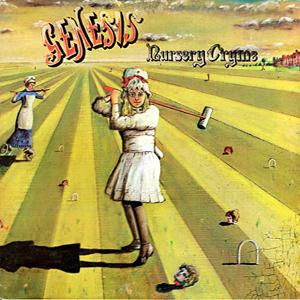
Besides being a clever pun, Nursery Cryme has cover art that neatly depicts the events leading up to the epic opening. As the lyric sheet helpfully points out, “The Musical Box” is a cry from the heart of a recently decapitated eight-year-old boy brought back from the netherworld when his nine-year-old murderess opens the eponymous toy. Filled with “a lifetime’s desires”, his hopes to play doctor and more with her accelerate to an uncomfortable level. Onstage, Peter would don an old man’s mask and gait, thrusting in rhythm; musically, the tension and foreboding suggested on the last album in “The Knife” improve here, leading to a glorious, neo-classical end. Phil makes his presence known on the second track, singing lead on “For Absent Friends”, but his voice sounds so much like Peter’s that it’s not immediately apparent. It’s a fairly brief duet for voice and guitar, soon taken over by “The Return Of The Giant Hogweed”. Where their contemporaries may have been lamenting the ecological damage done to trees, here Genesis chooses instead to sing of a plant threatening to destroy everything and everyone in its path. The music is more interesting than the lyrics, Tony Banks layering piano and organ, while the guitar and flute play precisely in unison. A change of pace with a heavily arpeggiated piano (ostensibly illustrating “the dance of the giant hogweed”, according to the notes) is nicely balanced too.

“Seven Stones” recalls the progressive folk where they started, but escalates to convey an awful lot of seriousness by the end. It’s hard to maintain, especially when followed by “Harold The Barrel”. Sung breathlessly in unison by Peter and Phil, this is a dark comedy about a guy on a ledge, from the points of view of various spectators. Their close harmonies are particular effective on “Harlequin”, another short trifle making way for another epic to takes out the album. “The Fountain Of Salmacis” gets another descriptive note on the lyric sheet, explaining how Hermaphroditus ended up with both male and female characteristics. While supposedly a standard tale in Greek mythology, it’s much improved by the musical elements. Beginning with a rush of organ and Mellotron, another world is immediately created, filled in expertly by the new guys and pointing the way to the next handful of albums.

They weren’t quite there yet, but Nursery Cryme at least sounds like a Genesis album. While its rating isn’t any higher than their first two, it’s certainly a better place to dive into the band.

Genesis Nursery Cryme (1971)—3

Tuesday, April 8, 2014

Crosby & Nash 5: Crosby-Nash

They could wait around for Neil to call, or see if Stephen wanted to do anything. Instead, while not exactly teeming with songs dying to be recorded, David Crosby and Graham Nash hooked up with some old and new friends for their first duo album in over 25 years.

And not just any album; Crosby-Nash was spread across two discs—one 45 minutes, the other half an hour—to give the impression that they really were teeming with songs dying to be recorded. They start strong with “Lay Me Down” and “Puppeteer”, both from the pen of James Raymond, Crosby’s long-lost son, with whom he’d reconnected in the mid-‘90s and started collaborating almost immediately. After that it gets pretty quiet—a little too quiet, especially if you’re waiting for an “Almost Cut My Hair” to blow the roof off the proceedings. Instead we get more immaculately recorded adult contemporary pop designed to accompany a gently swaying sailboat. Things pick up whenever the two harmonize, but as usual, they write separately or with anybody else in the band but each other, and cover people like Marc Cohn.

There’s nothing wrong with quiet and pretty; “Grace” is a very pretty piano interlude, but it’s used to set up an inferior song. “Luck Dragon” (again, written with James Raymond) comes close to rocking, while “Don’t Dig Here” (also written with guess who) gives Graham a chance to lament the environment over a riff that eventually rips off “Come Together”. “Michael (Hedges Here)” is a shaky but well-intentioned tribute to the late guitarist, who’s also credited with the arrangement of “My Country ‘Tis Of Thee” that closes the set.

Graham’s getting a little mushmouthed in his old age, and Crosby’s mellowed right with him, only the anger he used to exercise is now demonstrated by the warmed-over Steely Dan of “They Want It All”. He spends five minutes on the scat-sung “How Does It Shine?” (the answer: not as brightly as “Song With No Words” or even “Orleans”), the last minute or so turning into a faux-samba for anybody who misses Stephen Stills’ forays into the same. “Samurai” is an a cappella piece that obviously means something to him.

A shuffled “highlights” disc was made available around the same time, leaving some of us to wonder why they didn’t just leave it at that. Rather than alternating between the guys, the sequencing goes two and two, adding to the general tedium. Being the 21st century, it sounds great, thanks to ProTools and close miking. But there’s not a lot here that will compete with their old stuff.

Crosby-Nash Crosby-Nash (2004)—

Friday, April 4, 2014

Robyn Hitchcock 25: Goodnight Oslo

Having resigned himself to a future with a small but devoted fan base, Robyn kept writing, touring and recording, intent on staying active rather than changing the world. Goodnight Oslo wisely kept a good thing going, being his second release with the Venus 3, that tight little combo also busy being the guys not named Michael in R.E.M.

As has been his wont, he peeks around the gate before setting off. “What You Is” is a psychedelic soul number, with lines that emerge on the tenth listen, hiding behind the ladies’ vocals. “Your Head Here” sports a little whimsy like a refugee from the ‘80s, production tricks speeding up voices and even doubling Chris Difford-style. Keeping up the fun mood, “Saturday Groovers” is as catchy as anything he’s done, followed by the intoxicating “I’m Falling”. “Hurry For The Sky” is all Western, with dust and tumbleweeds permeating everything—not a common sound in the Hitchcock canon, and ultimately a gimmick.

“Sixteen Years” is more like it, with an arpeggiated guitar we expect—nay, demand from a song written partially by Peter Buck. Despite its Bo Diddley jazz intro, “Up To Our Nex” combines jangle, mandolins and mariachi horns for an addictive mix. The horns also pepper “Intricate Thing”, a pleasant little strum. The trippy “TLC” could also be an Egyptians refugee, except that the title stands for Tryptizol, Librium and Carbrital, which were among the drugs that killed Brian Epstein. Once that peters out, the title track taps insistently for six minutes, spinning mystery like a Norwegian “Year Of The Cat”.

Goodnight Oslo is the first time in, let’s say, sixteen years where he sounds like he’s making an album, rather than recording on the fly and embellishing as he goes. Maybe it’s the one-man horn section, used here as light dressing; maybe it’s Morris Windsor on backing vocals here and there. Whatever the secret ingredient, it further proves that he works best with a consistent unit supporting him. (And as had become almost automatic, early copies of the album included a bonus disc with two songs easily as good as anything else on the album proper.)

Robyn Hitchcock & The Venus 3 Goodnight Oslo (2009)—3

Tuesday, April 1, 2014

Billy Joel 15: Storm Front

Another lengthy break was out of character, and when Billy had another album ready, it was supposed to signify a change of direction. Longtime producer Phil Ramone was replaced by Foreigner’s Mick Jones, and most of the band was different, too. Beyond that, and for all its intention to rock, Storm Front was by-the-numbers adult pop, occasionally veering to social commentary, which was never one of his strong suits.

“That’s Not Her Style” picks up right where The Bridge left off, only with more harmonica. Most people likely skipped ahead what’s up next. Possibly his only novelty song, “We Didn’t Start The Fire” crams forty years of headlines into a distant cousin of “It’s The End Of The World As We Know It”, complete with sound effects (thankfully avoided for “JFK! Blown away! WHAT ELSE DO I HAVE TO SAY!”). He must have decided the song was long enough as it is, since he races through 25 years in the last verse. Also, the chorus has nothing to do with the rest of the song. “The Downeaster ‘Alexa’” is an “Allentown” for the fishing industry, with a title named after his daughter and a seafaring feel beating Sting by a couple of years. A true guilty pleasure is the undeniably catchy “I Go To Extremes”, with Liberty DeVitto pounding away and a few decent piano breaks. “Shameless” would become a smash hit (and apt description) for Garth Brooks in a few years, but here it has a near-Hendrix vibe, both in the delivery and the guitar parts. (Don’t ask us to elaborate further on that; it took us this long to get here.)

The title track rehashes “That’s Not Her Style”, in a slower tempo with an even more generic production, which provides a welcome opening for “Leningrad”, the first piano ballad here, and a sound that hearkens back to his earliest albums. Some of the lyrics are a little clumsy for a guy who’d actually been to the city in question, and only 20 minutes since that other history lesson. One of the better-constructed songs is “State Of Grace”, and one of the few not released as a single of any kind. Then “When In Rome” crashes in like the theme song for a sitcom, sung in his faux-Ray Charles voice. (Really, picture the opening credits for Family Matters or Perfect Strangers flying by, pastel colors and high top fades aplenty. Why hasn’t some TV producer grabbed this yet?) After a much-too-long ending, “And So It Goes” is a somber, romantic benediction. Despite its passing resemblance to the hymn “Jerusalem” (“And did those feet in ancient time”) it became something of a standard.

There’s nothing wrong with Storm Front, and it went on to sell four million copies in the US alone. Many of those would end up in used bins, but it was still a pretty good feat now that he was competing with Phil Collins for those yuppie dollars.

Billy Joel Storm Front (1989)—3