Tuesday, July 14, 2015

Jethro Tull 7: A Passion Play

Having convinced the world that their last record was an actual concept album and not merely a parody of one, Jethro Tull went whole hog with the formula and concocted one for real. A Passion Play followed the pattern of one song spread across two sides, only interrupted by a fairy tale. And instead of a newspaper, this time the packaging incorporated a program accompanying the alleged four-act stage performance. This helps change the impression that it’s just one song, as each of the acts is described with titles. However, these index points wouldn’t be fully utilized until the more elaborate CD reissues of recent years, so we’re not about to dissect each section with our usual drudgery.

If you listen long enough, read along with the lyrics and decipher the puns in the program, you might be able to follow the protagonist through his funeral, purgatory, limbo, Heaven, Hell and rebirth. Of course, any story on this scale needs music to carry it through, and A Passion Play has a lot to overcome. Having long abandoned blues, even folk takes a back seat to heavier prog, but the omnipresent flute and vocal tone of the auteur make it all too clear who this band is.

Heartbeats begin side one, which was apparently the law in 1973, giving way to an extended instrumental overture of sorts, Ian Anderson having added saxophones to his wind arsenal. The first song proper is mostly acoustic; “There was a rush along the Fulham Road” will be the most commonly repeated phrase throughout the next forty-odd minutes. The music turns harder as the side progresses, escalating through pointedly theatrical affectations, until another “hush along the Fulham Road” heralds a dance that closes the second act, to be interrupted by “The Story Of The Hare Who Lost His Spectacles”, narrated by bass player Jeffrey Hammond-Hammond in a broad, silly accent. (This originally ended side one with a “turn the page” sound effect, continuing on side two.)

The interlude is apparently just that, as the story proper picks up where it left off. The music is acoustic-based, but with an influx of synthesizers, making it heavier. A comparatively pastoral interlude is smacked aside by a trebly treated guitar riff, making things heavy yet again. The dénouement comes very close to the end of side two, and the show’s over.

A Passion Play is the most challenging Tull album yet, and the hardest yet to ingest. As there’s not really any “bad” music here, it’s enjoyable, but it can be exhausting trying to keep up with everything. In its current incarnation, with each of the formerly 22-minute sides split into smaller chunks, it’s a lot easier to revisit sections for familiarity. (The inevitable 21st-century upgrade added an extra disc of the sessions abandoned just before the Passion Play concept came together, plus DVD of surround sound mixes and video commissioned for the tour supporting the album.)

Jethro Tull A Passion Play (1973)—3
2013 An Extended Performance box set: same as 1973, plus 15 extra tracks (and 2 DVDs)
Friday, July 10, 2015

Pete Townshend 14: Classic Quadrophenia and Truancy

Back in 1972, The Who’s Tommy album was re-recorded and staged in an orchestral arrangement with an all-star cast. By the time it was recorded a third time with a different cast for the film, Pete Townshend had already spent 18 months putting together the band’s second released opera, Quadrophenia. While it never had the mainstream profile that Tommy has perpetuated, no thanks in part to the first work’s eventual Broadway success, Quadrophenia is the album that resonates more with Who freaks, and likely reminds its author less of his own troubled childhood.

Still, there’s plenty of gold in those hills, and as the band learned once they started performing it again in the ‘90s, technology has enabled them to recreate the album live on stage. Now that he lives with a classical arranger, it was easy for Pete to spearhead an orchestral version of the album.

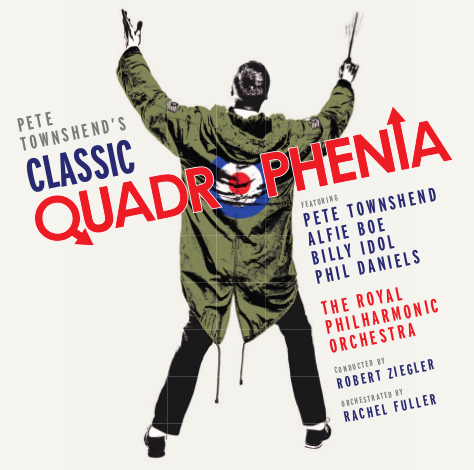
Pete Townshend’s Classic Quadrophenia (the composer having fallen to Paul McCartney’s tendency to put his own name within the title of a piece) is faithful to the original recording, except that there are no electric guitars, bass or drums. The elaborate synthesizer parts have been replicated and expanded by the orchestra and choir, and Jimmy’s lead vocal is tackled by one Alfie Boe, an operatic tenor (born the year the album first came out) who’s obviously studied Roger Daltrey’s parts closely. Pete himself sings the part of The Godfather, careful not to try the high note on “stutter”, while Phil Daniels, who played Jimmy in the film, appears twice in lines attributed to the dad. And Billy Idol, who was in the all-star performances in 1996, shows up four times as the Ace Face slash Bell Boy.

As the album was deemed “ineligible” for the classical charts, it will remain to be seen if this new incarnation will be anyone introduction to the music, and where that may lead. If you like the original, you won’t hate this, but you’ll likely play the original several times before even thinking about throwing this on.

Shortly thereafter, in advance of another threatened solo catalog overhaul, Pete released his second “hits” album, only two decades after the first one (and one decade after a double-disc anthology) and a period of time in which he released virtually no new solo material. Truancy runs chronologically and repeats about half of the original set, ignoring some fan favorites and the one “new” song included then. While some of the substitutions are debatable, any Pete album called “very best of” that doesn’t have “Slit Skirts” is false advertising, plain and simple. That said, the songs are pretty great, with the Scoop version of “You Came Back” a surprising inclusion. But the key selling point is the two new—yes, brand new—songs designed to entice the gullible. “Guantanamo” is further proof that he needn’t be political to be musically entertaining, and “How Can I Help You”, with its opening motif reminiscent of “Cut My Hair”, is suitably empathetic, and the kind of thing we wish he’d get off his duff and do more of already.

Pete Townshend Pete Townshend’s Classic Quadrophenia (2015)—3
Pete Townshend
Truancy: The Very Best Of Pete Townshend (2015)—3½

Tuesday, July 7, 2015

Kinks 3: Kinda Kinks

The third American Kinks album shared the title of the second British album, the same general photo, and nine of its tracks (of the remainder, two had already been on Kinks-Size and one would be held over), plus two recent singles bridging the sides.

Kinda Kinks is all Ray’s writing, with one obvious exception. “Look For Me Baby” is a clunky tune with Ray’s wife on prominent backing vocals, and Dave sings the countrified “Got My Feet On The Ground”, which he helped write. Both are harmless, but a real surprise is “Nothin’ In The World Can Stop Me Worryin’ ‘Bout That Girl”, a muted 16-bar blues following the same simple riff (later used quite effectively in Rushmore). Ray sings this one quite well, and hands “Wonder Where My Baby Is” over to Dave, who could relate to the lyrics, while he tackled the basic piano part. “Set Me Free” begins with that same chordal attack familiar from “You Really Got Me” and “All Day And All Of The Night”, complete with drums that sound like biscuit tins. But dig in some more and you’ll notice the subtle downward slope of the backing and a killer bridge. Near perfection in under two minutes and ten.

“Ev’rybody’s Gonna Be Happy” was a British A-side but an American B-side, repetitive but danceable. Everybody in London loved Motown, and the band’s take on “Dancing In The Street” isn’t any worse than any others that don’t have a horn section. “Don’t Ever Change” is another mild rewrite of “Stop Your Sobbing”, crossed with “Under The Boardwalk”, with a Spanish guitar adding Latin accents. That instrument is prominent on “So Long”, another deceptively simple-sounding song. The crunch returns, somewhat, on “You Shouldn’t Be Sad”, which balances a call-and-response vocal arrangement with some unexpected modulations. “Something Better Beginning” is an excellent rewrite of “Save The Last Dance For Me”, both lyrically and musically.

On top of everything else, Kinda Kinks shows how Ray Davies was developing as a writer before our very ears, and the band gamely kept up with him. It’s also the first Kinks album that can be truly recommended. Rhino’s CD followed the British listing, ignoring the American editions, but today’s deluxe version includes includes the songs from both sequences, and then some.

The Kinks Kinda Kinks (1965)—3
Current CD equivalent: Kinda Kinks

Friday, July 3, 2015

Jeff Beck 1: Truth

Besides being one of the most inventive, uncompromising guitarists of his generation, Jeff Beck is to be commended for having the same hairstyle for fifty years. One need only look at Nigel Tufnel to see the man’s influence.

After parting with the Yardbirds, the young axeman struck out for a solo career, but there was just one problem: he couldn’t sing. This is evident from his first single, the so-goofy-it’s-great “Hi Ho Silver Lining”, a record that included a more enduring B-side. The follow-up, “Tallyman”, wasn’t as embarrassing, nor as good.

Once it was established where his strengths lay, he put together a band that would attempt to set a precedent for a new kind of rock, balancing heaviness and lightness within the same song. A raspy kid named Rod Stewart would be his singer, bringing along Micky Waller on drums, while a chameleon named Ron Wood, already a guitarist on his own, would play bass. This lineup would record “I’ve Been Drinking”—used as the B-side to Beck’s instrumental butchering of the schlock classic “Love Is Blue”—before going on to record an album proper (incidentally, at Abbey Road in the weeks immediately before the Beatles started the White Album).

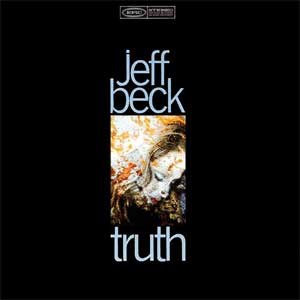
Truth is a likable hodgepodge of an LP, complete with self-deprecating notes from the man whose name graced the cover. It begins with a slowed down, groovy version of “Shapes Of Things”, which gives both Rod and Jeff a chance to show what they do best. “Let Me Love You” is one of those electric blues standards that everyone has to do at one point or another, while “Morning Dew” was the current folk equivalent, albeit with Jeff mangling the wah-wah pedal while an “unknown Scottish bloke” plays bagpipes. “You Shook Me” would be redone—some would say stolen—by Led Zeppelin a year later, complete with John Paul Jones on organ as he was on the Beck track. Here it’s merely two and a half minutes, grinding to a quick close described as “my guitar being sick”. A more subdued organ, with Keith Moon on tympani, drives a cover of “Ol’ Man River” from Show Boat.

If the listener wasn’t completely confused by now, the solo acoustic “Greensleeves”, precisely finger-picked, shows Jeff to be more than just flash. “Rock My Plimsoul” is another generic blues, better for the guitar than the lyrics. A nice addition is “Beck’s Bolero”, originally the B-side to his first single. Alongside the instrumental melody, we have Jimmy Page strumming an electric 12-string, John Paul Jones playing bass, Nicky Hopkins on piano, and Keith Moon on drums with a terrific howl a minute and a half in. Such catharsis is a memory for most of “Blues Deluxe”, yet another rote blues augmented by obvious added applause effects to give it that “club” feel. Finally, there’s “I Ain’t Superstitious”, a great nasty blues made even more diabolical by being in the key of F, especially difficult for bass players.

The abundance of blues tracks makes Truth less than perfect, but at least they’re spread out for variety, so the album manages to float well above the Mendoza line. Later reissues would pair it with the next Jeff Beck Group album, but today it can be found on its own with a pile of bonus tracks, including all the singles, and earlier versions of some of the album cuts.

Jeff Beck Truth (1968)—4

Tuesday, June 30, 2015

Small Faces: Ogdens’ Nut Gone Flake

Speaking of British bands with messy catalogs, Small Faces began as a genuine mod R&B combo before sliding into psychedelia. Besides being contemporaries of The Who, bass player Ronnie Lane would go on to collaborate many times with Pete Townshend, and drummer Kenney Jones would get the unenviable task of replacing Keith Moon. (Pianist slash organist Ian “Mac” McLagan would also marry Keith’s ex-wife, but we’re getting ahead of ourselves again.) Ronnie sang from time to time, but guitarist and lead singer Steve Marriott was likely the “star”, and not just because Paul Weller’s been copying his haircut for decades.

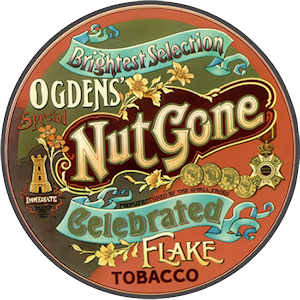
Their not-really-a-concept-album Ogdens’ Nut Gone Flake usually shows up on lists of classic albums nobody knows but everyone should hear, even without its original unique packaging based on a tobacco tin. Taking its cue from the previous year’s hit single “Itchycoo Park”, it combines Hammond-heavy swirly music with acoustic strums and music-hall silliness—and that’s just side one. The instrumental title track is something of an overture, always on the verge of becoming something bigger; they even put strings on it. Despite its loungey send-up beginning, “Afterglow Of Your Love” soon turns into a powerful Marriott belter. There’s a quick segue to “Long Agos And Worlds Apart”, sung by Mac, which has the same clap-along rhythm as the pub singalong “Rene” (rhymes with beanie) and its extended jam ending. “Song For A Baker” is a groovy rocker sung by Ronnie, before Steve comes back on the exceptionally catchy “Lazy Sunday”, delivered in a thicker Cockney accent than that of “Rene” and would one day be worn of its welcome by Phil Collins. (We’ll credit Glyn Johns for why the album sounds so good, from the flanging effects to the well-placed vocal interjections, very similar to what he’d already done for Traffic.)

Side two is where things get really wacky, with all of the songs strung together by a gobbledygook fairy tale about “Happiness Stan” looking for the moon. The narrator will remind newcomers of Michael Palin, and the side does sound like a parody, except that this was the source. The story itself is just that, hiding no real mysteries or message, except that Stan finds himself “Rollin’ Over” to greet “The Hungry Intruder”, a fly who grows giant enough to take him on “The Journey” to the cave home of “Mad John”, who tells Stan that life is as simple as “Happydaystoytown”. Of course. The songs would likely stand on their own without the narration, but it’s a gimmick that works.

Aside of the novelty of the presentation, two things stand out from Ogdens’ Nut Gone Flake. First is Ian McLagan’s mastery of the electric piano, a touch rivaled only by Nicky Hopkins. Then there’s Kenney Jones’ drumming. How could a guy this inventive and tight go on to become the Who’s metronome? (Because of the differences in mixes unique to different countries, several reissues of the album have offered mono and stereo versions, along with outtakes, but as long as the 12-song sequence is intact, anything else is gravy.)

Small Faces Ogdens’ Nut Gone Flake (1968)—3

Friday, June 26, 2015

Peter Gabriel 1: Car

It took him a couple of years—a pattern that would come to define his career—but Peter Gabriel’s first solo album after leaving Genesis was a bold statement, building on the performance art of his Genesis work while embracing different sounds than those to which he’d been previously shackled. Simply titled Peter Gabriel (but often referred to as Car or Rainy Windshield due to the cover art), it was produced by Bob Ezrin, who’d made his bones with Alice Cooper and Lou Reed. It’s a fairly straightforward collection of songs that straddle both whimsy and standard rock, falling into place all over the map.

“Moribund The Burgermeister”, with its keyboards and funny voices, should have satisfied those Genesis fans who longed to see their hero dressed as a flower or wearing a dress with a fox’s head. Once that’s out of the way, the classic “Solsbury Hill” allegorically tells of his decision to go solo. Anchored by acoustic guitars over 7/4 time, even since its inclusion in countless movie trailers the song never fails to exhilarate. With a rousing count-in, “Modern Love” is a straight-ahead rocker—complete with cowbell—saturated in guitars and keyboards to hide the salacious puns in the lyrics. (Its official video, depicting Peter in a fencing outfit, cavorting through what appears to be an abandoned airport, must be seen to be believed.) From there it’s a complete left turn to a barbershop quartet for “Excuse Me”, which turns into a soft-shoe number complete with tuba. The first side ends with the strangely beautiful “Humdrum”, a song that seems to be a showcase for more wordplay but is absolutely majestic from start to finish.

The classic rock sound creeps in on the second half for “Slowburn”, with stately piano and bubbling synth, followed by a screaming lead guitar. The dynamics here are especially effective, and its curious fade is a good setup for “Waiting For The Big One”, something of a big band pastiche. While Frank Sinatra wouldn’t cover it, the stops and starts for the voices to carry out the big ending make it quite a production. Then the London Symphony Orchestra makes their inevitable appearance on “Down The Dolce Vita”, another big number with a jokey wind-up clock section and an allusion to “Auld Lang Syne” buried beneath the mix. The sense of urgency turns to resignation for “Here Comes The Flood”, presented here in an orchestrated arrangement. It’s a misleading song, with apocalyptic overtones, but the suggestion is that we’re doomed to limbo rather than annihilation.

This would be his most mainstream offering for some time, but that’s not to suggest it’s “commercial” in the slightest. Like any masterwork, its jewels are revealed on repeat listens. Whether or not he missed his old band, he was off to a good start.

Peter Gabriel Peter Gabriel (1977)—4½

Tuesday, June 23, 2015

Doors 2: Strange Days

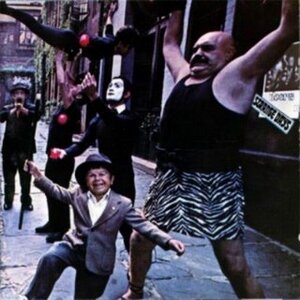
Less than nine months after the release of their debut, which still had legs, the second Doors album appeared. Strange Days follows the same formula as the first album, being instrumentally similar, and concluding with another lengthy, show-stopping epic. (The cover did try to make a departure, using a motley collection of street performers and freaks cavorting in an alley, while a tiny poster of the band with the album title is tucked in on the edge. Clever.)

The title track has enough “strangeness” to make it an effective and disorienting opener, setting a tone of darkness for the next 35 minutes. Robbie is credited with writing “You’re Lost Little Girl”, built as it is on his intricate guitar parts, and nothing special in the way of lyrics. “Love Me Two Times” is also credited to Robbie, as he likely came up with the riff; again, the lyrics aren’t much, but there’s a harpsichord in place of the organ for variety. “Unhappy Girl” is dominated by loopy slide and backwards effects, over before you know it. Jim was very proud of “Horse Latitudes”, a frightening piece of poetry backed by discordant sounds of the band, making the return of the loopy slide on “Moonlight Drive” something of a comfort.

“People Are Strange” is another catchy single despite its depressing message, and helped by the tricky ending. The insistent “My Eyes Have Seen You” is contradictorily followed by the moodier “I Can’t See Your Face In My Mind”, both fairly slight in comparison to “When The Music’s Over”. While not as pointedly provocative as “The End”, it still features many oft-repeated Morrison couplets and good dynamic contributions from the band, making it as much of a group performance as a showcase for Jim’s prose. And assuming you can stand the sound of the organ, a better song.

As with most sophomore albums following a classic debut, Strange Days had to catch up to a lot, but there are and were enough songs in their repertoire to keep it consistent. They were still able to concentrate on the music without the distractions that would soon take over their celebrity.

Even today the album lives in the shadow of its older brother. Much was made of the 50th Anniversary Deluxe Edition upon its release, even though all it contained was the original stereo mix on one CD and the original mono mix on the other. The alternate takes of “People Are Strange” and “Love Me Two Times”, which were added to the 40th Anniversary reissue, were not included.

The Doors Strange Days (1967)—3½
2007 40th Anniversary Edition: same as 1967, plus 2 extra tracks
2017 50th Anniversary Edition: same as 1967, plus 10 extra tracks