Friday, March 29, 2013

Frank Zappa 15: Waka/Jawaka

While recovering from a stage accident that nearly took his life, Frank devoted his spare time to writing and arranging two albums’ worth of jazz-infused music, which, in another about-face to his recent work, featured a minimum of lyrics.

The first of these to appear was Waka/Jawaka, which bears a pretty blatant reference to Hot Rats right there on the rather clever cover. However, the similarities don’t go that deep—the biggest difference that the new stuff employed a lot of overdubbed horns, giving the proceedings a “big band” sound.

Along with such holdovers as Aynsley Dunbar, George Duke, Don Preston and even the return of Jeff Simmons, new contributors include Tony Duran on slide guitar, Sal Marquez on trumpet and vocals and somebody named Erroneous on bass. “Big Swifty” takes up all of the first side, beginning with a tightly syncopated rhythm, before sliding into a lengthy jam of dueling improvs. The result is something like a less chaotic “King Kong”.

Side two includes two relatively short tracks with vocals, but at least they’re not Flo & Eddie. “Your Mouth” is a bluesy shuffle mostly based on the structure of “Key To The Highway”, but with some more changes in the chorus. Frank solos most of the way through to the fade, leaving us to assume that the lyrics were an afterthought. “It Just Might Be A One-Shot Deal” is a little more complicated, using wacky accents to question the motives of a certain frog, pausing a few times for Sneaky Pete Kleinow to solo on the pedal steel, cutting to a more chaotic section. There’s a quick jump to the title track, which sets up a horn-driven theme, itself a setup for ten minutes of soloing.

These ears don’t hear anything as snappy as side one of Hot Rats, but the two longer instrumentals make Waka/Jawaka worth the effort. To help it along, he wasn’t done yet.

Frank Zappa Waka/Jawaka (1972)—3

Wednesday, March 27, 2013

Steely Dan 4: Katy Lied

Having decided they weren’t made to be a touring unit, Becker and Fagen began crafting their albums with the assistance of the finest session musicians they could hire. That wasn’t such a shocking move; after all, some of the finest records of the previous decade were performed by the same handful of working stiffs. Steely Dan was merely being overt about it. Katy Lied furthered the Steely Dan sound—jazz-tinged FM radio fodder, with increasingly inscrutable lyrics—but one featured performer stands out. Today Michael McDonald is best known for his work with the Doobie Brothers and his smash hit single “Sweet Freedom”, but back then he was a just another smoky vocalist who dominates any track with his voice.

The first two tracks offer two angles on that trademark sound—“Black Friday” fading in on a galloping electric piano, “Bad Sneakers” with an electric sitar—that divide fans from non-fans. “Rose Darling” has some of the country touches from Pretzel Logic, something of a cousin to “Barrytown”. Speaking of retreads, “Daddy Don’t Live In That New York City No More” echoes “Show Biz Kids” without being as clever. The superior “Doctor Wu” suggests the title of the album, and presents the sax and chime tree combo that would re-emerge in a few years, complete with another faux-Eastern suggestion. The lyrics don’t make any sense, but the chorus is tremendous, climbing higher and higher.

“Everyone’s Gone To The Movies” matches a sinister suggestion of pederasty with a sunny calypso beat, and maybe that’s the point. There’s yet another sequel of sorts in “Your Gold Teeth II”, which doesn’t appear to share much with its interminable elder; this one has way more jazz changes, and even a decent melody dancing over a 6/8 rhythm. “Chain Lightning” lopes along in a slow shuffle for a Rick Derringer solo, but one of the more striking tracks is “Any World (That I’m Welcome To)”. While a monologue by a Holden Caulfield type isn’t such a weird thing for this band, there’s almost something defiant and hopeful in the chorus, almost like the Animals’ “It’s My Life”. (Joe Jackson liked it so much he borrowed the feel for the coda on “Nineteen Forever”.) Listen for that distant organ behind the second verse. Finally, “Throw Back The Little Ones” continues their tradition of ending albums with a clunker. Despite offering fishing advice, it’s got the telling lyric “Hot licks and rhetoric don't count much for nothing.”

Katy Lied has its moments, but as we’ve stated before and will again, Steely Dan is not for everyone. For most fans, it’s all or nothing, and there isn’t anything here that could be considered buried treasure. Therefore, it’s okay for what it is.

Steely Dan Katy Lied (1975)—3

Monday, March 25, 2013

Band 1: Music From Big Pink

The Band’s history has been recounted several times, by them even, so we’re going to try not to go too deep into here. It should be said, however, that the years prior to recording their debut album were spent first toiling in the wake of Bob Dylan’s chemically infused 1966 tour, then finding their gig postponed while he recuperated from a motorcycle accident. Still on something of a retainer, they rented a couple of houses in the Woodstock area, one of which was painted a lovely shade of Calamine pink. Once Bob’s health was settled enough for him to get around, he’d stop by the house after taking his stepdaughter to school, and he and the boys would jam for hours on end (fueled, according to one source, by strong coffee and potent weed).

Among many breakthroughs during that period, pianist Richard Manuel became an extremely competent drummer in the absence of Levon Helm (himself a master of the mandolin). Before long the four and then five members of this little unit became very adept at switching instruments and playing off of each other—just like a band should be.

While it wasn’t recorded there, Music From Big Pink still manages to convey the sense of five guys sitting around a very small room, possibly a basement, creating a brand of music wholly untouched by psychedelia, and infused with the spirit of what might be called Americana, even if four of the guys were Canadian.

Of course, if two of your members were allowed to share a copyright with Dylan, you’d be an idiot not to include those songs on your album, right? That’s why “Tears Of Rage”, music by Richard, begins the program, providing a stately introduction and some nicely arranged horns. Robbie Robertson gets credit for “To Kingdom Come”, and even features the guitarist taking a stab at a lead vocal amidst the group holler. Richard returns for his own “In A Station”, driven by a keyboard sound that’s the closest they’d get to psychedelic. “Caledonia Mission” is another inscrutable tune seemingly sung by Richard, but no! It’s Rick Danko. The one song everybody knows, and argues about the words, is “The Weight”. Levon sings the bulk of it, stepping aside on one verse for Rick, taking it back and closing it out.

“We Can Talk” is a rollicking opener to side two, an unfortunately overlooked track in the wake of what comes next. First there’s “Long Black Veil”, a cover from the 1950s that sounds like it was written in the 1850s. The killer is “Chest Fever”, beginning with a fantastic faux-Bach fugue from Garth Hudson’s fingers, followed by a groove the other four keep up so well it doesn’t matter what the hell the words are about since nobody can understand them anyway. We stop for breath in the mournful “Lonesome Suzie”, a sentimental Richard song, and then it’s back to Bob. Several people have covered “This Wheel’s On Fire”, but since Rick wrote the music for it, this one might get the edge. And finally, Richard’s lonesome falsetto nails “I Shall Be Released”.

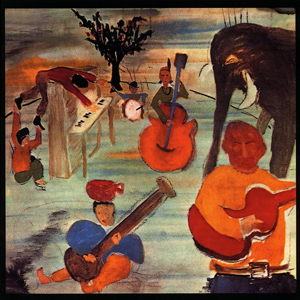
One of the nicest things about this album is that sense of communion. The inner sleeve sports a large group photo labeled “Next Of Kin”, with the musicians mixed in among cousins and grandparents. The label doesn’t even say “The Band”, going instead with the individual names of each player, plus their producer John Simon, an honorary member himself. Such democracy wouldn’t last, but luckily, Music From Big Pink is here to preserve it. Even Bob’s cover art—the elephant and oddly placed teapot notwithstanding—suggests the homemade qualities that have brought people back again and again.

As the self-imposed caretaker of the legacy, Robbie has not let a chance to exalt the album go by. The first expanded CD version added nine tracks, including some outtakes, some recordings previously ascribed to the Basement in an act of either error or connivance, and a couple of oddities that actually did come from there. When the golden anniversary rolled around, he had the album remixed by Bob Clearmountain, included only five of the bonus tracks from the previous version, and added an a cappella mix of “I Shall Be Released”. That means you’ll want to keep the first expanded CD, not only for the original mix, but for “Katie’s Been Gone” and “Orange Juice Blues”.

The Band Music From Big Pink (1968)—4
2000 CD reissue: same as 1968, plus 9 extra tracks
2018 50th Anniversary Edition: “same” as 1968, plus 6 extra tracks

Friday, March 22, 2013

Simon & Garfunkel 6: Greatest Hits and Concert In Central Park

1970 said farewell to not only the Beatles, but also Simon & Garfunkel. As with the Fab Four, fans of the odd couple from Queens continually hoped for a reunion. And a few times, their dreams came true.

Two years was an eternity in those days, so their one-off performance at a George McGovern benefit was a Big Deal. Columbia issued the Greatest Hits album around the same time. Along with a handful (but not all) of their hit singles, some undated live versions provide wonderful substitutions. (“Kathy’s Song” and “For Emily, Whenever I May Find Her” showcase each of the boys in a solo.) Besides photographic evidence that Paul Simon looks just as awful with a hat as without one, it’s also the only place to get “America” with a clean intro.

By this time, Simon had already started his solo career proper, and Garfunkel was soon to follow. Outside of the occasional joint gag appearance, the only other collaboration of the dynamic duo was 1975’s “My Little Town”, released as a joint single promoting each of their current, separate LPs. Meanwhile, both boys took stabs at movie stardom, sporadically releasing solo LPs throughout the decade. Art’s were as unadventurous as Paul’s were increasingly slick, and when the ‘80s arrived, not even Paul’s handful of hit singles kept him from seeming a has-been. (Even he was aware of this, as One-Trick Pony made plain.)

Still, it was with mostly joy rather than cynicism that greeted the news of another benefit concert, this one happening on the Great Lawn in Central Park, to be recorded for an album and broadcast on HBO. The Concert In Central Park presents the entire show as performed, with two exceptions: an encore repeat of “Late In The Evening”, and the ironically disrupted “The Late Great Johnny Ace”, a song about dead musicians performed nine months after John Lennon’s murder less than a mile away. In addition to their hits, backed by competent studio musicians, Art gamely harmonizes on some of Paul’s solo hits. The covers of the oldies “Wake Up Little Susie” and “Maybelline” add to the general feeling of nostalgia and fun.

The original 2-LP package, which even included a booklet with lyrics and photos, both vintage and of the event itself, wasn’t cheap, and fans were basically buying some of these songs for the third or fourth time. But it still captures a special moment in time, where the two old friends managed to harmonize, no matter what was going on between them backstage. Its specialness, if that’s a word, was underscored by the decision the following to do a reunion tour and record an album together, both of which were aborted due to infighting, and it would be some time before either man found his bearings again. In fact, once Paul had regained his commercial status, he returned to the park nearly ten years later to the day, with an even larger band, but no Art.

Simon and Garfunkel Simon And Garfunkel’s Greatest Hits (1972)—4
Simon and Garfunkel
The Concert In Central Park (1982)—4

Wednesday, March 20, 2013

Bruce Springsteen 4: Darkness On The Edge Of Town

The hit album kicked off a transition period, wherein Bruce broke away from his manager, resulting in the first of many lengthy delays between albums. While the legal hassles may have kept him out of the recording studio, he did stay busy writing and performing, recording over three LPs’ worth of material. Of those, ten songs made it to Darkness On The Edge Of Town, an ode to the “workin’ man” framed by the shaky typewriter motif and the bedhead portraits the antithesis of glamour.

Bruce never released an album without painstakingly refining the arithmetic of each album’s side, and Darkness is framed with a similar formula to Born To Run. Each side begins with a potboiler, the first being “Badlands”. A natural anthem for radio, it’s got an incessant drumbeat, and we’re mostly surprised that it took until today for us to notice that the main musical motif is basically a major-key ripoff of “Don’t Let Me Be Misunderstood”, and only because we read it on Wikipedia. His nastiest track to date follows, the downright ugly “Adam Raised A Cain”. Its simple riff brings to mind Tom Petty’s brand of “heartland” rock, a comparison sure to inspire cries of blasphemy. (The breakdown and restart in the middle is pretty cool, however.) Perhaps to bring things back to comfortable surroundings, “Something In The Night” pairs piano and glockenspiel for a good minute with some of those “WAH-HAW” yells from “Backstreets”. While familiar, to have such a slow song in the middle of the side threatens to shut everything down, but luckily “Candy’s Room” provides an edgy momentum in a portrait of teenage lust. It’s particularly welcome when the tempo slows again for “Racing In The Street”, notable for its detailed automotive description and liberal lifting from Martha & The Vandellas.

In case you’d fallen asleep, what used to be side two kicks in with “The Promised Land”, a defiant twin to “Badlands”. It’s a classically constructed rock ‘n roll song, with excellent color provided in the “blow away” repetitions in the third verse. That dirgey drumbeat returns for “Factory”, which could be a clever representation of the drudgery of blue-collar employment, but it seems a lot longer than its two minutes. “Streets Of Fire” is just as slow, but it’s punctuated by his strangulated delivery. (But without this song, would we live in a world without the film of the same name?) The questionable twang he employs on “Prove It All Night” is at least supported by an upbeat tune. The title track employs that same plodding tempo for the fifth forehead-slapping time, and finally gets the recipe right for an effective closer.

Darkness On The Edge Of Town isn’t a bad album, but we suspect that its overall sameness spurred the legend of the outtakes. (That, along with the rave reviews his mammoth live performances were getting.) It’s the vocals that ultimately hold back the album from classic status, no matter what Rolling Stone says. While he’d established a unique sound, he was also becoming a caricature, a New Jersey cowboy obsessed with cars, streets, the night and his strained relationship with his father. While that resonated with a sizable section of the American populace, not everybody can relate. Still, his lead guitar work stands out, particularly on “Badlands”, “Streets Of Fire”, and “Candy’s Room”, where their economy equals the inventiveness.

Bruce Springsteen Darkness On The Edge Of Town (1978)—3

Monday, March 18, 2013

David Bowie 35: The Next Day

The last two times David Bowie staged a “comeback” was the ‘80s, when Let’s Dance and Never Let Me Down were each preceded by a baffling three-year gap. This time, however, the comeback is more profound and satisfying, since he’d more or less been written off to old age. Somehow, against all odds, there’s a new Bowie album, just as if he hadn’t spent the past nine years away from music. Where the ‘90s found him following trends instead of setting them, The Next Day is simply an album. Or, as one of our favorite reviews says, it’s a Bowie best-of, except that all the songs are new.

The title track recalls “Repetition” from Lodger but happily moves on from there. Like most of the lyrics on the album, they don’t match the era suggested by the music. Many advance reviews called “Dirty Boys” a Tom Waits homage; that’s an uninspired comparison, since if anything, it’s another track in the vein of the Berlin trilogy or Scary Monsters. “The Stars (Are Out Tonight)” has an excellent driving beat, even if the lyrics need a little work to be convincing. One of the more inscrutable tracks is “Love Is Lost”, with its tense backing and abrasive organ. But right away that’s four strong tracks to set up the curveball. “Where Are We Now?” was a striking choice for the first sample from the album, as it’s so slow. Taken within the context of the rest of the album, it’s gorgeous. “Valentine’s Day” is a deceptively catchy tune, but the subject matter appears to be a school shooting, so it seems perverse to enjoy it. Still, try not to swoon at the guitar line that follows the chorus (foreshadowed in the previous song). “If You Can See Me” is incredibly chaotic, but he makes it hang together, even with a sped-up vocal buried in the mix.

Much of the album touches on the concept of war waged by deluded despots—not a new subject for him. “I’d Rather Be High” and “How Does The Grass Grow?” both offer laments from the point of view of a young soldier boy stuck in an impossible situation, but again, the atmosphere doesn’t belabor the point. One thing the album lacks is a wacky cover, and “Boss Of Me” might have been the best place to put it, were it the Malcolm In The Middle theme song. There is a silly dance song, and if you can’t tap your toes to “Dancing Out In Space”, you probably shouldn’t be reading this blog. “(You Will) Set The World On Fire” begins with a promising riff, and pounds away at a late ‘80s/Tin Machine idea that completely jars with lyrics about the Greenwich Village folk scene. Something of a gear shift happens with “You Feel So Lonely You Could Die”, a torchy tune that ends with a nod to “Five Years”, adding to the “coming full circle” vibe. It makes “Heat” an ambiguous ending for the album proper, slowing things down for only the second time. It’s tough to figure out what’s going on here, except that his father ran a prison, which affects his identity.

The album was simultaneously released in a “deluxe” edition, which added three tracks, of which “Plan” is the most exciting, a brief instrumental used as the intro music to the “Stars” video. By year’s end, an even more elaborate deluxe package appeared, with a DVD plus a second CD offering those three tracks, a Japanese exclusive track, two remixes and some more new songs. Of those, “The Informer” expands on the promise of “Plan”, and “Born In A UFO” has a trashy charm.

The Next Day is a very “poppy” album, just as Heathen and Reality were in their own small ways. He worked with a small crew of longtime regulars, just happy to be along for the ride. Anybody looking for an early clue to the new direction should instead relax and enjoy that same ride. It’s tempting to crow about how wonderful the album is; we must admit that our enthusiasm about The Next Day comes from a) the excitement at having a new album when he’d seemed to have retired, and b) the fact that it’s not a wretched attempt to be trendy. It’s a Bowie album, in that it sounds like him. And boy, is it nice to have.

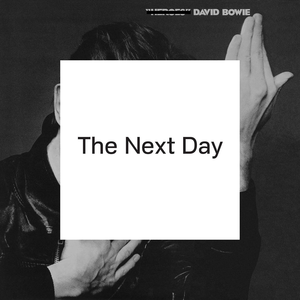
That said, the cover—a manipulation of “Heroes”—is just plain lazy coming from a guy who’s thrived on striking visuals.

David Bowie The Next Day (2013)—3

Friday, March 15, 2013

Jam 4: Setting Sons

The Jam had more or less found their way, with a handful of edgy singles keeping them in the charts until their next LP, but even that was uneasy going. Setting Sons was envisioned as a concept album, and while such a thing may have seemed perverse after a decade of prog-rock, which punk was supposed to have destroyed, recall that it was the “mod” bands (The Who, The Kinks, Small Faces) that had made the first stabs at the “concept” concept a decade earlier. (In the US, the sides were swapped, which jumbled the thin concept even more, while “Strange Town”—a standalone single from earlier in the year, was added as the second song on side two.)

Perhaps it was just as well it didn’t work, since the songs hang better, together and on their own, without being tethered to a song cycle about three boyhood friends whose lives went in markedly different directions. Such an idea is obscured by the opening track about the “Girl On The Phone” (complete with sound effects) stalking the singer because, well, he’s a singer. That out of the way, the back story is set up in “Thick As Thieves”, a catchy look back at the boys’ lost youth. One of them pens the letter paraphrased in “Burning Sky”, bragging about his busy corporate life. Another could be the angry military pawn of “Little Boy Soldiers”, pushed through several tempo changes. Somebody else is stuck in the “Wasteland”, trying to maintain hope in the face of economic decline.

The rest of the songs, while topical, are worthy vignettes outside the original idea. “Private Hell” is a fitting title for the situation holding an aging housewife hostage, her kids grown and distant, her husband merely a reason to shop for groceries week after week. The youth of the day are dismissed as “Saturday’s Kids”, but still seem more appealing than the snobs attacked in “The Eton Rifles”.

The most striking song on the album is arguably “Smithers-Jones”. Written by bassist Bruce Foxton and already heard as a straight rock B-side, it got a major makeover with classical strings, an inspired match for such a vivid portrait of an office drone, worthy of Weller and Davies—and even more effective coming after the businessman’s spiel in “Burning Sky”. That said, the slightest song could be their closing Who-heavy cover of “Heat Wave”, familiar to ‘70s kids from Linda Ronstadt’s version, and here featuring a horn section in a harbinger of albums to come. (Guesting on piano was one Mick Talbot from the Merton Parkas, in another harbinger.) Bringing the album in at 32 minutes, it’s still a good performance.

And that’s the point—the parts make the sum. In a short amount of time, the band had become something of spokesmen, with two strong songwriters offering wry observations of society. Not bad for three yobbos in their early 20s.

The Jam Setting Sons (1979)—3½