Monday, April 29, 2013

Frank Zappa 16: The Grand Wazoo

Mere months after Waka/Jawaka, its sibling appeared. The Grand Wazoo offers even more jazz fusion with many of the same musicians, but even more horns and woodwinds. While credited to The Mothers, it’s still part of the Hot Rats genre, with a minimum of lyrics. The lengthy liner notes and cover art suggest some kind of concept behind the album (helped by appearance of the Uncle Meat character), but as with most of his stabs at this genre, there’s no real story to follow.

“For Calvin (And His Next Two Hitch-Hikers)” is a slower number in the tradition of “Twenty Small Cigars”, but with mysterious vocals and a lot of random blowing. The title track presents a good argument for letting his music speak for itself—just ask yourself if you could sit through all 13 minutes as easily if Flo & Eddie had been allowed to sing over it. Its multiple themes are presented very well, with plenty of soloing and a decent three-note riff that’s so simple it’s perfect. (On all CD versions, these two tracks are swapped, making for preferable listening.)

“Cletus Awreetus-Awrightus” hearkens back slightly to “Peaches En Regalia”, with a jangly piano and wacky solo by legendary sax man Ernie Watts, but scatted vocals where another horn part should be. “Eat That Question” begins with a lengthy electric piano exploration by George Duke, then Frank joins for a heavily-wahed riff and solo. The festivities turn chaotic, then slow to a halt, before reviving the riff again. (Maybe it is supposed to illustrate something in the story after all.) The very title “Blessed Relief” suggests something of a finale, but in this case it’s just a lot of frilly sounding flutes and electric piano over a lazy jazz beat.

The concept aside, there are enough similarities between The Grand Wazoo and Waka/Jawaka to make the differences almost arbitrary. It could be said that the best of both albums could have been combined into one excellent collection, but that would likely be considered blasphemy so we’ll just leave it there.

The Mothers The Grand Wazoo (1972)—3

Sunday, April 28, 2013

Jimi Hendrix 13: Radio One

Like most hungry London-based performers, The Jimi Hendrix Experience made multiple appearances on the BBC’s handful of radio shows that focused on current pop music. And like most people who went on to be world-famous, many of those performances were spread around via bootlegs until legitimate releases happened.

The first such release came courtesy of Rykodisc. Radio One presented 17 tracks, split between hits and more unique performances. As with most BBC collections, fanatics had lots to pick apart, while the more casual fan could gravitate towards markedly alternate versions of songs they knew from the albums, along with those that were, well, new. “Killin’ Floor” was constant in his setlists, and cooks here. The blues chestnut “Catfish Blues” appears in its then-first known performance (complete with a nod to “Rollin’ And Tumblin’”), as does “Hear My Train A-Comin’”, with unfortunate “party” noises, which also mar “Spanish Castle Magic”. “Driving South” was an excuse to jam, and comes from a show hosted by British blues legend Alexis Korner, who also plays slide with the band on “Hoochie Koochie [sic] Man”. Jimi even composed a “Radio One Theme” for one show.

These performances took place throughout a very busy 1967, when the band played a lot of shows and had the tightness to prove their worth. Save the occasional handclap or vocal overdub, these are live performances, and prove Jimi was able to create his own pyrotechnics without the multitracking that would soon dominate his regular studio work. Thus “Burning Of The Midnight Lamp” is a simpler trio version, without all the decorations the single/album track got. Of course, one must take the good with the bad, so while his funky arrangement of “Hound Dog” has merit, the overdubbed barking makes it one to skip. Better backing vocals are on their cover of “Day Tripper”, which does not include John Lennon, no matter what anybody tells you.

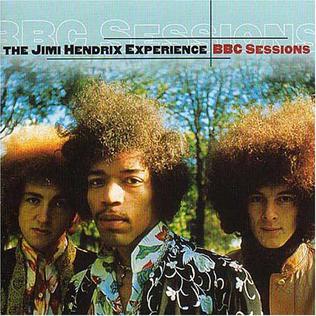
Ten years later, once the “family” gained control of the masters, an expanded double-disc set more directly titled BBC Sessions presented virtually everything he recorded for the station, including alternate takes from the same shows, presented in a not-quite-chronological order to cut down on repetition. This is good, since we get two more versions of “Driving South” and another “Hear My Train A-Comin’” (this one with “support” vocals). Even with the retreads, they did find more rarities, like his one-time-only cover of Dylan’s “Can You Please Crawl Out Your Window?” And that really is Stevie Wonder playing drums on the extended jam that leads into his own “I Was Made To Love Her”.

Of historical importance, the set ends with the band’s notorious performance on the Lulu TV show, when they cut short “Hey Joe” (which had been requested by the hostess herself) to go into “Sunshine Of Your Love” in “tribute” to the recently disbanded Cream, who’d written the song with Jimi in mind in the first place. And it’s just as well, since there are two other, similar takes on “Hey Joe” elsewhere in the set.

Because the BBC never saved anything, the sound quality on both is a little muddy, and the tweaking modern-day producers took to make the new set less mono doesn’t help. But as a companion to the three true Experience albums, and in balance with some of the other post-Experience recordings we’ll get to soon enough, BBC Sessions is a worthy addition to one’s Hendrix pile. (It was eventually re-released once Sony took over the Hendrix catalog, with the addition of another “Burning Of The Midnight Lamp” and a DVD with a documentary. They also released a single-disc version, but what’s the point?)

The Jimi Hendrix Experience Radio One (1988)—
The Jimi Hendrix Experience
BBC Sessions (1998)—4
2010 reissue: same as 1998, plus 1 extra track (and DVD)

Saturday, April 27, 2013

Jimi Hendrix 12: Live At Winterland

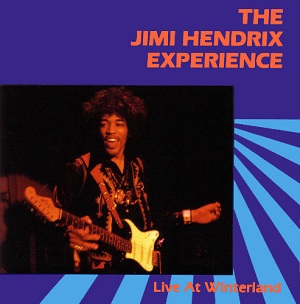
Just in time for the music industry’s celebration of the 20th anniversary of the Summer of Love came the first “new” Jimi Hendrix album specifically designed for the CD market. The first product of Rykodisc’s brief affiliation with the Estate, Live At Winterland was compiled from a three-day residency at a converted San Francisco ice skating rink the week Electric Ladyland was released. The compilers had six shows to choose from, and only repeated one performance from The Jimi Hendrix Concerts.

By this time his manager was professionally recording his concerts, so the source used was superior to anyone’s bootlegs. This CD was produced by Alan Douglas and future Beach Boys catalog maven Mark Linett, and they did a decent job of presenting the trio as they were, seamlessly blended to simulate a single show. After Bill Graham’s introduction (a Douglas trope), they plow through “Fire” and “Manic Depression”, then Jimi provides an explanatory intro for a jam on Cream’s “Sunshine Of Your Love”. “Spanish Castle Magic” is marred by buzzing amplifiers, and he acknowledges the absence of “Red House” from the American version of his first album. Jack Casady of Jefferson Airplane sits in on bass for “Killing Floor”; “Tax Free”, an instrumental familiar from War Heroes, gets an eight-minute excerpt. From there it’s a good run through “Foxey Lady”, “Hey Joe”, and “Purple Haze” right into “Wild Thing”. All in all, a solid listen. (Five years later, the album celebrated an anniversary of its own with the release of Live At Winterland+3, containing—you guessed it—three more songs on a 30-minute bonus disc, including a lengthy exploration on “Are You Experienced”.)

In this century, once the Estate realized that fans would be interested in multi-disc archival digs, the shows were mined for a four-CD package simply titled Winterland. However, as would be their wont, they still took liberties with history, by curating a disc each from each day’s two shows, and adding a fourth of “extras” from three of the shows, bolstered by an interview conducted two months earlier on the opposite coast. (Amazon customers got another disc with a little over a half an hour of music from eight months earlier at a different Bill Graham venue, most of which was previously released as an official bootleg, and notable for the first collaboration with Buddy Miles, on a cover of “Dear Mr. Fantasy” in two pieces because the tape ran out. Meanwhile, a single disc of Winterland “highlights” muddied up the discography further.)

Being a new mix spearheaded by Eddie Kramer, the sound is different from the Rykodisc releases; they even restored Herbie Rich’s organ and Virgil Gonsalves’ flute on songs where they’d been omitted earlier. But there was still some editing and combining of performances to enhance general listenability, and some chatter heard on the old CDs didn’t make it. There is naturally repetition of several songs, but he never played anything the same way twice, and for the most part the set focuses on songs that enabled his soloing as opposed to just playing the hits and familiar album tracks, which he does too. (“The Star-Spangled Banner” makes two appearances, once of which is compiled from two performances; the October 11 “Voodoo Child” remains exclusive to Live At Winterland+3, but at least the set included full versions of songs included on The Jimi Hendrix Concerts, which had since been deleted.) Nearly five hours of music is a lot to take in, but it’s educational to hear him in an environment where he could settle in for a stint and stretch, rather than just rush from town to town and show to show.

The Jimi Hendrix Experience Live At Winterland (1987)—
1992 Live At Winterland+3: same as 1987, plus 3 extra tracks
The Jimi Hendrix Experience Winterland (2011)—

Friday, April 26, 2013

Beach Boys 16: 20/20

Not that anyone cared, but the Beach Boys were already up to their twentieth album—including three Best Of collections issued against their will and the notorious Stack-o-Tracks album, which was only about thirty years ahead of the karaoke craze. (Really, if you’re into the non-vocal portions of Beach Boys albums, it’s a terrific set.)

For 20/20, the Boys tried to present something for everyone. “Do It Again” is an excellent retro single, with the upside-down drums leading into a “classic” chorale. (On the album, in a touch of foreshadowing, they added “workshop” sounds from Smile over the fade.) “I Can Hear Music” is also a wonderful track, but it’s a cover of a Phil Spector composition with a nod to his production. Then there’s “Bluebirds Over The Mountain”, which tries to marry a calypso song to something more contemporary, as demonstrated in the closing nightmare strings and occasional guitar screams. It’s an approach better suited to “Be With Me”, another line drive from Dennis Wilson. His newly found magic touch doesn’t quite carry to “All I Want To Do”, screamed by Mike Love, and possibly the first recording by a mainstream band to include a field recording of coitus, simulated or not. “The Nearest Faraway Place” is a lush Brian Wilson instrumental—except that it’s contributed by Bruce Johnston, his onstage replacement.

Perhaps in the spirit of “Sloop John B”, they go all out for “Cotton Fields”, a Leadbelly song that wasn’t any better when Creedence did it a year later. (Personally, we like the rendition John Lennon did on the radio a year before, when he sang of how his mama used to “smash [him] in the cradle”.) “I Went To Sleep” is another list describing Brian Wilson’s day in the style of “Busy Doin’ Nothin’”; it’s mostly a setup for “Time To Get Alone”, which Carl gets to sing and give a little boost. The jaw-dropper on the album is “Never Learn Not To Love”, which the liner notes neglect to mention began as a song by Dennis houseguest Charles Manson. (For what it’s worth, Axl picked a better song for “The Spaghetti Incident?”) As elaborate as that is, the big finish is given over to a couple of Smile refugees. First, there’s “Our Prayer”, a gorgeous Gregorian-style fugue for voice. That is given as a lead-in to “Cabinessence”, possibly the prettiest song from the ill-fated project, leaving another teaser for what could have been.

So there’s a strong start and a strong finish, but everything else in the middle of 20/20—as well as the individual production credits for each song—only reveals just how unfocused the band was. (Pun unintended, but it’s telling that Brian isn’t on the front or back covers, but only in the gatefold, where he’s partially obscured by an eye chart.) Undeterred, they carried on, but not with any less struggle. Proof comes in the bonus tracks to the original, then deleted, then restored two-fer disc of the album (which also included Friends; as with that album, in 2018 I Can Hear Music: The 20/20 Sessions provided a digital-only deep dive with 40 tracks’ worth of alternates and outtakes, including several increasingly shaky Dennis demos, and even a cameo from the Wilsons’ mother). “Break Away” was another flop single that might have done better at another time than the summer of ’69. One clue could be that it was written by their dad. (The 4 Seasons would have nailed this in ’64.) Dennis got the B-side, the intricate if stumbly “Celebrate The News”. “We’re Together Again” has potential, but the brief stab at “Walk On By” and “Ol’ Man River” prefaced by “Swanee River” and will have you wondering where their inspiration went. They hoped to begin the ‘70s with a fresh start. They hoped to begin the ‘70s with a fresh start.

The Beach Boys Stack-o-Tracks (1968)—3
1990 CD reissue: same as 1968, plus Beach Boys’ Party! album and 3 extra tracks
The Beach Boys 20/20 (1969)—
1990 CD reissue: same as 1969, plus Friends album and 5 extra tracks

Wednesday, April 24, 2013

Jam 6: The Gift

Their longest gap yet between albums was interrupted by a couple of singles, the latter of which included prominent horns. Not yet 24 years old, Paul Weller was moving away from the punk/mod sound that brought so many fans to his band, and was now writing songs to be performed in a funk/soul style.

That wouldn’t be a bad thing if he had a more convincing voice to carry it. While his throat had developed a huskiness, the kid we hear testifying all over The Gift seems more like a poser. And despite some excellent songs, it’s their least successful album.

“Happy Together” (announced as being “in technicolor”) begins with a dub-style toast, then settles into an urgent groove. “Ghosts” ticks gently under a nicely picked theme, with canned handclaps and some trumpets. Things go immediately wrong on “Precious”, an interminable funk jam one would expect from, say, Culture Club. When that finally ends, “Just Who Is The 5 O’Clock Hero?” celebrates the man who comes home every day “covered in sh-t and aches and pains”. Then it’s back to jamming—“Trans-Global Express” gave the tour a name, but buried Weller’s words under an echo- and delay-heavy mix. Yet another “one two free four” calls up “Running On The Spot”, another decent tune fighting against a bad mix.

The noisy instrumental “Circus” sets up “The Planner’s Dream Goes Wrong”, a faux-calypso tale. Thankfully, the rest of the album is a major improvement. “Carnation” is classic Jam, tuneful and cohesive. “Town Called Malice” was the big hit, a Motown experiment that actually works. And the title track conjures up some of the punk spirit for something of “In The Midnight Hour” turned on its head.

Some people adore The Gift, to the point where the 30th anniversary deluxe edition released in the UK was very well received, loaded as it was with contemporary singles, demos, alternates, a complete show from the final tour, and a DVD. However, we agree with the band’s own rhythm section, who were very disappointed with the direction the music was going, and were equally frustrated when Weller broke up the band in favor of the slicker Style Council. Clearly, he was on to other things, and just wanted the chance to grow. For that, we can’t blame him.

The Jam The Gift (1982)—

Monday, April 22, 2013

Steely Dan 5: The Royal Scam

At this point it’s become difficult to categorize Steely Dan—too sneaky for pop, too proficient for rock, too pop for jazz. That’s probably they way they like it, but at the same time, it makes it difficult to voice how or why the band can rub people the wrong way.

The Royal Scam has all the usual hallmarks—pristine sound, jazzy keyboards, nasal vocals and snide lyrics that seem to be about something and nothing, except when they’re almost too obvious. The hero of “Kid Charlemagne” would appear to be a high-rolling drug dealer, while the narrator of “The Caves Of Altamira” ponders his measly existence while reflecting on prehistoric paintings. Sometimes a song is at odds with itself—such as in the case of “Don’t Take Me Alive”, which begins with a fuzzy diminished arpeggio, then saunters through a boogie with a lyric of the type usually associated with Warren Zevon. “Sign In Stranger” could also take place in another country, with repeated references to zombies, and a wonderful piano part by Paul Griffin. And then there’s “The Fez”, which is about as ‘70s as you can get for a song that may simply be an emphatic endorsement of prophylactics. (Griffin got co-writing credit for this, justifiably.)

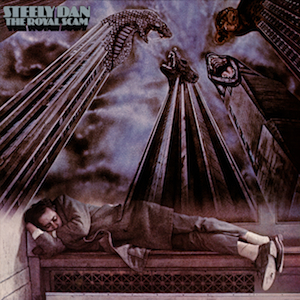
“Green Earrings” presents another jazz riff that seems to modulate a half-step at a time for the chorus. Meanwhile, Peter Frampton wasn’t the only guy working a talk box in 1976, as demonstrated in “Haitian Divorce”. “Everything You Did” is now notable for indirectly inspiring “Hotel California”. The title track oozes with a menace, somehow matching the mood of the cover art and capping a generally pessimistic album.

Does this do the album justice? Do the paragraphs manage to present an endorsement or dismissal? Somehow we feel it’s lacking, but that’s why we set it up as above. The Royal Scam is recommended for fans, and neither astounds nor annoys.

Steely Dan The Royal Scam (1976)—3

Friday, April 19, 2013

Rutles 1: The Rutles

Beatle parodies are often tributes at heart, and vice versa. Whether you’re Todd Rundgren or Oasis, the more successful attempts have qualities of their own, without resting solely on the novelty of aping the familiar. And it’s not always easy to write/record a Beatlesque song/record without coming dangerously close to copyright infringement.

Such was the case of The Rutles, which grew out of a sketch on Eric Idle’s first series after Monty Python. After a couple of teasers on Saturday Night Live, their “mockumentary” was aired on a Wednesday night at 9:30 to a miniscule audience (including this correspondent, who didn’t get most of the jokes). Hindsight has brought forward most of the sources of the humor—hailed by George Harrison as highly accurate—especially when viewed in conjunction with the Anthology episodes.

The songs came from Neil Innes, who had already bridged the musical and comedy fields by appearing with the Bonzo Dog Band in Magical Mystery Tour and then on his own in Monty Python & The Holy Grail. Besides having a knack for writing catchy pop, he could pull off an excellent Lennon impression (such as “world” pronounced “weld”, and “girl” rhyming with “yell”). The George equivalent (“Stig”) was visually portrayed by Rikki Fatarr, who was and is predominantly a drummer, while the Ringo role went to the comically non-telegenic John Halsey. (Idle appeared on-screen as the Paul replicant Dirk McQuickly, gamely playing a Hofner bass left-handed, but using his fingers instead of a pick.)

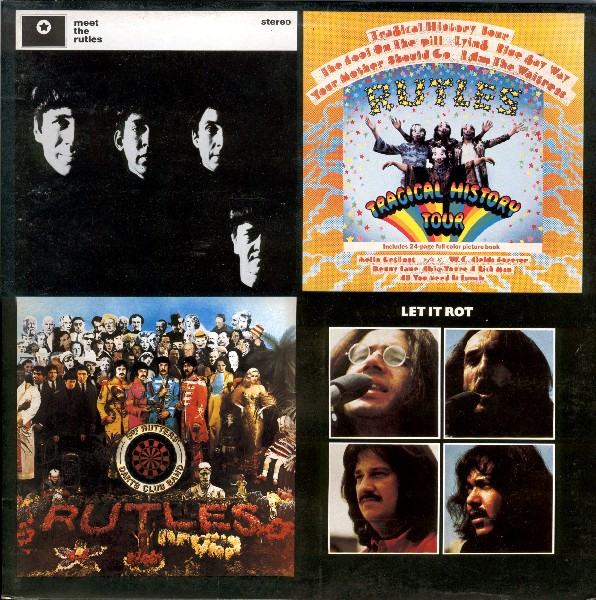
The soundtrack LP included 14 of the 20 songs used in the film. Part of the fun of the album is spotting all the references, so we’re not going to reveal all of them here, but some are just too priceless to hide. “Hold My Hand” (with the “yeah yeah” tag in its chorus) is fairly obvious, while the call-and-response in “Ouch!” perfectly apes that of “Help!” “I Must Be In Love” is just great pop, with a guitar part that sounds a lot like The Searchers’ “When You Walk In The Room”. “Love Life” manages to stumble around like its inspiration, and “Piggy In The Middle” has some wonderful surprises in the mix. The best track is “Cheese And Onions”, which originally aped “Imagine” (right down to the headphones and gum) but gets a big surprise ending here. John himself didn’t object to “Let’s Be Natural” in the face of “Dear Prudence”, but allegedly said “Get Up And Go” sounded too much like “Get Back” to appear on the album (it does appear on the CD, with the other missing songs from the film). And having a song titled “Another Day” in the lineup is just plain cheeky.

Beatle fanatics and Python fans combine for a fairly voracious personality type—the sort that will actually collect Rutles bootlegs. They’d also want to find every international edition of the Archaeology follow-up in 1996, despite its lack of the charm the original still sports.

The Rutles The Rutles (1978)—4
1990 CD reissue, same as 1978, plus 6 extra tracks