Friday, May 31, 2013

Frank Zappa 17: Over-Nite Sensation

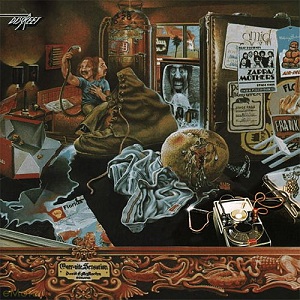
The recent fusion experiments inspired him to apply that updated sound to some actual songs his technically proficient combo could play. Over-Nite Sensation turns away from extended improvisation (for the most part) to make a play for FM radio, which had become permissive enough to handle tracks that more than hinted at sexual perversions (and if the lyrics weren’t clear enough, the miniscule details all over the album jacket drove the point home).

“Camarillo Brillo” is loaded with precise rhymes and references to other Zappa signposts, launching some more in-jokes in the process (“is that a Sears poncho?”). A heavy wah intro brings in the slightly funky “I’m The Slime”, which also introduces his deep half-spoken voice, both a trademark and an excuse to eschew melody. “Dirty Love” is fairly straightforward, though his fascination with poodles (and their use by some fetishists) is still puzzling. “Fifty-Fifty” features the truly challenging voice of Ricky Lancelotti, best known as one of the Banana Splits; that it’s one of the few Zappa songs only available in one incarnation, studio or live, speaks to its disposability, though the electric violin solo makes a nice distraction.

“Zomby Woof” is another reinterpretation of a monster movie motif, or maybe it’s a metaphor. Ricky sings the second half of it, so there’s that. The more literal “Dinah-Moe Humm” became a regional hit, considering the appeal of the lyrics, helped along by the backing singers who obviously found union scale preferable to raising objections over what they were singing. Finally, “Montana” is apparently where one goes to make a fortune farming dental floss.

Over-Nite Sensation is a good album, but not a great album, trying too hard at times to be goofy. Still, it’s one of those Zappa albums that makes a good gateway, since it delivers one of the main stereotypes of his image.

After a busy few years of 50th anniversary packages, the album got its due with the expected assortment of outtakes (including early arrangements of “Inca Roads”, “RDNZL”, and “Echidna’s Arf”), rehearsal takes, and alternate mixes, plus two and a half discs devoted to two very different concerts only weeks apart. The first of these still features extended solos and music from the big band albums—including an extended drum solo with Frank on some of the percussion—while the second features an extended medley from Uncle Meat and previews songs that would be central to the next album. A Blu-ray disc included the usual hi-res mixes, plus a transfer of the album’s original quadrophonic mix—high-tech stuff back then.

The Mothers Over-Nite Sensation (1973)—3
2023 50th Anniversary Edition: same as 1973, plus 47 extra tracks (and Blu-ray)

Wednesday, May 29, 2013

Donald Fagen 1: The Nightfly

We may as well consider The Nightfly to be the last Steely Dan album, since it has all the hallmarks of such, save a single contribution from Walter Becker. It was recorded and released relatively quickly, arriving less than two years after Gaucho. Despite its sterility, a by-product of the early ‘80s thanks to the new fad called digital recording, it’s still better than that album.

Critics then and now have hailed The Nightfly for its careful use of digital technology, presenting it as a solid defense in the re-emergence of analog among snobs. It’s also something of a concept album, and even though its sound doesn’t really fit the thoughts of a not-yet-adult suburban kid on the verge of the Kennedy administration, the songs are good; the hopeful, forward-thinking tone of “I.G.Y.”, predicting a future resembling that of The Jetsons, fits with the modern sound. “Green Flower Street” is a jazzy blues about an interracial romance, a set up for a slick version of the Lieber-Stoller R&B classic “Ruby Baby”. That song was once covered by the Beach Boys, and it’s hard not to hear echoes of “Wouldn’t It Be Nice” in “Maxine”. Somebody should do a new arrangement of this song that uses only the piano as heard on the intro, but still using the intricate one-man harmonies.

“New Frontier” continues the seduction motif; this time the narrator’s trying to drag his quarry down to his bomb shelter with promises of Dave Brubeck records. That’s likely part of the playlists dear to the narrator of the title track, vividly depicted on the album cover. This is probably the least successful segment of the album, if only because the music conjures less the sound of free-form radio than the Teflon-coated version of jazz perpetuated from the mid- to late ‘80s and afterwards by GRP Records and stations who wished they’d been the first to apply for the call letters WJAZ (proximity to Mount Belzoni notwithstanding). The old Dan version of island music returns on “The Goodbye Look”, which may or may not take place in recently “liberated” Cuba. He must have made it out in time, because we leave him hoping for romance in the jaunty “Walk Between Raindrops”.

Just as nothing was heard from the entity known as Steely Dan for some time, so was The Nightfly Donald Fagen’s only solo statement for several years, save the occasional soundtrack contribution. Still, it made for a nice wrap-up to the catalog, ending their era as the reigning sultans of sarcasm. Unless sardony is a real word, which it isn’t.

Donald Fagen The Nightfly (1982)—

Monday, May 27, 2013

Cars 5: Heartbeat City

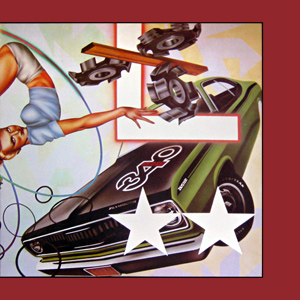
As a sign of things to come, there was a sizable gap between The Cars’ fourth and fifth albums. Part of that time was spent for Ric Ocasek and Greg Hawkes to record solo albums, and likely the rest of the time involved programming the Fairlight drums that drive Heartbeat City. This album is extremely familiar for its singles, and moreso the accompanying videos, which MTV played constantly.

Those singles were so well-placed that hearing them within the original album context seems almost random, particularly if you remember hearing them as each came out. Nonetheless, beginning the album with “Hello Again” and that belching synth riff makes sense. “Looking For Love” is a hidden pop gem, overshadowed nearly immediately by “Magic”, one of the greatest summer songs ever. (Even if you could spot the table he was standing on in the pool the second time you watched the video.) Then there’s “Drive”, all lush keyboards and Ben’s scolding voice, its video notable for introducing Ric to Paulina Porizkova. Ben also gets lead on “Stranger Eyes”, another edgy number.

“You Might Think” was the first single, and starts side two in true potboiler fashion. It’s still a pretty good stupid song. “It’s Not The Night” is the now-obligatory Greg Hawkes co-write, but it’s hard to tell how something this slight took two people to create. (Not one of Ben’s better vocals either.) “Why Can’t I Have You” was another slow single, but even another appearance by Paulina didn’t help sell it. “I Refuse” screams ‘80s movie soundtrack, but the title track ends everything in a menacing fashion.

Heartbeat City is another quality Cars album, full of snappy pop just like they’d always promised. A noticeable difference in the production credits is Robert John “Mutt” Lange, then between Def Leppard albums; modern ears can hear his hand in the backing vocals, so maybe it’s his touch that helps keep the album sounding fresh.

The first expanded CD added some worthy extras, including the hilarious remix of “Hello Again”, a heavily bossa nova demo of “Drive”, three “early versions”, the B-side “Breakaway”, and the standalone single “Tonight She Comes”, used to promote the following year’s hits album. Seven years later, all those except “Tonight She Comes” were included in a Deluxe Edition along with more “early versions” and “early mixes”, as well as a song already on the Panorama expansion, and a Houston concert that was already the basis of a VHS back in the day.

The Cars Heartbeat City (1984)—
2018 expanded edition: same as 1984, plus 7 extra tracks
2025 Deluxe Edition: same as 1984, plus 42 extra tracks

Friday, May 24, 2013

Rolling Stones 47: Light The Fuse

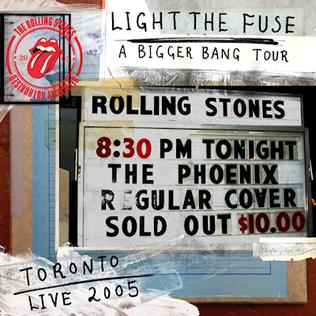
While gearing up for various celebrations of their 50th anniversary, the Stones quietly made some more official bootlegs available. Two were expansions of already documented tours, making Light The Fuse one of the more enticing titles. This was a club show to kick off their 2005 tour supporting A Bigger Bang, recorded at a Toronto theater with capacity of about a thousand. (Not the same place that spawned side three of Love You Live, a show that would have to wait another ten years to be put out.)

The club atmosphere is good for them, as it removes the distractions of the spectacle so common to Stones tours. Here they’re just playing, opening up with the new “Rough Justice”, and going back for a sloppy “Live With Me” and a slower, dirtier “19th Nervous Breakdown”. Any doubt that Charlie can’t keep up is dispelled by a sharp take on “She’s So Cold”, followed by “Dead Flowers”. With audible interplay between the instruments, “Back Of My Hand” works a lot better in this setting than it did on the album.

About halfway through Mick thanks the crowd and the city, and introduces all the people on stage, including the singers and horn players who’d turned up during “Ain’t Too Proud To Beg”. That provides a nice spot for Keith to sing “Infamy”, which stumbles to a close, and Mick comes back to yell “Oh No, Not You Again”. Things turn left for covers of “Get Up Stand Up” and “Mr. Pitiful”. Then it’s “Tumbling Dice”, “Brown Sugar”, a tease, and “Jumpin’ Jack Flash”.

We pick on these guys a lot here, but it’s examples like Light The Fuse that demonstrate why they’re still worth having around. When it comes right down to it, they’re a pretty decent band.

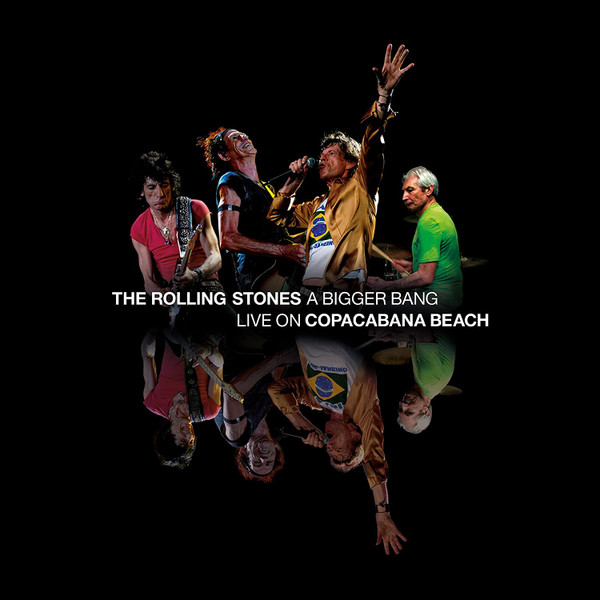
Since we gotta talk about it somewhere, the Archive Download series would peter out in time, but vault releases would continue with multiple concerts from well-mined tours repackaged as CD packages with DVDs and/or Blu-rays and of course multicolored vinyl versions. The 21st century was eventually acknowledged with a rejig of one of the shows included in an earlier DVD box set, this one a free concert in Rio de Janeiro in front of an audience of over a million and a half. With the exception of a few songs from the new album, the set is pretty much the same as ever, with the exception of a cover of “The Night Time Is The Right Time”, featuring Lisa Fischer.

Rolling Stones Light The Fuse: A Bigger Bang Tour (2012)—
CD equivalent: none; download only
The Rolling Stones A Bigger Bang Live On Copacabana Beach (2021)—3

Wednesday, May 22, 2013

Beach Boys 18: Surf’s Up

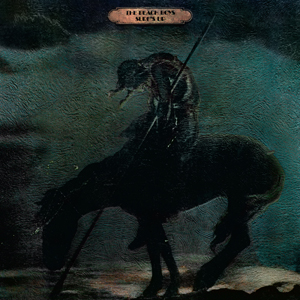
This is one odd little album, nearly sunk by some embarrassingly earnest tracks, and saved by some truly great ones. Surf’s Up gets its title from yet another Smile refugee, this one the haunting centerpiece that was supposed to be the capper of that abandoned album. Its inclusion is welcome, but an odd choice for an album largely “concerned” with ecology. The cover, featuring a rendition of the 19th-century sculpture “The End Of The Trail”, gives the album a link to the American past, and suggests a gravitas we’re still not convinced the band could carry.

The Beach Boys had a new manager who’d managed to finagle his way into their orbit at a time when they weren’t looking too closely at résumés for accuracy. He thought they should be more socially conscious, so that’s why “Don’t Go Near The Water”—an odd sentiment from a bunch of guys who’d spent ten years telling us of the wonders of the beach and surf—starts the program with a lament about pollution. It’s an impressive recording; it’s just too bad the lyrics try too hard. All is nearly redeemed right away with Carl’s wonderful “Long Promised Road”, his first great song, and a terrific match of lyrics and music. But then “Take A Load Off Your Feet” has that same rinkydink approach that sank Smiley Smile, and it’s hard to believe they could really take themselves this seriously. The seesaw goes back for “Disney Girls (1957)”, a suitably nostalgic reverie from Bruce that’s not at all embarrassing. Which can’t be said for “Student Demonstration Time”, a stupid rewrite of “Riot In Cell Block Nine” referencing recent antiwar activity, complete with idiotic sound effects and Mike Love’s voice processed as if it were coming from a megaphone. (You know, for that “realistic” feel.)

“Feel Flows” got some exposure in this century on the Almost Famous movie soundtrack; a mildly psychedelic track, it’s layered in phasing effects and stops for a lengthy free-form jazz flute solo. “Looking At Tomorrow” is helpfully titled “A Welfare Song” as if the bleak lyrics weren’t clear enough. Its bathroom echo effects recall John Lennon, of all people, and its brevity sets up the final three songs of the album, all pointedly credited in whole or in part to Brian. “A Day In The Life Of A Tree” is one of the more bizarre songs, if only because that quivery vocal is provided not by Brian, whom it resembles, but that earth-friendly manager, singing from the point of view of a dying tree. “’Til I Die” continues the virtual wake, gorgeous despite its bleak outlook. This leads up to the unveiling of the title track, embellished from its original, abandoned 1966 incarnation to include some newer touches, and fading grandly, just like “Cabinessence” did two albums prior.

There really is more good than bad on Surf’s Up, although the bad is bad enough to mar the album as a whole. Still, Carl and Brian contributed some of their best work, though Dennis, the recent rising star, is virtually absent. Even Bruce had something worthwhile to say. At the turn of this century, Capitol reissued the album as a two-fer with Sunflower, which again had some people hailing the pair as buried treasure, as they would the big expansion of both fifty years later. Truthfully, the Boys could do a lot worse, and they would.

The Beach Boys Surf’s Up (1971)—3

Monday, May 20, 2013

Billy Joel 7: 52nd Street

So now he was a star, and he did the smart thing: he didn’t screw with the formula. Same band, same producer, same New Yawk summertime radio candy, with a few touches to indulge his knowledge of pop history and classical motifs. 52nd Street was an easy hit as a result.

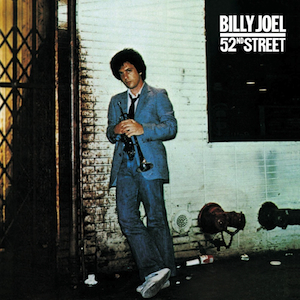
“Big Shot” crashes out of the speakers, all snotty delivery and fingerpointing. “Honesty” is another one of his lovely classical pieces expanded into a pop song. What always kills is the way he stretches the word “on” neatly into the final chorus. “My Life” was drilled into the public consciousness by its use as the theme song for the sitcom that launched the career for future Oscar® winner Tom Hanks, though we’re still not sure why it sounds like he’s puking on the fade. “Zanzibar” is an incredibly complicated composition for a portrait of a twentysomething barfly—perhaps the protagonist of “Captain Jack” if he’d lived this long? This is the tune that fits the use of the trumpet on the album sleeve, with bop legend Freddie Hubbard taking the solo. (So much so that it’s easy to overlook Doug Stegmeyer’s bass while that’s going on.)

As before, side one is stacked with the hits, so side two presents hidden treasure for the casual album buyer. A slow piano with a smoky sax sets up the false intro for “Stiletto”, one of his more popular deep cuts. “Rosalinda’s Eyes” returns to the MOR lite jazz sound of the mid-‘70s; it’s notable to mention that “Rosalinda” is a variation on his mother’s name. The horn-heavy “Half A Mile Away” has some decent hooks, but overall it’s fairly slight. A harbinger of future works, however, appears in the big production behind “Until The Night”. Here is an overt Righteous Brothers homage at a time when they were in the “where are they now” file; his stellar, intricate vocal arrangement is spot-on, and the little touches in the arrangement (percussion, strings, etc.) show a dedication from students of the recording art form. (Righteous Brother Bill Medley would even record it himself a few years later.) It makes such a statement on the side that the title track comes off as something of an afterthought, but still well played.

52nd Street would have been welcome to anyone who’d already inhaled The Stranger—more of the same without being a complete retread. And that’s just what we demand of our pop stars.

Billy Joel 52nd Street (1978)—

Friday, May 17, 2013

Jimi Hendrix 16: Blues

The Rykodisc albums and Reprise box sets proved that there was still gold in the Hendrix hills. With an eye on streamlining (and reissuing) the catalog, the estate made the very surprising move to take it to MCA in the U.S. They promised that further archival projects would make everything wonderful, but immediately raised eyebrows by repackaging the three Experience albums with new artwork, and deleting the existing Reprise CDs, including the recent box sets.

But MCA’s next move was surprisingly good, even with Alan Douglas’s name in the credits. Blues collected 11 mostly obscure recordings to firmly present Jimi Hendrix as a key link in the blues guitar tradition, rather than just a flashy guy who played with his teeth.

The set is neatly bookended by “Hear My Train A-Comin’”, first in an acoustic 12-string solo performance from 1967, then in the lengthy electric performance as heard on Rainbow Bridge. “Red House” appears in its original UK LP rendition, then again with the expanded “Electric Church”. In between are such warhorses as “Born Under A Bad Sign”, “Mannish Boy”, “Catfish Blues”, and “Bleeding Heart”, plus the originals “Once I Had A Woman” and “Jelly 292”, alternate versions of previously altered album tracks. The most interesting yet controversial piece is a re-edited “Voodoo Chile Blues”, from several takes of the slow version heard on side one of Electric Ladyland.

The timing for Blues was excellent, given the genre’s then-resurgence thanks to young white guys like Jonny Lang and Kenny Wayne Shepherd, who considered Jimi an influence, and such veterans as Buddy Guy and B.B. King, who considered him an heir. Its stature in the canon is confirmed by its continual in-print status when the estate took over the catalog five years later, and again in this century when it moved to Sony.

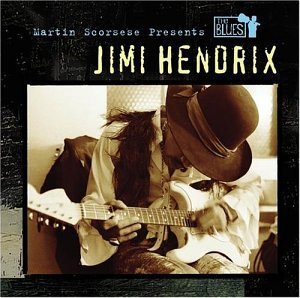
Also in this century, a couple of years before stamping his name on documentaries about Bob Dylan and George Harrison, director Martin Scorsese tried to one-up Ken Burns with a PBS series on the blues. If anything, it opened the opportunities for a flood of companion CDs covering famous and forgotten bluesmen, the likes of which hadn’t been seen since Sony rediscovered Robert Johnson in 1990. The Hendrix estate also heard cash registers, so they dove in with another set.

Martin Scorsese Presents The Blues: Jimi Hendrix should not be considered definitive in the least; while it only overlaps a few song titles with Blues, it’s not exactly illuminating. Five of the tracks could be considered standard—the Smash Hits version of “Red House”, “Come On” and the long “Voodoo Chile” from Electric Ladyland, the execrable “My Friend” from The Cry Of Love and later First Rays Of The New Rising Sun, and “Midnight Lightning”, which closes South Saturn Delta. Three songs are repeated from the 2000 box set, including a smoking take of “Hear My Train A-Comin’” with the Experience.

That leaves exactly two songs not officially released before. “Georgia Blues” is a something of a rewrite of “Stormy Monday”, featuring Lonnie Youngblood on sax and lead vocals, in an uncanny similarity to Bob Seger. Slightly more interesting is “Blue Window”, where he’s backed by the Buddy Miles Express for 13 minutes, horns and all.

As many of the tracks feature Jimi playing alongside people other than the Experience or the Band of Gypsys, the album does succeed in presenting another side of him. Unfortunately, it had already been done, and better, making it less a loving portrait than a grab for cash. Its out-of-print status today suggests that even the Estate doesn’t consider it part of the canon. Naturally, with the latter of those rare tracks out of circulation, used copies go for big bucks.

Jimi Hendrix Blues (1994)—4
Jimi Hendrix
Martin Scorsese Presents The Blues: Jimi Hendrix (2003)—3