Saturday, August 31, 2013

Lou Reed 27: Animal Serenade

At first one balks at the idea of yet another Lou Reed live album, particularly after the trial that was The Raven, the odor of “contractual obligation”, and the double-CD, two-hour length. However, Animal Serenade emerges as one of the more striking and enjoyable installments in his catalog.

The band consists, again, of Mike Rathke on guitar and guitar synthesizer—which replicates many of the piano parts familiar from the albums—and Fernando Saunders on bass and vocals, as well as some electronic drums. Jane Scarpantoni plays cello, of course, and the artist then known as Antony provides ethereal vocals. (Unfortunately missing from the listening experience are the demonstrations of Lou’s tai chi master, who appeared alongside the band on stage.)

He sounds a little drunk at first, teasing the crowd with the correct way to play “Sweet Jane” before switching abruptly to “Small Town”, peppering the lyrics with asides about Long Island, despite the show happening in L.A. But he soon hits his stride, and stays almost conversational over a subdued backing. The setlist runs a wide gamut, pulling out such deep cuts as “Tell It To Your Heart”, “The Day John Kennedy Died”, and the title tracks from Set The Twilight Reeling and Ecstasy. Three songs from Berlin predict that album’s revival a few years away. “Vanishing Act” and “Call On Me”, two of the better tracks from The Raven, are welcome, and after a brief history lesson, he recites his own version of the title poem in a different but still unsettling approach to Willem Dafoe’s take. Fernando gets the spotlight for his own lovely composition “Revien Cherie”.

Velvet Underground songs are mostly reserved to the later part of the show, and given vibrant readings thanks to the performers and their respective technologies. “Venus In Furs” is stretched to ten minutes via a harrowing cello solo, while “All Tomorrow’s Parties” is more rock than baroque. “Candy Says” is wisely handed over to Antony, who gives it a reading exponentially greater than Lou admits he could himself. Rather than the usual “hits”, more familiar tracks include “Dirty Blvd.” and “Street Hassle”, wherein all three parts are condensed to about two-thirds its original length.

All in all, it’s something of an “intimate evening with Lou,” though we wish he’d’ve shouted down those of the audience who hoot during quiet sections, or at least the pinhead who requests “Rock ‘N Roll Animal!” As there are other examples of angry Lou available for your listening pleasure, Animal Serenade is a recommended alternative.

Lou Reed Animal Serenade (2004)—

Friday, August 30, 2013

Frank Zappa 20: One Size Fits All

While one of his more challenging albums musically, One Size Fits All is also one of Zappa’s more accessible. Unless we’re missing something, there doesn’t appear to be a single off-color lyric or bathroom subject matter anywhere; instead, the focus is on the music and the incredible performances herein.

The positively dizzying “Inca Roads” approaches prog-rock, from its subject matter to its time signatures to its Moog solos. But as soon as you hear Ruth Underwood’s vibes and marimbas, it’s a Zappa song through and through. “Can’t Afford No Shoes” is political below the surface, which is easy to miss if you just concentrate on the guitar. One of his more majestic (there’s that word again) melodies has got to be “Sofa”, which is heard again at the end of the album with German lyrics, and no amount of research has been able to explain what the hell it all means. “Po-Jama People” is a pretty tasty showcase for George Duke’s piano and Zappa’s guitar, playing at each other, and particularly after the vocal section finishes.

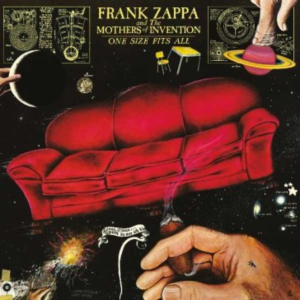
Side two concentrates more on his own homegrown mythology. One can spend as much time pondering the significance of “Florentine Pogen”, which would seem to be a young lady named after a Swedish brand of cookie, or one could squint at the constellations on the star map all over the cover and play find-the-in-joke. Luckily for “Evelyn, A Modified Dog”, she doesn’t suffer the same ridicule and abuse as her poodle relations, and before you know it we’re in the drunk tank in “San Ber’dino”, with a harmonica that sounds like an accordion. In a mild harbinger of a future style, “Andy” gets a grand arrangement, something like Utopia-goes-to-Broadway. Whatever it’s about.

One Size Fits All was partially recorded in a television studio for eventual broadcast, which would account for its fresh, live sound. Again, the music is of such a level and quality that the words seem an afterthought. It’s an excellent place to newcomers to wade in, particularly after such a high silly ratio in much of his other ‘70s work. (The 50th Anniversary Edition filled out the balance of the disc containing the album as well as a second with session outtakes and rough mixes, and included a Rotterdam concert from 1974—a week after the Helsinki concerts—on two more. A Blu-ray included the album in Dolby Atmos and 5.1 surround.)

Frank Zappa and the Mothers Of Invention One Size Fits All (1975)—
2025 50th Anniversary Edition: same as 1975, plus 36 extra tracks (and Blu-ray)

Wednesday, August 28, 2013

Robyn Hitchcock 21: Olé! Tarantula

It would seem that Robyn Hitchcock’s albums are the most consistent when he’s either working completely solo, or when he’s got a solid unit behind him for the duration. That’s the evidence one gleans from the first play of Olé! Tarantula, his most solid album since the heyday of the Egyptians. Here he’s helped out by the Venus 3, a trio of escapees from Young Fresh Fellows, Ministry and R.E.M. (longtime buddy Peter Buck). And considering that the other two guys have since been tapped to help out R.E.M. onstage and in the studio, that should suggest a certain mutual intuition.

Right from the top, “Adventure Rocket Ship” and “Underground Sun” sound like vintage Robyn; even “Museum Of Sex” works despite its saxophones and rambling lope. Speaking of which, “Belltown Ramble” sports a dotty piano over the acoustic and non-linear lyric for six minutes. The title track seems like an excuse to write a song to match said title, but it’s got all the ingredients for fun.

By now Robyn fans tend to give songs with titles like “(A Man’s Gotta Know His Limitations) Briggs” the benefit of the doubt, whatever the context. “Red Locust Frenzy” comes at the traditional spot when one of his albums starts to drag, nudged along by a riff not distantly related to “I’m Only You”. “‘Cause It’s Love (Saint Parallelogram)” was written with XTC’s Andy Partridge, and could have used some of his lyrical whimsy. “The Authority Box” is nice and trashy, in direct contrast with “N.Y. Doll”, something of a letter written from the point of view of that band’s Arthur Kane.

As we’d long begun to suspect that we were supporting this guy more out of habit than fascination with his development—not helped by pricey import-only items like Obliteration Pie and This Is The BBC—it was truly joyous to find something as, well, good as Olé! Tarantula. Clearly this was not a fluke, since he took the band on the road (pushed by some exposure from the Sundance Channel) and dug deep into his catalog. Some examples emerged on Sex, Food, Death… And Tarantulas, an EP released the following year; in the meantime, it was hoped that the Venus 3 would be able to help their boss out again, provided they could find the time.

Robyn Hitchcock & The Venus 3 Olé! Tarantula (2006)—3

Monday, August 26, 2013

Band 2: The Band

Their first album was dominated by the specter of their old boss Bob Dylan, but if they were going to get anywhere, they had to be their own men. So for their second album, they were simply and emphatically The Band. All the sounds and songs (more on that later) came from their own mouths and fingers. Once again the focus is on Americana, or an image what it was supposed to be at one time.

Richard Manuel wrote many of the songs on the debut, but here the most consistent name is that of Robbie Robertson. We’ll likely never know if Robbie’s adoption of the songwriting was genuine or underhanded, but there’s no question that the voice of The Band was a combination, with Richard’s plaintive tones countered by Levon Helm’s redneck yowl. These are nicely balanced on side one, with the near-majestic “Across The Great Divide” giving way to the ribaldry of “Rag Mama Rag”. Everybody knows “The Night They Drove Old Dixie Down” by now, its sad salute leading into the hope of “When You Awake”. “Up On Cripple Creek”, with its bouncy wah-wah clavinet returns the fun, but Richard’s stirring lead on “Whispering Pines” puts him back in charge.

Side two is a little more unpredictable, with even more obscure lyrics and complicated melodies. “Jemima Surrender” follows a dirty riff through a good groove before “Rockin’ Chair” takes us to the seaside. So when they all let loose on “Look Out Cleveland”, it’s a great reminder that these guys could really rock. “Jawbone” is just plain odd, with a trick opening and a nearly impossible-to-follow meter if you’re trying to clap along. “The Unfaithful Servant” (excellent lead vocal by Rick Danko) seemingly sends us back to another era, its graceful piano and acoustic guitar ringing in somebody’s parlor, while “King Harvest (Has Surely Come)” details what’s happening out in the fields. It’s an excellent display of their dynamics.

This is another one of those albums that people say is perfect, and they’re entitled to their opinion. It’s very good, and it’s solid, but most of all it’s mysterious. More than anything, it influenced other musicians, who would strive to recreate the same sense of community on their own records. But even The Band would find how ego and other distractions would make such a democracy impossible. We’ve gone back and forth about what rating to give it, simply because we don’t personally feel compelled to play it all that often, but somehow anything less doesn’t make sense.

The first expanded and remastered CD got major points for including “Get Up Jake”, a later B-side recorded during these sessions, alongside some intriguing alternate takes and/or mixes. These were all nicely carried over to the 50th anniversary edition of the album, once again remixed by Bob Clearmountain, alongside six further alternate takes and mixes. But the best reason to pick it up was the inclusion of their entire Woodstock set, which was split between music from Big Pink and then-unreleased arrangements of “Don’t Ya Tell Henry”, “Ain’t No More Cane”, “Baby Don’t You Do It”, and “Loving You Is Sweeter Than Ever”.

The Band The Band (1969)—4
2000 CD reissue: same as 1969, plus 7 extra tracks
2019 50th Anniversary Edition: same as 2000, plus 17 extra tracks

Sunday, August 25, 2013

Beach Boys 22: Endless Summer

Much like Elvis Presley, the Beach Boys were already a caricature by the time the post baby-boom generation knew who they were. And like Elvis, they deserve better than to be written off in that way.

Those youngsters who’d study the history of rock ‘n roll would learn about how Pet Sounds was their best album, and how the follow-up, Smile, was never completed despite its destiny as music that rivaled the Beatles’ best moments. They undoubtedly would also have found it odd that a band known best from Sunkist orange soda commercials could be spoken of so reverently. This could be reinforced by the popularity of Endless Summer, a well-sequenced compilation of songs about girls, cars, surfing and the beach.

It was a timely set; the band was gaining some of their old acclaim back as an excellent touring outfit, and with the trend started by Sha Na Na, American Graffiti, Grease (the Broadway version), and Happy Days, nostalgia was okay, particularly if it was back to a time of on-the-surface innocence. So it was that one of the most successful albums of 1974 was a compilation of previously released material that was about ten years old at the time. While the Beach Boys may not have been burning up the charts with their current work, their old label, never shy about cashing in, hit pay dirt with Endless Summer.

It doesn’t have every single classic from the early days, but certainly covers most of the period before Brian Wilson took over the studio and the band’s albums became solo projects with the guys singing. There’s a mild progression in chronology, but not so you’d notice. Side one is mostly about surfing, as evidenced in the song titles, including a couple of slow numbers. Side two covers driving and high school, with “In My Room” providing an excellent portrait of the American teenager. Side three gets a touch more sophisticated musically, particularly by the inclusion of “Let Him Run Wild” and “Don’t Worry Baby”, two of Brian’s best productions. Side four is all upbeat singalongs, from “California Girls” to the closing throwback of “All Summer Long”.

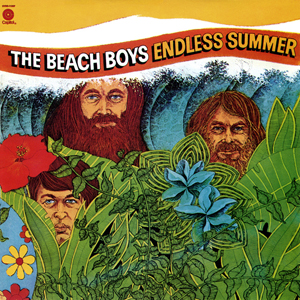
Probably the worst thing we can say about the album is the artwork, as we doubt even the band members themselves would be able to clarify who was who. It evokes a mental image of too much time in the sun, right about the middle of August when the humidity has become unbearable, your skin blistered from sunburn and the pungent stench of Noxzema and Caladryl. Luckily, that goes away when the music starts. Endless Summer follows through on its premise, with 20 songs in under an hour. The CD version would add “Good Vibrations” to the lineup, but by then the racks were glutted with redundant compilations, including the 1975 follow-up Spirit Of America. The album is now out of print, and while there are several “summer”-related Beach Boys titles that include many of the same tracks, the original 2-LP set has proven impossible to beat.

The Beach Boys Endless Summer (1974)—4
1988 CD reissue: same as 1974, plus 1 extra track
Current CD equivalent: none

Friday, August 23, 2013

Bruce Springsteen 8: Live/1975-1985

Springsteen fever lasted a good two years after Born In The U.S.A. came out, and when the world tour finally finished, it seemed as good a time as any to put out a live album. But rather than just pull from the shows they’d just done, Bruce, his management and his grateful record company decided to make it an event. Therefore, Live/1975-1985 was released as a box set, following the five-LP/three-CD or tape pattern from the previous year’s Bob Dylan box. Even then, it wasn’t too much of a stretch to put those two curly-haired, gravel-voiced singer-songwriters in the same sentence, but while Bob had 20 years of music (released and unreleased) under his belt, the 3½-hour length of the Bruce box was roughly equivalent to one of his concerts.

The title was pushing it, since only one of the forty songs was recorded as early as 1975; maybe because his old manager would have got the cash? But it does progress chronologically for the most part, with the bulk of three sides coming from L.A.’s Roxy Theater in 1978, then a couple of sides bouncing between Nassau Coliseum and the Meadowlands in 1980 and 1981, and the final four sides coming from the Born In The U.S.A. mega-tour. (Again, with few exceptions, everything comes from either L.A. or New Jersey.)

The opening “Thunder Road” from 1975 is mostly Bruce and Roy Bittan on piano, making for an intimate start. It’s also a good setup for the club atmosphere of the Roxy shows, which is where his storytelling works best, as on the lengthy rap in the middle of “Growin’ Up”. Soon enough, the recordings move to the hockey arenas and stadiums, where the sound of “Bruuuuuce” fills the gaps between songs (though you can almost hear the footsteps of the crowd heading towards the bathroom during “Working On The Highway”). In a harbinger of the future, Patti Scialfa gets to wail a bit by herself on “Cover Me”, and “No Surrender” is transformed into a sensitive folk song.

Of course, the big excitement to collectors was any and all of the songs that hadn’t ever been on a Springsteen album before. “Paradise By The ‘C’” is a good-timey instrumental showcasing Clarence Clemons and Danny Federici. You gotta wait all the way until side seven to hear “Seeds”, a song he apparently ever only played three times, which is just as well, since it’s the groove from “Pink Cadillac” for about five minutes with canned horns. That comes out of “Born In The U.S.A.” and precedes the lengthy intro to “The River”, wherein he does a monologue about how he and his dad never got along except for this one time he went for his physical at the draft board and they didn’t take him. Lest anybody be confused about how he felt about the Reagan administration, an angry cover of Edwin Starr’s “War” comes next. (Maybe he’d heard Frankie Goes To Hollywood’s version?)

His shows always included a rousing cover or twelve, so we also get a hot performance of the Stax nugget “Raise Your Hand” (also covered by the J. Geils Band in the same era). Then there were the songs made famous by others, like “Fire” (Pointer Sisters) and “Because The Night” (Patti Smith). A reverent cover of “This Land Is Your Land” from 1980 sets up the leap to the near-present and a trio of songs from Nebraska that manage to come across in a stadium setting. It’s fitting that the set ends with his cover of Tom Waits’ “Jersey Girl”, a B-side that was a big radio hit around these parts.

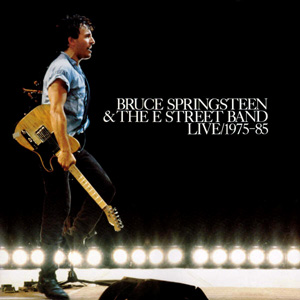
Being who it was and when it came out, every major publication (led by Rolling Stone, who were always close to his payroll) hailed the box as the greatest development in the evolution of recorded music. Granted, Springsteen’s live shows are what sustained his reputation over all those lean years, helped along by bootlegs often derived from local radio broadcasts of shows such as these, albeit with four-letter words and references to bootleggers rolling tapes. (While Bruce is the only person we see on the cover, for the first time, the E Street Band was given equal billing, and rightfully so.) And the set sold very well, considering that it was Springsteen, and it was Christmas. And just like that, everybody who wanted it had it, and returns of unsold copies after the new year were plentiful. That doesn’t take away just how solid it is.

Bruce Springsteen & The E Street Band Live/1975-1985 (1986)—4

Wednesday, August 21, 2013

Cream 2: Disraeli Gears

Like any hungry band, Cream gigged a lot, and managed to build up enough material for another album. Disraeli Gears is arguably their most popular album, as it features many of their most famous songs—any of which are likely playing on the radio as you read this.

Eric Clapton was getting the courage to sing more, as heard on “Strange Brew”, but even more prominently in duet with Jack Bruce on “Sunshine Of Your Love”, one of the most iconic riffs ever. But a more important influence on the band would be engineer Felix Pappalardi, who managed to contribute songs (and eventually instruments) to the mix, starting with “World Of Pain”, the motif of which would be borrowed 27 years later by Elvis Costello, of all people. “Dance The Night Away” is dominated by two 12-string guitars, played in a style Jimmy Page must have heard while with the Yardbirds. The nearly plodding “Blue Condition” marks the vocal debut of Ginger Baker, whose pitchless delivery reminds one of Syd Barrett, though his pronunciation “through” as “froo” is endearing.

Jack’s voice dominates side two, which starts with the one-two punch of “Tales Of Brave Ulysses” and “SWLABR”. They’re two of the funniest songs in rock, and we’re not so sure that was intentional. Part of it comes from Bruce’s near-histrionic delivery (“comin' to me with that soulful look on your FA-A-A-A-CE”; “her NAME is AF-ro-DIE-TEE”,), the rest from the lyrics. They’re also very catchy, musically, “Ulysses” sporting a chord sequence that will re-appear, and soon. The “up” feel is soon enveloped in the mist that is “We’re Going Wrong”. It’s a very moody song, played with such tension and mystery that when the blues comes back for “Outside Woman Blues”, it’s like coming up for air. (It’s credited as an arrangement of somebody else’s song, which we’d love to hear to confirm whether Eric added “whilst” himself—making it the consummate British blues recording.) Despite some excellent guitar, “Take It Back” suffers from distracting harmonica and party sounds, but its off-kilter effect makes a logical transition to “Mother’s Lament”, a silly traditional song sung in thick Cockney three-part harmony.

Some would say Disraeli Gears is their best album; as ever, one’s enjoyment will be tempered by how sick they are of those radio staples. The interplay between the three is incredible, and entirely in synch, with nobody dominating. (The drums are still mixed to one channel, which was the style at the time.) Even if you never need to hear the hits again, there’s enough buried in between to grab your attention. (The eventual deluxe expansion offered the album in mono and stereo, but shortchanged fans with demos and BBC sessions that had already been released, the only rarity being “Blue Condition” sung by Clapton, in both mono and stereo.)

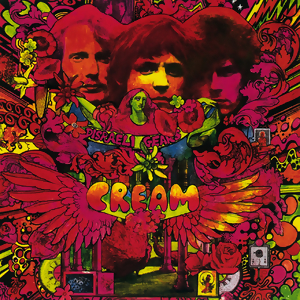
Cream Disraeli Gears (1967)—4
2004 Deluxe Edition: same as 1967, plus 29 extra tracks