Tuesday, June 30, 2015

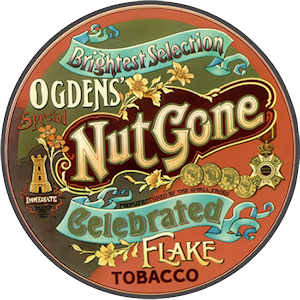
Small Faces: Ogdens’ Nut Gone Flake

Speaking of British bands with messy catalogs, Small Faces began as a genuine mod R&B combo before sliding into psychedelia. Besides being contemporaries of The Who, bass player Ronnie Lane would go on to collaborate many times with Pete Townshend, and drummer Kenney Jones would get the unenviable task of replacing Keith Moon. (Pianist slash organist Ian “Mac” McLagan would also marry Keith’s ex-wife, but we’re getting ahead of ourselves again.) Ronnie sang from time to time, but guitarist and lead singer Steve Marriott was likely the “star”, and not just because Paul Weller’s been copying his haircut for decades.

Their not-really-a-concept-album Ogdens’ Nut Gone Flake usually shows up on lists of classic albums nobody knows but everyone should hear, even without its original unique packaging based on a tobacco tin. Taking its cue from the previous year’s hit single “Itchycoo Park”, it combines Hammond-heavy swirly music with acoustic strums and music-hall silliness—and that’s just side one. The instrumental title track is something of an overture, always on the verge of becoming something bigger; they even put strings on it. Despite its loungey send-up beginning, “Afterglow Of Your Love” soon turns into a powerful Marriott belter. There’s a quick segue to “Long Agos And Worlds Apart”, sung by Mac, which has the same clap-along rhythm as the pub singalong “Rene” (rhymes with beanie) and its extended jam ending. “Song For A Baker” is a groovy rocker sung by Ronnie, before Steve comes back on the exceptionally catchy “Lazy Sunday”, delivered in a thicker Cockney accent than that of “Rene” and would one day be worn of its welcome by Phil Collins. (We’ll credit Glyn Johns for why the album sounds so good, from the flanging effects to the well-placed vocal interjections, very similar to what he’d already done for Traffic.)

Side two is where things get really wacky, with all of the songs strung together by a gobbledygook fairy tale about “Happiness Stan” looking for the moon. The narrator will remind newcomers of Michael Palin, and the side does sound like a parody, except that this was the source. The story itself is just that, hiding no real mysteries or message, except that Stan finds himself “Rollin’ Over” to greet “The Hungry Intruder”, a fly who grows giant enough to take him on “The Journey” to the cave home of “Mad John”, who tells Stan that life is as simple as “Happydaystoytown”. Of course. The songs would likely stand on their own without the narration, but it’s a gimmick that works.

Aside of the novelty of the presentation, two things stand out from Ogdens’ Nut Gone Flake. First is Ian McLagan’s mastery of the electric piano, a touch rivaled only by Nicky Hopkins. Then there’s Kenney Jones’ drumming. How could a guy this inventive and tight go on to become the Who’s metronome? (Because of the differences in mixes unique to different countries, several reissues of the album have offered mono and stereo versions, along with outtakes, but as long as the 12-song sequence is intact, anything else is gravy.)

Small Faces Ogdens’ Nut Gone Flake (1968)—3

Friday, June 26, 2015

Peter Gabriel 1: Car

It took him a couple of years—a pattern that would come to define his career—but Peter Gabriel’s first solo album after leaving Genesis was a bold statement, building on the performance art of his Genesis work while embracing different sounds than those to which he’d been previously shackled. Simply titled Peter Gabriel (but often referred to as Car or Rainy Windshield due to the cover art), it was produced by Bob Ezrin, who’d made his bones with Alice Cooper and Lou Reed. It’s a fairly straightforward collection of songs that straddle both whimsy and standard rock, falling into place all over the map.

“Moribund The Burgermeister”, with its keyboards and funny voices, should have satisfied those Genesis fans who longed to see their hero dressed as a flower or wearing a dress with a fox’s head. Once that’s out of the way, the classic “Solsbury Hill” allegorically tells of his decision to go solo. Anchored by acoustic guitars over 7/4 time, even since its inclusion in countless movie trailers the song never fails to exhilarate. With a rousing count-in, “Modern Love” is a straight-ahead rocker—complete with cowbell—saturated in guitars and keyboards to hide the salacious puns in the lyrics. (Its official video, depicting Peter in a fencing outfit, cavorting through what appears to be an abandoned airport, must be seen to be believed.) From there it’s a complete left turn to a barbershop quartet for “Excuse Me”, which turns into a soft-shoe number complete with tuba. The first side ends with the strangely beautiful “Humdrum”, a song that seems to be a showcase for more wordplay but is absolutely majestic from start to finish.

The classic rock sound creeps in on the second half for “Slowburn”, with stately piano and bubbling synth, followed by a screaming lead guitar. The dynamics here are especially effective, and its curious fade is a good setup for “Waiting For The Big One”, something of a big band pastiche. While Frank Sinatra wouldn’t cover it, the stops and starts for the voices to carry out the big ending make it quite a production. Then the London Symphony Orchestra makes their inevitable appearance on “Down The Dolce Vita”, another big number with a jokey wind-up clock section and an allusion to “Auld Lang Syne” buried beneath the mix. The sense of urgency turns to resignation for “Here Comes The Flood”, presented here in an orchestrated arrangement. It’s a misleading song, with apocalyptic overtones, but the suggestion is that we’re doomed to limbo rather than annihilation.

This would be his most mainstream offering for some time, but that’s not to suggest it’s “commercial” in the slightest. Like any masterwork, its jewels are revealed on repeat listens. Whether or not he missed his old band, he was off to a good start.

Peter Gabriel Peter Gabriel (1977)—4½

Tuesday, June 23, 2015

Doors 2: Strange Days

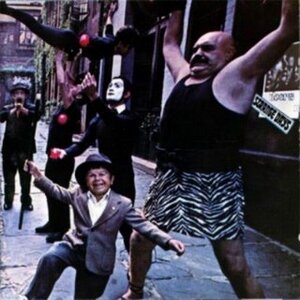
Less than nine months after the release of their debut, which still had legs, the second Doors album appeared. Strange Days follows the same formula as the first album, being instrumentally similar, and concluding with another lengthy, show-stopping epic. (The cover did try to make a departure, using a motley collection of street performers and freaks cavorting in an alley, while a tiny poster of the band with the album title is tucked in on the edge. Clever.)

The title track has enough “strangeness” to make it an effective and disorienting opener, setting a tone of darkness for the next 35 minutes. Robbie is credited with writing “You’re Lost Little Girl”, built as it is on his intricate guitar parts, and nothing special in the way of lyrics. “Love Me Two Times” is also credited to Robbie, as he likely came up with the riff; again, the lyrics aren’t much, but there’s a harpsichord in place of the organ for variety. “Unhappy Girl” is dominated by loopy slide and backwards effects, over before you know it. Jim was very proud of “Horse Latitudes”, a frightening piece of poetry backed by discordant sounds of the band, making the return of the loopy slide on “Moonlight Drive” something of a comfort.

“People Are Strange” is another catchy single despite its depressing message, and helped by the tricky ending. The insistent “My Eyes Have Seen You” is contradictorily followed by the moodier “I Can’t See Your Face In My Mind”, both fairly slight in comparison to “When The Music’s Over”. While not as pointedly provocative as “The End”, it still features many oft-repeated Morrison couplets and good dynamic contributions from the band, making it as much of a group performance as a showcase for Jim’s prose. And assuming you can stand the sound of the organ, a better song.

As with most sophomore albums following a classic debut, Strange Days had to catch up to a lot, but there are and were enough songs in their repertoire to keep it consistent. They were still able to concentrate on the music without the distractions that would soon take over their celebrity.

Even today the album lives in the shadow of its older brother. Much was made of the 50th Anniversary Deluxe Edition upon its release, even though all it contained was the original stereo mix on one CD and the original mono mix on the other. The alternate takes of “People Are Strange” and “Love Me Two Times”, which were added to the 40th Anniversary reissue, were not included.

The Doors Strange Days (1967)—3½
2007 40th Anniversary Edition: same as 1967, plus 2 extra tracks
2017 50th Anniversary Edition: same as 1967, plus 10 extra tracks

Friday, June 19, 2015

Jon Kanis 1: All-American Mongrel Boy

A musician, journalist, video archivist, visual artist, DJ, tour manager and probably a bunch of other things, Jon Kanis has been toiling in the entertainment industry for over 25 years. His experiences and observations have been collected in an anthology, Encyclopedia Walking: Pop Culture & The Alchemy Of Rock ‘N Roll.* The virtual soundtrack to that tome could well be All-American Mongrel Boy, which collects a dizzying array of recordings from various self-made demos, EPs, CDs and collaborations over a 25-year period. The songs on this CD represent only a fraction of those listed in the sprawling discographical appendix of the book.

The music runs the gamut from college rock through adult alternative to whatever label can be applied to that created by those born on the cusp of Baby Boomers and Gen X, touching on folk, country and even avant-prog along the way. His voice combines Roger McGuinn twang with Peter Case smoke, a drawl as comfortable as a baggy wool sweater. With contributions from people better known as right-hand men for Frank Zappa and Brian Wilson, when it comes to six degrees, Kevin Bacon’s got nothing on this guy.

Kanis wrote all the songs himself, naturally, including such clever turns of phrase as “Where Is Joe Strummer When You Need Him?” and “It Is & It Isn’t”. The spirit of creation shines in a couple of collaborations from Steel Bridge Songfest, an annual collective songwriting festival. Others have pointed out how well “Dweller On The Threshold” evokes early Elton John, and we’ll add that it does so without a prominent piano. The lyrics are smart without being patronizing, and the instrumentals “A.C. In Michigan” and “The Return Of The Edmund Fitzgerald” aren’t just background music.

All-American Mongrel Boy is a testament to the so-called struggling musician working under the radar of fame and fortune, and an inspiration to anyone with talent to burn and songs nobody’s heard—yet. Chances are he’s written another pile of songs since publishing his book, so this could conceivably be Volume One of his archives.

Jon Kanis All-American Mongrel Boy (1989-2014) (2014)—3½

Tuesday, June 16, 2015

World Party 1: Private Revolution

If Karl Wallinger had done nothing but play keyboards on “The Whole Of The Moon” by the Waterboys, he would still be respected around these parts. However, he learned fairly quickly that he wouldn’t be able to collaborate with Mike Scott on his own terms, so he recorded something of his own one-man band project called World Party, which turned into a real live Pinocchio when he had a worldwide hit.

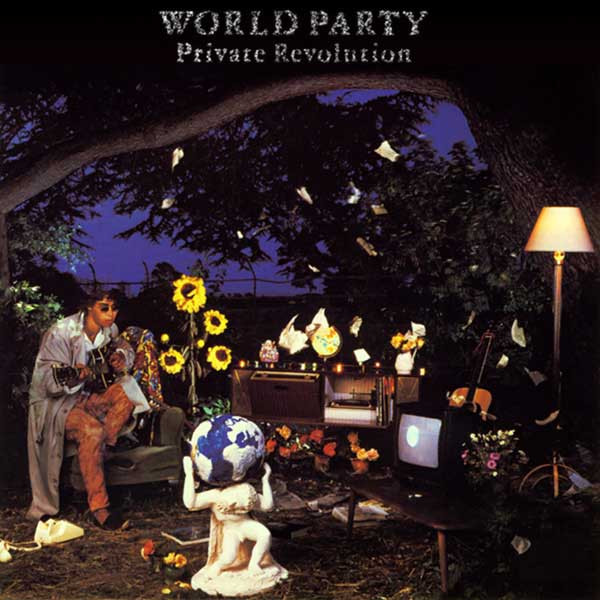
“Ship Of Fools”—subtitled in some places as “Save Me From Tomorrow”, after the hook in the chorus—was an infectious surprise in the darkening winter months of 1986 to 1987, a strolling piano sub-boogie with a vocal that sounded like Jagger channeling Dylan. It was one of the better developed tracks on Private Revolution, which spilled his other obvious influence, that of the recently de-Revolutioned Prince. Drum machines had only progressed so far at that point, and that dated sound colors both the title track and “Making Love (To The World)”. The blatant homage is mostly out of the way with those, so the lengthy follow-up single “All Come True” delivers more mystery in only a few chords. “Dance Of The Hoppy Lads” is a brief instrumental before the smooth soul of “It Can Be Beautiful (Sometimes)”.

Dylan dominates side two, from the outright parody of “The Ballad Of The Little Man” to the straight cover of “All I Really Want To Do”. In between is the countryish “Hawaiian Island World”, notable now mostly for the debut backing vocals (and one scream) by one Sinead O’Connor. The song “World Party” likely came before the band had a name, with a chorus borrowed from the Beatles. Finally, “It’s All Mine” lopes through an ecological lament, but only if you’re paying attention to the lyrics.

Private Revolution would sound better today if it were produced better, but that’s assuming that more sophisticated instruments wouldn’t subtract from the charm. It would have been easy to expect this to be a one-hit wonder, and maybe he’s faded into the background, but Karl Wallinger would have a lot more to offer, in his own sweet time.

World Party Private Revolution (1987)—3½

Friday, June 12, 2015

Waterboys 3: This Is The Sea

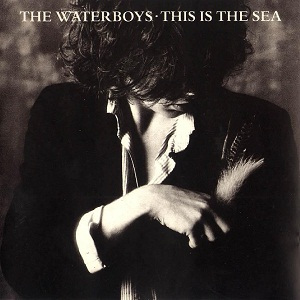
By now The Waterboys were practically a full-fledged band, with most of the previous contributors abetted by Steve Wickham on violin and young Chris Whitten, who packs a wallop all over the place. Always in search of what he called “The Big Music”, on This Is The Sea Mike Scott found it.

The lengthy opening of “Don’t Bang The Drum” is meant to recall Sketches Of Spain but comes closer to a bullfight. When the song proper crashes in, the drum is indeed banged, Mike Scott shouting his words and occasionally “whoo”-ing along the sax. The greatest song they recorded to date, if ever, is “The Whole Of The Moon”, loaded with poetic imagery and a majestic arrangement that incorporates horns and an angelic vocal descant. Even thinking of the sound effect after “you came like a comet” brings chills. Easily one of the best non-mainstream songs of the decade. From there the fragment called “Spirit” seems even more anticlimactic, and “The Pan Within” a little automatic but still stirring.

Side two wanders a bit, from the heavy “Medicine Bow” to the sung poem/tirade “Old England”. “Be My Enemy” chops up a sample “from a Prince bootleg” before turning into a gallop a la “Tombstone Blues” with a Dylanesque snarl to boot. “Trumpets” wants to be a tender love song, and while it doesn’t use the actual instrument, the constant blare of the sax doesn’t help the seduction. But the title track pulls everything together, filtering Van Morrison’s “Sweet Thing” (not for the last time) through a hypnotic Wall of Sound strum evoking crashing waves for a big finish.

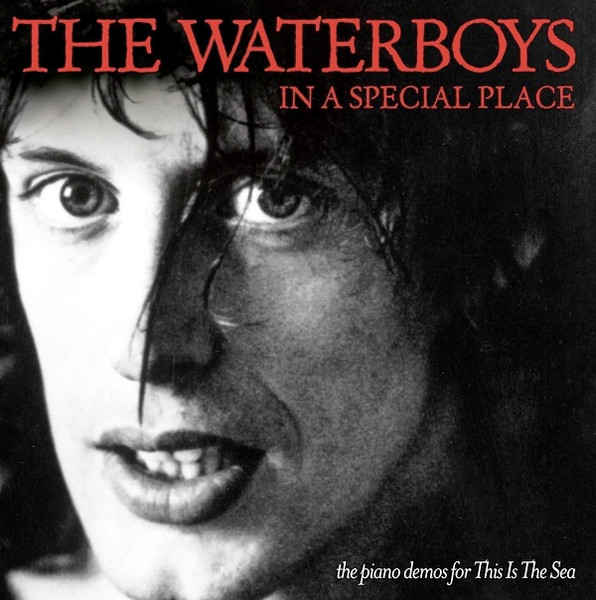
Having achieved his best album yet, it would be a while before Mike Scott would approach this sound again. Those seeking more of the same should seek out the double-disc expansion, including B-sides, extended takes, and other sounds—even an answering machine greeting—from the dozens of tracks originating from the original sessions. If that’s not enough, a later disc called In A Special Place is subtitled “The Piano Demos For This Is The Sea”, offering a selection of just that, including several discarded ideas. This was eventually supplanted by the six-CD 1985 box, helpfully subtitled “How The Waterboys Made This Is The Sea And Saw The Whole Of The Moon”, and loaded with demos, outtakes, alternates, and live recordings. (There’s even a lost Bob Dylan instrumental taken from a recording session with Dave Stewart.)

The Waterboys This Is The Sea (1985)—3½
2004 remastered edition: same as 1985, plus 14 extra tracks
The Waterboys In A Special Place – The Piano Demos For This Is The Sea (2011)—3

Tuesday, June 9, 2015

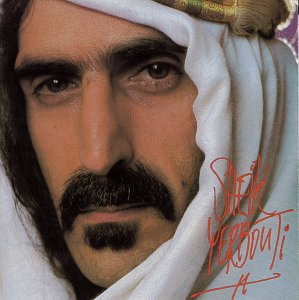
Frank Zappa 26: Sheik Yerbouti

His legal issues had subsided, so Frank was now recording and releasing music on his own label, albeit with major distribution. That corporate umbrella must have been relieved when the first LP—a double, no less—under the deal became a mild hit thanks to an unlikely hit single.

Sheik Yerbouti—the title capitalizing both on the current disco craze and the ongoing conflicts in the Mideast—kicks off Zappa’s phase of recording the tracks live before subjecting them to multiple overdubs, edits and what he called xenochrony, which pits recordings from different sources against each other to make a new whole. All this attention to the musical detail was naturally sabotaged from the inside by the lyrics.

Right off the bat, “I Have Been In You” begins as modern doo-wop, but Frank’s greasy lead vocal turns it into a lyrical parody of Peter Frampton’s “I’m In You”. “Flakes” is a complaint about incompetence mostly notable for the lengthy overdone Bob Dylan impression courtesy of guitarist Adrian Belew (complete with harmonica blasts). Six minutes of this will realize that the melody and structure would later show up in Adam Sandler’s “Hanukah Song”. The sentiment of “Broken Hearts Are For Assholes” is pretty straightforward, but it’s incidental to the asides about gay culture and coda endorsing sodomy. “I’m So Cute”, histrionically vocalized by heartthrob Terry Bozzio is a parody of early New Wave (the ending restored on the current CD).

Adrian Belew does a similar vocal to “Jones Crusher”, in the same vein too, and then we have two Lumpy Gravy-style interludes of impenetrable conversation and musique concrete given their own titles (“Whatever Happened To All The Fun In The World” and what’s now called “Wait A Minute”) bookending “Rat Tomago”, a guitar solo from a performance of “The Torture Never Stops”, excerpted here for your pleasure and soon to spawn a series of similar albums. Released as a single everywhere but the U.S., where there’s no way it would get past the FCC for airplay, “Bobby Brown” is by far one of his most offensive lyrics, and funny despite itself. The rest of side two is instrumental, via the xenchronous bass-drums duet of “Rubber Shirt” and “The Sheik Yerbouti Tango”, another wild guitar solo.

“Baby Snakes” is best known as the title of one of the few films he actually finished, but a closer inspection suggests a reference to genitalia. Terry returns to sing the teenage anthem “Trying To Grow A Chin”, which improves at the closing chant (“please kill me ‘cos that would thrill me”), and Adrian sings the synth effect-heavy “City Of Tiny Lights”, where you can clearly hear the audience for the first time on the album. The song that sold the album was easily “Dancin’ Fool”, a disco parody destined for replays on the Dr. Demento show. But the song that really made people mad was “Jewish Princess”; apparently it’s bad enough to be a chauvinist, and worse to court anti-Semitism.

Side four has only two songs. “Wild Love” is musically ambitious with meticulously arranged vocals given the same puerile content to harmonize over, but “Yo’ Mama” makes much better use of its time, with an easier rhythm, silly rhymes and ten minutes of soloing, going from slinky to majestic.

Juvenile as it is, Sheik Yerbouti sounds good, and has a good balance of music vs. comedy. Using technology to create his albums from live performances was nothing new, but creating something seamless wasn’t successful until this one.

Frank Zappa Sheik Yerbouti (1979)—3