Tuesday, April 28, 2020

Sting 15: My Songs

No, dammit. Just… no.

Apparently “enhancing” his music with orchestral touches wasn’t enough for one lifetime. Determined as ever to sound contemporary, My Songs is an attempt by Sting to bring his catalog up into the here and now. That means remixing old tracks, both solo and with the Police, or rerecording them. In the latter instance, “Demolition Man” gets yet another makeover, this time with lots of screaming guitars. But in the case of practically everything else here, the differences between the originals and these versions aren’t apparent outside the vocal. There’s nothing radical or inventive in the arrangements. The feeling the listener gets while enduring this ego exercise is a new appreciation of the album title, as expressed by a three-year-old. (“MY songs! MY fire engine! MY toys! MINE!”)

Rerecording one’s old albums is a common practice among legacy artists who wish to create higher royalties than those granted by the labels that owns the originals. But Sting has been on the same label for his entire career, so that excuse doesn’t apply here. Nor does this particular lord of the manor need the extra euros. If you loved the original versions, stick with them. They won’t waste your time. (Following the tour of the same name, a special edition of the so-called “critically acclaimed” album—according to the press release; a Google search found zero instances of any positive acclaim—added a bonus disc of live versions, which merely add the sound of a rapturous crowd.)

Sting My Songs (2019)—2

Friday, April 24, 2020

Marshall Crenshaw 8: Miracle Of Science

Having sprung for the mild teaser of a live set, Marshall Crenshaw’s new label went all out to make his new album something to remember. This being the days of non-vinyl, the jewel cases of Miracle Of Science were treated with a glitter-effect hologram, while the liner itself was presented origami-style with multiple creases and miniscule credits. Meanwhile, he made the most of his deal by eschewing big studios and recording most of the album himself.

Of course, packaging is moot if the album doesn’t stick, and this one does. Following an indexed soundbite from an obscure Sammy Petrillo/Duke Mitchell movie, “What Do You Dream Of?” hits the ear candy jackpot, and the album hardly lets up from there, from the haunting “Laughter” and “Only An Hour Ago” through “Seven Miles An Hour” and the extended quasi-surf instrumental “Theme From ‘Flaregun’”. Our favorite by far is “Starless Summer Sky”, which dates back to his pre-professional years.

The originals are mixed with covers with only the barest misstep, “The ‘In’ Crowd” sounding the most like an indulgent afternoon spent overdubbing. Research tells us that “Wondrous Place” was an old Billy Fury tune; “Who Stole That Train” is an old rockabilly number that also sounds just like him, just as Grant Hart’s “Twenty-Five Forty-One” fits like a glove.

After being unavailable for too long, Marshall made Miracle Of Science the first of a projected series of reissues on his own Shiny-Tone label. The packaging was more straightforward, but he did rejig the sequence somewhat and give a few songs a fresh mix. Besides adding two brand new obscure covers, “Seven Miles An Hour” becomes a bonus track itself, as he now chose to end the album proper with the song played backwards. Beyond that, the album is still a winner, and welcome back.

Marshall Crenshaw Miracle Of Science (1996)—
2020 Shiny-Cool reissue: same as 1996, plus 3 extra tracks

Tuesday, April 21, 2020

Monkees 11: The Mike & Micky Show

One of the things that helped the Monkees as they kept touring 50 years after the fact was the active involvement of Mike Nesmith. The surviving members were also careful to hire a crack backup band of multi-instrumentalists to replicate all the parts fans knew from the records. (Having one of Mike’s sons and Coco Dolenz, sister of Micky, in the troupe kept the tours family affairs.) Peter Tork had bowed out for health reasons towards the end of his life, which the other two acknowledged by billing their concerts as “The Mike & Micky Show”. This also made an easy title for the live album that ensued from the 2019 run.

To their credit, this is not a strictly “all the hits” package. Mike sticks mostly to songs he wrote or sang, and the focus is more on the deep cuts the longtime fans love most, like stuff from Headquarters and Head, and obscurities like “St. Matthew”. A so-called acoustic set recasts “Papa Gene’s Blues” and “Tapioca Tundra”, and “Auntie’s Municipal Court” gets a rare outing. The banter between the two is still fun, but Micky’s recounting of how he came to write “Randy Scouse Git” is becoming about as tired as Paul McCartney’s story of “Yesterday”. Only two of the newer songs are included: the complicated Paul Weller/Noel Gallagher collaboration “Birth Of An Accidental Hipster”, and the sublime “Me & Magdalena”, which Mike closes by acknowledging writer Ben Gibbard.

Both Mike and Micky are in their 70s, and some of the keys are taken lower to accommodate old men’s voices. But listening to Micky keep up with every word on “Goin’ Down” after all these years deserves a standing O. Live—The Mike & Micky Show is a decent souvenir for those who still care, and especially those who have yet to experience these guys while they still can. And yes, they still do “Last Train To Clarksville” and “Daydream Believer.”

The Monkees Live—The Mike & Micky Show (2020)—3

Friday, April 17, 2020

Pink Floyd 20: The Later Years

Having thoroughly mined the band’s early progress for a massive multi-volume audio-visual package, David Gilmour and Nick Mason continued loading up shelves with a set that concentrated on the period of Pink Floyd that pointedly did not involve any participation from Roger Waters. Rather than being all-inclusive, The Later Years attempts to reframe the fruits of this critically divisive period.

Right away the set immediately acknowledges the shortcomings of the Momentary Lapse Of Reason album by presenting a brand new mix, incorporating keyboard parts developed by Richard Wright whilst on the lengthy tour that followed the album’s release. Moreover, Nick went back and re-recorded several drum parts, replacing some of the electronics used on the original, and some of the parts played by session people that weren’t him. While the mix removes a good deal of the mid-‘80s sheen that made us wince back then, and we do hear musical touches that weren’t obvious before, it doesn’t change the fact that the songs weren’t very good to begin with. (That said, we never had a problem with “One Slip”, so the new version of that is nice to hear.)

Two discs are devoted to a greatly expanded Delicate Sound Of Thunder, incorporating songs left off that album’s original release, slotted in place to present the full set of the tour. Some songs were extended, and others remixed. While interesting for completeness’ sake, you probably had to be there to appreciate it all. (The original VHS counterpart of Delicate Sound Of Thunder was also expanded and included on Blu-ray and DVD, as was the Pulse video; apparently there was no desire to include Pulse in the CD portion.)

Another disc is devoted to the band’s complete closing set at 1990’s Knebworth Festival, which capped their lengthy tour, fully available for the first time. This was released on its own a couple years later; at less than an hour, it sticks to the hits, with only “Sorrow” played from the album they were still promoting. Then-twenty-year-old phenom Candy Dulfer plays sax on two songs, and “Run Like Hell” is audibly dotted by the fireworks display.

Five live tracks released as B-sides in 1988 and 1994 kick off a disc otherwise devoted to music from the planning stages of The Division Bell. These are apparently the original recordings, as opposed to the remixed and embellished material that made up The Endless River, with titles like “Blues 1” and “Rick’s Theme”. “Marooned Jam” and the early version of “High Hopes” will sound familiar, while “Nervana” was included on the deluxe editions of that “posthumous” album.

As before, the CDs are only part of the whole presentation. In addition to the aforementioned concert films, Blu-rays and DVDs include surround and high-res mixes of the updated Momentary Lapse, Division Bell, and the 1994 recordings, as well as footage from Knebworth and a show performed in the Grand Canal of Venice, various music videos, the films projected on screens during the shows, and other clips of varying interested. And of course there’s a book and a couple of 45s and memorabilia and such.

Also as before, a single-disc teaser offered a potpourri of selections from the set. The Later Years (1987-2019) differed in artwork and the appendage of years in the title, and gave equal time to songs from Knebworth, the expanded Delicate Sound, the updated Momentary Lapse, and the 1994 recordings. (There is a bonus in the form of a tour rehearsal of “Lost For Words”, taken from one of the Blu-ray/DVD portions.)

The Later Years is arguably not as essential as much of The Early Years, and certainly not on par with the expanded versions of The Dark Side Of The Moon and Wish You Were Here, but considering that a generation of Floyd fans were baptized in this incarnation, it does provide closure. Sure, the overall tone is a little defensive, but the boys should be commended for wiping away some of the muck that had developed over the decades.

Pink Floyd The Later Years (2019)—3
Pink Floyd
The Later Years (1987-2019) (2019)—3
Pink Floyd
Live At Knebworth 1990 (2021)—3

Friday, April 10, 2020

Peter Gabriel 10: Secret World Live

Having taken his latest album around the world for a typically elaborate tour, Peter recorded its live souvenir in Italy and issued as both an audio and a video release. While Secret World Live might best be enjoyed on a screen, where the songs are enhanced by the silly choreography of David Rhodes and Tony Levin, the album itself provides a nice overview of his most commercially successful era.

Thanks to technology, the band was able to replicate the sound of the records pretty well, but luckily they took several opportunities to stretch. “Steam” takes some time to catch fire, beginning in the more tense arrangement that the faithful would have enjoyed as the B-side “Quiet Steam”. There’s a nice interlude in the middle of the first half that travels from the even rarer “Across The River”, through “Slow Marimbas” (from Birdy!) and into a great jam on “Shaking The Tree”. We never get tired of “Solsbury Hill”, and this version is nice too. “Red Rain” and “Secret World” gain even more power in the live setting, the latter complete with a repeat of the coda. And the average consumer can finally own an extended “In Your Eyes”, stretched to over eleven minutes that never drag. Throughout, then-unknown Paula Cole, yet to wonder where all the cowboys had gone, sings all the requisite female parts and harmonies. Youssou N’Dour must not have been available, so a variety of singers attempt to replicate his wail.

While some writers have equated Secret World Live with “listening to a light show”—likely forgetting that such an insult can only be applied to half-assed Pink Floyd reviews—there’s a charm in the album that will appeal to fans. And who knows—maybe casual fans will enjoy it too.

Peter Gabriel Secret World Live (1994)—

Friday, March 27, 2020

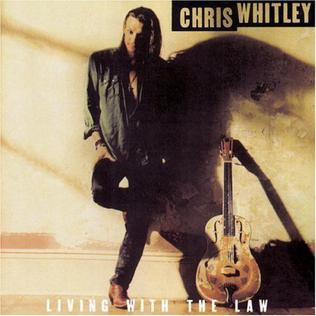
Chris Whitley: Living With The Law

Here’s an album we very likely would never have heard had a friend not told us, “It’s the closest thing you’re going to find to that Daniel Lanois album you like so much.”

Indeed, Living With The Law was produced by Malcolm Burn and engineered by Mark Howard, both Lanois protégés who had been involved with Acadie and other productions. But instead of applying the sound to established legends like Robbie Robertson and Bob Dylan, this time the recipient was somebody brand new on any scene. Chris Whitley was a good-looking kid with long hair who specialized in open tunings on National acoustic and occasional electric guitars, with a voice that flipped easily from growl to falsetto and back. The rhythm section was the familiar Lanois crew of Daryl Johnson and Ronald Jones, with Bill Dillon adding the more straightforward guitar parts.

From the opening “Excerpt”—a few seconds of tuning up—the overall sound is dusty, wide open space, rooms with bare light bulbs, radios that go in and out of reception (used to good effect over the fade of “Dust Radio”). The titles say a lot: “Big Sky Country”, “Make The Dirt Stick”, “Bordertown”. “Phone Call From Leavenworth” is voice and guitar, as a prison ballad should be; “Look What Love Has Done” is an excellent display of his vocals. But while blues is the driver, the songs are catchy and cross genre; even the urgent “Kick The Stones” was used in the soundtrack of Thelma & Louise. “Poison Girl” is a wonderful rocker, but the best is still the defiant yet hurt “I Forget You Every Day”.

It took Chris Whitley a long time to do a follow-up, and by then he was all about distortion and sonic yowl. He would eventually get back to basics, but his bad health caught up with him, and he never quite followed on the commercial promise of Living With The Law. If only we could remember who it was that told us about the album in the first place.

Chris Whitley Living With The Law (1991)—

Tuesday, March 24, 2020

Dwight Twilley 2: Twilley Don’t Mind

The Dwight Twilley Band’s debut was a mélange of tracks created in studios on different continents over a few years, but Twilley Don’t Mind was made in one place, and somewhat quickly. While a little more uniform and streamlined, it’s just as solid as Sincerely.

The straightforward rock of “Here She Comes” is a good place as any to start, especially when driving with the top down in search of young girls in wet T-shirts and tight blue jeans. “Looking For The Magic” has Dwight’s terrific natural tremolo vocals with verses that sound like they were made up on the spot. Oh mercy indeed. (Cool trivia: Tom Petty is credited with guitar on this track, but in the clip you can find of them miming the song for TV, he’s holding a bass.) “That I Remember” brings a welcome swagger despite the lonesome lyrics, while “Rock And Roll 47” is another in-joke we don’t get. But then Phil Seymour takes the lead vocal on “Trying To Find My Baby”, possibly our favorite song of the oeuvre.

Perversely, Phil also sings lead on the title track, which almost adds insult to injury, since he’s the band’s entire rhythm section. This comparative trifle of a number is nicely forgotten by the almost grandiose “Sleeping”, which isn’t just the longest track, but even sports a string arrangement by James Newton Howard, who’d been busy the previous couple of years with Elton John. Lest one think the boys were too ambitious, “Chance To Get Away” is a terrific close harmony gold nugget. And while “Invasion” may seem a trifle along the lines of “England” or “TV”, the lyrics reveal some pointed commentary on their professional ties.

By the time the album came out, the Shelter label had been swallowed up by relative upstart Arista, so one could assume Twilley Don’t Mind would have gotten some more legs, even after three singles were released from the album. It still makes a wonderful companion to the debut, and should be sought out post haste. (Sometime in the ‘90s it was decided to swap the opening tracks of each side, which does the favor of getting the title track out of the way early. Also, some but not all CDs also included “Fallin’ In Love”, a lost gem that fell off the original sequence, as a bonus track.)

Dwight Twilley Band Twilley Don’t Mind (1977)—