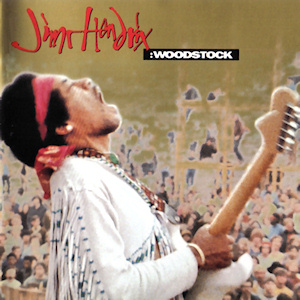
 He didn’t play until the final morning, after most of the crowd had already left, but thanks to the film, Jimi Hendrix’s appearance at the Woodstock Festival has become legendary. He closed both the movie and the soundtrack album (both released before his death) and had all of side one to himself on Woodstock Two, released the following March.
 Jimi was in transition; Billy Cox had replaced Noel Redding on bass, and for this performance he brought along two percussionists plus one Larry Lee—another old Army buddy who’d just returned from Vietnam—on second guitar. Due to comments he made throughout the set, this configuration has been called Gypsy Sun & Rainbows. While the extra musicians may have helped him fill out his sound to his liking in the studio, they couldn’t onstage, and future performances would go back to his tried and true trio format.
Because 1994 was the 25th anniversary of Woodstock, complete with another two festivals taking place that summer, the revitalized estate authorized an official release of Jimi’s performance that day. However, Alan Douglas was still in charge, so he rejigged the setlist and cut the program down to just over an hour so it could fit on a single CD. Everything that was on the original Woodstock albums was included, and in longer versions, but still not complete. It did subtitle “Jam Back At The House” with “Beginnings”, as it was known on other releases, and one of the solos after “Purple Haze” was now correctly titled “Villanova Junction”.
 It was more than people had outside of bootlegs, and it was good enough for five years, when the new regime instigated another look, this time under the supervision of Eddie Kramer, who’d recorded the festival in the first place. Live At Woodstock contained most of the performance, now spread across two CDs and in the original sequence, but still without a few drum solos, Larry Lee’s solo spots, as well as some of his guitar solos. Even so, it seems more complete, particularly with all the stage patter left in.
After being erroneously announced as the Jimi Hendrix Experience, he starts by greeting the audience and introducing the musicians, almost apologizing for their lack of preparation. The first music we hear them play is “Message To Love”, making its public debut. “Hear My Train A Comin’” is identified by its alternate title and explored for ten minutes. “Spanish Castle Magic” had already become a jam, but at least the crowd would have heard it before; likewise, “Red House”. Despite having a precise riff, “Lover Man” is pretty straight but threatens to go off the rails, and “Foxy Lady” goes through the verses before letting him blaze out a solo. “Jam Back At The House” was another new funky one that required everyone to pay attention, and they seem to, though Mitch has trouble after his drum solo. “Izabella” was another new one, something of an antiwar love song, followed by tight “Fire”.
This is the point where the set became legendary, and not just because it appeared in the film. “Voodoo Child (Slight Return)” is on fire all the way, though he takes it down to introduce the band again. There’s a brief quote of what would soon be known as “Stepping Stone”, and while he repeatedly thanks the crowd, he doesn’t leave the stage, but keeps playing. What should be the last chord of the song turns into “The Star-Spangled Banner”, with only Mitch trying to keep up with him. Then he kicks into “Purple Haze”, wherein he clearly sings “kiss this guy.” Once that ends he solos alone for about four minutes, with only the occasional sound of a tambourine from somebody onstage, eventually coming to “Villanova Junction”. After that they try to leave, but the crowd wants more. Jimi toys with playing another new song, but can’t remember the words, so it’s back to “Hey Joe”.
Live At Woodstock is more historic than it is excellent, and the producers likely did us a favor by smoothing out or omitting the rougher edges. It’s interesting to have some things in proper context, but sometimes it’s easier to print the legend.
Jimi Hendrix Woodstock (1994)—3
Jimi Hendrix Live At Woodstock (1999)—3
No comments:
Post a Comment