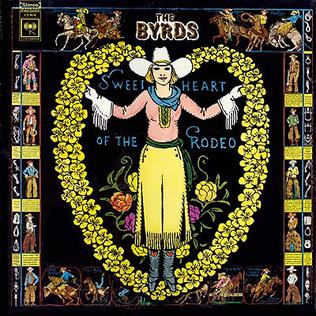
 The original Byrds were now down to two: McGuinn and Hillman. Still saddled with a record contract, they regrouped with a couple of new members and some grand ideas. Instead, they followed the post-psychedelic hangover of 1968 by going back to basics. Anchored by multi-instrumentalist trust fund brat Gram Parsons, the band more or less invented country-rock with Sweetheart Of The Rodeo.
Neither veteran brought an original composition to the album, but being the Byrds, they do frame the set with two Bob Dylan songs (“You Ain’t Goin’ Nowhere” and “Nothing Was Delivered”) recently unearthed from the Basement Tapes. The rest are straight arrangements of traditional songs, bluegrass favorites and even an R&B cover, a wonderfully pretty “You Don’t Miss Your Water”. Throughout, the songs are colored by rolling piano, banjo, pedal steel guitar and not a single Rickenbacker. McGuinn still took center stage as the leader, and even without his old granny glasses he could still carry a tune—so much so that for either legal or personal reasons he overdubbed his lead vocal on a few tracks that were originally cut with Gram Parsons singing.
That Parsons guy tended to make a pretty big impression on everyone he met; supposedly he was the one who turned the Byrds ship into this particular harbor. “You’re Still On My Mind” is a good drinkin’ song, and “Life In Prison” fits the same stereotype. His best moments on the album are on his own songs; “Hickory Wind” and “One Hundred Years From Now” (even sung by McGuinn) became immediate genre classics. And although mostly relegated to bass and mandolin duties, Hillman indulges his bluegrass roots with strongly sung performances of “I Am A Pilgrim” and “Blue Canadian Rockies”.
Sweetheart Of The Rodeo was not an immediate hit, but became a touchstone once more rock musicians began incorporating country sounds into their work. Its importance in the history of the Byrds was underscored by the inclusion of the original Gram Parsons vocals on the three songs McGuinn tinkered with on the band’s 1990 box set. It’s also the only one of their albums to be given its own “deluxe” expansion past a single CD. The Legacy Edition includes the three Parsons vocals originally featured on the box set, along with the standard outtakes, a bunch of early Parsons tracks and a whole pile of rehearsal takes on a second disc, but ignores five of the bonus rehearsals on the 1997 CD, so completists have to have both.
The album does show something of a progression through their first five, and while the Byrds continued as a band for another five years, they really weren’t the same band. Only Roger McGuinn was left, and he built a new unit around the amazing speedy picking of a kid named Clarence White. There would be some definite highlights over the next handful of albums—“Ballad Of Easy Rider” and “Chestnut Mare” to name two—and they still maintained a rabid fan base, but people seeking the jingle-jangle sound of the original band would be disappointed. (Besides, David Crosby was doing pretty well with his new friends anyway.)
The Byrds Sweetheart Of The Rodeo (1968)—4
1997 CD reissue: same as 1968, plus 8 extra tracks
2003 Legacy Edition: same as 1968, plus 28 extra tracks
Love this one--trumps most of Parsons' other stuff IMO, excepting Gilded Palace of Sin, then again I've had a soft spot for country for a while!
ReplyDeleteI've heard a lot of accounts about Parsons' lead vocals all being overdubbed because of contractual reasons, but he's definitely doing lead on several of these tracks...I wonder if anybody knows the true story!
According to producer Gary Usher, the legal issues were resolved, but he wanted more of a balance between McGuinn, Hillman and Parsons on lead vocals. McGuinn was the recoginized singer of the band, so Usher wanted more vocals form him.
ReplyDeleteUp front, I will say that I am not much of a fan of traditional country music, and not at all of current “country” music. Back in my lost youth, even less so, for cultural and family reasons as well as musical ones. So, I wasn’t ever inclined to pick up one of the many copies I saw in the cutout bins, with that corny title and even cornier artwork.
ReplyDeleteThe first track from the album that I heard was “You Ain’t Going Nowhere”, which was on their second “Greatest Hits” record. I like it a lot – it’s catchy, fun, and McGuinn’s vocal makes it sound like a classic Byrds track. However, my major exposure came with the first boxed set, with those ten tracks from the sessions. I much prefer this sequence instead of the actual album.
Even so, it never sounded like Byrds music to me. As Dave from “Progography” put it, Parsons tried to “hijack” the band for his own purposes. The Byrds’ sound had evolved to a fantastic peak on “Notorious Byrd Brothers”. Then Parsons shot it all to hell. I feel better when I think of it as a Parsons solo album with guest appearances by McGuinn and Hillman.
You and a lot of other people say that they “more or less invented country-rock,” but where’s the rock? Certainly, it’s not on the final album. Only on the outtake “Lazy Day” (which is very Chuck Berry-esque), although I suppose another outtake, “Reputation,” has enough of an edge to qualify. The 12-string guitar which was the instrumental link to the band’s past is only heard on “Lazy Days” and yet another outtake, “Pretty Polly”. Otherwise, the band’s musicianship is sidelined by that of the Nashville session musicians and Clarence White.
This probably sounds like I don’t like the music much, For the most part, the boxed has the most likeable choices. They dispensed with most of the drearier album tracks in favor of more energetic ones, like “Pretty Boy Floyd”, “Lazy Days” and “..Polly..”. I do prefer Parsons’ original vocals. “Hickory Wind” is genuinely moving. “One Hundred Years from Now” is almost as perplexing as the Dylan tracks. I agree that this is a lovely version of “You Don’t Miss Your Water”. However, “I Am a Pilgrim” is rather dull. As for “The Christian Life”, it’s cringeable, even for a practicing Christian like me. It’s quite naïve.
It’s unsure where the Byrds would have ended up if they had never run into Parsons, but they would have been better off. He abandoned them before the album even came out and became drawn into the orbit of the Stones (which ended up becoming his undoing.). His disruptive presence caused an identity crisis which they never recovered from, even if some fine music would appear down the road.
When I say they invented country-rock, it was only that they brought the genre to the ears of people who might not have sought it out. Mike Nesmith tried that too, but they were more successful at it. At least it's a more credible claim that saying John Fogerty invented grunge by wearing a flannel shirt.
Delete